

Green Card for Investors From Italy: EB-5 Investment and Application Routes

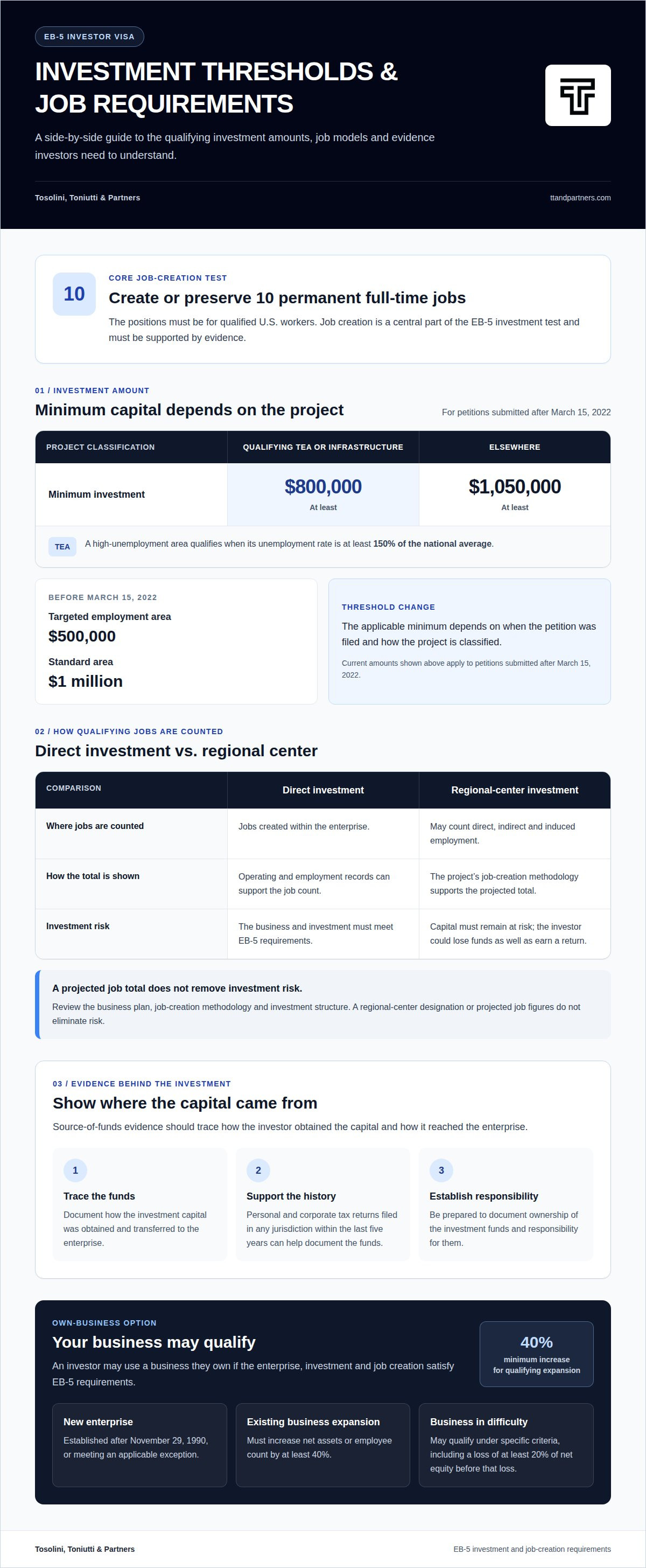
Where you apply can change the process, but not the EB-5 investment test. For a green card for investors (EB-5) from Italy, petitions submitted after March 15, 2022 require at least $800,000 in a qualifying targeted employment area or infrastructure project, or $1,050,000 elsewhere; according to U.S. Citizenship and Immigration Services, the investment must also create or preserve 10 permanent full-time jobs for qualified U.S. workers.
It’s natural to focus first on the required capital, but the investment structure matters too. Your own business may be an option if it meets the program’s investment and job-creation requirements.
This guide explains how EB-5 works, what makes a business investment eligible, and how applying from Italy differs from applying while in the United States. It also outlines the roles of consular processing and adjustment of status, so you can understand which route may fit your circumstances.
Table of Contents
What is an EB5 Investor Visa?
The EB-5 program offers an immigrant visa route through qualifying investment in a U.S. commercial enterprise. Eligibility depends on the investment amount, documented capital, and job creation.
Job Creation Requirements
EB-5 job creation means creating or preserving qualifying full-time positions through the investment. According to U.S. Citizenship and Immigration Services, the program requires an investment to create or preserve 10 permanent full-time jobs for qualified U.S. workers. This requirement shapes both the business plan and the evidence submitted with the filing. For investors, the key distinction is whether the project can document eligible jobs through its operating records or approved regional-center methodology.
Investment and Source-of-Funds Documentation
The required capital depends on the project’s location and classification. According to U.S. Citizenship and Immigration Services, an investment of at least $800,000 applies to a qualifying targeted employment area or infrastructure project; outside those categories, the minimum is $1,050,000. A high-unemployment area must have an unemployment rate at least 150% of the national average, according to U.S. Citizenship and Immigration Services.
Investment thresholds changed on March 15, 2022. Petitions filed before that date had minimums of $500,000 for a targeted employment area and $1 million for a standard area. For petitions submitted after that date, the applicable current thresholds are $800,000 or $1,050,000. Source-of-funds evidence should trace how the investor obtained the capital and how it reached the enterprise. Personal and corporate tax returns filed in any jurisdiction within the last five years can help document that history. Investors should be prepared to document their ownership of the investment funds and responsibility for them.
Direct and Regional Center Job Creation
A direct investment creates jobs within the enterprise, while a regional-center investment may count direct, indirect, and induced employment. This affects how the project demonstrates its job total. Regional-center capital must remain at risk, so the investor could lose funds as well as earn a return. To assess the risk, review the project’s business plan, job-creation methodology, and investment structure. A regional-center designation or projected job figures do not eliminate investment risk.
Residence, Physical Presence, and Family Eligibility
An EB-5 investor may include a spouse and unmarried children under 21 as derivative applicants, according to U.S. Citizenship and Immigration Services. The age threshold matters when identifying eligible family members for the application. A green card also connects investment approval to longer-term U.S. residence: naturalization generally requires five years of continuous residence. Applicants must also have been physically present in the United States for at least 30 months during the five years immediately before filing. These naturalization requirements are distinct from the initial EB-5 investment criteria.
Can I Invest in My Own Business and Obtain an EB5-Based “Green Card”?
Yes. An investor may use a qualifying business they own, provided the enterprise and investment meet EB-5 requirements. The path continues after approval: permanent residence begins with conditions that must later be removed.
Conditional Permanent Residence
An approved EB-5 investor initially receives conditional permanent residence for two years. This status gives the investor time to establish that the business and investment meet program requirements, rather than granting unconditional permanent residence immediately.
Your own business may qualify if it is a new commercial enterprise established after November 29, 1990, or meets an applicable exception. A qualifying expansion of an existing business must increase its net assets or employee count by at least 40%. The business plan should connect the investment structure to the required job creation.
For an existing business, the distinction between expansion and ordinary operating activity matters. The investor’s filing must show how the proposed investment supports the qualifying enterprise and its jobs. A business in difficulty may also qualify under specific criteria, including a loss of at least 20% of net equity before that loss.
Removing Conditions with Form I-829
Form I-829 is the petition an investor files to request removal of conditions on permanent residence. U.S. Citizenship and Immigration Services says it must be filed within the 90 days before conditional residence expires. The petition needs evidence that the investor maintained the qualifying investment and fulfilled the job-creation requirements.
Successful removal leads to a 10-year green card for the investor and eligible family members. The investment may need to remain in place for three to seven years, depending on the project. This period can extend beyond the initial two-year conditional residence, so the investment’s terms and exit structure deserve careful attention.
For an individual business, evidence may include operating and employment records that support the original plan. The filing should explain any material changes and show how the enterprise met the program’s requirements. Discuss your EB-5 case when you need guidance on the investment and removal-of-conditions process.
EB-5 Consular Processing and Adjustment of Status: How an Immigration Lawyer Guides Your Case
After the immigrant investor petition, the next stage depends on where you apply and your eligibility. The route determines which forms, records, and appointments your application requires.
Petition Processing and Visa Wait Times
Petition processing and visa availability are separate stages that shape the overall timeline. Recent EB-5 petition processing trends range from 19 to 52 months. A pending petition does not itself complete the immigrant visa process; visa availability also matters. The June 2024 Visa Bulletin showed no EB-5 backlog or additional wait time for applicants from Italy, but that dated snapshot should not be treated as a current prediction.
An immigration lawyer can organize the case around its current stage, identify missing evidence, and explain how processing updates affect the next filing. Your route determines whether the final application proceeds through consular processing overseas or adjustment of status in the United States. This distinction matters when planning residence, travel, and the timing of the remaining steps.
Application Forms and Filing Process: Professional Support for EB-5 Applicants
The process begins with Form I-526, the immigrant investor petition. A lawyer prepares the filing by aligning the investment evidence, business or project records, and the investor’s personal information. The investor supplies accurate identity, family, financial, and immigration records; the legal team checks consistency across documents before submission.
After petition processing, applicants outside the United States generally proceed through consular processing, including the DS-260 application. Eligible applicants already in the country may seek adjustment of status through Form I-485. A lawyer assesses which route applies, prepares the relevant forms, and coordinates the supporting record for submission. These steps can also affect when an applicant may pursue permanent residence or, later, U.S. citizenship.
For an Italian applicant, the key practical difference is where the final immigrant application is handled: through a U.S. consular post or within the United States. Legal support can help keep the petition and later application consistent, while you provide the underlying records and respond to requests for additional evidence. A project’s unemployment classification can also affect its investment category, so the case file should accurately reflect the selected project.
Applying for an EB-5 Green Card from Italy or the United States: How Legal Support Differs
The main distinction is where the final immigrant-visa stage takes place. Applicants applying from Italy generally use consular processing, while eligible applicants already in the United States may pursue adjustment of status. For an Italian national seeking a green card for investors (EB-5) from Italy, the filing location shapes the later application steps, not the underlying investment criteria.
For consular processing, legal support focuses on preparing the overseas application and keeping it consistent with the approved petition. The DS-260 is the immigrant visa application; its supporting records should align with the investor’s identity, family details, and investment history. The National Visa Center stage and consular appointment follow petition processing. If later documents differ from the petition, the discrepancy may prompt questions that require a clear response.
For adjustment of status, an eligible applicant files Form I-485 in the United States. Counsel reviews how the applicant’s current immigration circumstances relate to the filing and organizes the supporting record. Petition approval and eligibility to adjust status are distinct parts of the process, so location alone does not determine whether Form I-485 is available. This route makes current status and application timing central considerations.
Either route involves reviewing the source of investment capital, checking that records are consistent, and preparing responses to government requests. If your spouse or children are included, their information must also align across the family’s applications. The coordination differs by route: an Italy-based case proceeds through consular processing, while a U.S.-based case focuses on adjustment documentation and status considerations.
Before proceeding, identify the route that fits your circumstances and the documents it requires. A green card for investors (EB-5) from Italy case may be handled through consular processing or, where eligible, adjustment of status. Discuss your EB-5 application route to plan around your location and immigration status.
Tosolini, Toniutti & Partners: GREEN CARD
Tosolini, Toniutti & Partners assists individuals seeking a Green Card through investment in the United States. The firm can help coordinate the investment, supporting records, and application route into a coherent legal case, whether you are applying from Italy or already in the United States.
Consider legal support when assessing whether your own business may qualify, documenting the source of investment funds, or preparing for consular processing or adjustment of status. Each stage has distinct requirements, and your chosen route shapes the supporting documents and next steps. A clear review can help you understand how the requirements apply to your circumstances before the case proceeds.
For guidance on your Green Card matter, contact Tosolini, Toniutti & Partners.
Choose a Path That Fits Your Longer-Term Plans
Your next step is to align an immigration strategy with the business and personal priorities you want it to support. A green card for investors (EB-5) from Italy is one possible route, but the decision should account for more than the investment itself. Consider how your plans in the United States may evolve, what role your business will play, and which family members may be part of the move.
If your objectives point elsewhere, Tosolini, Toniutti & Partners also handles E-1, E-2, and O-1 visa matters. These are distinct options to discuss in light of your professional or business circumstances, rather than substitutes to select by name alone. A clear assessment can help connect your immediate immigration needs with the direction you intend to take.
To discuss your circumstances and possible next steps, contact Tosolini, Toniutti & Partners. A considered plan can make the way forward clearer.
Frequently Asked Questions
Can an Immigration Lawyer Help Me Apply for an EB-5-Based Green Card from within the United States?
Yes. An immigration lawyer can assess whether your current immigration circumstances support an adjustment-of-status application, prepare the relevant filing, and organize supporting documents. The review can consider your immigration history, investment petition, and family members’ applications. Being physically present in the United States does not by itself establish eligibility, so assess the route before preparing the final filing.
Do I Need a Business Plan in an EB-5 Case?
A business plan is especially important when your investment relies on your own enterprise. It can explain the company’s activities, how it will use the investment capital, and how its operations support planned employment. For example, a plan for an expanding company should connect its proposed growth with staffing and financial projections. The accompanying documents should be consistent with the business structure and investment evidence.
How Can an Immigration Lawyer Help Me Address a Potential Increase in the EB-5 Investment Requirement?
A lawyer can identify which investment threshold applies to your project and filing, then organize the case around that classification. The analysis considers whether the project qualifies as a targeted employment area or infrastructure project and whether the investment evidence supports the petition. No filing strategy can guarantee protection from future rule changes. Legal guidance can help distinguish current requirements from proposed or hypothetical changes.
How Much Does an EB-5 Visa Cost for Italian Citizens?
The required investment is at least $800,000 for a qualifying targeted employment area or infrastructure project, or $1,050,000 for other projects, according to U.S. Citizenship and Immigration Services. Those amounts are investment thresholds, not the complete cost of an application. Government filing charges and project-related expenses may also apply, so the total depends on the selected route and investment structure.
What Qualifies as a New Commercial Enterprise?
A new commercial enterprise is generally a business established after November 29, 1990. An existing business may qualify through a permitted exception, including a qualifying expansion that increases net assets or employee numbers by at least 40%. For an investor using a business they already own, the key issue is showing how the investment changes or supports the enterprise, rather than merely documenting continued ownership.
What Is the EB-5 Visa Program?
The EB-5 program is a U.S. immigrant-investor pathway that links qualifying investment to job creation. It can lead to permanent residence for an investor and eligible family members, subject to program requirements and later removal of residence conditions. The program’s central considerations include the investment’s structure, the source of capital, and evidence that the associated enterprise meets its employment obligations.



Comments