

How to Form a US Subsidiary for an Italian Company and Estimate the Cost

The filing fee is only the starting point.
It’s easy to focus on the incorporation fee, but the state you choose and the company’s operating plans shape the wider budget. A branch and a subsidiary also differ in legal responsibility and U.S. tax exposure, so choosing the right structure matters as much as the initial cost. These are key considerations when forming a US subsidiary for an Italian company.
This guide explains how to build a practical formation estimate, compare a branch with a subsidiary, and choose a state based on where the business will operate. It also outlines federal and state tax obligations to factor into your planning, helping you assess the decisions involved in forming a US subsidiary for an Italian company.
Table of Contents
Choosing between a U.S. branch and subsidiary
Decide whether the U.S. operation should be a separate legal entity. A branch is an extension of the Italian company, while a subsidiary is a separate U.S. entity owned by its Italian parent. A subsidiary generally helps shield the parent’s assets from the subsidiary’s debts and legal obligations. An Italian company seeking a distinct U.S. operating structure, for example, may prefer a subsidiary over a branch.
Compare the tax reach of each structure. A U.S. branch exposes a foreign company’s worldwide earnings to U.S. tax law. An incorporated subsidiary limits that exposure to the company’s U.S. earnings. This difference can affect how the parent records U.S. activity and plans cross-border transactions. Map expected U.S. revenue and parent-company activity before choosing between branch and subsidiary treatment.
Choose an entity type for the subsidiary. Common options include a limited liability company (LLC) and a corporation. Both create a U.S. legal entity distinct from the Italian parent, but their governance structures differ. An LLC may suit a closely held operation seeking flexible internal arrangements. A corporation may better fit a business planning formal board governance or outside investment.
Assess whether an LLC or C-corporation fits the ownership plan. A foreign-owned entity generally cannot use the S-corporation structure because of shareholder residency requirements. An Italian parent should compare an LLC with a corporation based on its intended ownership, governance, and tax classification. For example, a parent expecting to bring in investors may value corporate shares and formal governance. A smaller operation may prioritize simpler internal management.
Align the legal structure with agreements and operations. Identify who will own the U.S. entity, who can sign contracts, and how the parent will document transactions with its subsidiary. The LLC’s operating agreement or the corporation’s bylaws should support that arrangement. Keep the subsidiary’s records, bank account, contracts, and financial activity distinct from the Italian parent’s. These practices reinforce the separation created by the entity structure.
Make the choice before filing formation documents. The selected state’s filing process establishes either an LLC or a corporation, so first align the entity type with the operating plan. Consider where staff, customers, and management will be based, and whether investors or lenders expect a specific structure. For a company expanding from Italy, the right choice connects ownership, liability separation, and U.S. activity rather than relying on a generic preference.
Federal and state taxation of subsidiaries
Map tax exposure across federal, state, and local levels before the subsidiary begins operating. Your state choice also affects registration, annual filings, and business-law obligations.
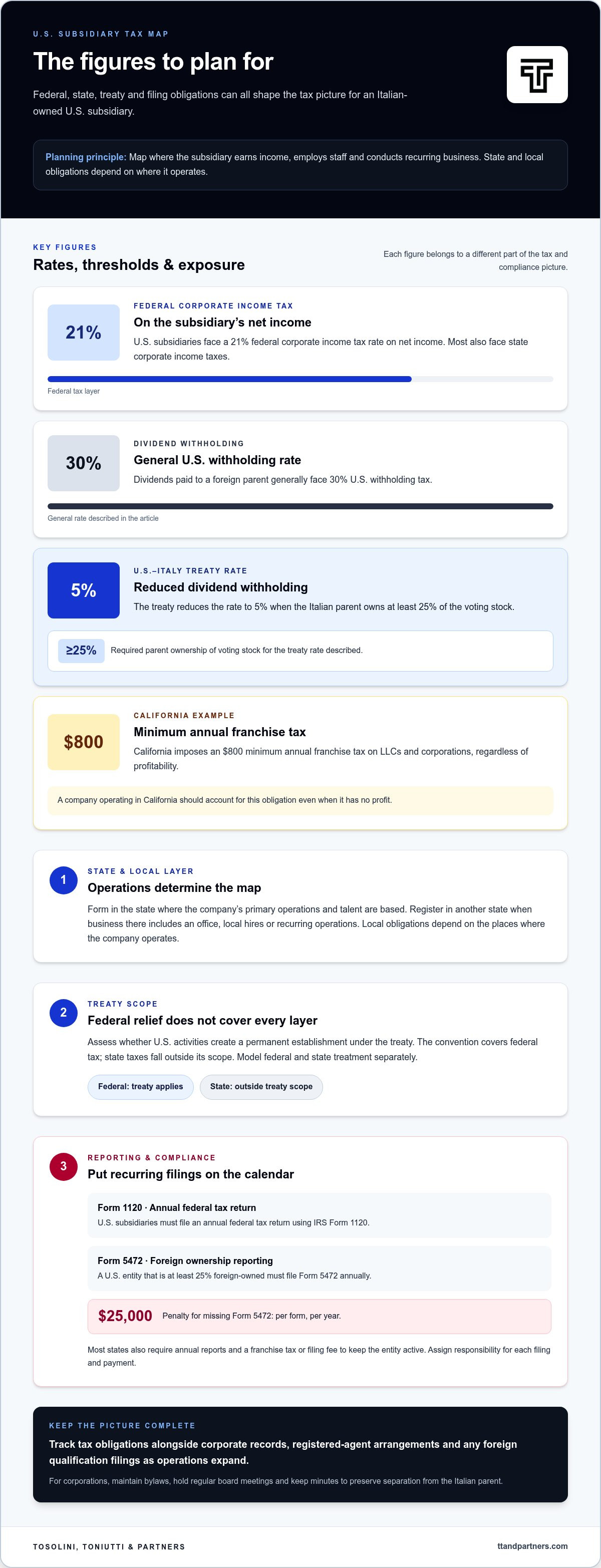
Identify Federal, State, and Local Tax ObligationsStart by mapping where the subsidiary earns income, employs staff, and conducts recurring business. U.S. subsidiaries face a 21% federal corporate income tax rate on net income, and most also face state corporate income taxes. Local obligations depend on the places where the company operates, so include each operating location in the tax map.No single state is best for every subsidiary. Form in the state where the company’s primary operations and talent are based, then register in another state when it conducts business there, such as through an office, local hires, or recurring operations.Check each state’s filing and payment rules before selecting its legal structure. California imposes an $800 minimum annual franchise tax on LLCs and corporations, regardless of profitability, according to the California Franchise Tax Board. A company operating there should account for that obligation even when it has no profit.
Review U.S.-Italy Tax Treaty EffectsReview how the U.S.-Italy tax treaty may affect payments from the subsidiary to its Italian parent. Dividends paid to a foreign parent generally face 30% U.S. withholding tax, but the treaty reduces the rate to 5% when the Italian parent owns at least 25% of the voting stock.Assess whether the company’s U.S. activities create a permanent establishment under the treaty. The convention covers federal tax, while state taxes fall outside its scope. Model federal and state treatment separately rather than assuming treaty relief addresses every U.S. tax obligation.
Prepare IRS Filings and Ongoing ComplianceSet a filing calendar for the subsidiary and its foreign owner. U.S. subsidiaries must file an annual federal tax return using IRS Form 1120, according to the Internal Revenue Service. A U.S. entity that is at least 25% foreign-owned must file Form 5472 annually, also according to the Internal Revenue Service.Missing Form 5472 carries a penalty of $25,000 per form per year, according to the Internal Revenue Service. Most states also require annual reports and a franchise tax or filing fee to keep the entity active. Assign responsibility for each filing and payment.Maintain corporate records alongside tax filings. Corporations should hold regular board meetings, keep minutes, and maintain bylaws to preserve separation from the parent. Track each state’s business-law requirements, registered-agent arrangements, and any foreign qualification filings as operations expand.
How much does it cost to establish a company in the US?
When forming a US subsidiary for an Italian company, estimate formation expenses separately from recurring administration and tax-compliance work. The state, entity type, registered-agent arrangement, and ownership records all shape the budget.
Prepare Incorporation and Parent-Company DocumentsChoose the entity type and state before preparing formation documents. State registration establishes the U.S. entity under that state’s rules, so align its name, ownership, and management details with the Italian parent’s plans.Gather parent-company information for the formation process, including its legal name, ownership details, and authorization for the U.S. entity. Keep those records consistent with the articles of organization or incorporation and internal governance documents. Differences in names or ownership records can complicate later banking and federal filings.For a corporation, prepare bylaws and records of board decisions; for an LLC, prepare an operating agreement. These documents define authority and help preserve separation between parent and subsidiary. Include them in the formation file rather than treating the state filing as the entire legal structure. This document set is a core cost factor when forming a US subsidiary for an Italian company.
Arrange Registered Agents and EIN ApplicationsInclude a registered agent in the initial cost estimate. Every U.S. state requires LLCs and corporations to maintain an agent with a physical address in the state of incorporation. Compare this recurring cost with the company’s ability to maintain an eligible address.After incorporation, apply to the Internal Revenue Service for an Employer Identification Number (EIN). The EIN is free when requested from the IRS, and it identifies the company for federal tax administration. Companies without a U.S.-based responsible party may wait several weeks, so factor that timing into banking and operational planning.
Budget for Federal Filings and Intercompany DocumentationSet aside resources for federal tax preparation and related-party reporting, not only formation expenses. A U.S. entity that is at least 25% foreign-owned must file Form 5472 annually, according to the Internal Revenue Service. Transactions between the Italian parent and its U.S. subsidiary make accurate intercompany records important.Document intercompany charges under the arm’s-length pricing rules in IRS Section 482. Transfer-pricing documentation can reduce the penalty on a transfer-pricing adjustment from 40% to 20%. Budget for preparing and maintaining records that reflect actual transactions, pricing methods, and supporting analysis.Use a worksheet with separate lines for state registration, registered-agent service, the EIN application, tax filings, and transfer-pricing documentation. These items distinguish one-time formation expenses from ongoing administration. The estimate gives the Italian parent a clearer view of the resources needed when forming a US subsidiary for an Italian company.
Selecting a state of incorporation
You can establish a subsidiary in any of the 50 states. Choose based on where the company will operate, not incorporation alone.
Map the subsidiary’s people, customers, and operations. Start with the state where its core team and primary business activity will be located. Forming elsewhere can add another registration, registered-agent fees, and franchise-tax obligations if the company later operates locally. For example, a company with its office and staff in Texas should compare forming there with the added steps of incorporating in Delaware.
Compare state tax treatment with the full operating footprint. Wyoming, Nevada, and Texas do not apply state income tax, while Delaware imposes franchise taxes. These differences matter, but they don’t determine the total tax picture by themselves. Consider the subsidiary’s actual sales and operations, plus the other states where it may create tax obligations. Sales tax rules can also apply without a physical presence: $100,000 in state sales or 200 transactions can trigger obligations.
Weigh Delaware’s legal and administrative fit. Delaware is a common incorporation choice for companies seeking a corporate structure, but it still imposes franchise taxes. A subsidiary incorporated there may operate elsewhere, but that activity can require registration in the operating state. Delaware does not require a foreign subsidiary to maintain a physical address or bank account in the state. Compare that flexibility with the cost of maintaining obligations in more than one state.
Prepare the state’s formation filing before submission. A corporation generally files articles of incorporation; an LLC uses its state’s formation filing. Confirm that the legal name, ownership details, and management structure match the Italian parent’s records. The state filing creates the entity, while internal governance documents establish how owners and managers make decisions. Keep the records consistent for banking and later compliance.
Estimate timing and recurring requirements together. The basic U.S. subsidiary formation process takes 1 to 2 weeks, depending on the state. Filing speed is only one consideration: most states also require annual reports and a recurring franchise tax or filing fee. If the subsidiary expands into another state, foreign qualification may add registration and agent obligations. Compare the complete state footprint, not only the initial filing.
Opening a US subsidiary of an Italian company
Assess liability, banking, immigration, and operational exposure together when setting up the subsidiary. Limited liability, separate governance records, account-opening requirements, immigration planning, and state registrations all affect readiness to operate.
Assess Liability and Banking RisksMaintain clear separation between the Italian parent and its U.S. subsidiary. Keep contracts, finances, and governance records in the subsidiary’s name to support that structure. For banking, prepare for identity checks: under the USA Patriot Act, banks must conduct a background check on the account opener, including in-person verification of two forms of photo ID.Plan the bank account as an operational milestone, not a routine filing. U.S. banks may require a company director to visit a branch in person. A company seeking a U.S. merchant account also needs a physical address and bank account, so account for these dependencies before planning sales operations.
Evaluate Immigration and Operational RisksKeep company formation separate from immigration planning for any Italian owner or employee. Incorporation creates a U.S. entity, but it doesn’t resolve an individual’s ability to work in the country. Map intended roles and business activities against the appropriate immigration pathway before assigning U.S. duties.Build operational compliance into the opening plan. Hiring locally brings employment steps, including I-9 verification. Sales, offices, or recurring activity across state lines can also create additional registration and tax obligations. For example, a subsidiary with staff and customers in multiple states needs a state-by-state operating map.
Sequence the launch milestones. The basic formation process takes 1 to 2 weeks, while the full operational setup typically takes 2-3 months. The longer period can include banking, tax or license registrations, and preparation for commercial activity. Track each dependency, since a completed state filing alone doesn’t mean the business can yet receive payments or hire.
Establish governance before transactions begin. A corporation should hold regular board meetings, keep minutes, and maintain bylaws. These records help demonstrate that the subsidiary operates separately from its Italian parent. Document approval authority, contract signing, and intercompany transfers before money or services move between the companies.
Build a durable compliance calendar. State-level compliance may involve recurring filings, payments, and registered-agent arrangements, so account for these in the operating plan. Add federal tax filings, state obligations, employment tasks, and any foreign qualification to the calendar. Include cross-border subsidiary planning in your launch sequence.
Tosolini, Toniutti & Partners: E-2 VISA
Tosolini, Toniutti & Partners helps individuals and corporate clients address U.S.-Italy immigration needs alongside cross-border business planning. As the subsidiary structure and operating plan take shape, immigration questions may arise for an Italian owner or employee planning to live in the United States. The firm assists with Green Card matters, a separate consideration from forming the company itself.
Keeping corporate setup and personal immigration planning distinct clarifies which decisions concern the business and which concern an individual’s status. If your expansion plans also involve a Green Card matter, contact Tosolini, Toniutti & Partners to discuss your situation.
Contact Tosolini, Toniutti & Partners to discuss your U.S.-Italy plans.
Shape the Next Stage of Your U.S. Expansion
For leaders forming a US subsidiary for an Italian company, the next step is connecting the legal structure to the people and commercial plans behind it. A durable U.S. presence depends not only on the entity’s documents, but also on clear decision-making, responsible cross-border coordination, and a realistic path from launch to growth.
Immigration planning can be part of that wider strategy when owners or employees expect to work in the United States. Tosolini, Toniutti & Partners offers E-2, E-1, and O-1 visa services alongside its cross-border legal work. Considering those needs early can help keep business planning and individual plans aligned.
Build your next steps around the company’s intended U.S. activity and the people who will carry it forward. Explore your U.S.-Italy business plans with Tosolini, Toniutti & Partners, and move ahead with a clear foundation for expansion.
Frequently Asked Questions
What US entity type should an Italian company choose for a subsidiary: LLC or corporation?
An LLC or corporation can work; the right choice depends on ownership, governance, and tax planning. An Italian parent generally cannot use an S corporation because of shareholder residency requirements. For example, a closely held subsidiary may value an LLC’s flexible internal arrangements, while a corporation may better suit formal board governance or planned outside investment. Compare the intended ownership and management model before preparing state formation documents.
What are the steps to form a US subsidiary owned by an Italian company?
First choose the state and entity type, then file the formation documents and apply for an EIN. Next, establish governance records, arrange the registered agent, and prepare for banking and state tax or license registrations. The basic formation process takes 1 to 2 weeks, while banking and local registrations can extend setup to 3 to 6 weeks. Keep the parent’s ownership information consistent throughout the process.
What documents and information are required to incorporate a US subsidiary with a foreign parent?
Prepare the state formation filing, proposed entity name and type, and accurate information about the Italian parent’s ownership. Add the subsidiary’s governance document, such as corporate bylaws or an LLC operating agreement, to define decision-making and authority. Keep parent and subsidiary records aligned. Filing requirements vary by state, so the state you select determines the exact format and details required for submission.
How much does it cost to form and maintain a US subsidiary, including state fees and registered agent costs?
An EIN is free when requested from the IRS. Build the ongoing budget separately: most states require annual reports and a franchise tax or filing fee. The state, entity type, agent arrangement, and operating footprint determine the full formation and maintenance cost.
What US tax obligations apply to a subsidiary owned by an Italian company?
A subsidiary generally faces federal corporate income tax and, in most cases, state corporate income tax. The federal corporate income tax rate is 21% on net income. The Internal Revenue Service requires an annual Form 1120, and a U.S. entity that is at least 25% foreign-owned must file Form 5472 annually. Related-party transactions also require attention to transfer-pricing rules and documentation.
Does an Italian-owned US subsidiary need an EIN, US bank account, business licenses, or a local address?
After incorporation, the subsidiary must apply to the Internal Revenue Service for an EIN. A bank account supports operations, and banks may require a director to complete paperwork in person. Each state requires a registered agent with a physical address in the incorporation state, while merchant-account setup requires a physical address and bank account.



Comments