

US Elective Residency Visa for Italy: The 2026 Strategic Guide

The Italian Elective Residency Visa is a sophisticated legal architecture, not merely a retirement permit, and treating it as anything less often leads to immediate consular rejection. You've likely realized that the path to securing a US elective residency visa for Italy is paved with opaque financial definitions and uncompromising real estate mandates. It's frustrating to find that even a successful remote career can disqualify you from this specific path, as consulates now draw a sharp line between active labor and true passive wealth.
This strategic guide empowers you to master these complexities by providing expert legal insights on income structures and cross-border compliance. We'll examine the €31,000 minimum income threshold verified for 2026, the absolute prohibition on all forms of work, and the necessity of a registered property deed or long-term lease. You'll learn exactly how to navigate the critical eight-day window to secure your Permesso di Soggiorno, transforming a complex vision into a compliant, permanent reality beneath the Italian sun.
Key Takeaways
Define the strategic boundaries of the Elective Residency Visa as a specialized long-stay permit reserved for those with significant, verifiable passive wealth.
Identify the specific financial documentation and income thresholds necessary to satisfy the rigorous requirements for a US elective residency visa for Italy in 2026.
Evaluate the legal nuances of the "suitable habitation" requirement to ensure your Italian residence meets the exacting standards of the consulate before your interview.
Master the transition from visa issuance to the mandatory local registration process required for your residency permit within eight days of your arrival.
Coordinate your relocation with a sophisticated cross-border strategy that addresses international taxation and the architectural integrity of your existing corporate holdings.
Table of Contents
The Italian Elective Residency Visa (ERV) in 2026: A Strategic Overview
The Visto per Residenza Elettiva is a sophisticated legal instrument within the broader Schengen Area visa policy, specifically designed as a long-stay "D" visa for non-EU nationals. In 2026, the distinction between residency and tourism is sharper than ever. This isn't a tool for extended travel or a convenient loophole for remote workers. It's a residency permit for those who've achieved a level of financial independence that allows them to settle in Italy without seeking employment. While often colloquially labeled a retirement visa, the US elective residency visa for Italy serves a much broader, more diversified demographic of high-net-worth investors and individuals with robust, passive portfolios.
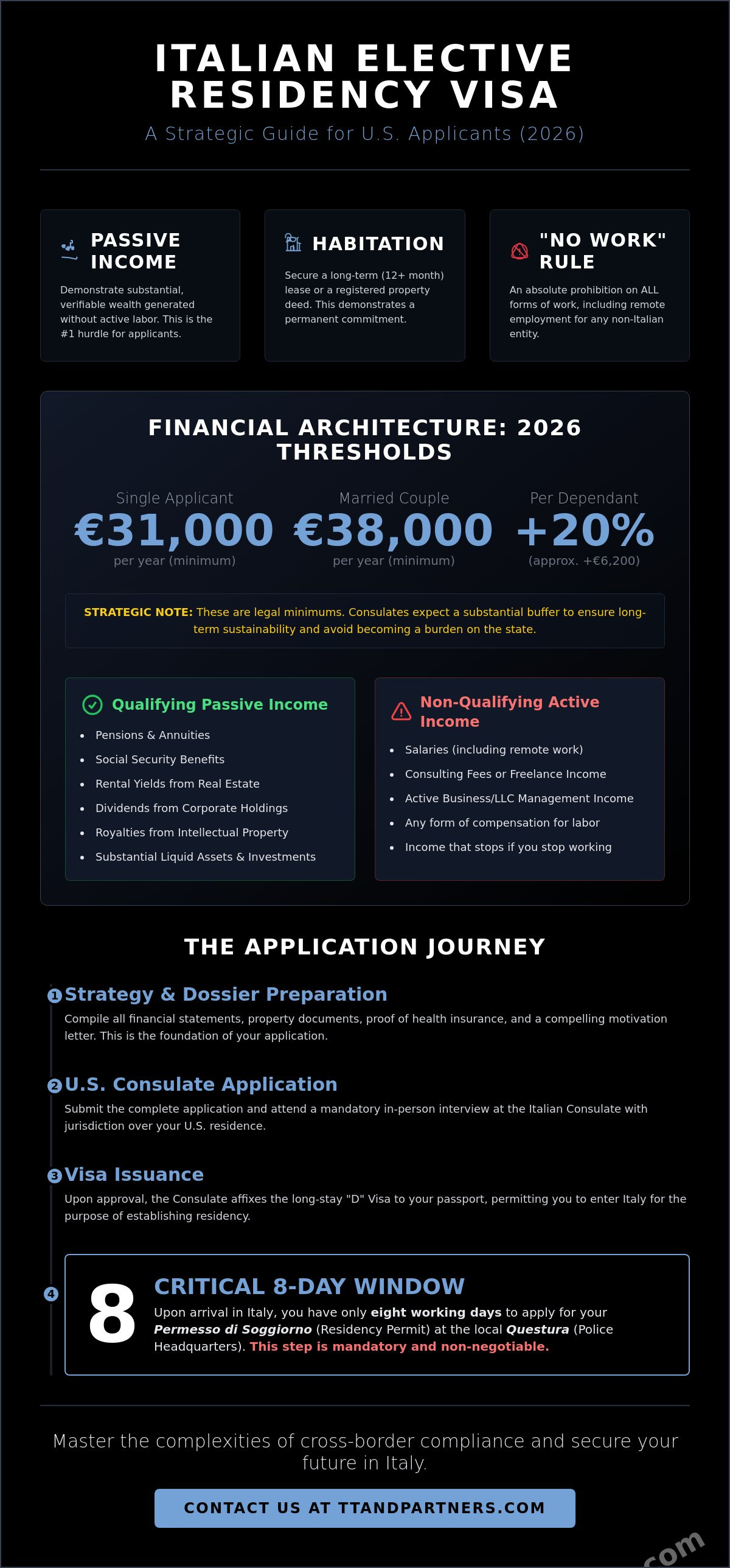
The "No Work" mandate remains the most rigid boundary of this legal structure. Consulates don't just prohibit local Italian employment; they strictly forbid all forms of active labor, including remote work for US-based entities. Many applicants face rejection because they mistake a remote salary for passive income. To the Italian government, "passive" means your presence isn't required to generate the funds. This includes dividends, social security, pensions, and rental yields. If your income stops when you stop typing, it's not elective residency material. It's a hard line that defines the very nature of this visa path.
Residency vs. Tourism: Why the ERV is a Permanent Commitment
Securing an ERV requires a shift in mindset from visitor to resident. Italy expects a stable and continuous presence. This commitment is often measured by the 183-day rule, which triggers Italian tax residency and serves as a benchmark for permit renewal. Unlike the newer Digital Nomad Visa, which accommodates the transient nature of modern work, the ERV demands a permanent anchor. You must demonstrate a genuine intention to make Italy your primary home through a year-long lease or property ownership. It's a commitment to the local community's fabric, not a seasonal stay.
The Legal Philosophy of "Elective" Living
The term "elective" signifies a conscious choice to integrate into the Italian lifestyle. It's not merely about having the funds; it's about proving the intent. The motivation letter in your application packet is where this vision takes shape. It must articulate why Italy is your chosen destination and how you intend to sustain your life there without participating in the labor market. We assist clients in refining this narrative, ensuring that the intellectual and financial commitment is clearly communicated to consular officials to minimize the risk of discretionary denial.
Documenting Passive Income: The #1 Hurdle for US Applicants
The financial architecture of a successful US elective residency visa for Italy rests on the absolute clarity of your passive income streams. While the baseline figures for 2026 are established at approximately €31,000 for a single applicant and €38,000 for a married couple, these numbers represent a legal floor rather than a secure threshold. Consular officials exercise significant discretion; they often look for a substantial buffer to ensure you won't become a burden on the Italian social system. This is particularly true for younger high-net-worth individuals whose portfolios must demonstrate long-term sustainability beyond simple retirement age projections.
Official guidance from the Italian Consulate General highlights that income must be substantial, stable, and likely to continue in the future. For families, the guidance suggests an additional €6,200 for each dependent child. Relying on the bare minimum is a strategic risk that frequently leads to administrative delays. We suggest presenting a portfolio that exceeds these mandates to reflect a lifestyle commensurate with your chosen Italian residence.
Qualifying vs. Non-Qualifying Income Sources
Pensions, annuities, and Social Security benefits form the bedrock of a qualifying application because they are inherently passive. Rental yields from US-based real estate are also highly valued, provided they're documented by registered leases and federal tax returns. The hurdle for many younger applicants lies in LLC distributions. These must be clearly structured as shareholder dividends rather than compensation for active management. Any hint of salary, even if it's from a foreign employer or a personally owned US company, will trigger an immediate rejection. Italy's stance is firm: this visa is for those who live off their wealth, not those who work to maintain it.
The 2026 Financial Portfolio Strategy
Consolidating your accounts months before the interview is essential for a clean consular audit. Officials prefer a streamlined view of your liquidity rather than a fragmented collection of minor holdings. While fixed assets like property ownership in the US add weight to your overall net worth, the consulate prioritizes liquid assets that can be easily accessed. You must provide a comprehensive two-year historical bank statement record to prove the stability of these funds. Sudden deposits or unexplained spikes in wealth are red flags that suggest temporary window-dressing rather than genuine financial durability. If you're unsure how your specific asset mix will be perceived, seeking a strategic evaluation of your financial documentation can prevent costly setbacks.
The Real Estate Anchor: Securing Your Italian Residence
The real estate component of your application is the physical manifestation of your intent to settle in Italy. Consulates require a "suitable" habitation, which means the property must meet local health and safety standards and be appropriate for the size of your family unit. A short-term rental or a simple hotel reservation is strictly prohibited for the US elective residency visa for Italy. According to the Official Elective Residency Visa Requirements, you must provide either a registered lease agreement for at least one year or a deed of ownership to a residential property.
Choosing between a lease and a purchase is a strategic decision that impacts the strength of your file. Renting offers flexibility during your initial year, allowing you to experience a specific region before committing significant capital. However, purchasing a home signals a higher degree of permanence and socio-economic integration to the consulate. If you choose to acquire property, our team provides comprehensive Real Estate Closing services to ensure the transaction is legally sound and meets all consular standards for residency.
A common pitfall for US applicants is failing to register the Contratto di Locazione (lease) with the Agenzia delle Entrate. Without this official registration, the lease has no legal standing for visa purposes. The consulate requires a copy of the registered contract, which includes the payment of relevant registration taxes, as proof of a secured residence. This document serves as the foundation for your eventual local registration in Italy.
Strategic Property Acquisition for Visa Success
The property must match your family unit's requirements; a studio apartment is rarely considered sufficient for a couple with children. Consulates scrutinize the room count and square footage to ensure the living conditions are dignified and sustainable. The "pre-approval" trap is a significant risk, as you must commit to a property before knowing if your visa will be granted. Ownership provides a powerful legal anchor that resonates with Italian officials, as it demonstrates a long-term investment in the country's built heritage.
Navigating Italian Rental Contracts
Italian law offers various contract structures, such as the 4+4 (unrestricted) or 3+2 (fixed-rate) models. For visa purposes, the duration must be at least twelve months. US-based lessees should include specific clauses regarding maintenance and early termination to protect their interests. Most importantly, the property must be "ready for habitation." This means utilities should be functional and the space must be furnished or ready to be furnished immediately upon your arrival in Italy.
The Application Journey: From US Consulate to Permesso di Soggiorno
The journey toward a US elective residency visa for Italy begins long before you step onto Italian soil. It's a meticulous two-stage legal process that starts at the Italian Consulate with jurisdiction over your US residence. The "Visto D" application packet is an exhaustive dossier of your financial and residential commitments. Once the consulate approves your file and collects the €116 national visa fee, they'll issue a visa usually valid for 365 days. This sticker in your passport is your key to entry, but it doesn't grant you residency yet. It's merely the permission to arrive and begin the formal legalization process.
The journey follows a structured five-step progression after your arrival in Italy:
The Consular Interview: Submission of your finalized dossier at your local US-based consulate.
Visa Issuance: Receiving the entry sticker that allows you to move your life to Italy.
The 8-Day Rule: Filing the "Kit Giallo" at a local post office immediately upon arrival.
The Questura Appointment: Completing digital fingerprinting and administrative verification at the police headquarters.
Receipt of the Residency Card: Collecting the physical card that finalizes your legal elective residency.
Missing the eight-day deadline or failing to pay the necessary fees, including the €30 application fee and the €30.46 production fee, can jeopardize your legal status. If you find the administrative requirements of the Permesso di Soggiorno daunting, professional guidance ensures your transition remains seamless and compliant with local regulations.
The Critical First Week in Italy
You have a legal obligation to report your presence and apply for residency within eight working days of entry. The "Ricevuta," or receipt, you receive at the post office acts as your legal stay permit during the months of processing. Common mistakes at the post office, such as missing photocopies of every passport page, can lead to significant delays in your Questura appointment. It's the most time-sensitive phase of the relocation.
Renewals and Long-Term Integration
The initial permit is typically valid for one year. Subsequent renewals may extend to two-year cycles depending on local policies. Maintaining status requires strict adherence to the "continuity of stay" rule; you shouldn't be absent from Italy for more than six consecutive months. After five years of continuous, legal residency, you may qualify for the permanent residency permit, known as the Permesso di Soggiorno UE per soggiornanti di lungo periodo, which offers a more stable anchor.
Cross-Border Strategy: Tax, Legal, and Sibling Visa Considerations
The transition to Italy involves more than physical relocation; it requires a sophisticated alignment of your global financial architecture. Obtaining a US elective residency visa for Italy triggers immediate tax implications that demand a proactive cross-border strategy. While the US-Italy Tax Treaty exists to prevent double taxation on passive income like pensions and dividends, you'll still face complex reporting requirements. Italian fiscal residency is generally established if you spend more than 183 days in the country within a calendar year, subjecting your worldwide income to Italian taxation. This shift requires a technical audit of your assets to ensure compliance without compromising your wealth.
For business owners, the interaction between residency and corporate structures is delicate. You might maintain an existing LLC Incorporation in the US, but the income drawn must be strictly characterized as passive distributions to remain compliant with ERV mandates. If your goal is active business management or treaty-based investment, comparing the ERV with the E-2 Visa framework is essential. The latter allows for active operational control, whereas the ERV is a fortress for those who have already exited the labor market. Should asset disputes arise during this transition, specialized International Litigation support becomes the necessary shield for protecting your cross-border interests.
Tax Implications for US Elective Residents
Italy enforces wealth taxes on foreign holdings that many US citizens find surprising. IVIE, a tax on foreign real estate, and IVAFE, a tax on foreign financial assets, require precise valuations of your US-based holdings. You must also continue to satisfy US global taxation rules, including FBAR and FATCA reporting. Navigating these overlapping jurisdictions requires a technical understanding of how Italian "Fiscal Residency" interacts with your federal tax obligations back home. It's a balance of maintaining your US-based portfolio while integrating into the Italian fiscal landscape.
Professional Legal Support for a Seamless Relocation
A successful move depends on the architectural integrity of your application. High-net-worth relocations are too complex for standardized forms; they require attorney-led motivation letters that harmonize your financial history with Italian legal expectations. A dual-jurisdiction firm provides the necessary bridge between US corporate law and Italian immigration statutes. We invite you to Contact Tosolini, Toniutti & Partners for a strategic residency consultation to ensure your Italian legacy is built on a compliant, secure foundation.
Designing Your Italian Legacy
Establishing a permanent home in Italy is a multi-layered architectural process that demands more than simple financial eligibility. It requires a meticulous alignment of your US-based assets with the specific, evolving mandates of the Italian legal system. Success depends on your ability to prove a truly passive income structure and secure a residential anchor that satisfies both consular scrutiny and local registration requirements. By mastering these cross-border complexities, you transform a vision of Mediterranean life into a compliant, enduring reality. The US elective residency visa for Italy is the gateway to this new chapter, provided your application reflects the professional precision it deserves.
Our firm brings decades of experience in US-Italy cross-border law to your relocation strategy. We specialize in high-net-worth immigration, providing dual-jurisdiction legal representation that bridges the gap between your American corporate holdings and your Italian residency goals. Don't leave your transition to chance; ensure every detail of your application is legally fortified. Schedule a Strategic Residency Consultation with Our US-Italy Experts today. Your future in Italy is within reach when built on a foundation of expert legal insight.
Frequently Asked Questions
Can I work remotely for a US company on an Italian Elective Residency Visa?
No, you cannot perform any form of active labor, including remote work for a US company, while holding this visa. The Italian government reserves this residency path strictly for individuals who can sustain themselves through passive wealth such as pensions, dividends, or rental income. If your income requires your active professional participation, you should consider the Digital Nomad Visa instead.
Is there a minimum investment required for the Italy Elective Residence Visa?
There's no statutory minimum investment required for the US elective residency visa for Italy, as it's not an investment-based permit. Instead, the focus is on the stability and volume of your passive income, which should ideally exceed the €31,000 to €32,000 baseline for a single applicant. While you don't need to invest in Italian businesses, you must prove you have sufficient liquid assets to live without employment.
How long can I stay outside of Italy without losing my residency permit?
You shouldn't remain outside of Italy for more than six consecutive months if you intend to maintain your residency status. The *Permesso di Soggiorno* is granted on the condition that Italy remains your primary and stable residence. Exceeding this six-month threshold can trigger a revocation of the permit or lead to a denial when you apply for your scheduled renewal.
Can I bring my spouse and children on the same Elective Residency Visa?
Yes, you can bring your spouse and dependent children, provided your passive income meets the higher thresholds required for a family unit. You'll generally need to demonstrate an additional 20% in annual income for your spouse and approximately €6,200 for each dependent child. Each family member must also be covered by a health insurance policy providing at least €30,000 in coverage for the Schengen area.
Do I need to buy property in Italy to qualify for the ERV, or is renting sufficient?
Renting is entirely sufficient for the application, provided you secure a registered lease agreement with a minimum duration of one year. You don't need to purchase property to qualify for residency. However, the lease must be formally registered with the *Agenzia delle Entrate*, and short-term tourist rentals or Airbnbs are never accepted as proof of a suitable habitation.
What is the processing time for an Italian Elective Residency Visa in 2026?
Consular processing in the United States typically takes approximately 90 days from the date of your interview. After receiving the visa and entering Italy, you must initiate the residency permit process within eight working days. The final administrative phase, which includes your appointment at the Questura for fingerprinting, can take several additional months depending on the specific province.
What happens if my visa application is rejected by the Italian Consulate?
If your application is rejected, the consulate is legally required to provide a written notice stating the specific reasons for the denial. You can choose to rectify the issues and submit a new application or file a formal appeal through the Regional Administrative Court (TAR) in Italy. Rejections are frequently caused by income that isn't clearly passive or housing documentation that fails to meet registration standards.
Does the Elective Residency Visa lead to Italian citizenship?
Yes, this residency path can eventually lead to Italian citizenship through naturalization after ten years of legal residency. You must maintain a continuous and lawful presence in Italy throughout this decade to remain eligible. Once the ten-year mark is reached, you can apply for citizenship, provided you meet the language requirements and demonstrate continued financial self-sufficiency.



Comments