


Choosing the Right Italian Citizenship Lawyer: A 2026 Buyer’s Guide
- Gianni Mendes Toniutti, Esq.

- Mar 26
- 12 min read
The most efficient route to an Italian passport in 2026 isn't found in a crowded consulate waiting room, but through a precisely engineered legal petition in the Italian civil courts. You likely understand that a single missing birth certificate from 1895 or a misunderstood 1948 rule can dismantle years of genealogical research. It's a high-stakes process where your international business interests and family legacy intersect. Finding the right italian citizenship lawyer is no longer just about document collection; it's about architectural precision in building a legal case that withstands the scrutiny of the Ministry of the Interior. This guide provides a strategic framework to select expert counsel who can bypass the 24 month consulate backlog while protecting your global tax position. We'll examine how to audit a firm's litigation record, evaluate their digital infrastructure, and ensure their strategy fits within your broader wealth and mobility portfolio. This approach ensures your dual status remains a functional asset rather than a legal liability.
Key Takeaways
Understand the critical distinction between basic genealogical services and the sophisticated legal counsel required to navigate the shifting landscape of 2026 Italian court precedents.
Learn to assess a firm’s regional expertise to ensure your italian citizenship lawyer possesses the dual-jurisdiction mastery necessary for a successful judicial outcome.
Evaluate the strategic nuances between administrative and judicial routes, specifically regarding the litigation frameworks essential for 1948 female-line cases.
Analyze the comprehensive investment structure of dual status, weighing professional legal fees against the enduring value of European mobility and healthcare access.
Explore how to integrate your citizenship into a broader international vision, facilitating seamless real estate acquisition and long-term estate planning in Italy.
Table of Contents The Role of an Italian Citizenship Lawyer in 2026 Evaluating Expertise: How to Choose Your Attorney Strategic Paths: Jure Sanguinis, 1948 Cases, and Marriage Investment and ROI: The Cost of Professional Counsel Beyond the Passport: A Strategic Partnership
The Role of an Italian Citizenship Lawyer in 2026
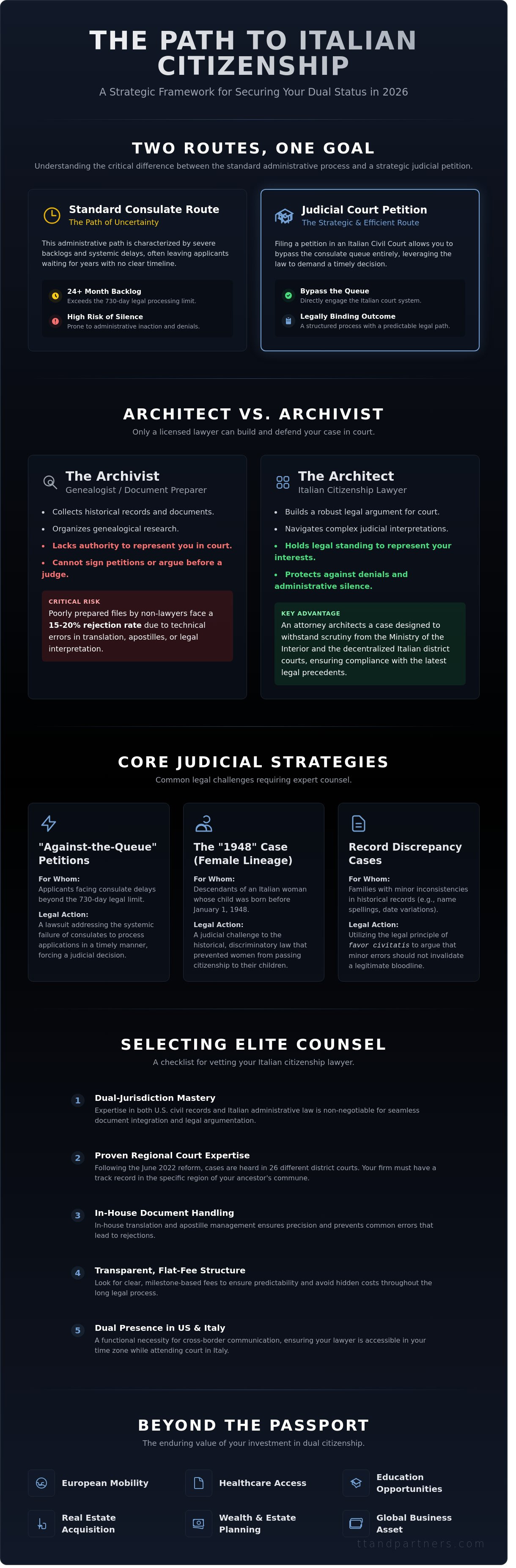
The pursuit of dual nationality in 2026 demands more than a collection of historical records; it requires a structural understanding of how Italian nationality law interfaces with modern judicial interpretations. While a genealogist serves as an archivist of the past, an italian citizenship lawyer acts as the architect of your future legal status. This distinction is critical because the Italian Ministry of Interior and the Court of Cassation have tightened their scrutiny over the last 24 months. Professional legal counsel ensures that your application isn't merely a pile of papers but a robust legal argument designed to withstand the rigors of the Italian court system.
Legal Representation vs. Document Preparation
A document preparer or genealogist lacks the authority to step inside a courtroom. Only a licensed attorney holds the power to sign petitions and argue before a judge. Relying on non-lawyer services for complex lineage breaks often leads to rejected applications that cannot be easily appealed. Legal standing is the recognized capacity of an individual to bring a claim before a court of law to seek a judicial remedy for a specific grievance. Beyond simple filings, an italian citizenship lawyer protects your interests against administrative silence or arbitrary denials.
Navigating the 2026 Regulatory Landscape
Recent shifts, specifically the implementation of the June 2022 reform that decentralized citizenship trials to district courts, have created a fragmented legal environment. Professional counsel provides the necessary foresight to navigate these local variations across Italy's 26 judicial districts. They mitigate risks associated with the "minor issue" where parents naturalized while their children were still minors, a point of contention that saw a 12% increase in court challenges during 2025. A visionary legal strategy is essential for several reasons:
1948 Cases: These require a judicial challenge to the discriminatory historical law preventing women from passing citizenship to children born before January 1, 1948.
Against-the-queue Petitions: These lawsuits address the systemic failure of consulates to process applications within the 730-day legal limit.
Historical Record Inconsistencies: Lawyers utilize the principle of favor civitatis to argue that minor name discrepancies shouldn't invalidate a legitimate bloodline.
The complexity of the current landscape means that every word in your petition has weight. Your legal representative doesn't just manage data; they build a bridge between your family's history and the Italian state. If you're ready to begin this structured journey with precision, you can reach out through our contact page to discuss your specific lineage and goals.
Evaluating Expertise: How to Choose Your Attorney
Selecting an italian citizenship lawyer is an exercise in identifying structural integrity within a legal framework. Much like an architect assesses a site's foundation, you must evaluate a firm's dual-jurisdiction expertise. A competent attorney functions as a bridge between US civil records and the administrative requirements set by the Italian Ministry of Foreign Affairs. This requires a deep understanding of how these two distinct legal systems intersect.
Since the judicial reform effective June 22, 2022, citizenship cases are no longer centralized in a single national court; they're heard in regional courts. You need a firm with a proven track record in the specific "Corte d’Appello" where your ancestor's commune is located. Success in one regional jurisdiction may look different than success in another. Precision in translation and apostille management is equally vital. In-house handling of these documents ensures that technical nuances aren't lost, preventing the 15% to 20% rejection rate often seen in poorly prepared files. Transparency in fee structures, specifically flat-fee milestones, provides the predictability necessary for long-term legal planning.
Key Selection Criteria for US-Based Italians
A strong presence in both the United States and Italy is a functional necessity for cross-border communication. This dual-presence model ensures your italian citizenship lawyer can attend court hearings in Italy while remaining accessible during convenient US business hours. During your initial consultation, look for a partnership approach rather than a transactional one. Ask specific questions about your lineage: How does the "minor issue" affect your claim? What's their strategy for 1948 cases? If you're ready to analyze your family's specific legal path, you can connect with our team for a detailed review.
Avoiding the "Document Mill" Trap
The market is saturated with "document mills" that prioritize volume over legal precision. Red flags include 100% success claims or guaranteed timelines. International law is subject to bureaucratic shifts; no ethical attorney guarantees a result without a comprehensive case review. Demand a tailored legal opinion that addresses the unique gaps in your family history. Professional liability insurance is another non-negotiable factor. It signals that the firm operates with the accountability required for high-stakes international litigation. A bespoke strategy always outweighs a generic service package when your heritage is on the line.
Strategic Paths: Jure Sanguinis, 1948 Cases, and Marriage
Choosing the correct legal trajectory is a matter of structural precision. Most applicants begin by researching the citizenship by descent application process through their local consulate. While this administrative path is the traditional route, it's often hindered by systemic backlogs. An italian citizenship lawyer evaluates whether your lineage fits the standard jure sanguinis criteria or if a judicial approach is required to secure your rights.
The 1948 Case represents a specific legal niche where the "female line" was historically denied the right to pass citizenship. Before January 1, 1948, Italian women couldn't transfer citizenship to their children. Since the 2009 Supreme Court of Cassation ruling, this gender discrimination is regularly overturned in court. These aren't simple applications; they're litigated cases that require a robust trial strategy to prove the unconstitutionality of the original denial.
For those seeking citizenship through marriage (Jure Matrimonii), the landscape changed significantly on December 4, 2018. Applicants must now demonstrate B1 level proficiency in the Italian language. This requirement isn't a mere formality. It's a legal prerequisite that requires certification from recognized entities like the CLIQ association. If you're navigating these complexities, consulting a professional via our contact page can provide the necessary clarity on your eligibility.
The Judicial Route: Bypassing Consulate Backlogs
When a consulate fails to provide an appointment within the 730-day legal limit, it's considered a "denial of justice." This allows an italian citizenship lawyer to move the case directly to the Italian civil courts. Following the June 2022 reform, these cases are heard in regional courts based on the ancestor's place of birth. Current court calendars suggest that cases filed today will likely reach a final decision by the 2026 timeline. The Avvocatura dello Stato acts as the legal defense for the Italian government, carefully reviewing all ancestral records to ensure they meet strict evidentiary standards.
Special Circumstances: Naturalization and Reacquisition
The 1912 Law (Law no. 555) remains the cornerstone of modern eligibility. If an ancestor naturalized as a foreign citizen before July 1, 1912, they automatically lost their Italian status and the ability to pass it to the next generation. We also see cases where an ancestor naturalized before the birth of their child, which usually breaks the chain of descent. Legal strategies in these instances focus on:
Verifying exact naturalization dates through USCIS or NARA records.
Proving the ancestor was still an Italian citizen when the next in line was born.
Utilizing reacquisition laws for those who lost citizenship but maintained a residency link to Italy.
Precision in these dates is the difference between a successful claim and a permanent rejection.
Investment and ROI: The Cost of Professional Counsel
Acquiring Italian citizenship is an exercise in strategic planning. It requires the same precision one applies to a high-end architectural project. You aren't just paying for paperwork; you're investing in a permanent asset for your lineage. Total investments typically range from $8,000 to $25,000. This encompasses legal fees, international document retrieval, and Italian court taxes like the €518 contributo unificato. The ROI is measurable. An EU passport grants access to a market of 450 million people and healthcare systems that consistently rank in the global top ten. Education costs also drop significantly; European tuition is often 75% lower than private American universities. It's a generational shift in opportunity.
Fee Structures and Transparency
Most reputable firms operate on a milestone-based retainer system. A full-service package covers everything from the initial genealogical search to the final court decree and the eventual passport issuance. Transparency is vital. You should expect a clear breakdown of administrative taxes versus professional service fees. If you're unsure about the structural integrity of your specific lineage, scheduling a consultation provides the clarity needed for a fixed-fee quote. This prevents the "scope creep" that often plagues unmanaged legal processes.
The Hidden Costs of Inaccurate Filings
The most expensive path is the one you have to walk twice. DIY attempts often fail at the "One and the Same" hurdle. If a birth certificate says "Giovanni" but a death record says "John", an italian citizenship lawyer must file a supplementary court order to prove identity. These corrections add $2,000 to $4,000 in unplanned costs and months of delays. Looking toward 2026, the Italian court system expects a 15% increase in processing efficiency, yet document accuracy remains the primary gatekeeper. Professional oversight ensures you don't lose three years to a simple clerical error. Budgeting for this multi-year process requires a phased approach, where 60% of the capital is deployed in the first 12 months for document acquisition and apostilles.
Secure your family's future with a customized citizenship roadmap.
Beyond the Passport: A Strategic Partnership
Acquiring dual status is more than an administrative milestone; it's a structural foundation for a sophisticated global life. A skilled italian citizenship lawyer functions as the architect of this transition, ensuring that your new legal identity integrates seamlessly with your existing international business and estate plans. This process isn't just about travel documents. It's about creating a robust framework for cross-border litigation and asset protection that spans two distinct jurisdictions.
The vision of Tosolini, Toniutti & Partners centers on bridging the legal gap between the US and Italy. We view every case through the lens of a long-term strategic partnership. Whether you're managing complex inheritance issues or defending corporate interests abroad, having a legal team that understands the nuances of both Italian civil law and American common law is essential. We provide the intellectual depth and technical precision required to maintain harmony across your global legal footprint. The expertise of an italian citizenship lawyer ensures the process is handled with the precision your family deserves.
Corporate and Real Estate Synergy
Holding Italian citizenship simplifies the process of LLC incorporation and business expansion across the European Union. In 2023, EU-based entrepreneurs benefited from streamlined regulatory filings that aren't available to foreign nationals. Your status allows you to optimize real estate investments by bypassing the reciprocity requirements that often complicate property acquisitions for non-EU citizens. When you find the right property, your lawyer facilitates the entire closing process, from the initial proposta d'acquisto to the final deed of sale. This professional oversight ensures that every technical detail, from building permits to tax identification, aligns with your broader financial objectives. Strategic partners don't just find solutions; they anticipate the structural needs of your investment portfolio.
Securing Your Legacy
The intergenerational benefit of this process is its most enduring feature. Italian citizenship passes to your children automatically, providing them with permanent access to the European labor market and educational systems. It's a gift of mobility that doesn't expire. A well-executed citizenship claim carries the same elegance as a perfectly designed building; it serves a functional purpose while standing the test of time. We invite you to contact Tosolini, Toniutti & Partners to begin your cross-border journey and secure a legacy that reflects your family's history and future potential.
Architecting Your Future in Italy
Securing your heritage in 2026 requires a structural foundation built on precise legal expertise. The landscape of dual nationality has shifted, making the role of an italian citizenship lawyer more about strategic navigation than mere document collection. Successful outcomes today depend on identifying the correct path among 1948 litigation, marriage, or jure sanguinis while accounting for the latest judicial precedents in Italian courts. It's a process where technical accuracy meets historical legacy.
Tosolini, Toniutti & Partners offers 20 years of specialized experience in US-Italy cross-border law to guide this transition. Our bilingual team operates with active licenses in both jurisdictions, providing a level of oversight that single-country firms can't match. We've managed hundreds of complex 1948 cases, ensuring every detail aligns with the rigorous standards of the Italian legal system. This isn't just a transaction; it's a partnership designed to withstand the test of time and changing regulations. You deserve a legal framework as enduring as the history you're reclaiming.
The path to your Italian passport is clear when you have the right experts by your side.
Frequently Asked Questions
Do I need a lawyer if I am applying for Italian citizenship by descent?
You don't strictly need a lawyer for standard administrative paths through a consulate, but complex lineage issues often require legal intervention. An italian citizenship lawyer ensures the structural integrity of your application by navigating the 1912 Citizenship Law and subsequent amendments. Roughly 30 percent of applicants face delays due to minor discrepancies in historical records that a legal professional can rectify through court orders.
What is a 1948 case and why does it require an Italian attorney?
A 1948 case is a legal challenge against the rule that prevented Italian women from passing citizenship to children born before January 1, 1948. You must hire an attorney because these claims require a trial in the Italian Civil Courts. Since the 2009 Supreme Court ruling, these cases have a success rate exceeding 95 percent, provided the legal framework acknowledges the gender discrimination inherent in the original 1912 statutes.
How long does the Italian citizenship process take in 2026?
The process currently spans 18 to 36 months depending on the specific legal path and the workload of the regional courts. Judicial cases typically conclude within 24 months, while consulate appointments in major hubs like New York or London often have waitlists extending past 2028. Recent legislative updates in 2022 decentralized these cases to local district courts to improve efficiency and reduce the previous four year backlog.
Can an Italian citizenship lawyer help if the consulate has no appointments?
Yes, an italian citizenship lawyer can file a denied justice lawsuit in the Italian courts if you can't secure a consulate appointment within a reasonable timeframe. This strategy leverages Article 2 of Law 241/1990, which mandates that administrative procedures must conclude within 730 days. By proving that the consulate's calendar is fully booked for years, your attorney moves the jurisdiction directly to Italy for a faster resolution.
What are the benefits of having an Italian passport as a US citizen?
Holding an Italian passport grants you the right to live, work, and study in any of the 27 European Union member states without a visa. You'll gain access to high quality healthcare systems and significantly lower tuition rates at European universities. Additionally, the Italian passport ranks as the 1st most powerful globally in 2024, offering visa free entry to 194 destinations compared to 188 for US passport holders.
How much does it cost to hire an Italian citizenship attorney?
Professional fees for a judicial case generally range from 5,000 to 15,000 Euros, depending on the number of family members included in the petition. This investment covers the legal research, court filings, and representation before the Italian judge. You should also budget approximately 1,500 Euros for administrative costs, including document translations, apostilles, and the mandatory 300 Euro government application fee.
Is it possible to lose my US citizenship by becoming an Italian citizen?
You won't lose your US citizenship because the United States has recognized dual nationality since the 1967 Supreme Court case Afroyim v. Rusk. The Italian government also permitted dual citizenship starting on August 16, 1992, through Law 91/1992. As long as you don't formally renounce your US citizenship at a consulate, you'll maintain all rights and responsibilities in both nations simultaneously.
What documents are required for an Italian dual citizenship application?
You must provide long form birth, marriage, and death certificates for every ancestor in your direct line starting from the Italian born relative. This includes the ancestor's naturalization records or a No Record letter from USCIS if they never became a citizen. Every non-Italian document requires an international Apostille and a certified translation to ensure it meets the technical standards required by the Ministry of the Interior.
Disclaimer
The information provided in this website is offered purely for informational purposes. It is not intended to create or promote an attorney-client relationship, and does not constitute and should not be relied upon as legal advice. We intend to make every attempt to keep this information current. We do not promise or guarantee, however, that the information is correct, complete or up-to-date, and readers should not act based upon this information without seeking professional counsel from a licensed attorney. Transmission of information from this newsletter is not intended to create, and its receipt does not constitute, an attorney-client relationship with Tosolini, Toniutti & Partners or any of its individual attorneys or personnel.


Comments