

Cross-Border Commercial Litigation: Courts, Laws and Evidence

Choosing arbitration does not automatically make a cross-border dispute simpler. Cross-border commercial litigation proceeds through a court’s procedural and appellate system. Arbitration, by contrast, depends on an agreement and the rules selected by the parties or an institution.
It is understandable to focus first on where a dispute will be heard. The practical outcome can also depend on which law applies, how evidence is preserved and obtained across borders, and whether a decision can be enforced where the other party’s assets are located.
This article explains how court litigation differs from arbitration and what that choice can mean for an international business dispute. It also covers jurisdiction, governing law, overseas evidence, and foreign judgment enforcement, including why evidence planning matters before formal discovery begins. Together, these factors shape the course of a case and the prospects of turning a legal decision into a practical result.
Table of Contents
What are Cross-Border Commercial Disputes?
A cross-border commercial dispute involves a business conflict connected to more than one country, such as a U.S.-Italy contract dispute. Court proceedings follow the court’s procedures and appeals, while arbitration depends on the parties’ agreement and selected rules. Costs and timelines in U.S. litigation vary with factors such as the volume of evidence, procedural disputes, foreign-law issues, and court schedules.
Managing Parallel Proceedings
Parallel proceedings are related court cases or arbitrations taking place in more than one jurisdiction at the same time. They matter because separate decision-makers may consider overlapping claims or evidence, creating a risk of conflicting decisions. For example, a U.S. court case and an arbitration concerning the same U.S.-Italy contract may proceed concurrently. Counsel assesses jurisdiction, sequencing, and how a decision in one proceeding could affect the other.
Discovery for Foreign Proceedings
Under 28 U.S.C. § 1782, a party may seek discovery in the United States for use in a foreign proceeding. In a U.S.-Italy commercial dispute, relevant records held in New York could potentially support a proceeding abroad. The provision can make evidence held in the United States relevant to a case outside it. Counsel assesses the request’s purpose and connection to the foreign proceeding, as well as how the material may assist the matter.
Serving Process Across Jurisdictions
Service of process is the formal delivery of legal papers to a party in another jurisdiction. In a U.S. case involving an Italian recipient, the required method may depend on an international convention, Italian law, federal procedural rules, or a combination of these. Identifying and documenting the correct service route matters because disputes over notice can affect proceedings and cause delay.
Technology also shapes procedure: courts and arbitration proceedings may use virtual hearings and AI-assisted document review. These tools can support remote participation and document organization, while counsel remains responsible for assessing the evidence and its context. In arbitration, the chosen seat can affect procedural law and enforceability, so it is a material term to assess when drafting a U.S.-Italy contract.
Recognition and enforcement of foreign judgments in Japan
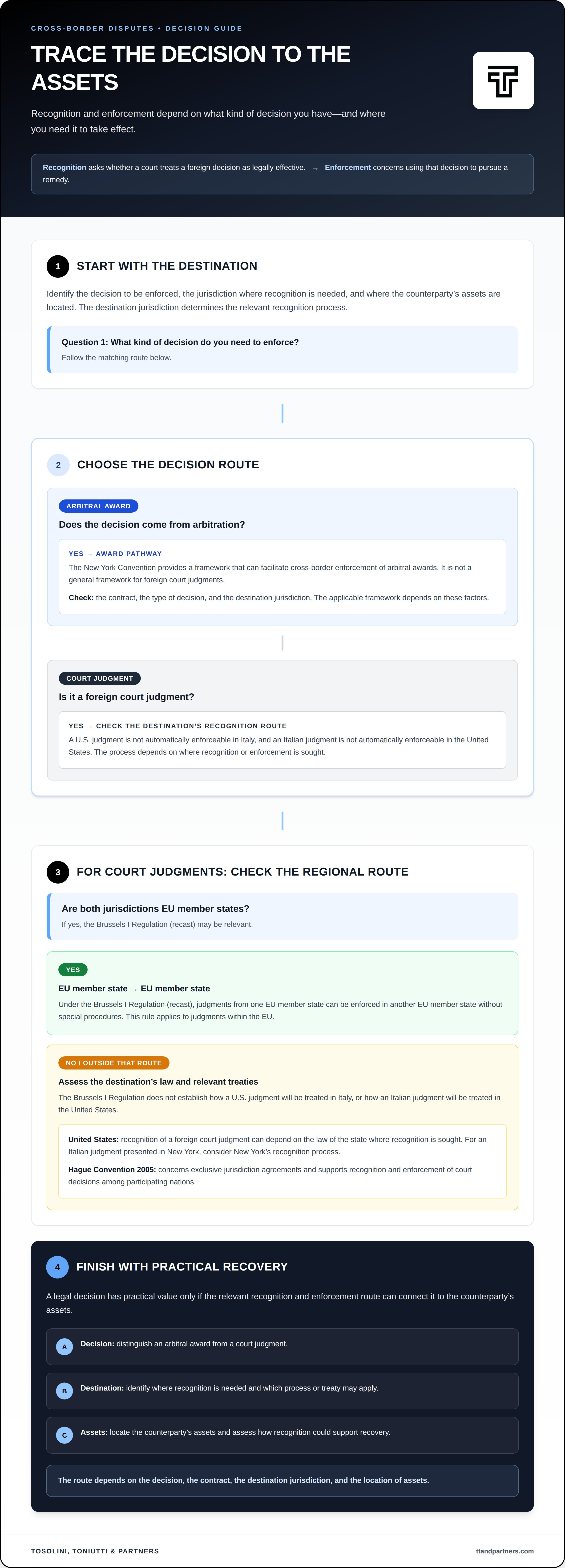
Recognition asks whether a court treats a foreign judgment as legally effective. Enforcement concerns using that judgment to pursue a remedy. In a U.S.-Italy dispute, the country where the judgment is presented matters. A U.S. judgment is not automatically enforceable in Italy, and an Italian judgment is not automatically enforceable in the United States. The applicable process depends on the jurisdiction where recognition or enforcement is sought.
First distinguish court judgments from arbitral awards. The New York Convention provides a framework that can facilitate enforcement of arbitral awards in cross-border disputes; it is not a general framework for foreign court judgments. The Hague Convention 2005 concerns exclusive jurisdiction agreements and supports recognition and enforcement of court decisions among participating nations. The relevant framework depends on the type of decision, the contract, and the destination jurisdiction.
Regional arrangements have a defined reach. Under the Brussels I Regulation (recast), judgments from one EU member state can be enforced in another EU member state without special procedures. This rule applies to judgments within the EU. It does not establish how a U.S. court judgment will be treated in Italy, or how an Italian judgment will be treated in the United States.
In the United States, recognition of a foreign court judgment can depend on the law of the state where recognition is sought. A business seeking to enforce an Italian judgment in New York therefore needs to consider the applicable New York recognition process. The judgment, the parties, and the location of assets all inform how recognition may lead to practical recovery.
Assess enforcement viability early, before choosing a dispute strategy. Identify the decision to be enforced, the jurisdiction where recognition is needed, and the location of the counterparty’s assets. For an arbitral award, consider the New York Convention framework; for a court judgment, analyze the destination’s recognition process and any relevant treaty. This distinction helps businesses plan for the practical value of a decision across the U.S.-Italy relationship.
Jurisdiction and applicable law in international disputes
For a U.S. business sued abroad or pursuing a foreign company, counsel assesses jurisdiction, applicable law, and available dispute-resolution routes. Counsel can also coordinate with local legal experts on foreign proceedings, evidence, and treaty interpretation.
A foreign party or overseas transaction alone does not put a commercial dispute in U.S. federal court. Some international cases qualify based on the parties’ citizenship and the amount in controversy; others require a federal question or another statutory basis. State courts may also hear disputes, depending on the claims and jurisdictional rules.
Applicable law is a separate question. Contract, fraud, and related claims may turn on state law, foreign law, or a contractual choice-of-law provision. A leading issue in U.S.-Italy disputes is whether the contract’s governing-law clause matches its jurisdiction clause. The Brussels I Regulation generally places cross-border commercial cases in the defendant’s country of residence, subject to exceptions.
Commercial disputes can arise from international sales, import or export arrangements, customs compliance, or trade provisions. In global supply chains, businesses frequently rely on trade compliance partners such as Global4PL to manage importer and exporter of record requirements and reduce regulatory risks. A joint venture dispute, for example, may concern management authority, financial obligations, or alleged contract breaches. These are commercial disputes across borders, not territorial boundary claims. In each case, jurisdiction and governing law can shape the claims and remedies available.
Dispute-ready drafting can reduce uncertainty before a disagreement arises. Clear governing-law and jurisdiction clauses identify the intended legal framework and forum. Contract review should also account for notice provisions and limitation periods: missing a required notice or deadline can weaken a case. Multi-tier dispute-resolution clauses may set out stages such as negotiation or mediation followed by arbitration or court proceedings, making it valuable for commercial teams to understand what to expect from business mediation sessions when working through early resolution steps.
The Foreign Sovereign Immunities Act can matter when a foreign state or state-linked party is involved. Sovereign-immunity arguments may affect whether a U.S. court can hear a claim. Counsel assesses this issue alongside the parties, transaction, contract language, and statutory basis, then coordinates the litigation strategy across relevant jurisdictions.
Cross-border evidence preservation and discovery
Evidence planning should begin before formal discovery, while relevant information remains accessible. In a U.S.-Italy dispute, counsel can map records held by each party, including contract versions, business emails, messaging records, and accounting files. An initial review identifies custodians, storage locations, and systems that may contain material evidence. Deletion, employee departures, and device replacement can otherwise create gaps that complicate later requests.
Preservation requires more than retaining a signed agreement. Counsel can connect each disputed issue to likely evidence: delivery records for an alleged supply failure, for example, or financial entries for a disagreement over joint venture performance. This helps focus collection on relevant sources rather than gathering everything indiscriminately. A chronology can then show which records support each party’s account and where important gaps remain.
Cross-border collection also requires coordination. A U.S. company may hold relevant files while Italian personnel maintain related records in separate systems or languages. Counsel coordinates with local legal and technical specialists to identify custodians, organize collection, and assess how records relate to the claims. The contract and the locations of documents and assets can inform the broader evidence strategy.
During discovery, document review can combine technology with legal analysis. AI-assisted review may help organize large document sets, but it cannot determine a record’s significance. Counsel evaluates context, relevance, consistency, and whether a document supports or undermines a party’s position. Virtual hearings can enable remote testimony, but preparation still depends on reliable records and clear witness evidence.
A practical takeaway: preserve potentially relevant data early, then connect each collection decision to a disputed issue. That approach can reduce avoidable evidence gaps and keep requests focused. For help assessing a cross-border evidence strategy, contact the legal team.
Tosolini, Toniutti & Partners: INTERNATIONAL LITIGATION
Tosolini, Toniutti & Partners provides international litigation support for businesses facing cross-border disputes. Turn to the firm when a U.S.-Italy commercial matter raises connected questions about court jurisdiction, applicable law, overseas evidence, or enforcing a judgment abroad. Coordinating these issues helps align the litigation strategy with the dispute’s practical and legal demands.
The firm’s support may be relevant whether a business is responding to proceedings initiated abroad or considering action against a foreign counterparty. An early assessment can organize the central issues: the contract and its dispute clauses, evidence held in each country, and the location of assets that may matter to enforcement. The appropriate approach depends on the circumstances of the dispute.
For a measured discussion of an international commercial matter, contact Tosolini, Toniutti & Partners.
Shape the Next Decision with Clarity
The next step is to define what a workable outcome means for the business, beyond a legal ruling. Consider how the dispute affects ongoing operations, commercial relationships, and future decisions. A clear view of these priorities can help align legal strategy with the company’s wider direction.
For businesses with plans that extend beyond a dispute, Tosolini, Toniutti & Partners also offers E-1 VISA, E-2 VISA, and O-1 VISA services. The firm’s international litigation support may be relevant when a commercial matter crosses borders and requires coordinated legal analysis.
Bring the central documents and a concise account of the business issue to an initial discussion. That gives counsel a practical starting point for considering the matter’s objectives and next decisions. Discuss your matter with Tosolini, Toniutti & Partners and take a considered next step in your cross-border commercial litigation.
A deliberate strategy can keep the business’s priorities in view as the matter develops.
Frequently Asked Questions
How Is International Commercial Litigation Different from Arbitration?
International commercial litigation is decided by a court, while arbitration is decided by an arbitrator under an agreement. Court cases follow the court’s procedural and appellate system; arbitration follows rules selected by the parties or an institution. A contract may direct some or all disputes to arbitration. The chosen seat can affect procedural law and enforceability, so review the dispute clause before proceedings begin.
What Should a Business Evaluate When Selecting Cross-Border Litigation Counsel?
Assess whether counsel can address the jurisdictions, legal issues, and evidence involved in the specific dispute. For a U.S.-Italy matter, that may mean analyzing the contract, coordinating with local legal experts, and planning how records held in each country will be handled. Discuss how the legal strategy accounts for parallel proceedings and asset locations, since these factors can shape a case beyond its merits.
What is cross-border commercial litigation?
Cross-border commercial litigation is a court dispute involving a business relationship connected to more than one country. For example, a U.S. company might dispute an Italian supplier’s performance under a contract, with the agreement, witnesses, or records in different jurisdictions. The case may require analysis of where it can be heard, which law applies, and how evidence and any resulting judgment will be handled internationally.
Which courts have jurisdiction over an international commercial dispute in the United States?
No single U.S. court automatically has jurisdiction just because a party or transaction is foreign. Federal jurisdiction may depend on the parties’ citizenship and amount in controversy, a federal question, or another statutory basis. State courts may also be relevant. For example, a contract claim involving a foreign company still requires a valid jurisdictional basis and analysis of the claims and forum.
How are foreign judgments recognized and enforced in U.S. courts?
Recognition of a foreign court judgment in the United States can depend on the law of the state where recognition is sought. Recognition concerns whether the court treats the judgment as effective; enforcement concerns pursuing a remedy based on it. The destination state and the judgment’s circumstances guide the analysis. Identifying where the counterparty’s assets are located can help frame the enforcement strategy.
How are U.S. court judgments enforced abroad?
Enforcement depends on the country where the U.S. judgment will be presented and the rules or treaties applicable there. The Hague Convention 2005 supports recognition and enforcement of court decisions among participating nations when contracts contain exclusive jurisdiction clauses. It does not provide a universal route for every judgment or destination. An early assessment should identify the target country, relevant agreement, and assets that may be reached.


Comments