

Delaware LLC vs Florida LLC: Which Fits Your U.S. Plans

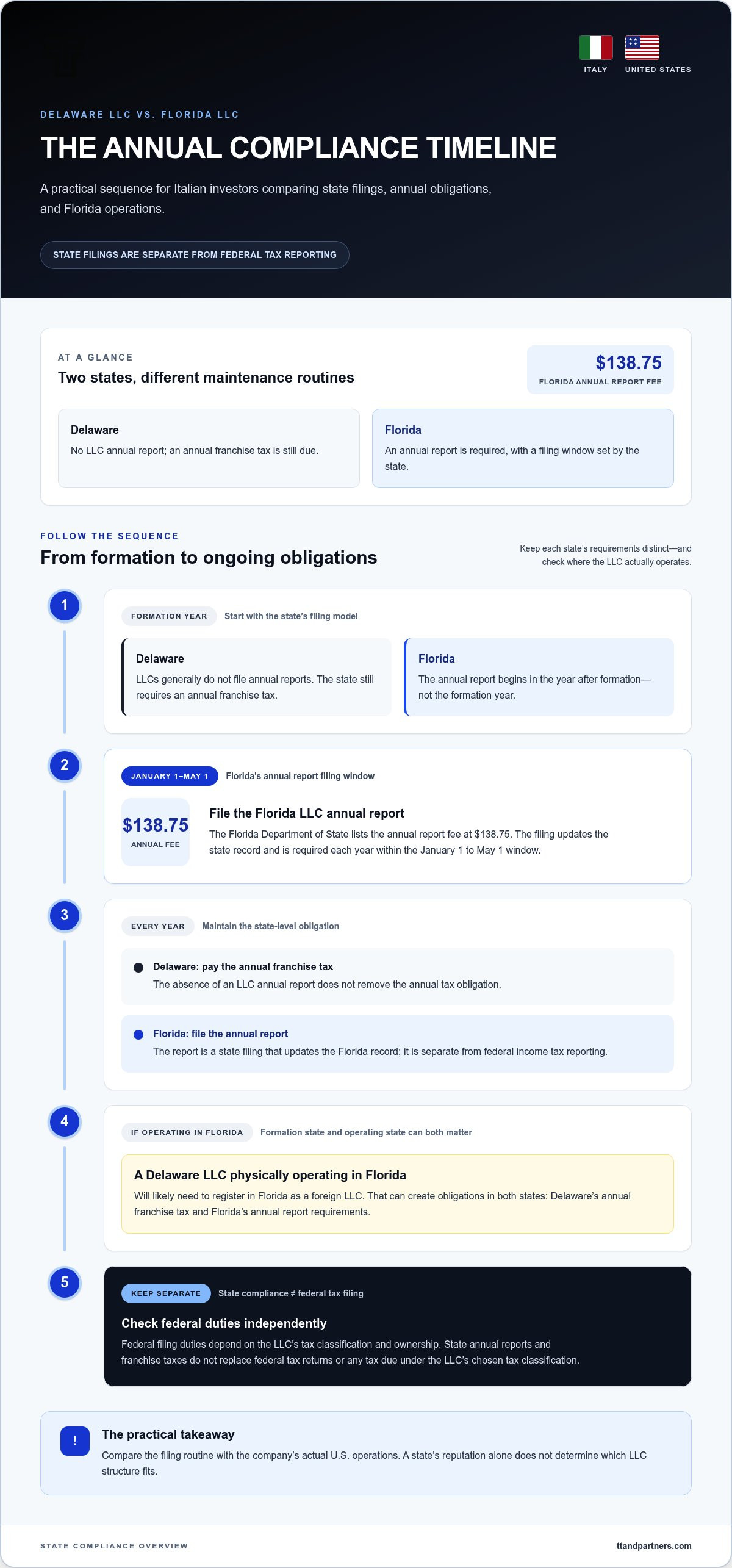
The Delaware LLC vs. Florida LLC choice for Italian investors depends less on a state’s reputation than on where the business will operate and how it plans to grow. Delaware LLCs don’t file annual reports but do owe an annual franchise tax; Florida LLCs must file an annual report between January 1 and May 1 each year, beginning the year after formation, according to the Florida Department of State.
It’s sensible to compare both states carefully: filing requirements are only one part of the decision. The right structure should reflect the company’s ownership and planned operations. This guide to Delaware LLC vs Florida LLC for Italian investors explains how the states differ in reporting, public records, management, profit distributions, and suitability for U.S. operations or fundraising.
You’ll see how each state may suit an Italian investor’s plans, including why a business operating in Florida may have different obligations from one formed there. The goal is to help you choose a structure that supports the company’s next stage.
Table of Contents
Does Delaware require an annual report from LLCs?
No. Delaware LLCs generally don’t file annual reports, but they do owe an annual franchise tax. Florida requires an annual report instead, so the states have different maintenance requirements. An Italian investor forming a Delaware LLC should also distinguish state obligations from federal tax returns and any tax due under the LLC’s chosen tax classification.
The Florida Department of State lists the Annual Report - Limited Liability Company fee at $138.75 annual. The Florida Department of State requires a Florida LLC to file its annual report between January 1 and May 1 each year, beginning in the year after formation. That filing updates the state record; it is separate from federal income tax reporting.
What are Delaware LLC formation fees and annual taxes compared with Florida LLC fees? The total state cost depends on the formation and ongoing maintenance requirements that apply.
When is Delaware preferable? Delaware may suit Italian investors who prioritize governance flexibility or fundraising plans. Florida may be a better fit when the business will operate there.
Must a Delaware LLC doing business in Florida register there? A Delaware LLC operating physically in Florida will likely need to register there as a foreign LLC, creating obligations in both states.
Do Italian investors need an ITIN, EIN, or U.S. tax return? An EIN application can use a third-party designee without an SSN or ITIN. Federal filing duties depend on the LLC’s tax classification and ownership.
What about FBAR and FATCA? FinCEN says an LLC member with U.S. bank accounts exceeding $10,000 at any time during the year must file FBAR, FinCEN Form 114, by April 15. FATCA is a separate cross-border reporting consideration.
What liability protection and legal risks apply? In Delaware, a creditor of an LLC member may obtain a charging order against distributions rather than seize the ownership interest. Florida law protects single-member LLCs from creditors pursuing the member’s debts.
For Italian investors, choosing between a Delaware LLC and a Florida LLC should come down to the company’s actual operations, compliance needs, and growth plans.
Public-record information and owner privacy
Delaware and Florida differ in what their public filings disclose, so forming an LLC in either state does not guarantee the same level of privacy. Delaware doesn’t require LLC managers or members to appear in its annual reports or Certificate of Formation. This limits what those state filings reveal about the people behind the entity, but it does not provide complete anonymity. Under Delaware law, a registered agent still keeps a contact person’s details.
Florida’s annual report includes LLC details, its EIN, and at least one person authorized to manage the company. Florida filings may disclose information about people connected with an LLC. Italian members should distinguish public state records from private ownership arrangements. For example, a manager-managed LLC may name an authorized manager in its filing, while the operating agreement sets out internal rights and responsibilities.
Before filing, review what information each state requires and decide who will serve as the LLC’s manager or authorized representative. Keep the operating agreement, ownership records, and state filings consistent. If the LLC hires employees or earns income, privacy in public records does not remove separate tax or reporting obligations. Choosing Delaware also does not conceal ownership from every government agency or financial institution.
For Italian owners, the U.S.-Italy tax treaty, signed in 1984, may affect dividend withholding: the stated rate is 15%, reduced to 5% when an Italian shareholder has held more than 25% of the capital for over 12 months. Treaty treatment and foreign tax credits depend on the payment’s characterization and the LLC’s tax classification.
Treat state records as a guide to filing visibility, not a promise of anonymity. Delaware filings generally leave member and manager names off the Certificate of Formation. Florida filings disclose management information and, in the specified formation case, owners. The practical choice depends on which details become public and how the LLC will operate, not on the label “anonymous LLC.”
LLC management and profit distribution
Both Delaware and Florida LLCs can set their internal management arrangements in an operating agreement. The agreement can establish who makes decisions, approves major transactions, and manages daily operations. In a member-managed LLC, owners hold authority; in a manager-managed LLC, designated managers do. For example, Italian owners living abroad might appoint a manager to oversee U.S. operations while retaining approval rights over major decisions. The registered agent receives official notices but does not automatically manage the company.
Profit allocation and cash distributions are related, but they aren’t the same. The operating agreement should explain how profits and losses are allocated, when cash may be distributed, and whether the company will retain reserves for business needs. An LLC could allocate profits according to ownership interests but delay distributions to fund expansion. Clear terms help prevent disputes when members contribute different amounts of capital or take different roles. Delaware’s governance framework and LLC case law may appeal to owners who want flexibility in structuring these arrangements.
For U.S. tax purposes, an LLC is generally pass-through by default. A single-member LLC is treated as a disregarded entity, while a multi-member LLC is generally taxed as a partnership. An LLC can elect corporate tax treatment using Form 8832. These classifications affect how income is reported, but don’t by themselves determine the timing or amount of member distributions.
How are U.S. LLC profits and distributions taxed for Italian tax residents? U.S. tax classification and Italian treatment may differ, so an LLC’s U.S. pass-through status doesn’t alone establish how Italy taxes its income. Italian rules, including Article 73 TUIR on tax residence and Article 167 TUIR on controlled foreign companies, may also matter; foreign tax credits depend on the income and applicable tax treatment.
Before forming the LLC, define decision-making rights, profit allocations, distribution conditions, and tax classification in the operating agreement. Compare those terms with the company’s ownership, capital contributions, and plans. Delaware’s governance advantages may matter for a complex or investor-focused organization. For either state, the best fit depends on the LLC’s intended governance and actual business activity.
Choosing a structure for U.S. operations or fundraising
Start with the company’s planned U.S. footprint. If it will operate physically in Florida, employ staff there, or serve the Florida market, forming there may align its legal home with its day-to-day activity. A Delaware LLC operating in Florida may also need to register as a foreign LLC, adding state filing and maintenance tasks. For Italian investors, the comparison should start with where the business will actually operate, not just where its formation document is filed.
Delaware may suit a company that values its governance framework or expects to raise capital. Delaware LLCs and corporations may appeal to businesses pursuing fundraising or a future public offering. Before filing, consider business partners’ roles, investor expectations, and any plans to change the entity structure later. A closely held business centered in Florida may find it more straightforward to form and operate in the same state. The choice depends on these practical priorities, not reputation alone.
What steps and documents do Italian citizens need to form and operate a U.S. LLC? Choose a state, select an available name, appoint the required in-state registered agent, and file the formation document. Delaware requires a Certificate of Formation; Florida’s Articles of Organization require the LLC name, principal office, and registered agent. Prepare an operating agreement, obtain an EIN, and identify applicable federal tax filings.
When required for a foreign-owned U.S. disregarded entity, Form 5472 must be attached to a pro forma Form 1120. Keep ownership, formation, and tax records aligned, particularly if the LLC adds foreign members or changes activities. If Florida operations are planned, include foreign registration and Florida reporting in the compliance calendar. For a venture that may later add partners or seek institutional capital, establish decision rights and ownership terms early.
Use this guide: choose Florida when operations are centered there and local alignment matters most; consider Delaware when governance needs or fundraising plans justify maintaining a presence in another state. In some situations, a holding-company arrangement involving Wyoming or New Mexico may be considered, but it creates a separate entity with its own administration.
For guidance connecting U.S. business plans with cross-border considerations, discuss your U.S. expansion plans.
Tosolini, Toniutti & Partners: E-2 VISA
Tosolini, Toniutti & Partners helps Italian investors connect U.S. business plans with relevant immigration pathways, including the E-2 VISA. Choosing Delaware or Florida establishes a company’s state framework; it doesn’t by itself determine an investor’s immigration route. Consider immigration advice when assessing how your intended investment, business role, and U.S. plans fit together.
The firm also handles E-1 VISA, O-1 VISA, and GREEN CARD matters. For an investor weighing LLC formation alongside a longer-term move to the United States, considering business structure and immigration objectives together can help clarify the next steps. Contact Tosolini, Toniutti & Partners to discuss your plans.
Build the U.S. plan around your next move
Choose a structure that supports the company you intend to build, not just the filing you need today. For Italian investors comparing Delaware and Florida LLCs, the next step is to align the legal structure with planned U.S. operations, ownership roles, and personal plans. That coordination can help keep business decisions and immigration planning moving in the same direction.
Tosolini, Toniutti & Partners assists with E-2 VISA, E-1 VISA, and O-1 VISA matters for people pursuing U.S. business and professional opportunities. If your plans involve a U.S. investment, consider how the company’s formation fits into your broader path before committing to a structure.
Contact Tosolini, Toniutti & Partners to discuss your U.S. plans and identify a considered next step.
Frequently Asked Questions
How is a Florida LLC different from a Delaware LLC?
A Florida LLC is often the more direct fit for a business whose operations are centered in Florida, while Delaware may appeal when governance flexibility or fundraising plans carry greater weight. For example, a company with Florida-based staff should factor in registration where it operates, even if formed elsewhere. The practical difference is the combination of state filings, public disclosures, and business priorities, not simply the state named on formation documents.
Is it better to incorporate in Delaware or another state?
Delaware isn’t automatically better. The right choice depends on where the business operates and what its owners need from the structure. A company with Florida operations may face Florida registration requirements even if formed in Delaware. A venture that prioritizes Delaware’s governance framework may find the state worth considering. Compare ongoing state obligations and future plans rather than choosing based only on reputation.
What Is the Best State to File an LLC?
The best state is usually the one that fits the LLC’s operating footprint and ownership plans. A business expecting to employ staff or maintain a physical presence in Florida should consider local requirements when choosing where to form. A venture focused on raising capital may weigh Delaware’s governance advantages. Before filing, map where the company will operate and identify any additional state registration that activity may require.
What information goes on the public record?
Public disclosure depends on the state and the filing. Delaware doesn’t require members or managers to be named in the Certificate of Formation. Florida’s annual filing identifies LLC details, its EIN, and at least one person authorized to manage it; owners must be listed in the specified single-LLC formation case. Keep public filings distinct from internal ownership agreements and information shared with banks or tax authorities.
What is the annual filing like in each state?
Delaware LLCs owe an annual franchise tax but don’t file an annual report. Florida LLCs must submit an annual report within the state’s filing window. Assign responsibility for each task, retain payment confirmations, and calendar the applicable deadline. If a business is registered in both states, track each state’s requirements separately: completing one state’s filing does not satisfy the other’s.
Why do so many companies choose Delaware?
Delaware may appeal to companies seeking a flexible governance framework and an established body of LLC case law. These features can matter to a venture planning complex internal arrangements or future fundraising. There are trade-offs: a business operating in another state may also have to meet that state’s registration requirements. Delaware can be a strategic choice, but it is not a universal shortcut to simpler compliance.



Comments