

US Business Contracts for Italian Companies: Key Risks

US business contracts for Italian companies can lead to cross-border disputes when they leave governing law, forum, or responsibility for losses unclear. U.S. state laws differ, so the chosen jurisdiction can affect how a dispute is resolved. An indemnification clause may require one party to cover the other’s legal fees, while a contract without an express liability limit can leave exposure potentially unlimited.
A contract that looks straightforward may carry consequences beyond its commercial terms. This article explains how disputes arise between U.S. and Italian businesses, which federal, state, and local rules may affect performance, and how governing-law and dispute-resolution clauses shape a conflict. It also covers payment, delivery, warranties, indemnification, and liability limits, highlighting where careful drafting can clarify responsibilities and manage contractual risk.
Table of Contents
Federal, state, and local compliance considerations
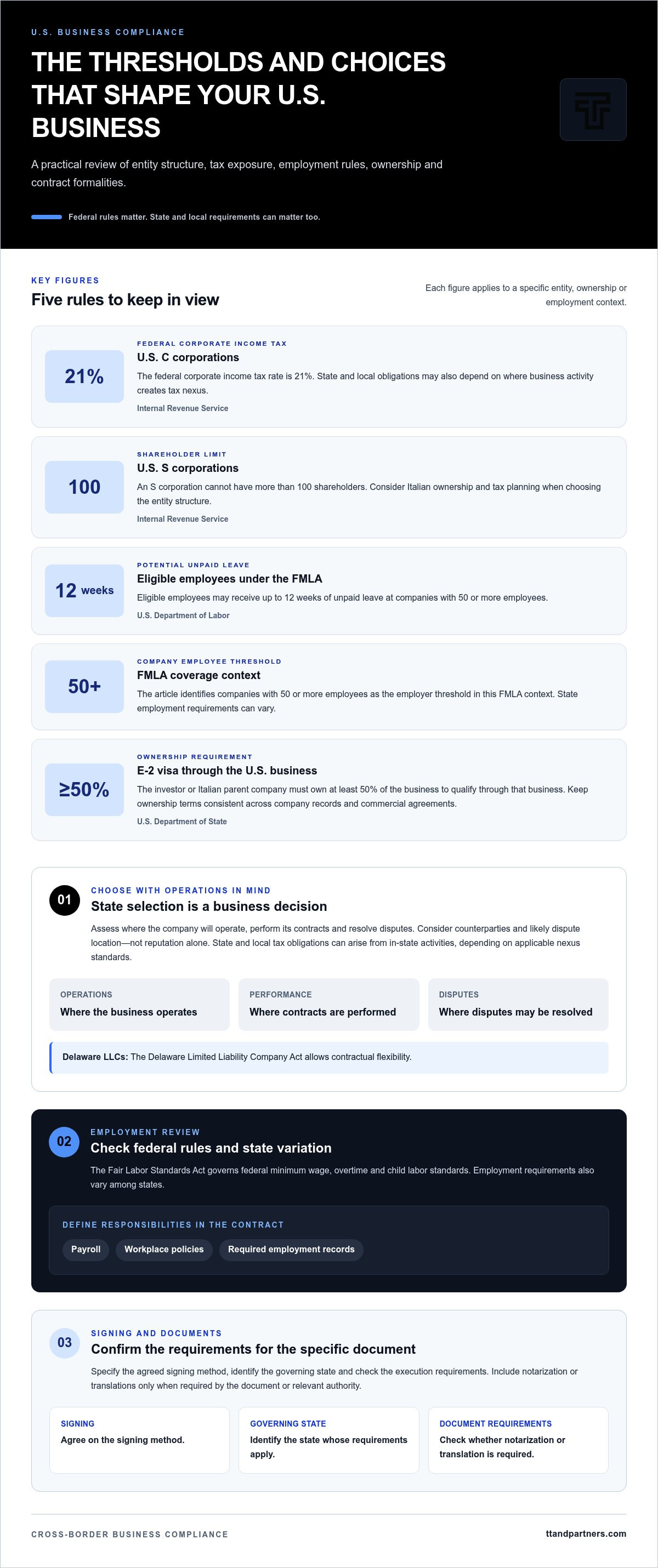
Build the compliance review around the business structure, the states where it operates, and the contract’s actual work. According to the Internal Revenue Service, U.S. C corporations are subject to a federal corporate income tax rate of 21%. A U.S. S corporation cannot have more than 100 shareholders, according to the Internal Revenue Service. Italian ownership and tax planning therefore belong in the entity decision, not as an afterthought to a purchase or sales agreement.
Choose a state based on business operations, counterparties, and likely dispute location, not reputation alone. Which U.S. state should an Italian company choose for incorporation, contracting, or dispute resolution? The best fit depends on where the company will operate, perform its contracts, and resolve disputes. Delaware LLCs are governed by the Delaware Limited Liability Company Act, which allows contractual flexibility. State and local tax obligations can arise from in-state activities, depending on applicable nexus standards.
Employment clauses also need a state-level review. The Fair Labor Standards Act governs federal minimum wage, overtime, and child labor standards, while employment requirements vary among states. Under the Family and Medical Leave Act, eligible employees may receive up to 12 weeks of unpaid leave at companies with 50 or more employees, according to the U.S. Department of Labor. Define which party handles payroll, workplace policies, and required employment records.
For Italian investors using a U.S. business, ownership can connect entity structure with immigration planning. According to the U.S. Department of State, the investor or Italian parent company must own at least 50% of the business to qualify for an E-2 visa through that business. This threshold can shape governance and control provisions. Keep ownership terms consistent across company records and commercial agreements.
What contract formalities, signatures, notarization, and document translations are required for Italian companies in the U.S.? Specify the agreed signing method, then identify the governing state and the execution requirements for the particular document. Include notarization or translations only when required by that document or the relevant authority. This focused approach gives an international business team practical guidance without assuming that one rule applies throughout the United States.
How should a contract choose governing law, state venue, and dispute resolution for a U.S.-Italy business deal?
For US business contracts for Italian companies, governing law and dispute forum are separate choices. Governing law sets the rules for interpreting the agreement; venue identifies where a court case may proceed. Because state laws differ, that choice can affect how the contract is interpreted and how a dispute unfolds. Name the governing state expressly rather than relying on a party’s headquarters or the place where the agreement is signed.
Next, match the forum to the parties’ commercial relationship. A contract performed mainly in one U.S. state may name courts there, while a transaction involving operations in several states calls for a deliberate venue choice. Specify the court system and location, and consider practical factors such as access to witnesses, business records, and relevant personnel. A clause that says only “U.S. courts” leaves room for disagreement about where proceedings belong.
For cross-border deals, arbitration offers a private process and may be faster than court litigation. It can also support international enforcement: arbitration awards are more readily enforceable across borders under the New York Convention. The clause should identify the arbitration rules, seat, language, and disputes covered. If these details are unclear, the parties may end up arguing about procedure before addressing the underlying claim.
Italian courts may decline to enforce foreign contractual terms that conflict with fundamental Italian legal principles or mandatory EU regulations. A U.S. governing-law clause therefore may not settle every issue in Italy. Draft US business contracts for Italian companies with the agreement’s performance, the parties, and potential enforcement locations in mind. For a U.S. property purchase, align the sale agreement’s dispute provisions with the related real estate closing.
Before signing, compare the chosen law, forum, and dispute process with the transaction’s actual structure. For a property deal, real estate closing assistance can address the closing’s legal requirements alongside the contract terms.
What clauses should U.S. contracts with Italian companies include for payment, delivery, warranties, and liability?
Set payment terms around clear triggers, records, and remedies. Specify the currency, invoice requirements, payment deadline, and process for resolving disputed charges. For example, a supply agreement can make payment due after delivery and acceptance, with acceptance criteria defined in the contract. Clarify whether partial deliveries are invoiced separately. Also state how either party must report a billing error and what happens to undisputed amounts while it is addressed.
Define delivery as an operational process, not just a date. Specify the delivery location, who arranges transportation, when the buyer must inspect the goods, and how each party records receipt. A contract for Italian-made equipment delivered to a U.S. facility could set out packaging standards, required shipping documents, and how to report damage. For services, replace shipping terms with milestones, deliverables, review periods, and the person authorized to approve completed work.
Warranty terms should reflect whether the agreement covers goods or services. The distinction affects warranties, remedies for non-performance, and risk allocation. For goods, identify the promised specifications, permitted use, and process for reporting defects. For services, define the agreed scope and objective completion criteria. State which correction, replacement, or other remedy applies if performance falls short. A clear process helps distinguish a warranty claim from a change in project scope.
Review indemnification separately from ordinary warranty remedies. A U.S. indemnification clause may require one party to cover the other party’s legal fees. Define the covered claims, notice requirements, control of the defense, and any negotiated cap or limitation. For example, distinguish third-party claims from losses arising directly between the contracting parties. Vague language can obscure which costs are covered and who manages the response.
Finally, include an express limitation-of-liability clause. Without one, exposure under a U.S. contract may be potentially unlimited. Define the losses covered, those excluded, and whether exceptions apply to specified obligations. Align this clause with indemnification, warranties, payment remedies, and any agreed insurance responsibilities. In a cross-border supply deal, inconsistent limits can leave one party bearing risks that another clause appears to cap.
How do U.S. and Italian contract law differ on contract formation, good faith, and remedies?
Contract formation can depend on the exact exchange between the parties. Under the Italian formation rules described here, acceptance must match the offer; a changed term is a counteroffer. Silence usually isn’t acceptance, unless prior dealings or specific circumstances imply otherwise. For example, changing a delivery term in an Italian supplier’s offer requires agreement to the revised proposal, rather than an assumption that the original offer still stands.
Timing and communication matter, too. Acceptance must reach the offeror within a reasonable timeframe and use a method that complies with the offer’s requirements. If a U.S. buyer receives an Italian supplier’s proposal by email, the agreement should identify who can accept and how acceptance is recorded. A defined approval process helps distinguish a binding agreement from ongoing negotiations.
U.S. business agreements are often more detailed and specify enforcement mechanisms. The U.S. legal system relies on common law, in which courts interpret contracts using prior decisions. Italian contracts for the sale of goods are governed by the Italian Civil Code. These differences make it important to state obligations directly instead of assuming both parties give the same meaning to an informal exchange or general phrase.
Make good-faith expectations concrete in the written terms. For example, a software services agreement can set out cooperation duties, access to information, review milestones, and notice of obstacles. These clauses give the parties clear reference points during performance instead of leaving “good faith” as an undefined standard. The applicable legal framework still matters, particularly if a dispute reaches a U.S. or Italian court.
Tailor remedies to the transaction. Goods and services contracts can differ in warranties, remedies for non-performance, and risk allocation. For defective equipment, specify how to report the defect and the agreed remedy. For incomplete services, define correction, completion, or termination rights. If an existing U.S.-Italy agreement is already in dispute, discuss the contractual dispute and the remedies set out in its governing terms.
Tosolini, Toniutti & Partners: E-2 VISA
Tosolini, Toniutti & Partners assists individuals and corporate clients with Green Card matters connected to U.S. plans. This support may be relevant when an Italian company’s expansion also involves an individual’s longer-term immigration planning. Contract terms shape the commercial relationship, while immigration matters concern a person’s ability to live in the United States. Keeping these considerations distinct helps businesses plan each part of a cross-border move clearly.
Consider immigration support alongside business planning when a U.S. venture involves a founder, executive, or other person seeking permanent residence. Tosolini, Toniutti & Partners can address Green Card matters as part of its U.S.-Italy legal work. To discuss your situation, contact Tosolini, Toniutti & Partners.
Turn your U.S. plans into a coherent next step
Cross-border growth depends not only on the contract, but also on how the business will operate and who will lead its U.S. presence. Treat contract planning as part of a broader market-entry strategy: align commercial commitments with the company’s ownership structure, leadership plans, and immigration needs. This perspective helps decision-makers keep legal and operational choices moving in the same direction.
For Italian founders and companies considering a U.S. venture, Tosolini, Toniutti & Partners offers E-2, E-1, and O-1 visas, as well as Green Cards. The right immigration pathway depends on the person’s role and business circumstances. Aligning those plans with US business contracts for Italian companies can support a more considered expansion strategy.
Contact Tosolini, Toniutti & Partners to discuss your U.S.-Italy plans. A deliberate next step can bring greater clarity to the opportunities ahead.
Frequently Asked Questions
What U.S. business contract laws apply to Italian companies doing business in the United States?
No single contract law governs every U.S. transaction. The agreement’s chosen governing law may shape interpretation, while federal, state, and local rules may still apply to particular activities. Distinguish the law governing the contract from rules tied to performance, such as employment or privacy requirements. For example, a services agreement involving U.S. employees raises different compliance questions from a goods purchase without local staff.
What are the U.S. tax, withholding, and permanent establishment issues for Italian companies signing business contracts?
Tax and withholding questions depend on the company’s structure, income, activities, and where work takes place. A governing-law clause alone does not determine whether U.S. tax obligations arise. Map which entity invoices, performs services, owns assets, and pays personnel, then assess the relevant federal and state rules. Delivering services remotely may raise different questions from maintaining U.S. staff or facilities.
Do U.S. contracts with Italian companies need to comply with GDPR, CCPA, or U.S. data-transfer rules?
Privacy obligations depend on the parties’ activities and the personal data involved. The United States has no unified federal data privacy law comparable to the GDPR, and the California Consumer Privacy Act is a notable state law. In the contract, identify the data each party handles, its role, and where the data moves or is accessed. These details help clarify which privacy requirements need closer review.
What are typical U.S. business contract fees and legal costs for Italian companies?
There is no single legal cost for every contract. The cost depends on the case and is provided after a quote request. Relevant factors include the agreement’s complexity, the amount of drafting or review required, negotiation needs, and whether a dispute has begun. Reviewing one agreement differs from work involving several contracts, multiple jurisdictions, or active litigation.
How can an Italian company enforce a U.S. contract or judgment, and how are arbitration awards recognized?
Arbitration awards are more readily enforceable across borders under the New York Convention. Italian courts may decline to enforce foreign contractual terms that conflict with fundamental Italian legal principles or mandatory EU regulations.



Comments