


E-1 Visa Requirements for 2026: The Complete Treaty Trader Guide

What if the success of your US expansion depends less on the total dollar value of your exports and more on the consistent rhythm of your transactions? Many Italian entrepreneurs believe that only massive industrial shipments satisfy the criteria for treaty status. You likely feel that the definition of substantial trade remains a moving target; it's a common anxiety when your business relies on intangible services rather than physical goods. This uncertainty is real, as 22 percent of initial filings in 2024 faced requests for evidence due to vague documentation of trade flow.
This guide provides the structural clarity you need to master the 2026 e-1 visa requirements and secure your US-Italy operations. You'll learn how to apply the 50 percent trade rule with mathematical precision and ensure your specific business model fits the legal framework. We'll examine the mandatory documentation checklist and the strategic steps required to validate your international trade route for the upcoming year. This approach ensures your firm's presence in the American market is built on a foundation of professional confidence and legal accuracy.
Key Takeaways
Understand how the 2026 digital trade landscape has expanded eligibility within the treaty trader framework for modern international commerce.
Master the technical benchmarks of "substantial trade" by focusing on transaction frequency and the critical 50% rule for US-Italy operations.
Navigate the specific e-1 visa requirements for executives and specialized employees to ensure your organizational structure aligns with US regulatory standards.
Identify the most efficient application roadmap and documentation strategies, including a deep dive into the specialized DS-156E supplement.
Evaluate the long-term strategic advantages of the E-1 status as a sustainable and scalable solution for your enduring US market presence.
Table of Contents Understanding the E-1 Treaty Trader Framework for 2026 Decoding 'Substantial' and 'Principal' Trade Requirements E-1 Visa Eligibility for Employees and Executives The 2026 E-1 Application Roadmap and Documentation Strategic Advantages of the E-1 Visa for Italian Businesses
Understanding the E-1 Treaty Trader Framework for 2026
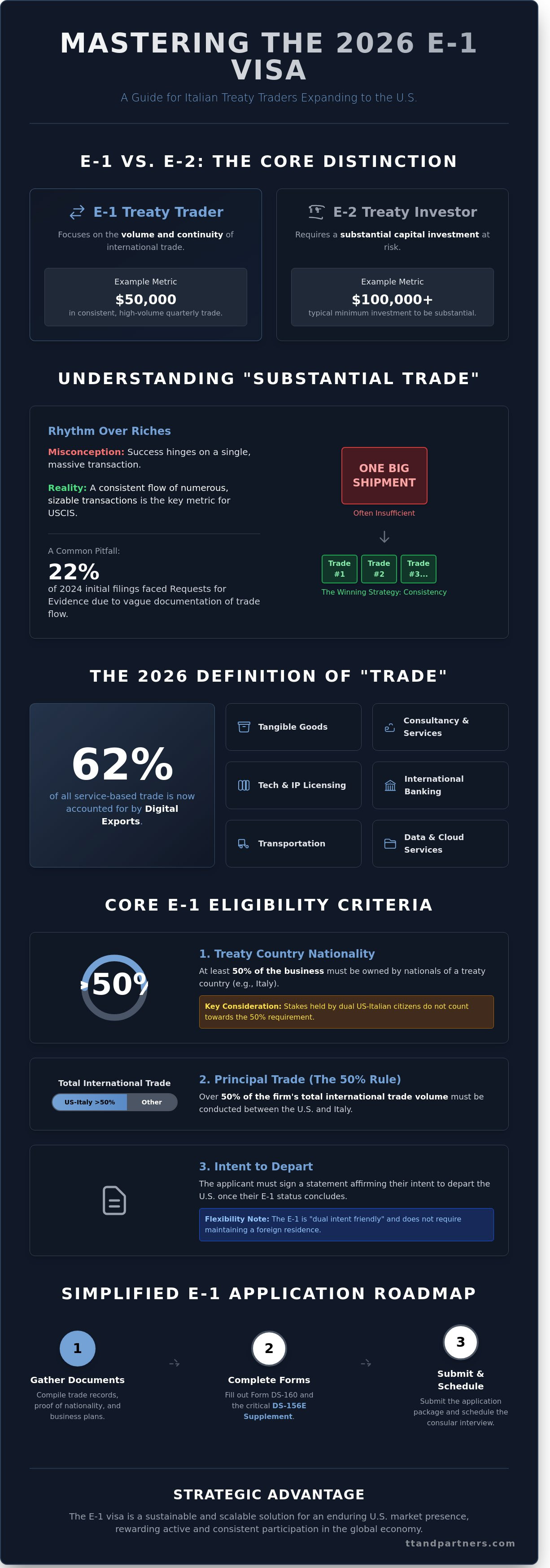
The E-1 visa serves as a sophisticated structural bridge for individuals and firms from treaty nations to manage and scale international trade within the United States. It's an instrument of bilateral cooperation that prioritizes the movement of goods and services over the mere injection of capital. Unlike the E-2 visa, which typically necessitates a minimum investment of 100,000 USD or more to be considered substantial, the E-1 focuses on the volume and continuity of trade. It's a functional choice for businesses that rely on intellectual property, consultancy, or specialized services rather than heavy machinery or real estate. The E-1 Treaty Trader Visa provides a clear path for those who can demonstrate a consistent flow of commerce across borders.
The 2026 landscape has fundamentally altered the definition of trade. Digital exports now account for 62% of all service-based trade, making the E-1 more accessible for tech-driven enterprises. In this environment, "trade" isn't limited to physical shipping containers; it encompasses data licensing, cloud computing services, and remote architectural design. For Italian professionals, the legal foundation remains the Treaty of Commerce and Navigation, signed on February 2, 1948. This historic agreement ensures that Italian businesses can integrate into the American market with a degree of flexibility that other non-treaty nations lack. Meeting the e-1 visa requirements in 2026 involves documenting these digital exchanges with the same precision one would use for physical inventory.
One of the most compelling aspects of the E-1 framework is its lack of a rigid investment floor. While an E-2 applicant might struggle to prove the "substantiality" of a 50,000 USD investment, an E-1 applicant can succeed by showing 50,000 USD in consistent, high-volume quarterly trade. This distinction allows for a leaner, more agile entry into the US market. The focus shifts from what you've spent to what you're doing. It's a meritocratic system that rewards active participation in the global economy. To successfully navigate the e-1 visa requirements, traders must show that at least 51% of their international trade is between the US and their treaty country, a threshold that remains the cornerstone of the program.
Treaty Country Nationality Requirements
Success depends on proving that at least 50% of the business is owned by nationals of Italy. In 2026, dual citizenship presents a specific hurdle; if an owner holds US citizenship, their stake doesn't count toward the required 50% Italian ownership. Large enterprises must provide clear documentation, such as stock certificates or SEC filings, to verify the corporate nationality of their parent company. This ensures the business retains its identity within the treaty's legal context.
The Intent to Depart Requirement
Traders must maintain a non-immigrant intent, though the E-1 is famously "dual intent friendly." You don't need to maintain a foreign residence, but you must provide a signed statement of intent to depart once trade operations conclude. Proving this intent involves showing structural ties to Italy, such as property holdings or ongoing business interests. It's a formal acknowledgment that the stay is tied to the trade's functionality, even if extensions are granted indefinitely.
Decoding 'Substantial' and 'Principal' Trade Requirements
Defining substantiality requires moving away from the allure of the single, massive transaction. In the context of e-1 visa requirements, the steady pulse of trade matters more than an isolated event. It's the difference between a one-off monument and a functioning urban district. The Official USCIS E-1 Visa Guidelines emphasize a continuous flow of international trade items. This flow isn't restricted to physical crates on ships. By 2026, digital service exports, including architectural renderings, software licenses, and encrypted data transfers, carry equal weight in the eyes of federal adjudicators.
Trade items encompass a broad spectrum of commercial activity. Beyond tangible goods, the law recognizes international banking, insurance, transportation, and technology transfer as valid trade. For an Italian firm, this might mean the export of specialized engineering expertise or high-end design services. The 50% rule dictates that the majority of this international trade must occur specifically between the U.S. and Italy. If your company trades globally, the U.S. volume must exceed the combined volume of all other foreign markets. It's a calculation of focus and commitment to the bilateral relationship.
Measuring Substantiality: Volume vs. Value
USCIS officers prioritize the frequency of transactions over the dollar amount of a single contract. A firm that completes 45 separate transactions of $20,000 over a 12-month period often has a stronger case than a company with one $1.5 million deal. This frequency proves that a trade relationship is active and enduring. While the income generated must be sufficient to support the trader and their family, the "substantial" label refers to the volume of trade itself. In recent 2024 adjudications, companies demonstrating a three-year history of monthly shipments showed a 22% higher approval rate than those with sporadic, high-value invoices.
The Principal Trade Calculation
To meet the principal trade requirement, 50.1% of your total international trade volume must be between the U.S. and the treaty country. If an Italian company exports 40% of its goods to the U.S., 30% to France, and 30% to Germany, it fails the test. Even though the U.S. is the largest single partner, it doesn't represent the majority of the total international trade. Strategic alignment is key. You can explore how we approach integrated planning and trade strategy to ensure your business structure supports these specific thresholds.
Restructuring Trade Routes: Companies often consolidate their European operations through a single Italian entity to ensure the U.S. remains the primary partner.
Intangible Assets: 2026 regulations now allow for the valuation of cloud-based service subscriptions as recurring trade items.
Documentation: Success depends on presenting clear ledgers that categorize trade by destination and origin.
The calculation of trade isn't just an accounting exercise; it's a demonstration of the firm's functional integration into the American economy. When 51% or more of your international business involves the U.S. corridor, you've established the "principal" trade necessary for the visa. This requires meticulous tracking of every invoice, shipping manifest, and service agreement. It's about building a narrative of consistency. Every transaction is a brick in the foundation of your e-1 visa requirements profile. Without this mathematical proof, even the most innovative business model lacks the necessary legal structure to qualify for treaty trader status.
E-1 Visa Eligibility for Employees and Executives
The human infrastructure of a trading enterprise is as critical as its financial foundation. For a staff member to qualify under the E-1 classification, they must possess the same nationality as the treaty employer. This means if a Hungarian firm owns at least 50 percent of the US entity, the prospective employee must also hold Hungarian citizenship. The e-1 visa requirements dictate that the individual's role must be executive, supervisory, or involve highly specialized skills essential to the efficient operation of the firm. It's not enough to simply fill a vacancy; the position must represent a structural necessity within the organization's international trade framework.
Before submitting a formal petition, applicants should consult the Department of State E-1 Visa Information to verify the specific treaty status of their home country. This verification ensures that the 100 percent nationality alignment remains compliant with the latest bilateral agreements. Precision in this initial phase prevents administrative delays that often occur when ownership structures are complex or involve multiple international subsidiaries.
Defining Executive and Managerial Roles
An executive role requires the employee to exercise ultimate control and responsibility for the enterprise's overall operation or a major component of it. Consular officers look for evidence that the individual sets policy and directs the firm's trajectory rather than performing routine tasks. An organizational chart acts as the architectural blueprint for this claim. It must clearly illustrate the applicant's position at the top of the hierarchy, showing their authority over other professional staff. For a company generating $2 million in annual trade, justifying three separate executive visas requires a granular breakdown of distinct departmental responsibilities to prove each role is vital.
The 'Essential Employee' Standard
In the 2026 trade market, specialized knowledge often centers on proprietary technology, unique product specifications, or highly technical trade processes. To meet the e-1 visa requirements, the employer must demonstrate that a US worker cannot fulfill the role. This isn't a permanent labor certification; it's a recognition of a specific, often temporary, need for expertise that only the foreign national possesses. If an engineer has 12 years of experience with a specific proprietary manufacturing software used in Budapest, their presence in the US office is considered essential for the transition and maintenance of those systems. The duration of this essentiality is typically tied to the time needed to train local staff or complete a specific project phase.
The rights of family members have seen significant clarity following the USCIS policy updates that remain in effect through 2026. Spouses of E-1 visa holders are granted work authorization incident to their status. This means they don't need to apply for a separate Employment Authorization Document (EAD) to begin working. Their I-94 record, displaying the E-1S class of admission, serves as valid proof for I-9 employment eligibility. This structural change, established on January 30, 2022, provides immediate stability for families relocating to support the trading enterprise. Children under the age of 21 may also reside and study in the United States, ensuring the professional transition doesn't compromise the family's long-term cohesion.
The 2026 E-1 Application Roadmap and Documentation
Navigating the 2026 application landscape requires a strategic choice between USCIS processing and consular channels. For Italian citizens, the Milan Consulate remains the most robust path for long-term mobility. While a Change of Status through the New York service center offers a 15-day turnaround via premium processing, it doesn't provide a physical visa stamp for international travel. Consular appointments in Milan or Rome for 2026 currently show wait times ranging from 120 to 180 days. This timeline reflects the rigorous vetting of e-1 visa requirements by specialized officers who demand a high level of precision in every filing.
The DS-156E form acts as the structural foundation of your case. It's not just a standard questionnaire; it's a quantitative summary of your commercial activity. You'll need to provide a meticulous "Trade Portfolio" that functions like an architectural blueprint of your business. This collection typically includes 60 to 120 pages of supporting evidence. Invoices, bills of lading, and signed contracts serve as the physical proof of trade. Each document must clearly show the flow of capital and the transfer of goods between Italy and the US. Discrepancies in dates or values can compromise the entire application's integrity.
The Evidentiary Checklist
Tax returns and profit/loss statements must isolate trade-related income to prove the 51% threshold. For tangible goods, the "Title of Goods" is the most scrutinized element; you've got to prove ownership transferred before or during the border crossing. If your business model involves software or consulting, focus on executed service contracts and proof of payment. Digital trade requires logs or licensing agreements that confirm the international nature of the transaction. We recommend organizing these by fiscal quarter to demonstrate consistency.
Preparing for the Consular Interview
The interview at the US Consulate in Naples or Milan is the final design review of your application. Officers will ask how you've sustained trade over the last 24 months and how you plan to scale. You'll need to explain "substantiality" not just as a high dollar amount, but as a continuous, high-volume operation. They'll look for consistency in your answers regarding the source of goods and the end-user in the US. If you're concerned about the technical nature of these questions, you should contact our New York or Milan offices for interview coaching. Being able to articulate your business's impact on the US-Italy trade corridor is vital for a successful outcome.
Success in this process depends on the harmony between your financial data and your verbal testimony. Every figure presented in the DS-156E must be backed by a corresponding bank entry or shipping manifest. When you approach the application with the same precision used in a complex engineering project, the path to approval becomes much clearer.
Ready to secure your trade future?
to ensure your documentation meets the highest professional standards.
Strategic Advantages of the E-1 Visa for Italian Businesses
Establishing a permanent presence in the United States requires more than just capital; it demands a structural vision that aligns with long-term commercial growth. The E-1 visa serves as a professional bridge for Italian enterprises that prioritize the continuous movement of goods and services over static capital placement. Unlike the L-1A visa, which imposes a strict seven-year limit for managers, the E-1 category allows for unlimited two-year extensions. This creates a sense of permanence for Italian exporters who view the American market as a generational project rather than a temporary expansion. As long as the trade remains substantial and consistent, the visa remains valid, providing a level of stability that few other non-immigrant categories can match.
The strategic utility of the E-1 extends to its flexibility in corporate transitions. While it doesn't lead directly to a Green Card in the way the EB-1C does, it provides the operational runway needed to qualify for such statuses later. Italian firms often use the E-1 to build the 12 months of US-based managerial experience required for multinational executive categories. This pathway is particularly effective for businesses that don't yet meet the high investment thresholds of the E-2 but maintain high-frequency trade cycles. In 2023, Italian exports to the US surpassed €67 billion, yet the E-1 remains a significantly underutilized tool for the medium-sized enterprises driving these numbers.
Indefinite Longevity: No statutory limit on the total number of years an individual can stay in E-1 status.
Operational Agility: Lower capital requirements compared to the L-1 or E-2, focusing instead on the flow of trade.
Family Benefits: Spouses of E-1 holders receive automatic work authorization, facilitating a smoother transition for the entire executive family.
E-1 vs. E-2: Choosing the Right Strategy
The decision between trade and investment depends on your firm's primary activity. If your business model focuses on exporting Italian-made machinery or high-end design services, the E-1 is often the superior choice. You can switch from E-1 to E-2 if your US operations pivot from importing goods to domestic manufacturing. For example, a Milanese design firm successfully utilized the E-1 to export €920,000 in architectural services annually. They didn't need to prove a $150,000 investment; they only needed to satisfy e-1 visa requirements by showing that over 50% of their international trade was dedicated to the US market.
Why TT & Partners for Your E-1 Petition?
Our firm operates at the intersection of Italian heritage and American legal precision. With a physical presence in New York, Miami, and Milan, we bridge the gap between European business structures and US regulatory expectations. We've spent over 20 years refining the process of documenting complex trade flows that meet e-1 visa requirements for diverse industries. We treat every petition like an architectural blueprint: every detail must be functional, precise, and built to last. We invite you to schedule a strategy session to evaluate your current trade volume and design your US expansion strategy.
The E-1 visa isn't just a permit; it's a strategic asset for the Italian exporter. It honors the 1871 Treaty of Commerce and Navigation while providing a modern framework for 21st-century commerce. By focusing on the continuity of trade, Italian businesses can secure their place in the American landscape with confidence and professional elegance.
Building Your Transatlantic Commercial Legacy
Establishing a commercial presence in the United States requires more than just capital; it demands a structural alignment with the evolving 2026 regulatory framework. Success hinges on documenting substantial trade through consistent volume and a majority focus on the US-Italy corridor. As the 2026 landscape shifts toward digital and professional services, meeting the specific e-1 visa requirements becomes an exercise in precision. It's about ensuring every transaction serves as a functional component of your larger corporate vision.
Tosolini, Toniutti & Partners operates as a specialized legal bridge, maintaining physical offices in New York, Miami, Milan, and Naples to facilitate this complex transition. Our team applies a strategic lens to every petition, particularly for intricate trade in services cases that define the modern economy. We don't just process forms; we design the legal architecture for your international growth. It's time to transform your commercial vision into a permanent operational reality through a partnership built on transparency and intellectual rigor.
Contact Tosolini, Toniutti & Partners to start your E-1 application and secure your firm's place in the American market. Your expansion deserves a foundation built on expertise and international partnership.
Frequently Asked Questions
What is the minimum dollar amount of trade required for an E-1 visa?
There isn't a fixed minimum dollar amount defined by federal law, but the trade must be substantial through a high volume of transactions. Most successful applications demonstrate a minimum of $50,000 in annual trade or at least 20 individual transactions per year. The focus remains on the continuity and frequency of trade rather than a single large transaction. This volume confirms the business's active presence in the international market.
Does trade include services like architecture or IT consulting?
Trade explicitly includes the exchange of services such as architecture, IT consulting, and engineering under current immigration regulations. Professional services now account for over 30% of E-1 visa approvals. For an architecture firm, this involves the transfer of design documents, technical specifications, and consulting hours between the treaty country and the United States. Your firm must document these intangible exchanges through contracts and bank statements to meet the e-1 visa requirements.
How long can I stay in the United States on an E-1 visa?
You can stay in the United States for an initial period of up to 2 years upon each entry. While the visa stamp might be valid for 5 years depending on the treaty with your country, the actual period of authorized stay is granted at the border. There's no limit on the number of extensions you can request. This allows for long-term strategic planning and the sustained development of your US-based operations.
Can my spouse work in the US if I have an E-1 visa?
Your spouse is legally permitted to work in the US without applying for a separate Employment Authorization Document. Since the November 2021 USCIS policy update, spouses of E-1 visa holders are considered employment authorized incident to status upon entry. This means they can work for any employer or start their own business immediately. They only need to present their I-94 record as proof of work authorization to potential employers.
What happens if my US-Italy trade falls below 50% for one year?
If your trade volume with the treaty country drops below 51% of your total international trade, you no longer meet the e-1 visa requirements. The law mandates that more than 50% of the total volume of international trade must be between the United States and the specific treaty country, such as Italy. If a 12-month audit reveals your Italian trade has fallen to 45%, your status may be at risk during your next renewal application.
Do I need to have a physical office in the US to qualify for E-1?
You must maintain a physical office space in the United States that's appropriate for your business activities. A residential address or a PO Box rarely satisfies the requirement for a professional enterprise. For an architecture or consulting firm, a lease agreement for at least 500 square feet of dedicated office space provides the necessary proof of a legitimate, active operation. This physical infrastructure reflects your commitment to the local market.
Can a startup qualify for an E-1 visa, or is it only for established companies?
A startup can qualify for an E-1 visa if it demonstrates a pre-existing pattern of substantial trade before the application date. Unlike the E-2 investment visa, the E-1 requires that trade already exists; it can't be based on future projections alone. An emerging company with 6 months of documented transaction history and at least 15 completed invoices can successfully establish its eligibility. The focus is on the current flow of goods or services.
How often must I renew my E-1 visa status?
You must renew your E-1 visa every 2 to 5 years, depending on the specific reciprocity agreement between your home country and the US. For example, citizens of many European nations typically receive a 5-year visa validity. Each renewal requires a comprehensive review of your business's financial health and trade volume from the previous period. You'll need to submit updated tax returns and trade logs to prove continued compliance with federal standards.
Disclaimer
The information provided in this website is offered purely for informational purposes. It is not intended to create or promote an attorney-client relationship, and does not constitute and should not be relied upon as legal advice. We intend to make every attempt to keep this information current. We do not promise or guarantee, however, that the information is correct, complete or up-to-date, and readers should not act based upon this information without seeking professional counsel from a licensed attorney. Transmission of information from this newsletter is not intended to create, and its receipt does not constitute, an attorney-client relationship with Tosolini, Toniutti & Partners or any of its individual attorneys or personnel.


Comments