

O-1 Visa Agent vs. Petitioner for Italians: A 2026 Strategic Guide
- Gianni Mendes Toniutti, Esq.

- May 23
- 13 min read
Most Italian creatives assume a prestigious U.S. job offer is the gold standard for relocation, but for those seeking true professional autonomy, a single employer might actually be a cage. You've likely spent years building a diverse portfolio in Milan or Rome, and the idea of being tethered to one desk in New York feels restrictive. It's a natural concern for visionaries who value independence as much as their craft.
Deciding between an O-1 visa agent vs petitioner for Italians is the most consequential choice you'll make before filing your I-129. This guide clarifies how to maximize your flexibility in the 2026 regulatory environment, where approval rates reached 93.9% but scrutiny on employment structure remains high. You'll learn how to leverage the April 2026 self-sponsorship policies and the role of an agent in managing multiple U.S. projects. This strategic overview provides the clarity you need to build a compliant, sustainable bridge between your Italian operations and your future American studio.
Key Takeaways
Understand why a U.S. sponsor is mandatory and how to align your international portfolio with U.S. immigration standards.
Evaluate the trade-offs between an O-1 visa agent vs petitioner for Italians to determine if you need the stability of a single employer or the freedom of multiple project sponsors.
Learn how a "blanket petition" from an agent can provide the legal framework for a freelance career while managing the increased risk of a Request for Evidence.
Explore the 2026 self-sponsorship pathway by incorporating a U.S. LLC to act as your official petitioner while maintaining a legitimate employer-employee relationship.
Discover how a specialized cross-border legal strategy can harmonize your Italian professional identity with complex American visa regulations.
Table of Contents
Understanding the O-1 Visa Sponsorship Requirement for Italian Talents
The O-1 Visa represents a pinnacle of professional recognition, yet it remains fundamentally dependent on a legal anchor within the United States. Unlike certain immigrant categories that allow for self-sponsorship, the O-1 classification strictly requires a U.S. based entity to file the petition. This requirement creates an immediate strategic fork in the road for many: the choice of an O-1 visa agent vs petitioner for Italians. This decision dictates not only the administrative path of the application but also the long-term professional mobility of the individual. The petitioner acts as the formal bridge between the Italian professional's extraordinary achievements and the specific demands of the American market.
The legal bond between the petitioner and the beneficiary is profound. The petitioner assumes full responsibility for the accuracy of the filing before USCIS, certifying that the Italian national possesses the rare skills claimed. For O-1A applicants in sciences, education, or business, the sponsorship often centers on a stable corporate structure with a clearly defined hierarchy. In contrast, O-1B applicants in the arts, motion pictures, or television frequently face a more fluid landscape. These creative professionals often juggle multiple prestigious commissions, necessitating a sponsor who understands the non-linear nature of an international artistic career. Regardless of the field, the petitioner must prove they have the capacity to oversee the work being performed.
The Role of the Petitioner in 2026
In the current regulatory climate, the petitioner's role has become increasingly complex. Filing Form I-129 requires meticulous evidentiary support that aligns with evolving USCIS standards. For 2026, the standard filing fee for most employers is $1,055, though small employers and nonprofits may qualify for a reduced fee of $530. Beyond the financial aspect, the petitioner must demonstrate a legitimate right to control the beneficiary's work. This is a concept that USCIS scrutinizes with heightened intensity, especially considering that nearly one in five O-category petitions received a Request for Evidence in 2025. For those requiring a rapid decision, the petitioner must also manage the Request for Premium Processing Service, which now carries a fee of $2,965 for a guaranteed 15-business-day response.
Why Italians Often Require Flexible Sponsorship
Italian talent frequently operates within a culture of high-level craftsmanship and independent consulting. Whether it's a designer in Milan or a tech entrepreneur in Rome, these professionals rarely fit the mold of a traditional 9-to-5 employee. This makes the strategic selection of an O-1 visa agent vs petitioner for Italians a critical step. A flexible sponsorship model allows for cross-border continuity, ensuring that ongoing projects in Italy can coexist with new U.S. engagements. This flexibility is often a prerequisite for those who eventually seek a Green Card. It allows for the gradual establishment of a permanent U.S. presence without sacrificing existing international business ties or the ability to work on a project-by-project basis.
The Technical Difference: US Agent vs. Direct Employer Petitioner
The structural integrity of your U.S. relocation depends on how you define your legal sponsor. When evaluating an O-1 visa agent vs petitioner for Italians, the primary variable is the scope of authorized work and the level of administrative control required. A direct employer petitioner is a single U.S. entity that hires you for a specific, ongoing role. This relationship is traditional and straightforward. In contrast, an agent serves as a more flexible vessel. Under the O-1 visa sponsorship requirement, an agent can represent multiple U.S. employers or even a foreign employer, acting as the central petitioner for a diverse itinerary of projects.
For 2026, USCIS has increased its focus on the evidentiary requirements of 8 CFR 214.2(o)(2)(iv)(E). This regulation demands that agent-based petitions include a comprehensive itinerary. This document must detail every engagement, including the specific dates of each project, the names of the end-user clients, and the locations where the work will occur. Given that nearly 20% of O-category petitions faced a Request for Evidence in 2025, the precision of this itinerary is often the difference between a seamless approval and a protracted legal challenge. It's not enough to simply list potential clients; you must provide signed contracts or detailed summaries of oral agreements for the entire duration of the requested visa stay.
Three Types of USCIS-Recognized Agents
The "Agent" role is not a monolith. First, an agent can be your actual employer, meaning they control your work, pay your salary, and handle tax withholdings. Second, an agent can represent multiple employers, acting as a coordinator for a freelancer who works with different U.S. galleries, tech firms, or production houses. Finally, an agent can represent a foreign employer. This is a powerful tool for Italian companies that wish to send their top talent to the U.S. to work on specific projects without establishing a massive American corporate infrastructure immediately.
The Direct Employer Advantage
While agents offer flexibility, a direct employer petitioner provides a path of least resistance. This model typically carries a simpler evidentiary burden because the employer-employee relationship is clear and singular. It's often the preferred route for researchers, executives, or engineers where the work is tied to a specific facility or laboratory. If your goal involves a long-term placement within a prestigious American institution, a direct petitioner offers a stable foundation that USCIS adjudicators view with high confidence. If you're unsure which path aligns with your specific career trajectory, you may wish to discuss your strategy with a professional advisor to ensure full compliance with the latest 2026 standards.
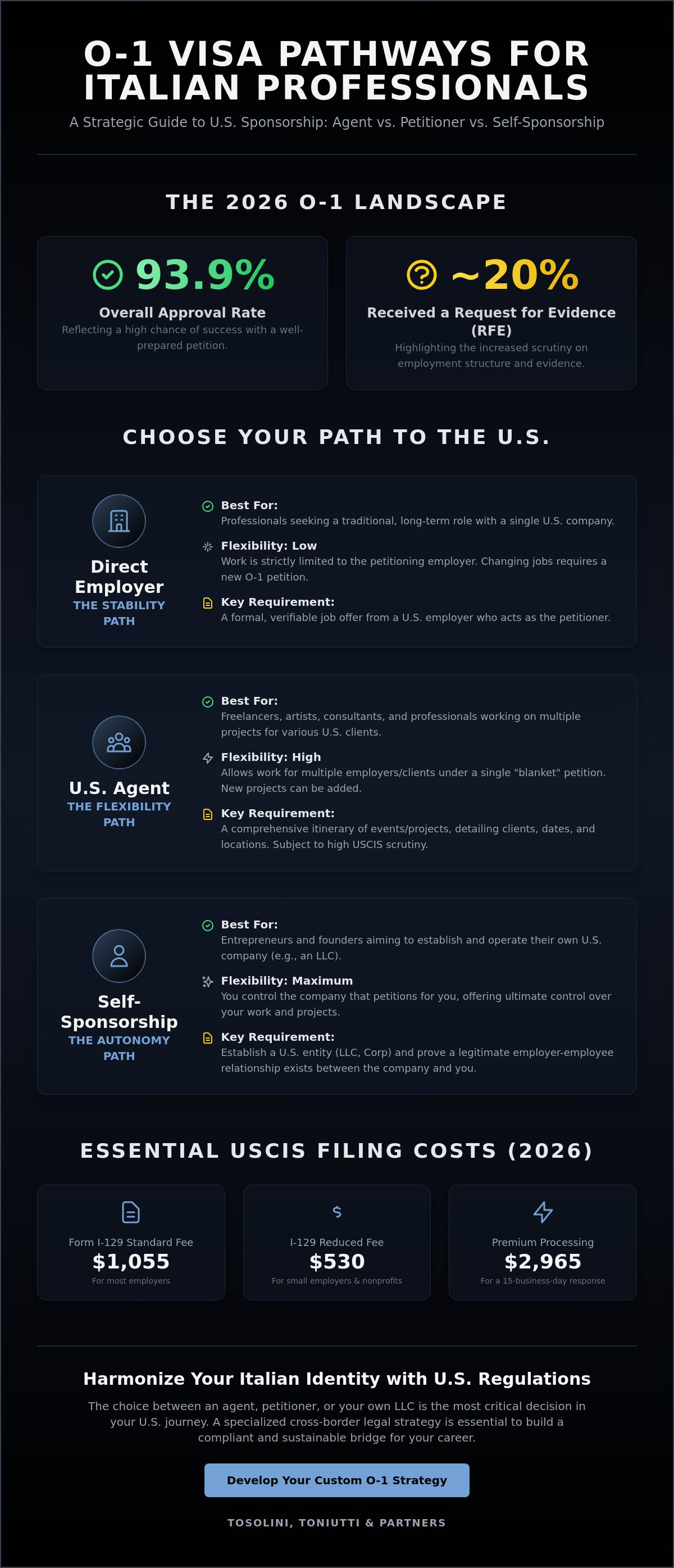
Strategic Choice: Flexibility of an Agent vs. Stability of a Petitioner
The decision to pursue a specific sponsorship model is an exercise in professional equilibrium. For the Italian visionary, the choice between an O-1 visa agent vs petitioner for Italians isn't merely a matter of paperwork; it's a strategic alignment of one's career trajectory with U.S. immigration reality. An agent-based petition offers what many call a "blanket" authorization. This structure allows a professional to engage with multiple U.S. clients under a single visa, providing the freedom to pivot between projects in fashion, design, or technology. It mirrors the independent spirit of the Italian consultant who refuses to be confined by a single corporate identity. This autonomy is a powerful asset for those maintaining active studios in both Milan and Los Angeles.
Yet, this flexibility introduces a distinct layer of complexity. Agent-based filings often face higher hurdles during the adjudication process. In Fiscal Year 2025, nearly one in five O-category petitions received a Request for Evidence (RFE). Many of these challenges focused on the validity of the itinerary and the agent's actual authority. The Technical Difference: US Agent vs. Direct Employer Petitioner lies in the burden of proof; an agent must provide exhaustive documentation for every future engagement. If the 2026 itinerary appears speculative or lacks signed contracts, USCIS may truncate the visa duration or deny the petition entirely. Stability, therefore, becomes the primary counter-argument for a direct petitioner.
A direct U.S. employer provides a more predictable path. For those in scientific research or executive roles, a single petitioner simplifies the evidentiary requirements and typically results in a full three-year approval. This stability is crucial for Italians who travel frequently between continents. A clear, singular employment relationship often leads to smoother consular interviews and less scrutiny at U.S. ports of entry. It creates a secure legal foundation, allowing the professional to focus on innovation rather than administrative maintenance.
When to Choose an O-1 Agent
This path is the gold standard for artists, performers, and boutique designers. If your U.S. presence consists of a series of exhibitions, masterclasses, or short-term consulting gigs, an agent is essential. It allows you to bridge the gaps between projects without needing a new visa for every client. Success requires a highly organized agent who can navigate the 2026 USCIS focus on substantive evidence and contractual consistency. You'll need to demonstrate that your work represents a continuous "event" or series of events across the United States.
When a Direct US Petitioner is Superior
Tech founders and researchers usually find the direct petitioner model more effective. It offers a singular base of operations and significantly lower administrative overhead. This structure is particularly advantageous when drafting employment agreements that require protection through International Litigation expertise. By tethering the visa to a stable entity, you reduce the risk of status interruptions. It's the most efficient way to establish a long-term American legacy while keeping your Italian heritage and business interests intact.
Self-Sponsorship for Italian Entrepreneurs: The US LLC Path
For many Italian founders, the dream of U.S. expansion is often clouded by a fundamental misunderstanding of sponsorship. You can't sign your own petition as an individual. However, the regulatory update of April 8, 2026, has solidified a sophisticated alternative: the beneficiary-owned company model. This pathway allows your U.S. entity to act as the formal petitioner, effectively bridging the gap between your personal extraordinary ability and your corporate vision. The key isn't just ownership, but the architecture of control. To satisfy USCIS, you must demonstrate a legitimate employer-employee relationship where a Board of Directors or an independent manager maintains the authority to oversee, and even terminate, your employment.
When weighing the choice of an O-1 visa agent vs petitioner for Italians, entrepreneurs often find that a well-structured LLC provides the most robust legal standing. By establishing this corporate layer, you move beyond the freelance perception of an agent-based filing. You present yourself as a cornerstone of a U.S. enterprise. This structure is particularly effective for those transitioning from an Italian startup to a global operation. It provides a clear narrative of investment and commitment to the American market, which is often favored during the adjudication of high-level visas.
Incorporating for Sponsorship
Strategic LLC Incorporation is the first step toward this autonomy. The entity must be more than a shell on paper. It requires documented capitalization and a clear operational plan. A meticulously drafted employment agreement is essential to define your role, salary, and the oversight mechanisms that prevent the petition from being flagged as prohibited self-sponsorship. This document serves as the primary evidence of the company’s intent to employ you under professional U.S. standards.
The "Agent" Role for Italian Companies
If your primary operation remains in Italy, you might utilize a U.S. agent to represent your Italian parent company. This "Foreign Employer" model allows the Italian firm to maintain control while the U.S. agent handles the administrative filings. It requires proof that the Italian entity has authorized the agent to act on its behalf. This hybrid approach often secures the maximum three-year duration, providing a stable window for market entry while keeping your European roots intact.
Establishing the correct corporate framework is a precision task that requires foresight. To ensure your company structure meets the 2026 evidentiary standards, reach out to our firm for a strategic consultation tailored to Italian business owners.
Navigating US-Italy Cross-Border Immigration with Tosolini, Toniutti & Partners
Successfully bridging the Atlantic requires more than a simple visa filing; it demands a deep understanding of the legal and cultural nuances that define the US-Italy relationship. At Tosolini, Toniutti & Partners, we specialize in crafting the sophisticated legal architecture necessary for Italian professionals to thrive in the American market. The choice between an O-1 visa agent vs petitioner for Italians is a pivotal strategic decision that influences your tax residency, corporate liability, and long-term residency goals. Our firm provides the intellectual rigor needed to align your extraordinary achievements with the specific evidentiary standards of USCIS while maintaining your professional integrity in Italy.
Our approach extends beyond the immediate O-1 Visa approval. We recognize that an Italian talent’s relocation often involves complex moving parts, including LLC incorporation for self-sponsorship, U.S. real estate closing for a new studio, and the protection of intellectual property through strategic international litigation. By integrating these services, we ensure that your transition is not a series of disconnected administrative hurdles but a unified professional expansion. This holistic perspective is what distinguishes a boutique practice focused on the individual’s vision from a high-volume immigration mill.
Why Professional Representation Matters in 2026
The 2026 landscape is defined by a dichotomy: a high 93.9% approval rate for O-category petitions tempered by a 19.7% Request for Evidence rate in 2025. USCIS now places unprecedented scrutiny on the legitimacy of agent-based itineraries and the substantive nature of contractual agreements. We ensure that every contract complies with both U.S. immigration requirements and Italian business law, preventing jurisdictional conflicts that could jeopardize your status. Our team meticulously curates your "Extraordinary Ability" portfolio, translating Italian accolades into the specific language of U.S. industry standards to minimize the risk of a protracted RFE process.
Start Your US Journey
The first step toward a successful U.S. placement is a rigorous preliminary evaluation of your eligibility and the most advantageous sponsorship structure. Coordinating with corporate and tax counsel is essential to avoid unforeseen liabilities during your transition. Whether you're an entrepreneur establishing a U.S. presence or an artist navigating a complex itinerary of projects, our team is prepared to guide you through the intricacies of the 2026 regulations. Contact our offices in the U.S. or Italy to begin the strategic planning of your extraordinary ability petition.
Architecting Your American Legacy
Securing a U.S. presence requires a harmonious blend of professional vision and legal precision. As we have explored, the decision between an O-1 visa agent vs petitioner for Italians is the foundation upon which your American career is built. Whether you choose the multifaceted flexibility of an agent or the singular stability of a direct employer, your choice must align with the 2026 regulatory landscape. Entrepreneurs now have a powerful, formalized pathway through U.S. LLC incorporation, while artists can leverage agent-based itineraries to bridge their European and American projects. Success lies in the meticulous details of your contracts and the strength of your extraordinary ability portfolio.
Tosolini, Toniutti & Partners brings decades of experience in U.S. and Italian cross-border law to every case. Our bilingual legal team, based in the United States, maintains a specialized focus on the unique needs of Italian entrepreneurs and visionaries. We invite you to consult with our US-Italy immigration experts today to ensure your strategy is as robust as your talent. Your future in the United States is a structure waiting to be designed; we are here to provide the engineering excellence required to make it a reality.
Frequently Asked Questions
Can an Italian individual act as their own O-1 visa agent?
No, an individual cannot serve as their own agent or petitioner for an O-1 visa. U.S. immigration regulations require a separate U.S. based entity or person to file the petition on your behalf. While you cannot self-petition, you can establish a U.S. LLC that acts as your petitioner, provided the corporate structure maintains a legitimate employer-employee relationship with independent oversight.
What happens if I change employers while on an O-1 visa sponsored by an agent?
If your O-1 visa is sponsored by an agent representing multiple employers, you can add new engagements without a new petition if the work falls within the original itinerary's scope. However, if you move to a new employer not previously disclosed, your agent must file an amended petition with USCIS. This flexibility is a primary factor when comparing an O-1 visa agent vs petitioner for Italians who prioritize freelance mobility.
Does an O-1 agent need to be in the same professional field as the Italian applicant?
There is no legal requirement for an agent to share your specific professional field or expertise. The agent must simply be "in business as an agent" and possess the legal authority to represent you and your various U.S. employers. Their primary role is administrative and contractual, acting as the central point of contact for USCIS and ensuring the integrity of your professional itinerary.
Is it harder for Italians to get an O-1 visa using an agent vs. a petitioner?
Using an agent isn't inherently more difficult, but it does invite higher levels of scrutiny regarding the "right to control" your work. Agent-based petitions were more likely to fall within the 19.7% of cases that received a Request for Evidence in 2025. Success depends on the quality of your contracts and the precision of your itinerary rather than the type of sponsor you choose.
Can a US LLC owned by an Italian citizen sponsor an O-1 visa for that same citizen?
Yes, a policy update effective April 8, 2026, formally allows a company owned by the beneficiary to act as the petitioner. The entity must be a separate legal person, such as an LLC or Corporation, and you must demonstrate that the company has the right to supervise your work. This is typically achieved through a Board of Directors or an appointed manager with the authority to fire the beneficiary.
What are the specific contract requirements for an O-1 agent petition in 2026?
In 2026, USCIS requires either a written contract or a detailed summary of the terms of an oral agreement between the agent and the beneficiary. The documentation must clearly state the compensation offered and the specific terms of employment. For agent petitions representing multiple employers, you must also include the contracts between the agent and each end-user client where the work will be performed.
How long does the O-1 visa sponsorship process take for Italian nationals?
Standard processing for an O-1 petition currently takes approximately 11 to 12 months as of May 2026. If your timeline is more urgent, you can opt for premium processing by paying a $2,965 fee to receive a response within 15 business days. Once the petition is approved, you'll need to pay the $205 DS-160 fee and attend a consular interview in Italy.
Can I work for Italian clients while in the US on an O-1 visa sponsored by an agent?
You can work for Italian clients only if they are included in your U.S. agent's petition as part of your authorized itinerary. The U.S. agent can act as the representative for a foreign employer, allowing you to perform services for your Italian clients while physically present in the United States. It's vital that these specific engagements are documented in the initial filing to ensure full visa compliance.


Comments