

Expired green card: What renewal, travel and returning mean

An expired Green Card does not automatically end your lawful permanent resident status, but the consequences of an expired green card can become more complicated when you need to prove your status or return to the United States. Expiration itself is not a crime; however, knowingly carrying an expired card without taking reasonable steps to renew it can lead to a misdemeanor charge.
It is understandable to worry that an expired card could affect your ability to live or work in the United States, or return after a trip abroad. In most cases, the key distinction is between your underlying permanent resident status and the document used to prove it.
This article explains when an expired card can create legal or practical problems, how Form I-90 renewal works, and what to consider before traveling or returning to the United States. It also covers how a pending application or other temporary proof of status may affect your plans.
Table of Contents
Is It a Crime to Have an Expired Green Card?
An expired card does not, by itself, end lawful permanent resident status. Status is a legal position; the Green Card is evidence of that position.
Card Expiration and Resident Status
A Green Card’s expiration date limits the card as a document; it does not automatically terminate permanent resident status. Most standard cards are valid for 10 years, and a permanent resident whose card expires can still live and work in the United States. The practical issue is proving status when an employer, agency, or other institution requests current evidence. A conditional resident’s card has separate requirements, so its expiration calls for different attention.
Expired Cards and Deportability
Card expiration alone does not make a lawful permanent resident deportable or end their status. Deportability is a separate issue: abandoning permanent resident status, committing a deportable offense, or being ordered removed may affect whether someone can remain. Replacing an expired document addresses proof of status, not a separate issue that could threaten residency.
The Immigration and Nationality Act requires permanent residents age 18 or older to carry valid proof of registration status. A person convicted of failing to carry the required document may face a fine of up to $100. A knowingly expired card can raise a separate concern: a permanent resident who carries one without taking reasonable steps to renew it can be charged with a misdemeanor. A successful conviction may damage residency, so filing for green card renewal is important when a card expires.
Can you apply for U.S. citizenship with an expired Green Card? Expiration alone does not prevent an otherwise eligible permanent resident from filing Form N-400 for naturalization. A Form N-400 receipt notice shown with the expired card extends it for 24 months from its expiration date. That extension can provide evidence while the citizenship case is pending, but it does not change eligibility requirements.
Renewing a green card with Form I-90
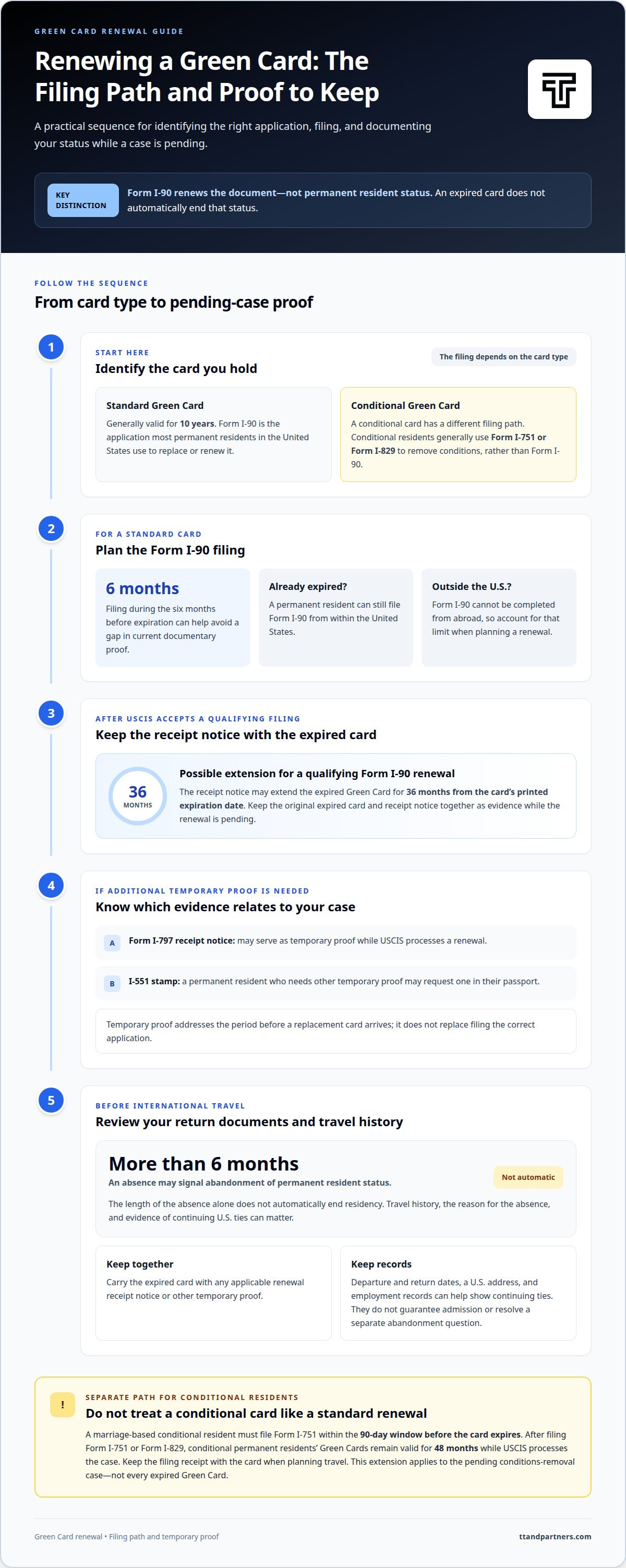
For most permanent residents in the United States, Form I-90 is the application to replace a Permanent Resident Card. Standard Green Cards are generally valid for 10 years, and filing during the six months before expiration can help avoid a gap in current documentary proof. If the card has already expired, a permanent resident can still file Form I-90 from within the United States. The form renews the document, not the underlying permanent resident status.
After USCIS accepts a qualifying Form I-90 renewal, the receipt notice may extend the expired Green Card for 36 months from the card’s printed expiration date, according to U.S. Citizenship and Immigration Services. Keep the original expired card and receipt notice together. The notice provides evidence of the extension while the renewal is pending, which can be useful when showing status or arranging travel.
A Form I-797 receipt notice can serve as temporary proof while USCIS processes a renewal. If a permanent resident needs other temporary proof, they may request an I-551 stamp in their passport. These documents address the period before a replacement card arrives; they do not replace the need to file the correct application. Form I-90 cannot be completed from abroad, so a resident outside the United States should account for that limitation when planning a renewal.
Before filing, distinguish a standard 10-year card from a conditional Green Card. Conditional residents generally use Form I-751 or Form I-829 to remove conditions, rather than Form I-90. A pending citizenship application is also a separate process from card renewal, even though an eligible resident may pursue both. Correctly identifying the card type and application matters because a receipt only supports the case connected to that filing.
For help assessing a Green Card matter and its filing path, explore immigration legal guidance.
Travel abroad and possible abandonment of residency
International travel can raise questions about whether a lawful permanent resident intends to keep living in the United States. An absence longer than 6 months may signal abandonment of permanent resident status, but that period alone does not automatically end residency. Travel history, the reason for the absence, and evidence of continuing U.S. ties can matter. Keep records of departure and return dates, and retain documents that show ongoing connections, such as a U.S. address or employment records.
An expired Green Card may complicate travel because airlines and officials need evidence of permission to return. Before leaving, consider whether the card will remain valid for your return and whether a renewal receipt notice or other temporary proof applies. A passport records international travel, while U.S. address and employment documents can help show continuing ties. These records provide context for an absence; they do not guarantee admission or resolve a separate question about abandonment.
Conditional residence follows a distinct filing process. A marriage-based conditional resident must file Form I-751 within the 90-day window before the Green Card expires, according to U.S. Citizenship and Immigration Services. Conditional residents with a two-year Green Card generally use Form I-751 or Form I-829 to remove conditions, rather than Form I-90. The correct form depends on the basis for conditional residence, so filing the wrong application can leave the conditions unresolved.
After filing Form I-751 or Form I-829, conditional permanent residents’ Green Cards remain valid for 48 months while USCIS processes the case. Keep the filing receipt with the card when planning travel, and carry the documents together. This extension relates to the pending conditions-removal case, not to every expired Green Card. A resident preparing for a lengthy international trip should consider the absence period, pending filings, and available proof as one connected travel plan.
Returning to the United States with an expired green card
An expired Green Card can complicate a permanent resident’s return after international travel. The document may be needed to establish status during the journey, and a carrier may question whether it supports travel. Expiration alone does not automatically end permanent resident status, but it can create practical difficulties when returning. Before departure, identify what valid temporary evidence you will carry for the return trip.
Can you travel internationally with an expired Green Card and a renewal receipt notice? You may be able to travel with both if a qualifying Form I-90 receipt notice extends the card. According to U.S. Citizenship and Immigration Services, that extension may cover 36 months from the card’s printed expiration date. Carry the expired card and the receipt notice together, and confirm the extension remains valid for your return.
A receipt notice is not a replacement card, and its usefulness depends on the application and extension it documents. Keep the original notice accessible with your passport and expired Green Card. For example, a resident returning after the extension period cannot rely on that notice as current proof under the stated extension. A pending renewal does not remove the need to plan for the evidence required during travel.
If your Green Card expires while you are abroad, Form I-90 cannot be completed from outside the United States. A permanent resident abroad may request a transportation letter through an appointment at the nearest U.S. consulate. The request includes two passport photos. Follow the letter’s due date, and travel to the United States before it expires, not 30 days after it was issued.
Immigration law distinguishes an expired document from permanent resident status, but return logistics still matter. If a trip overlaps with a card’s expiration or a pending renewal, consider which documents will be available throughout the journey. For guidance on return-related immigration questions, discuss your travel circumstances.
Tosolini, Toniutti & Partners: GREEN CARD
Tosolini, Toniutti & Partners assists individuals with Green Card matters, including expired cards, renewals, and questions about permanent resident status. When travel plans, a pending application, or conditional residence make the next step less straightforward, legal guidance can help clarify which issue requires attention and how the relevant documents fit together.
The key distinction is between the card as proof and the underlying immigration status. Reviewing that distinction alongside your circumstances can help you make informed decisions about renewal or travel. For assistance with a Green Card matter, contact Tosolini, Toniutti & Partners.
Plan Your Next Immigration Decision with Clarity
The consequences of an expired green card can reach beyond the document itself when your next decision involves travel, work, or another immigration matter. Treat each decision as part of a broader plan: identify what needs attention first, consider how timing affects your options, and keep your future U.S. plans in view. Understanding your circumstances can help you approach the next step more deliberately.
Tosolini, Toniutti & Partners handles Green Card matters and also offers E-1, E-2, and O-1 visas. If your situation involves more than one immigration pathway, consider how those matters relate before moving forward. For guidance tailored to your circumstances, contact Tosolini, Toniutti & Partners. A thoughtful next step can bring greater clarity to the decisions ahead.
Frequently Asked Questions
What happens if you do not renew your Green Card?
The consequences of an expired green card can include difficulty proving work eligibility or qualifying for certain benefits and services. Expiration alone does not automatically cancel permanent resident status. For an existing employee, an employer generally should not reverify solely because a Green Card previously presented for Form I-9 later expires. A current document may still matter in other situations requiring proof.
How long does it take after filing Form I-90?
Form I-90 processing generally takes several months, and the filing date alone does not show when your replacement card will arrive. You can check your case status online 72 hours after filing. Keep the receipt notice with your records while the case is pending. It documents the application and may provide temporary evidence under the extension terms that apply to your filing.
Does an Expired Card Lead to Deportation?
No. The expiration date alone does not make a permanent resident deportable. Deportation concerns arise from separate grounds, such as a deportable offense or abandonment of permanent resident status. INA Section 237(a)(2) addresses certain crimes that can result in deportation. A criminal charge or removal proceeding therefore raises a different issue from replacing an expired card and requires attention to the underlying circumstances.
Is There an Extension for Expired Green Cards?
There is no general grace period that automatically extends every expired Green Card. After USCIS accepts a qualifying Form I-90 renewal, its receipt notice may extend the card for 36 months from the printed expiration date. A Form N-400 receipt notice has a separate extension of 24 months from expiration. The application type and notice determine which extension applies.
What Can I Do?
To address the consequences of an expired green card, first identify whether the card is standard or conditional, because the filing route differs. Standard card replacement uses Form I-90; conditional residents generally file Form I-751 or Form I-829 to remove conditions. If you are abroad, Form I-90 cannot be completed there, so plan how to document your return. Also report a U.S. address change within 10 days.
What's the Relationship Between My Green Card and My Status?
Your Green Card is evidence of permanent resident status, not the status itself. Most standard cards have an expiration date, but some older Form I-551 cards do not have a 10-year expiration date. Cards issued before 1989 typically do not expire. Form I-151 is no longer valid evidence of permanent resident status, so the document’s form and age matter too.



Comments