

Guide to US LLC Formation for Italian Businesses

Choosing a state based only on its filing fee can leave important tax and compliance costs out of the decision.
It’s reasonable to want a clear budget before expanding into the United States. This guide explains how to compare an LLC with a C corporation, what registered-agent arrangements involve, and how to estimate formation fees alongside recurring state taxes and filings. You’ll also learn how the choice of state can affect costs and which cross-border legal considerations to address before establishing a U.S. presence. The goal is a practical framework for planning your structure, not a one-size-fits-all recommendation.
Table of Contents
Registered agent requirements
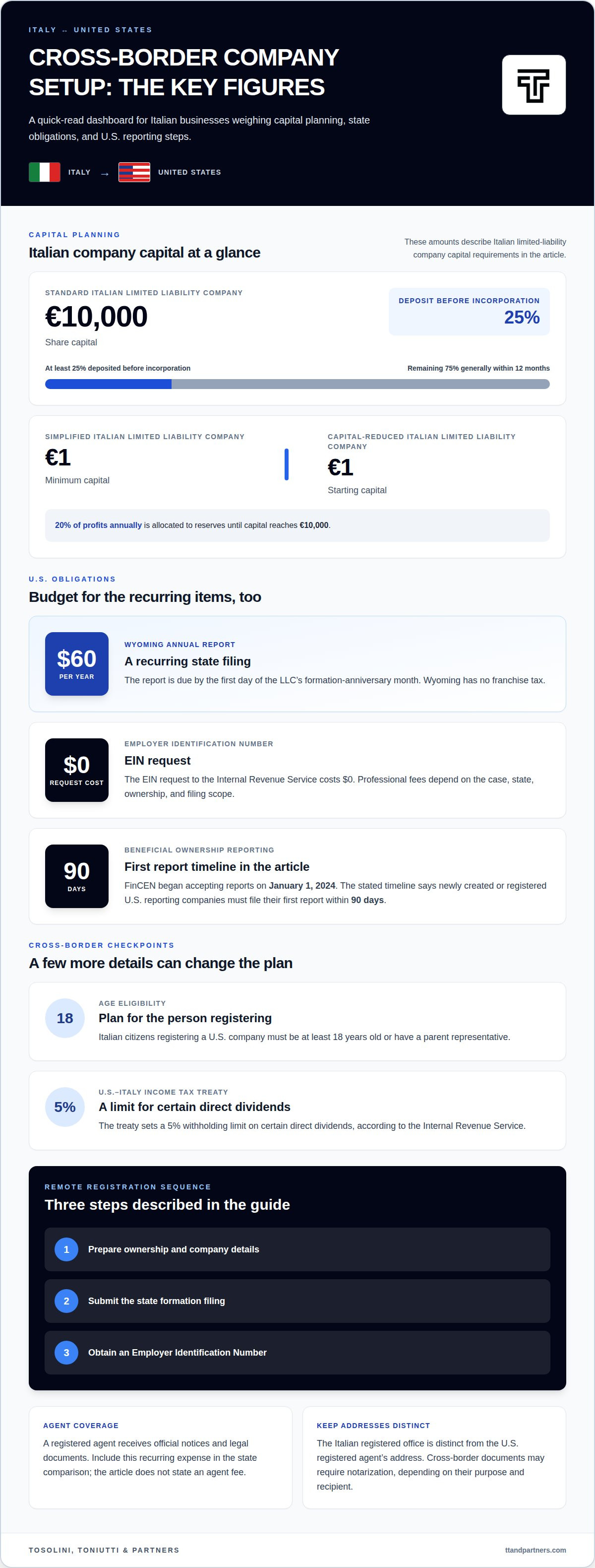
Appoint a registered agent in the state where you form the LLC. The agent receives official notices and legal documents on the company’s behalf. For US LLC formation for Italian businesses, include this recurring expense in your state comparison, not only in the initial filing budget.
Align Italian capital planning with the existing business structure. A standard Italian limited liability company has €10,000 share capital, with at least 25% deposited before incorporation. The remaining 75% can generally be paid within 12 months. A simplified Italian limited liability company requires minimum capital of €1. A capital-reduced Italian limited liability company also starts at €1 and allocates 20% of profits annually to reserves until capital reaches €10,000.
Include eligibility and document formalities in the registration plan. Italian citizens registering a U.S. company must be at least 18 years old or have a parent representative. Keep the Italian registered office distinct from the U.S. registered agent’s address. Documents used across borders may require notarization, depending on their purpose and recipient.
Distinguish ownership from business activity in Italy. Does an Italian owner need to register a U.S. LLC or its business activity in Italy? Ownership alone does not determine whether local registration applies; the company’s activities and presence in Italy matter. Planning US LLC formation for Italian businesses should include an assessment of those operations and related tax questions.
Treat banking as a separate onboarding step. Can an Italian-owned LLC open a U.S. business bank account and accept U.S. payments remotely? It can apply, but remote account opening and payment acceptance depend on the institution’s onboarding process and required company documents.
Track annual requirements alongside agent coverage. Wyoming’s annual report costs $60 per year and is due by the first day of the LLC’s formation anniversary month. The US-Italy income tax treaty sets a 5% withholding limit on certain direct dividends, according to the Internal Revenue Service.
How a professional can help you choose between an LLC and a C-Corporation
Define the entity’s commercial purpose before choosing a structure. A professional can map planned U.S. sales, investment, ownership, and management into a comparison of an LLC and a C corporation.
Compare tax treatment with the ownership plan. A U.S. corporation is taxed independently of its shareholders, while an LLC is treated as a disregarded entity for tax purposes. This distinction informs income tax analysis in both the United States and Italy.
Match governance to the founders’ needs. Consider who will own the business, how decisions will be made, and whether the company expects outside investment. A C corporation and an LLC organize ownership differently, so the intended relationship between the founders and the entity matters.
Choose the registration state by comparing where the company will operate with state filing and annual obligations. Which U.S. state is best for an Italian-owned LLC, and how can a professional help compare state fees and taxes? The right fit depends on operations, costs, and compliance duties. A professional can compare these factors across the relevant states.
Assess Wyoming and Delaware against the same operating plan. Wyoming has no franchise tax, while Delaware’s annual franchise tax creates a recurring obligation. Include formation charges, annual reports, and the company’s actual business presence in the comparison.
Consider the consequences of registering outside the state where the company operates. What are the risks, including foreign qualification and duplicate fees? The company may need to qualify as a foreign entity where it conducts business, adding registration and ongoing compliance in another state. A professional can assess whether those additional obligations outweigh the advantages of the original state.
What are the Costs and Registration Fees for Incorporating a Company in the USA?
Define the intended role of the U.S. company or subsidiary before budgeting. It can provide a separate structure for U.S. operations, contracts, and investment. For US LLC formation for Italian businesses, compare the planned activity and ownership before selecting an entity or state.
Estimate the state filing charge. Treat it as one part of the setup budget, separate from annual reports, taxes, and other compliance costs.
Include registered-agent coverage in the recurring budget. The state where you form the company determines where the agent must serve.
Organize remote registration as a sequence: prepare ownership and company details, submit the state formation filing, then obtain an Employer Identification Number from the Internal Revenue Service. The EIN request costs $0. For US LLC formation for Italian businesses, a professional coordinates these steps; professional fees depend on the case, state, ownership, and filing scope, and are provided after a quote request.
Account for FinCEN beneficial ownership reporting when assessing compliance. FinCEN began accepting reports on January 1, 2024. Newly created or registered U.S. reporting companies must file their first report within 90 days, under the stated reporting timeline.
Weigh the operational benefits alongside tax planning. A U.S. subsidiary may give Italian owners a defined structure for U.S. customers, contracts, or investors. Formation alone does not determine taxation; the company’s activities, ownership, and cross-border transactions shape the broader analysis.
State formation costs and annual franchise taxes
Compare state filing charges before establishing a company in the United States. These charges are separate from other formation and ongoing expenses.
Include annual state obligations in the comparison. Wyoming has no franchise tax, but its annual report costs $60. The report and fee are due by the first day of the LLC’s formation anniversary month. This recurring filing remains relevant even when the company has limited activity.
Schedule Delaware compliance by its calendar date. Delaware’s annual franchise tax is due every June 1. Include both the initial state charge and the annual tax when comparing Delaware with states that have different reporting requirements.
Account for other annual charges. New Mexico’s annual franchise tax is $0, while California’s is $800. State obligations differ, so compare the formation cost with recurring taxes and reports, not as a single opening expense.
Calendar federal filings for a foreign-owned LLC. A disregarded single-member U.S. LLC owned by a nonresident must file Form 5472 and a pro-forma Form 1120 annually, regardless of income or treaty status. The forms are due April 15 annually, with an automatic extension to October 15 via Form 7004. The Internal Revenue Service sets a minimum penalty of $25,000 for missing either filing.
Keep Italian accounts on their own timetable. If the fiscal year ends December 31, shareholders must approve annual accounts by June 30. A U.S. LLC’s state reports and federal tax filings do not replace this Italian company obligation.
Tosolini, Toniutti & Partners
Tosolini, Toniutti & Partners helps Italian entrepreneurs assess the legal and practical aspects of establishing a U.S. company. Its LLC incorporation services connect the formation decision with the wider cross-border business context, including ownership, state selection, registered-agent arrangements, and recurring filing responsibilities. This support is useful when a U.S. entity must fit an existing Italian business rather than operate as a standalone structure.
The firm can clarify which decisions to make before registration and how they relate. For example, the choice between an LLC and a corporation affects how the business is organized, while the operating state influences filings and ongoing obligations. A structured review brings these considerations together with the company’s intended U.S. activities and its relationship to its Italian owners.
This legal perspective is especially relevant when formation is one part of a broader expansion plan. A company may need to coordinate its entity structure with commercial arrangements, investment, or the founders’ personal plans. If immigration status is a separate consideration, Tosolini, Toniutti & Partners also handles Green Card matters. That service addresses an immigration question, not the choice of business entity.
Consider professional support when you need to assess the formation state, ownership structure, and cross-border responsibilities together, or when the company’s U.S. plans are evolving. The aim is to make the formation decision with a clear view of the legal structure and its ongoing responsibilities, rather than treating registration as a standalone filing.
For guidance on your U.S. business plans, contact Tosolini, Toniutti & Partners.
Frequently Asked Questions
How much does it cost to establish a company in the US?
Add recurring state filings, registered-agent coverage, and any applicable franchise taxes. Professional service fees depend on the case, the state, ownership structure, and filing scope, and are provided after a quote request. Estimate initial and annual costs separately before choosing a structure.
What is needed to establish a business in the US?
Start with a defined ownership structure, intended business activity, and state of registration. The process also requires a company name and a registered agent in the chosen state. Plan for an Employer Identification Number and ongoing state and federal filings. For example, a company selling to U.S. customers may need a different operating plan from a holding entity.
Can an Italian citizen or company form a US LLC without living in the United States?
Yes. Italian citizenship, U.S. residency, American co-owners, and physical presence in the United States are not required to form a U.S. company. An Italian individual or company can establish an entity remotely while arranging a registered agent and completing required filings. Formation does not itself resolve immigration, tax, or Italian registration questions related to the company’s actual activities.
What documents and information are required to form a US LLC from Italy?
Prepare the proposed company name, ownership details, business purpose, chosen state, and registered-agent information for the formation filing. The precise information depends on the state and ownership structure. If an Italian company will own the LLC, organize its identifying and formation details, along with the relevant representative’s information. These details also help align formation documents with later tax and banking steps.
Does an Italian-owned US LLC need an EIN, and how can a nonresident obtain one without an SSN?
An EIN identifies a business for U.S. tax purposes, and an Italian-owned LLC may need one for tax and administrative matters. A nonresident without a U.S. SSN or ITIN can submit Form SS-4 by fax. Processing typically takes 4-7 business days after the IRS confirms receipt. The EIN is a nine-digit number assigned by the IRS.
What US tax returns and annual reports must a foreign-owned single-member LLC file, and when are they due?
A disregarded single-member U.S. LLC owned by a nonresident must file Form 5472 and a pro-forma Form 1120 annually, regardless of income or treaty status. They are due April 15 annually; Form 7004 provides an automatic extension to October 15. The Internal Revenue Service states the minimum penalty for missing either filing is $25,000. State annual reports follow separate schedules.



Comments