

Green Card Renewal for Italians in the U.S.: 2026 Guide

What if the card that appears to need renewal calls for a different filing altogether? For Italian nationals, an expiring Green Card can raise understandable questions, but the card’s expiration date and permanent-resident status are not the same thing. Your next step depends on whether you hold a regular or conditional Green Card, or need a replacement because your card was lost, damaged, or contains incorrect information. That distinction is central to green card renewal for Italian residents.
If you’re unsure which category fits, you’re not alone. Form I-90 covers many renewals and replacements, while conditional residence follows a separate process. Filing under the wrong category can add uncertainty when clear, accurate information matters.
This 2026 guide explains how to identify the appropriate filing route, what to expect during filing and follow-up, and how to approach an expired card while an application is pending. It also explains when case-specific guidance may help, particularly for Italian nationals navigating U.S. immigration matters across borders.
Table of Contents
Green Card Renewal for Italian Residents: What an Expiring Card Means
Seeing an expiration date approach on your Green Card can make an administrative task feel like a question about your right to remain in the United States. If you’re an Italian national who already holds lawful permanent residence, separate the physical document from the immigration status it records. The card is evidence of permanent residence. Replacing it updates that evidence, not the nationality or category through which you became a resident.
USCIS commonly describes Form I-90 as the Application to Replace Permanent Resident Card. It covers certain situations involving an expired or soon-to-expire card, as well as replacement circumstances such as a lost, stolen, damaged, or incorrect card. People often call the process “renewal,” although the form’s name uses “replace.” The reason for filing matters because not every resident-card situation follows the same route.
The Green Card is a document proving permanent-resident status; its expiration date alone does not automatically end that status.
Does an expired Green Card mean permanent-resident status has ended?
No. An expired card and the underlying status are distinct. Expiration of the physical card, by itself, does not mean that lawful permanent-resident status has ended. The card is important evidence of that status, but it is not the status itself. Whether someone remains a permanent resident depends on their individual circumstances, not simply on the date printed on the card.
That distinction can be reassuring, but it doesn’t make an expired document irrelevant. A current card can be needed to demonstrate status in practical settings, including employment-related verification or travel. If the card has expired, it may be harder to provide the expected evidence promptly. Keep USCIS notices related to a filing with your records, and follow current USCIS instructions about what documentation to present while a replacement application is pending.
Does Italian nationality change the U.S. renewal process?
This guide addresses Italian nationals who already hold U.S. permanent residence. Italian citizenship does not, on its own, create a separate Green Card renewal form or process. The key questions are your resident category and why the card needs attention. An Italian citizen with regular permanent residence may have a different filing need from someone whose residence is conditional, even though both hold U.S. Green Cards.
This distinction matters for Italian residents managing immigration issues across two countries. Start by checking the wording and expiration date on your card. Then identify whether it reflects regular or conditional residence and whether it is expiring, missing, damaged, or inaccurate. These details help you identify the relevant filing question. They don’t replace a review of current USCIS instructions or a case-specific assessment if your history or residence category raises uncertainty.
For green card renewal for Italian residents, the first step is not to assume that an expiring card means your status has ended, or that every Green Card holder should file the same application. Understand what the card represents, then determine which category and reason apply. The next section compares the main filing routes.
Which Green Card Filing Applies to Italian Residents?
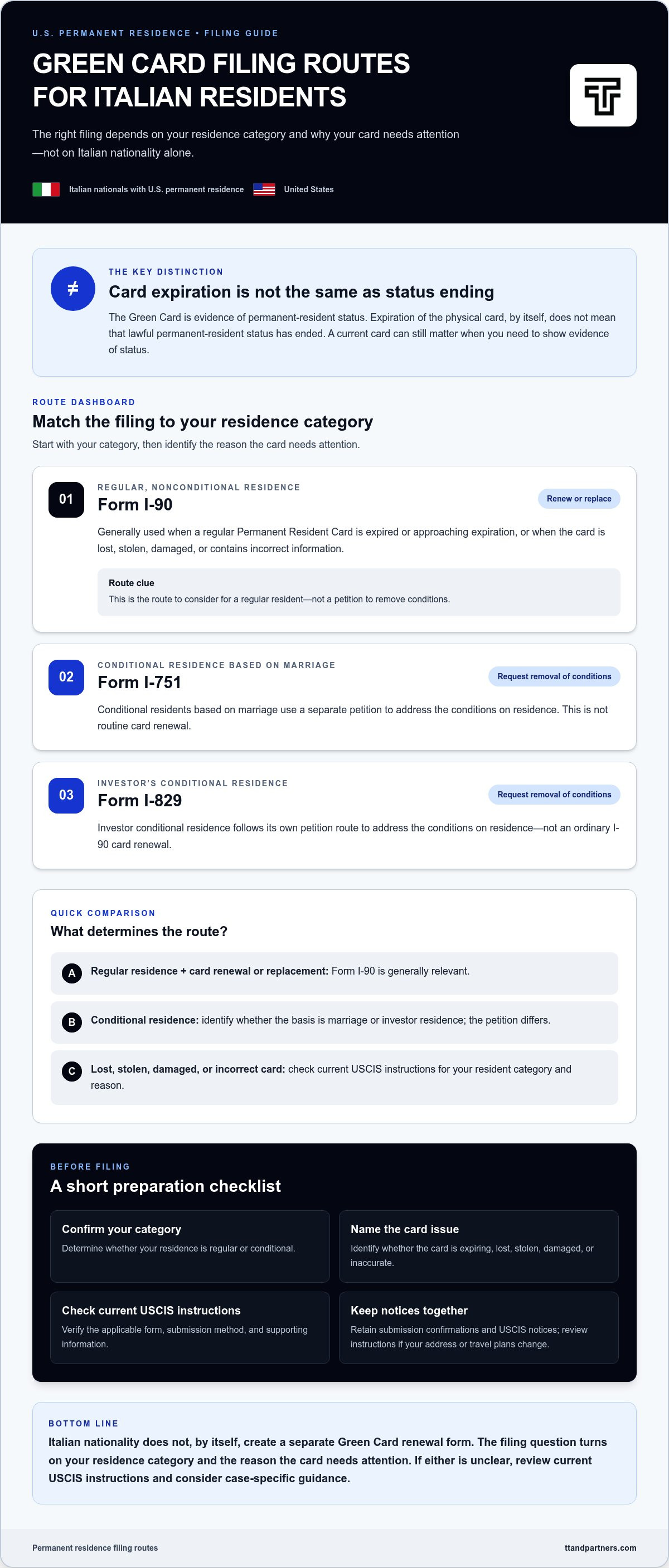
The filing route depends on the type of permanent residence you hold and what happened to your card, not on your Italian nationality alone. Start with your immigration category and the reason you need a card. This comparison can help you identify the right filing question before reviewing current USCIS instructions for your situation.
When is Form I-90 the relevant application?
For a lawful permanent resident with regular, nonconditional status, Form I-90 is generally the application to renew an expiring card or request a replacement. USCIS lists reasons that include a card that has expired or is approaching expiration, as well as a card that is lost, stolen, damaged, or issued with incorrect information. Select the reason that matches your circumstances. Review the current Form I-90 instructions and USCIS guidance before filing, especially if your card or residence category presents an unusual situation.
How is conditional residence different from card renewal?
Conditional residents follow a separate process to request removal of conditions. Form I-751 applies to conditional residence based on marriage; Form I-829 applies to an investor’s conditional residence. These petitions address the conditions on residence, rather than simply renewing the card. If your card is expiring, first establish whether your status is conditional and which petition applies. Don’t assume the ordinary I-90 renewal route is appropriate.
For a conditional resident whose card is lost, stolen, damaged, or incorrect, the immediate document issue may require a different analysis from the petition to remove conditions. Follow USCIS instructions that address both your status category and the specific reason you need a card. A filing made for the wrong purpose may not address the underlying requirement.
For Italian nationals, the distinction is practical: nationality provides context, but it does not determine the application. A resident whose card expires during regular permanent residence is in a different position from someone whose residence is conditional and whose conditions must be removed. If you’re uncertain which category applies, review the documents connected to your original grant of residence and compare them with current USCIS form instructions.
If the category or filing reason remains unclear, case-specific Green Card guidance can help you distinguish a card replacement from a petition concerning conditional residence.
How to Prepare and Submit a Green Card Renewal Application
A carefully prepared application starts with a clear filing purpose. For green card renewal for Italian residents, following a deliberate sequence helps ensure that the selected form, stated reason, and information provided all align. USCIS instructions can change, so use the current guidance for your application rather than relying on an old form or a prior filing.
Identify your resident category. Confirm whether you hold regular or conditional permanent residence. This determines whether you’re considering a card application or a separate petition.
Confirm why you’re filing. Identify whether the card is expiring, has already expired, was lost or damaged, or contains incorrect information. Select the reason that accurately reflects your circumstances.
Prepare your information. Review the application questions and gather supporting evidence relevant to your filing reason. Compare personal details with your card and other records.
Choose a submission method. Online and mail options depend on current USCIS instructions and your case. Check the official filing guidance before deciding how to submit and where to send any paper application.
Retain records and notices. Save a complete copy of the application, evidence, submission confirmation, and every USCIS notice. Keep them together so you can refer to the exact information filed.
Identify your resident category, confirm the filing reason, prepare consistent information, submit according to current USCIS instructions, and retain every notice.
What should applicants review before filing?
Check USCIS’s current form edition and instructions before completing the application. Review names, dates, card details, and other answers for accuracy, then compare them across the form and supporting evidence. Include information relevant to the selected filing reason, rather than unrelated records that could obscure the issue you’re addressing.
Consistency matters. If a detail differs between documents, don’t guess or silently change information to make the records match. Consider what the discrepancy relates to and how to explain it accurately in the filing. A final review of each answer and attachment can help catch omissions, mismatched details, or evidence that doesn’t support the stated reason.
What happens after submission?
After USCIS receives a filing, it may send official notices or request further steps. Read each notice carefully, note any response deadline, and follow the instructions that apply to your case. Procedures can vary, so don’t assume that every applicant will receive the same request or follow-up. Retain copies of correspondence and note when and how you respond.
For an eligible lawful permanent resident who files Form I-90 to renew a Green Card, the receipt notice provides an automatic 36-month extension of the card’s validity. Keep the notice with the expired card and review current USCIS guidance on how to use that evidence. Don’t rely on a general timeline or assume a particular outcome. Monitor your case through the appropriate USCIS channel.
If a category question or inconsistency makes preparation less straightforward, individual Green Card filing guidance can help you assess the application route and organize relevant details before submission.
Avoid Renewal Delays: Notices, Address Changes, and Travel Questions
Submitting an application is only one part of the process. For green card renewal for Italian residents, careful follow-up helps ensure an important USCIS notice or delivery update doesn’t go unnoticed. Keep contact information current, monitor the channel used for filing, and treat a missing card, an incorrect card, and a pending application as separate situations that may call for different next steps.
How should applicants manage USCIS notices and address updates?
Use this checklist to keep your application follow-up organized:
Save the submission confirmation and a complete copy of the application and supporting materials.
Check the USCIS account or other filing channel used for updates, and keep the email and mailing details associated with the case accessible.
Read every official notice promptly. Note what it asks you to do and any response deadline it states.
If your address changes, follow current USCIS instructions to update it and check whether the change must also be reflected in a pending case.
Keep proof of address updates and copies of any responses or delivery-related communications with your case records.
An address update and a pending application are related, but they aren’t necessarily the same task. Follow USCIS’s current address-change instructions, then review the instructions for your particular case to ensure correspondence can reach you. Don’t rely on an old deadline or assume that updating one record automatically updates every relevant filing.
What if the card is delayed, incorrect, or needed for travel?
A pending application is different from a card that USCIS says was produced but never delivered. It’s also different from a card that arrived with incorrect information. Identify which event occurred, keep the related notice or delivery details, and follow USCIS instructions for that specific issue. A replacement or correction question may require a different response from simply waiting for an application decision.
Travel requires particular care. A receipt notice or an expired card should not be treated as a universal guarantee that travel will be permitted or that every carrier or authority will accept the same evidence. Before making plans, review current USCIS guidance for proof of status and travel documentation, and consider how your circumstances may affect the answer. If travel is imminent or your documents don’t fit the standard guidance, seek case-specific legal advice rather than relying on a general rule.
Keep the paper trail orderly: application copy, confirmations, notices, address-update records, and any correspondence about card delivery. This makes it easier to explain what has happened and respond accurately if USCIS requests further action. For help assessing a notice, delivery problem, or travel-documentation question in the context of your U.S.-Italy immigration circumstances, contact Tosolini, Toniutti & Partners.
When Italian Green Card Holders May Benefit from Legal Guidance
A routine card renewal may be manageable by following current USCIS instructions. Individual legal guidance can be useful when the filing question depends on more than the card’s expiration date. For Italian nationals, cross-border circumstances may add context, but they don’t automatically make a renewal complex. A case-specific review can help clarify which facts matter and which filing category fits before you act.
When might a renewal question be more than a routine filing?
Consider an individualized review if you’re uncertain whether your residence is conditional, have a prior immigration filing that may affect the present application, or notice inconsistencies in names, dates, or other information across your records. These are reasons to examine the details, not automatic signs that something is wrong. A careful review can help distinguish a straightforward card issue from a question that calls for a different filing or explanation.
Your card or immigration records leave your resident category unclear.
A previous filing, notice, or decision may be relevant to the application you’re preparing.
Personal details differ across records, and you’re unsure how to present them consistently.
Your circumstances involve related U.S. and Italian immigration considerations.
Bring the relevant notices and records into the discussion rather than relying on memory alone. This gives an attorney a clearer basis for understanding your history and identifying questions that may need attention. It doesn’t guarantee a particular outcome, and not every Green Card renewal requires a lawyer.
A clear next step for an Italian resident in the United States
Tosolini, Toniutti & Partners advises on Green Card and cross-border U.S.-Italy immigration matters, and has represented Italian individuals and corporate entities since 2005. The firm’s cross-border experience is relevant when an Italian national needs to understand how a U.S. filing fits their wider circumstances. Its guiding phrase is “Your bridge between Italy and the United States.”
A focused case evaluation can help clarify whether the issue concerns an ordinary card renewal, a replacement, or a filing connected to conditional residence. It can also help identify inconsistencies or unresolved questions to address before proceeding. Bring your card and relevant USCIS correspondence so the discussion can be grounded in your records.
If you’re uncertain which route applies or how your prior filings affect the next step, use the firm’s contact page to discuss your Green Card matter. Tosolini, Toniutti & Partners offers a free initial case evaluation without a consultation fee.
Make Your Next Green Card Decision with Clarity
Your next step doesn’t need to be a guess. For green card renewal for Italian residents, understanding your own circumstances can help you move forward with greater confidence, especially if your card category, records, or prior immigration history raise questions. Use current USCIS guidance for general filing information, and seek individualized advice when your situation calls for closer review.
Tosolini, Toniutti & Partners advises on U.S.-Italy immigration matters, including Green Card issues. To discuss your circumstances and identify questions to address, request a free initial case evaluation. The evaluation is provided without a consultation fee.
With the right information and a considered next step, you can approach your Green Card matter with a clearer sense of direction.
Frequently Asked Questions
Can Italian citizens renew a U.S. Green Card while living outside the United States?
Possibly, but Italian citizenship alone doesn’t determine whether you can renew from abroad. Form I-90 eligibility and filing instructions depend on your resident category, the reason for filing, and your circumstances. A prolonged stay outside the United States can also raise separate questions about maintaining residence. Before submitting an application from overseas, review current USCIS instructions and seek individualized guidance if your absence or return plans may affect your status. Green card renewal for Italian residents abroad requires careful attention to both issues.
How early can I file to renew an expiring Green Card?
USCIS guidance generally allows eligible permanent residents to file Form I-90 during the six months before the card expires. Check the current form instructions before submitting, since the timing and appropriate filing route depend on the reason for your application. If your card is already expired, don’t assume you must wait or that the same timing guidance applies. Review USCIS instructions for your situation.
How much does it cost to renew a Green Card?
The cost depends on the current USCIS fee schedule and the filing method or circumstances that apply to your case. Check the official Form I-90 fee information immediately before filing, and confirm the total shown for your selected submission method. Don’t rely on an older article, saved payment amount, or third-party estimate. If your situation involves a different petition rather than Form I-90, review that form’s separate official fee guidance.
Can I renew my Green Card online?
USCIS makes online Form I-90 filing available for eligible applicants through an online account. Whether that option fits depends on your filing reason and the current instructions for your case. Before starting, make sure you’re using the current application and follow the prompts for your circumstances. An online account can also help you access case information and notices, so keep your sign-in details secure and check the account for updates.
What if I have a Green Card with no expiration date?
Don’t assume the card is invalid solely because it has no expiration date. First, check the card’s issue details and category, then compare them with current USCIS guidance for older Permanent Resident Cards. The appropriate next step can depend on the card version and your circumstances. If you need to present proof of status, confirm what USCIS currently recognizes rather than relying on the absence of an expiration date alone.
Can I apply for U.S. citizenship while my Green Card renewal is pending?
Possibly. A pending card renewal doesn’t automatically establish that you’re eligible for naturalization, and it doesn’t by itself answer whether you can apply. Naturalization has its own eligibility requirements and application process. Review current USCIS instructions for Form N-400 and consider how your residence history and immigration records apply. If a renewal issue or prior filing raises questions, individualized legal guidance can help you assess the two matters separately.
What should I do if I entered incorrect information on my Green Card renewal application?
If you notice an error before submitting, correct the application and review related answers and evidence for consistency. If you’ve already filed, use current USCIS instructions or your online account to identify how to report or correct the information. Don’t assume that submitting another application is the right fix. Keep a copy of what you filed and any evidence of the accurate information. For a consequential error, seek tailored legal advice.



Comments