

International Debt Collection from the US to Italy: A Practical Guide

Before filing a claim to recover a debt from Italy, determine where it can be pursued and what your records can prove. For US creditors, international debt collection US to Italy raises practical questions about applicable law, court jurisdiction, and what to do if the debtor disputes the claim.
A contract formed in the United States does not, by itself, determine which court can hear a dispute or how a judgment may be enforced in Italy. Differences in procedure and the need to organize records across borders can also affect whether negotiation or formal legal action merits consideration.
This guide explains the decisions to weigh, the records to organize, and the legal pathways that may be relevant to a claim involving Italy. Tosolini, Toniutti & Partners provides international litigation support for cross-border matters involving the United States and Italy. The firm has represented Italian individuals and corporate entities since 2005, and provides an initial case evaluation without a consultation fee. Your bridge between Italy and the United States.
Table of Contents
International debt collection from the US to Italy: why the route matters
How international debt recovery from the US to Italy can progress
Negotiated recovery or Italian legal action: compare the routes
Prepare a US-to-Italy debt claim with a focused evidence checklist
How Tosolini, Toniutti & Partners supports US-to-Italy debt disputes
International debt collection from the US to Italy: why the route matters
International debt collection US to Italy means pursuing payment across national borders when a US-based creditor seeks to recover a debt from a debtor in Italy. The distance between the parties is only part of the challenge. The agreement, the nature of the obligation, the debtor’s location, and the available records all shape which options are worth considering.
Informal collection seeks payment through communications and negotiation; formal legal recovery uses proceedings to establish or enforce a claim. A demand for payment is not the same as a court judgment, and neither automatically resolves where a dispute belongs or which law applies. A general overview of debt collection practices can provide context, but a cross-border claim requires attention to its particular facts.
Which facts shape a US-to-Italy debt claim?
Start with the transaction, not just the amount on an invoice. Identify the creditor and debtor, each party’s role, what was sold or agreed, and where the debtor is located. Confirm the parties’ correct legal names and distinguish a company from an individual or another entity. These details help frame the dispute and support accurate correspondence.
Next, review the agreement as a whole. A governing-law clause may identify the law the parties chose for contractual issues, while a dispute-resolution clause may address where or how disputes are handled. The effect of either clause depends on its wording and circumstances. Neither should be treated as an automatic answer to every question about jurisdiction or enforcement.
An invoice may state the amount claimed and its due date, but may not establish every element of the underlying agreement.
If performance is disputed, gather records showing what each party promised, delivered, accepted, or questioned.
If work was incomplete or an obligation was not performed, distinguish that issue from a straightforward failure to pay an undisputed invoice.
This distinction helps clarify whether the disagreement concerns payment alone or the parties’ underlying contractual duties.
Why cross-border recovery needs a coordinated view
US-side records may include the signed agreement, order history, invoices, delivery or service documentation, and communications with the debtor. Other considerations arise when assessing the debtor’s location, possible proceedings, or practical steps connected with a claim in Italy. Organizing both strands early gives counsel a clearer view of the evidence and the questions that remain open.
Analyze three issues separately: jurisdiction, meaning which court or forum may hear the dispute; applicable law, meaning which legal rules govern the relevant questions; and enforcement, meaning how a decision may take effect where the debtor or assets are located. A US demand or court claim does not automatically transfer into an Italian proceeding. Assess the contract, procedural posture, and intended next step together before choosing a route.
How international debt recovery from the US to Italy can progress
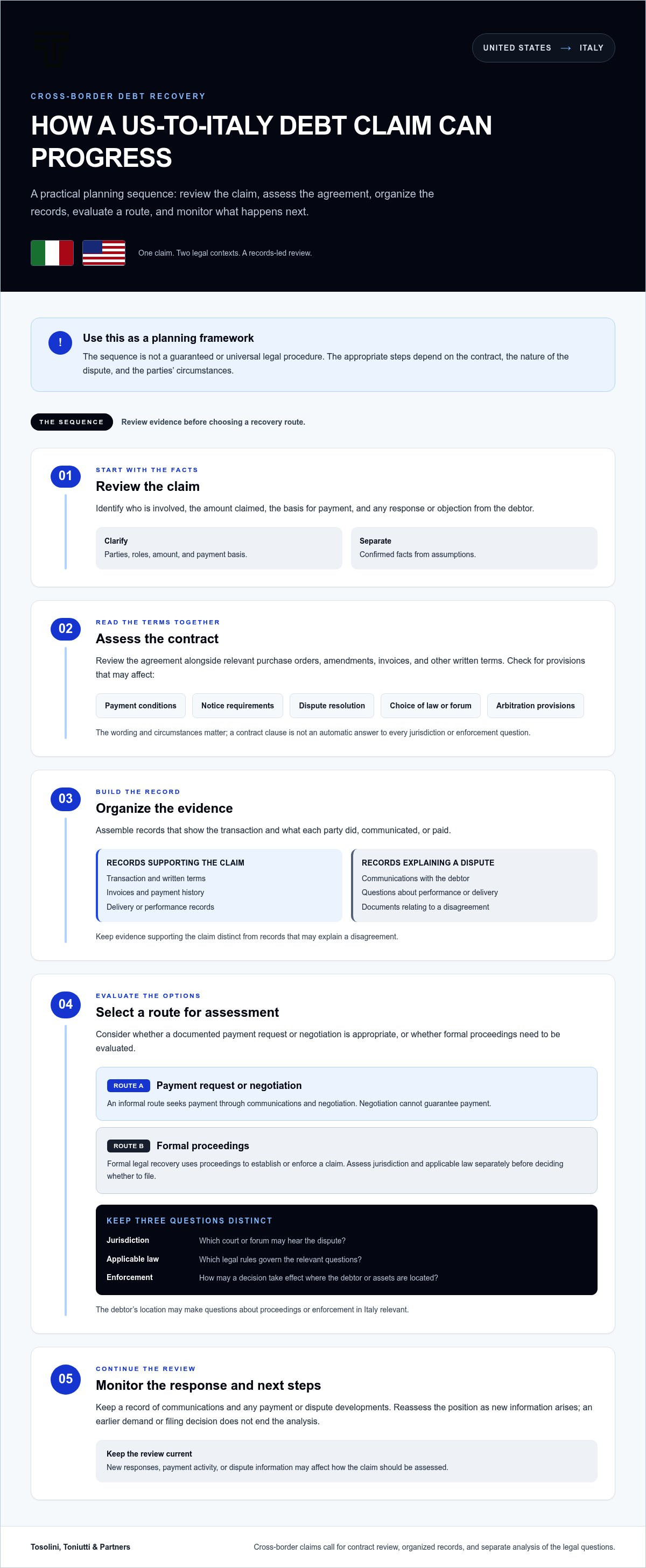
A disciplined process turns a collection concern into questions that can be addressed with documents and legal analysis. For international debt collection US to Italy, the sequence below is a planning framework, not a guaranteed or universal legal procedure. The appropriate steps depend on the contract, the nature of the dispute, and the parties’ circumstances.
Review the evidence before choosing a recovery route. The records help show what is owed, what may be disputed, and which legal options merit assessment.
Review the claim. Identify the parties, the amount claimed, the basis for payment, and any response or objection from the debtor. Separate confirmed facts from assumptions.
Assess the contract. Read the agreement alongside relevant purchase orders, amendments, invoices, and other written terms. Look for provisions that may affect payment, notice, dispute resolution, or the parties’ choice of law or forum.
Organize the evidence. Assemble records of the transaction, invoices, performance or delivery, payment history, and communications. Keep documents supporting the claim distinct from those that may explain a disagreement.
Select a route for assessment. Consider whether a documented payment request or negotiation is appropriate, or whether formal proceedings need to be evaluated. Analyze jurisdiction and applicable law separately before deciding whether to file. The debtor’s location may also make questions about proceedings or enforcement in Italy relevant.
Monitor the response and next steps. Record communications and any payment or dispute developments. Reassess the position as new information arises instead of treating an earlier demand or filing decision as the end of the analysis.
Start with the agreement and payment history
Review the contract, invoices, delivery or performance records, and payment communications together. Check the written terms for governing law, forum, arbitration, notice requirements, and payment conditions. If a purchase order differs from the signed agreement, the named creditor does not match the invoicing entity, or the records leave performance unclear, flag the inconsistency for legal assessment rather than relying on an assumed interpretation.
Assess negotiation and formal proceedings
A clear, documented payment request can state the basis of the claim and give the parties an opportunity to address it. It cannot ensure payment. If the debtor disputes the obligation or does not respond, formal proceedings may warrant consideration after counsel assesses the governing documents, jurisdiction, applicable law, and procedural requirements. An Italian payment-order procedure may be one route to evaluate, but it is not an automatic result or the right fit for every claim.
For a dispute requiring coordinated US and Italy legal analysis, Tosolini, Toniutti & Partners provides international litigation support. A focused cross-border case evaluation can help clarify which questions to address before deciding how to proceed.
Negotiated recovery or Italian legal action: compare the routes
For international debt collection US to Italy, the choice between negotiation and formal proceedings depends on the nature of the dispute, not simply the fact that an invoice remains unpaid. A debtor who acknowledges the balance but wants to discuss payment presents a different situation from one who disputes performance, challenges the contract, or has stopped responding. Use the comparison below to weigh options, then consider the facts and legal questions specific to the claim.
Consideration
Negotiated recovery
Italian legal action
Purpose
Seek voluntary payment or a mutually workable resolution, potentially preserving an ongoing commercial relationship.
Ask a competent court to determine or address the claim under an applicable legal procedure.
Evidence
Use the agreement, invoices, performance records, payment history, and correspondence to explain the amount and basis of the request.
Assess evidence against the legal and procedural requirements relevant to the claim and chosen route.
Procedural posture
Communications take place outside court. The parties may exchange proposals, clarify objections, or discuss payment.
A formal process involves procedural steps and may require the debtor to respond or defend the claim.
Key questions
Is the debt acknowledged? What is disputed? Is continued business valuable, and is there a constructive basis for discussion?
What do the contract and claim records establish? Which forum and law may apply, and what procedure fits the facts?
When an out-of-court approach may be considered
Negotiation may be worth considering when the debtor recognizes at least part of the debt, the parties have an active business relationship, or a specific disagreement might be resolved through clarification. Set out the contractual basis, amount claimed, and relevant supporting records clearly in writing. Keep copies of demands, replies, proposals, and records of any partial payments. A clear record helps show whether the dispute is narrowing or deepening. An informal request may support dialogue, but cannot compel payment or replace legal advice where rights or deadlines are at issue.
When formal proceedings may require assessment
Formal action may warrant analysis when negotiation has not resolved the dispute or the debtor contests a material part of the claim. The contract, quality of documentation, debtor’s position, and applicable procedure all matter. An Italian payment-order route may be one possibility to assess, but eligibility and procedural requirements must be evaluated for the specific claim rather than assumed from the existence of an unpaid invoice. Any resulting decision raises a separate question: whether and how it can be recognized or enforced across borders. That analysis depends on the decision, relevant law, and circumstances. Legal action is an option to evaluate, not a promised outcome.
Prepare a US-to-Italy debt claim with a focused evidence checklist
A well-organized file helps counsel understand how the transaction unfolded, what remains unpaid, and where the parties disagree. For international debt collection US to Italy, keep records complete and traceable. A clear file is more useful than a large collection of documents without context.
Gather the agreement, transaction and invoice records, proof of performance, payment history, and related communications, then arrange them in date order.
Documents that help explain the underlying claim
Begin with the documents that define the commercial relationship, then connect them to the amount claimed. Preserve original files and make working copies for organization. Do not revise source records or leave out material that may affect the claim.
Transaction terms: Contracts, purchase orders, amendments, and other written records showing what the parties agreed to. Include relevant changes rather than relying on an earlier version alone.
Invoices and account records: Invoices, account statements, and supporting calculations. Match each amount claimed to the document supporting it, and note any credits or payments received.
Performance or delivery: Records of goods delivered, services performed, acceptance, or other steps relevant to the transaction. Include records showing what was completed and when.
Payment history: Receipts, bank or account records, payment confirmations, and correspondence about partial payments or outstanding balances.
Separate documents establishing the basis and amount of the debt from records explaining a dispute or possible counterclaim. For example, keep a customer’s complaint about incomplete work with the relevant service records, rather than mixing it into the invoice sequence. This makes it easier to see both the creditor’s position and the issue the debtor may raise.
Communications and cross-border case organization
Keep payment requests, replies, dispute notices, and settlement communications in chronological order. Retain the full message thread where possible, including dates, attachments, and sender details. A brief index can identify what each record concerns, while a timeline can show how the claim and the parties’ positions developed.
Record the legal names of the parties and their roles as shown in the contract and transaction documents.
Note differences in names, addresses, or entity details across invoices, agreements, and correspondence.
Flag communications in another language and identify any translation needs for legal review.
Preserve original versions alongside translated or working copies, and avoid assuming a particular translation or filing requirement.
Consistency matters. If the agreement names one entity but the invoice names another, or a payment record does not clearly identify the related invoice, flag the gap instead of resolving it by assumption. These details can shape how the claim is assessed.
Once the file is organized, an initial case evaluation can help frame the cross-border legal questions raised by the records.
How Tosolini, Toniutti & Partners supports US-to-Italy debt disputes
A debt dispute involving a US creditor and an Italian debtor can raise questions across legal systems, contractual terms, evidence, and potential proceedings. Tosolini, Toniutti & Partners provides international litigation and arbitration support for cross-border matters involving the United States and Italy. This perspective can bring the different elements of an international debt collection US to Italy claim into a coordinated legal assessment, without assuming one route or outcome fits every dispute.
A cross-border perspective for a dispute involving Italy
Tosolini, Toniutti & Partners has represented Italian individuals and corporate entities since 2005 and has a strong presence in both the United States and Italy. That perspective is relevant when a contract, transaction records, and the debtor’s position need to be considered alongside potential legal steps across borders.
The firm’s international litigation practice can connect a review of claim documents with analysis of procedural questions. This may include examining how the agreement frames the parties’ obligations, identifying gaps or inconsistencies in supporting records, and assessing which legal issues need attention before a formal step is considered. A coordinated perspective helps frame the matter; it does not guarantee collection, enforcement, timing, or a particular result.
The objective is careful alignment: understand what the records establish, distinguish agreed facts from contested issues, and identify the questions that shape a reasoned next step. This can be valuable whether the parties are still communicating or the dispute has become more formal. Your bridge between Italy and the United States.
A practical next step for creditors
Before an initial case evaluation, gather the contract and amendments, invoices, payment records, and correspondence relevant to the debt or any dispute. A concise chronology can show when the obligation arose, what performance took place, what remains unpaid, and how the debtor responded. Keep original records intact and flag missing documents or conflicting details instead of resolving them by assumption.
Tosolini, Toniutti & Partners provides an initial case evaluation without a consultation fee. The evaluation can help frame the dispute, identify legal questions requiring analysis across the United States and Italy, and clarify what further information may be relevant to considering next steps. It is not a promise of recovery or a predetermined procedural recommendation; it is an opportunity to assess the matter in light of its documents and circumstances.
Request an initial case evaluation.
Choose your next step with a clear view of the claim
International debt collection US to Italy is best approached as a sequence of informed decisions, not a commitment to one predetermined route. Start by identifying the central uncertainty in your case: whether the obligation is clear, whether the debtor contests performance, or whether the contract raises questions about the proper forum or applicable law. This focus can make legal discussions more precise and help you weigh the implications of negotiation or formal proceedings for your business.
Review your records with a cross-border perspective. Note what is established, what remains disputed, and which questions need legal analysis. A measured next step can preserve options and help you avoid decisions based on assumptions about how a US claim will be handled in Italy.
Tosolini, Toniutti & Partners supports cross-border disputes through its US and Italy perspective. To discuss the legal questions raised by your matter, request an initial case evaluation. A clear starting point can help you move forward with a strategy shaped by the facts.
Frequently Asked Questions
Can a US company collect an unpaid debt from a debtor in Italy?
Yes, a US company can pursue payment from a debtor in Italy, but the available route depends on the contract, the claim, and the debtor’s circumstances. International debt collection US to Italy may involve direct efforts to resolve the matter or legal analysis of proceedings in Italy. Before relying on a particular forum or assuming a US claim will carry over, assess jurisdiction, applicable law, and where enforcement may be needed.
What documents do I need to pursue an Italian company for an unpaid invoice?
Gather the agreement and amendments, purchase orders, invoices, account statements, and records showing delivery or completed services. Include payment confirmations, credits, and correspondence about the balance. Check that the documents identify the same creditor and debtor, or make any differences clear. For example, if an invoice names a parent company but the agreement names a subsidiary, preserve both records and flag the relationship for legal review rather than assuming one entity owes the debt.
Can a US court judgment be enforced in Italy?
A US judgment may be eligible for recognition and enforcement in Italy, but it does not automatically become enforceable there. Under Italy’s domestic framework for judgments from non-EU countries, recognition is generally addressed through a court process in Italy. Relevant considerations can include whether the US court had proper jurisdiction and whether recognition would conflict with Italian public policy. Counsel should review the judgment and case history before enforcement steps are planned.
Is an Italian injunction procedure available for an unpaid commercial debt?
An Italian payment-order procedure may be a route to assess for a commercial debt, particularly where the claim is supported by suitable written evidence and is not contested. Availability and requirements depend on the specific facts and current procedure, so an unpaid invoice alone should not be treated as enough to qualify. Counsel can review the contract, supporting records, and any debtor objections to determine whether this procedure merits consideration.
How do I decide between negotiating and filing a legal claim in Italy?
Consider negotiation if the debtor acknowledges the balance, offers a reasoned response, or has a continuing commercial relationship worth preserving. State your position clearly in writing and keep a record of replies. A legal claim may need assessment if the debtor rejects the obligation, stops engaging, or disputes key performance facts. Compare the strength of the records, the contract’s dispute terms, and the practical purpose of each option with cross-border legal guidance.
What happens if the Italian debtor disputes the invoice?
Identify exactly what the debtor challenges, such as the amount, delivery, quality, or performance, and compare that position with the contract and transaction records. Keep the objection and supporting correspondence intact, then note which facts are agreed and which remain contested. A response may clarify whether the disagreement concerns part of the balance or the underlying obligation. That distinction can affect how counsel evaluates negotiation or formal proceedings.



Comments