

How to Register a Business in Italy as a Foreigner and Understand the Costs

Foreign founders can own 100% of an Italian company in most sectors without living in Italy. Registering a business in Italy as a foreigner is generally possible, although the right to establish a company may depend on reciprocity between Italy and the founder’s country. The practical decision is not only whether foreign ownership is allowed, but which structure fits and, for non-EU founders who plan to run the business in Italy, what immigration requirements apply.
Before committing to a business structure, it helps to understand the setup process and the costs involved. This guide compares common company forms, their capital and registration requirements, and the factors that shape setup costs. It also covers key registration steps and immigration considerations for registering a business in Italy as a foreigner, so you can assess the legal and practical fit before moving ahead.
Table of Contents
Can I Start a Business in Italy as a Foreigner?
Yes. Registering a business in Italy as a foreigner is generally allowed: foreign founders can own 100% of an Italian company in most sectors without living there. However, company ownership and permission to live in Italy and run the business are separate matters, particularly for non-EU founders.
Choose a Business StructureChoose a structure that fits your planned activities, ownership, and exposure to business debts. A sole proprietorship has no minimum capital requirement. A branch extends a foreign parent company’s operations, with the parent remaining responsible for the branch.Decide whether you need a separate Italian company or a local presence for an existing business. A representative office can conduct market analysis and contact potential customers, but it cannot sell or issue invoices. Choose according to what the operation will actually do.
Compare Company Structures and Capital RequirementsCompare capital requirements and ownership rules before selecting a company. A limited liability company generally requires €10,000, but can be incorporated with capital as low as €1. If capital is below €10,000, at least one-fifth of net profit must go to a reserve until the combined capital and reserve reach €10,000.A simplified limited liability company has capital from €1 to €9,999.99 and can be owned only by individuals. A joint-stock company requires €50,000 in share capital, with at least 25% paid at incorporation. Align the articles of association with the intended ownership and operations.
Assess Risks and Common MistakesAssess liability before choosing a partnership. In a general partnership, all partners are jointly and personally liable. In a limited partnership, general partners have unlimited liability, while limited partners risk their investment and cannot manage the business.Before registering a business in Italy as a foreigner, consider reciprocity rules, which may affect a foreign citizen’s right to establish a company. Non-EU citizens planning to live in Italy and run the business need a visa and residence permit that allow self-employment or business activity.
How much does it cost to register a company in Italy?
Budget separately for incorporation, administrative charges, and ongoing accounting. The total depends on the company form and the steps required for its planned activities.
Estimate Incorporation and Registration CostsBuild your startup budget by listing individual cost categories instead of relying on one estimate as a universal price.An Italian simplified limited liability company carries a €200 registration tax; stated exemptions cover notary fees, stamp duty, and administrative fees. These figures describe different components and estimates, so don’t simply add them together.Include any special license required for the planned activity.
Account for Administrative and Accounting FeesSet aside a separate budget for accounting and recurring administration.These are overall estimates, not a guaranteed bill for every entrepreneur or limited liability company. Use them as a starting point, then factor in the company’s activities and ongoing needs.For cross-border plans, clarify the business structure and setup before committing funds. If you are a U.S. citizen establishing a business presence in Italy, separate Italian company expenses from immigration and business-planning needs.
What are the Criteria for Business Registration in Italy?
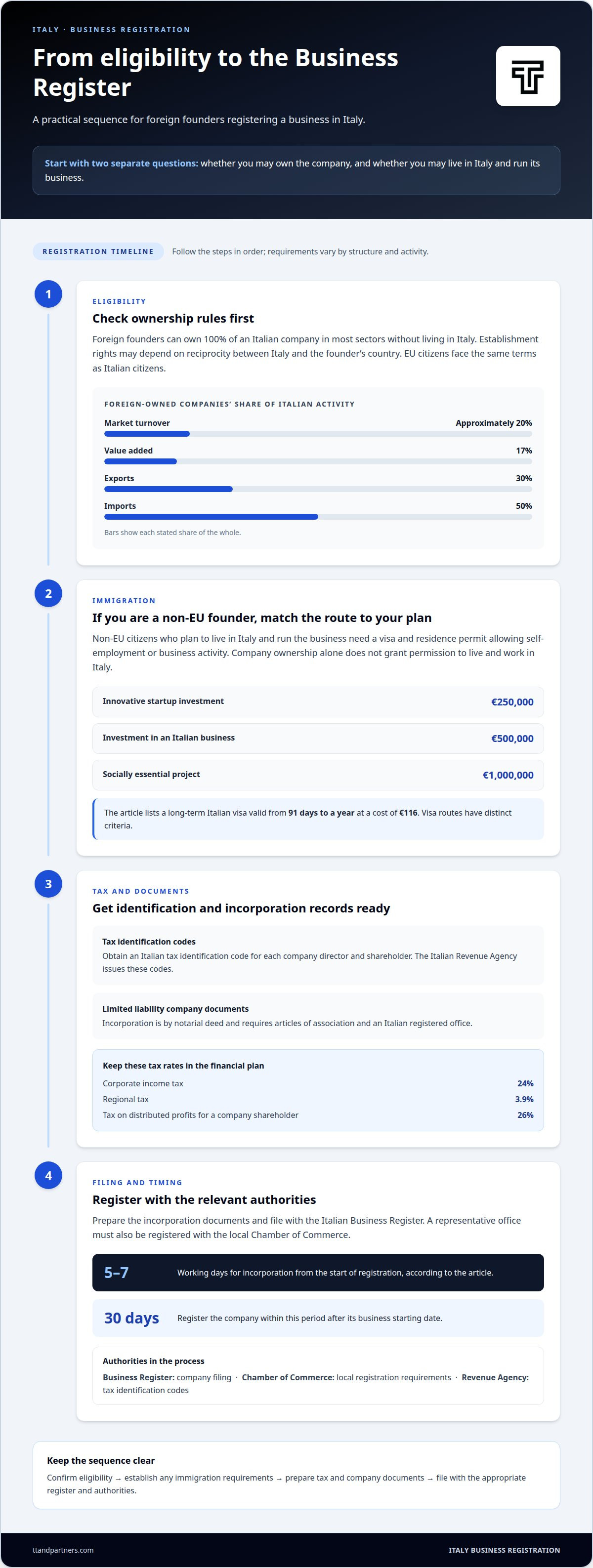
Foreigners can register companies in Italy; EU citizens face the same terms as Italian citizens. Non-EU founders need a visa and residence permit allowing self-employment to live in Italy and run the business. Company incorporation takes around 5-7 working days from registration start, involving the Business Register and relevant local authorities.
Review Foreign Ownership and Visa RequirementsAssess ownership eligibility and immigration separately. Foreign-owned companies generate approximately 20% of Italian market turnover, 17% of value added, 30% of exports, and 50% of imports.For a non-EU investor visa, listed minimum investments are €250,000 in an innovative startup, €500,000 in an Italian business, or €1,000,000 in a socially essential project. A long-term Italian visa valid from 91 days to a year costs €116. These routes have distinct criteria, so match the investment and intended activities to the relevant category.
Obtain Tax Codes for Directors and ShareholdersObtain an Italian tax identification code for each company director and shareholder. The Italian Revenue Agency issues these codes to identify individuals in tax and company procedures.Include corporate taxes in financial planning: Italy’s corporate income tax rate is 24%, and the regional tax rate is 3.9%. Distributed profits are subject to 26% tax for a company shareholder. These obligations differ from company formation documents, so account for both before operations begin.
Register with the Italian Business RegisterPrepare the incorporation documents and file the required registration with the Italian Business Register. A limited liability company is incorporated by notarial deed and requires articles of association and an Italian registered office.Register the company within 30 days of its business starting date. A representative office must also be registered with the local Chamber of Commerce. Keep the company’s legal structure and declared activities aligned across its documents and registration.
Check Registration Timing and AuthoritiesPlan for around 5-7 working days for incorporation from the start of registration. The Italian Business Register and local Chamber of Commerce are central to company filings; the Italian Revenue Agency handles tax identification codes.Plan the steps in sequence: obtain tax codes, prepare incorporation documents, then file for registration. A bank account may be part of the wider setup, but opening an account and registering a company are separate processes. Account for their separate timelines when planning a start date.
Doing business in Italy as a foreigner
Choose an operating model that reflects what the Italian business will actually do. A representative office can conduct non-commercial activities, such as market analysis and contacting potential customers, but cannot sell, sign contracts, or issue invoices. A branch’s income is taxed in the country where the business is conducted, an important distinction for cross-border planning.
Check whether the company’s planned activities require a start-up notification. Italy requires businesses to submit a self-certification notification before beginning various activities. Determine whether the planned work falls within those activities before setting an opening date, and keep the registered activity consistent with the work the company will carry out.
Set up tax and invoicing practices around the actual business model. Italy’s standard VAT rate is 22%, with reduced rates of 10%, 5%, and 4% for certain categories. The 5% flat-tax regime applies only to self-employed activity as a freelancer or sole proprietor, not business income from a company. A limited liability company and a sole proprietor therefore require different tax planning.
Plan employment separately from company formation. A foreign company can hire employees in Italy through an Employer of Record only if the agency is authorised by the Italian Ministry of Labour. Italian employer social security contributions are stated as 30% to 35% of gross salary, so include employment costs when modelling the operation’s finances.
Choose premises that suit the company’s intended use. If acquiring property is part of establishing your Italian operation, include the real estate closing in your planning.
Tosolini, Toniutti & Partners
Tosolini, Toniutti & Partners assists individuals and companies with U.S.-Italy cross-border immigration matters connected to business plans. Turn to the firm when establishing operations in Italy also raises questions about your immigration position or longer-term plans involving the United States.
For founders considering U.S. permanent residence, the firm also handles Green Card matters. This is a separate immigration pathway from registering a company in Italy, so assess each objective on its own terms as you plan your next steps.
For guidance on how your cross-border plans relate to immigration, contact Tosolini, Toniutti & Partners.
Shape Your Next Step Around the Bigger Plan
Registering a business in Italy as a foreigner is one part of a broader cross-border decision. Consider how your commercial plans, personal mobility, and long-term objectives fit together before moving ahead. Planning the sequence carefully can help align business decisions and immigration matters as your plans develop.
Tosolini, Toniutti & Partners assists with E-1, E-2, and O-1 visa matters for individuals and corporate clients. If U.S. immigration considerations form part of your international business plans, discuss how those goals relate to your next steps. The right conversation begins with the outcome you want to pursue, not a one-size-fits-all path.
Contact Tosolini, Toniutti & Partners to discuss your cross-border plans and move forward with clarity.
Frequently Asked Questions
Can a non-EU citizen open a company in Italy?
Yes, a non-EU citizen can own an Italian company in most sectors without residing in Italy. Establishing a company and living in Italy to run it are separate matters, and the requirements for each may differ. Eligibility to establish a company may also depend on reciprocity between Italy and the founder’s country. Consider both issues when planning your role.
What Documents Do You Need to Open a Business in Italy?
Required company documents depend on the structure and on whether the founder is an individual or a foreign company. A limited liability company requires articles of association, an Italian registered office, and a notarial deed. Directors and shareholders need Italian tax identification codes. Documents issued abroad may require authentication and translation, which can affect preparation time. A sole proprietorship has different requirements, including tax and social security registrations.
What is the minimum capital for a limited liability company in Italy?
An Italian limited liability company can be incorporated with capital as low as €1, although the general minimum is €10,000. When capital is below €10,000, it must be paid fully in cash, and at least one-fifth of net profit goes to a reserve until capital and reserve together reach €10,000. This means the initial contribution is not the only capital consideration.
What types of companies exist in Italy?
Common options include a sole proprietorship, a limited liability company, a simplified limited liability company, a joint-stock company, a general partnership, a limited partnership, and a branch of a foreign company. A representative office is another way to establish a presence, but it cannot carry out commercial activities such as selling or invoicing. For example, a foreign parent extending its existing operations may consider a branch, while a representative office may suit market research without commercial activity.
Is there Compliance After Company Formation in Italy?
Yes. After formation, a company must meet obligations related to its activities, tax status, and workforce. Some businesses need to submit a self-certification of compliance with the requirements for starting an activity before starting specific activities, while companies with employees must account for employment-related contributions. Sole proprietors also need INPS registration. Keep actual operations consistent with registered activities, and maintain the filings and records required for the company’s structure.
What Structures are Best for Company Setup in Italy?
The right structure depends on ownership, liability, and planned activities. A sole proprietorship has no minimum capital requirement, while a limited liability company provides a company structure for founders seeking limited liability. A simplified limited liability company may suit individual owners seeking a simplified form. For partnerships, compare personal exposure carefully: general partnership partners share personal liability, while liability and management in a limited partnership depend on each partner’s role.



Comments