

How to Expedite a Green Card Application Based on Eligibility

A faster green card decision starts with evidence, not urgency alone. To understand how to expedite a green card application, first consider the grounds USCIS may accept: severe financial loss, urgent humanitarian reasons, certain nonprofit or U.S. government interests, or a clear USCIS error. USCIS reviews each request individually and has discretion to approve or deny it.
When a pending case affects your work, family, health, or business, a timely decision can feel essential. A strong request links that urgency to a qualifying reason and supports it with clear documentation. This guide explains how to assess eligibility, prepare evidence such as employer or medical letters, and understand how an immigration attorney can help. It also covers the practical steps for submitting an expedite request while keeping the underlying green card application on track.
Table of Contents
How Can I Expedite My Green Card Application?
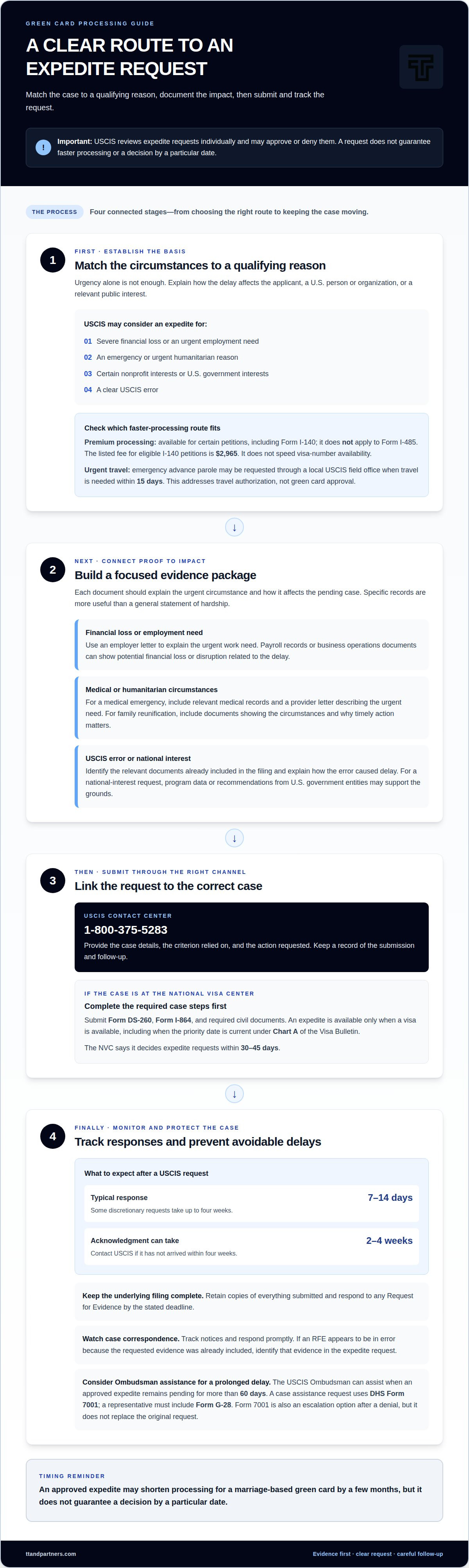
USCIS reviews expedite requests individually, so start by matching your circumstances to its criteria. Then identify the process that applies to your petition, adjustment application, or immigrant visa case.
Review Special Procedures and Premium ProcessingIdentify your application type before choosing a faster-processing route. For certain urgent trips, USCIS offers emergency advance parole through local field offices when travel is needed within 15 days. Premium processing applies to certain petitions, not every green card form: Form I-140 qualifies, while Form I-485 does not.For eligible I-140 petitions, the listed premium-processing fee is $2,965. Premium-processing timeframes vary by petition type. Premium processing does not speed visa number availability. Family-based cases typically take 2-7 years, while employment categories typically take 1-10 years or longer.
Submit and Track an Expedite RequestSubmit a request through the USCIS Contact Center at 1-800-375-5283, and retain your case details for follow-up. USCIS typically responds to discretionary expedite requests within 7 to 14 days, although some take up to four weeks. Acknowledgment can take 2-4 weeks; contact USCIS if it hasn’t arrived within four weeks.For an immigrant visa case at the National Visa Center (NVC), first submit Form DS-260, Form I-864, and required civil documents. An expedite is available only when a visa is available, including when the priority date is current under Chart A of the Visa Bulletin. The NVC says it decides requests within 30-45 days.For a marriage-based green card, an approved expedite request may shorten processing by a few months. It does not guarantee a decision by a particular date.
Prevent Delays Through Proper FilingFile a complete petition with the required supporting documents, and keep copies of everything you submit. If USCIS sends a Request for Evidence, respond by the stated deadline with the requested material. Missing a filing deadline can delay the overall application.Track notices and case correspondence so you can respond promptly and keep the case moving. If USCIS issued an RFE in error because the requested evidence was already included, clearly document that in any related expedite request.
USCIS expedite eligibility criteria
Expedite requests depend on specific circumstances, not urgency alone. USCIS has sole discretion to approve or deny them. Incomplete evidence can delay or lead to rejection of a request, and filing one does not guarantee faster processing.
Match the circumstances to an eligibility criterion. USCIS may expedite an application or petition for severe financial loss, urgent employment needs, emergencies or urgent humanitarian reasons, certain nonprofit interests, U.S. government interests, or clear agency error. Employment-based green card requests must meet at least one qualifying criterion. A March 21, 2024, USCIS Policy Alert outlined changes to expedited case processing.
Connect the reason to the case and its timeline. Explain how the delay affects the applicant, a U.S. person or organization, or a relevant public interest. For example, describe the specific impact of an urgent employment need or humanitarian emergency. If USCIS made an error, explain how it affected the application rather than simply saying the case has been waiting too long.
Submit the request through the appropriate channel. Applicants can generally begin by calling the USCIS Contact Center. Provide the case details, the criterion you are relying on, and the action requested. Keep a record of the submission and any follow-up so the request can be linked to the correct immigration case and its status.
Consider Ombudsman assistance when a delay persists. The USCIS Ombudsman can assist when USCIS approved an expedite request but it remains pending for more than 60 days. A case assistance request uses DHS Form 7001; a representative requesting assistance must include Form G-28. If USCIS denies the expedite request, Form 7001 is also an escalation option, but it does not replace the original request.
Supporting documentation
Build evidence around the specific urgent reason. Organize supporting documents so each item explains the circumstances and their effect on the pending application. For a medical emergency, include relevant medical records and a letter from a medical provider describing the urgent need. For humanitarian reasons involving family reunification, provide documents that show the circumstances and why timely action matters.
Document financial or employment consequences with records. An employer letter can explain an urgent work need, while payroll records or business operations documents can demonstrate potential financial loss. Connect each record to the applicant’s circumstances and the action requested. Evidence of a specific loss or disruption related to the delay is more useful than a general statement of hardship.
Address USCIS errors with a clear record of the filing. If USCIS issued a Request for Evidence even though the requested material was already included, identify the relevant documents in the initial submission and explain the resulting delay. For a request involving national interest, program data or recommendations from U.S. government entities may support the grounds. Include documentation with the green card application when it helps establish eligibility for expedited processing.
Use the travel procedure that fits the emergency. For urgent travel while a green card application is pending, request emergency advance parole through a local USCIS field office if travel is needed within the next 15 days. This addresses travel authorization, not approval of the green card itself. For a planned event, submit a travel-document expedite request at least 45 days before the event.
Incomplete or insufficient evidence can delay processing or lead USCIS to reject an expedite request. Keep the evidence focused: link each document to the urgent reason, the pending case, and the action requested.
Immigration attorney assistance
Ask an immigration attorney to assess the case and the grounds for expediting. The review should connect the green card process to a recognized reason, such as severe financial loss, urgent employment needs, humanitarian circumstances, U.S. government interests, or a clear USCIS error. An attorney can also distinguish an urgent situation from a delay that, on its own, may not support expedited processing.
Have counsel shape the argument around the filing record. An attorney can organize the timeline, identify the specific action USCIS should take, and prepare legal arguments and supporting letters. For example, a business-related request should explain how the delay affects a U.S. organization, while medical evidence should establish the urgent circumstances behind a humanitarian request.
Use legal assistance to address a prolonged delay. If a case remains unreasonably delayed, an attorney can assess whether a writ of mandamus in federal court is appropriate. This lawsuit seeks to compel USCIS to act on the case; it does not secure green card approval. The distinction is important: the legal remedy concerns agency action, not the outcome.
Coordinate any Ombudsman request with the existing case. Counsel can prepare a clear chronology and explain what assistance is being sought. For attorney representation in an Ombudsman request, include Form G-28, Notice of Entry of Appearance as Attorney or Representative. Keeping the evidence, prior USCIS notices, and requested action aligned helps present a coherent record.
Discuss the facts of your green card case with immigration counsel. Tosolini, Toniutti & Partners assists with Green Card matters, including assessing expedite eligibility and preparing a case strategy. If you need guidance on an urgent request or a delayed filing, contact the immigration legal team to discuss the next step.
Tosolini, Toniutti & Partners: GREEN CARD
Tosolini, Toniutti & Partners provides legal assistance with Green Card applications, including assessing expedite requests and addressing delayed filings. The firm can review how your case fits USCIS criteria, evaluate the supporting evidence, and help develop a focused strategy for the green card process.
Consider legal guidance when the grounds for expedited processing are complex, the documentation must address several connected circumstances, or USCIS has requested further evidence. A structured review can clarify the rationale for the request and keep it aligned with the underlying application.
If you’d like to discuss your Green Card case, contact Tosolini, Toniutti & Partners.
Move Forward With a Clear Case Strategy
The next step is to turn your circumstances into a focused plan for your green card case. A thoughtful approach to how to expedite a green card application starts with the outcome you need, the record already filed, and the evidence that best supports your position. Keep each decision connected to your broader immigration path.
Tosolini, Toniutti & Partners assists with Green Card matters and also handles E-2, E-1, and O-1 visa matters. If your situation involves more than one immigration objective, coordinated legal advice can help clarify how those plans relate without losing sight of the immediate filing.
For guidance on your circumstances and a practical next step, contact Tosolini, Toniutti & Partners. A clear strategy can help you approach the process with greater confidence.
Frequently Asked Questions
What Is an Expedite Request?
An expedite request asks USCIS to consider faster handling of a pending immigration application or petition. It concerns the pace of processing, not whether the applicant meets the underlying green card requirements. USCIS considers the stated reason and supporting evidence, then decides whether to grant the request. Filing one does not replace the original application or determine its final outcome.
What is Premium Processing and Does It Apply To Your Situation?
Premium processing is an optional, fee-based service for certain eligible petitions, requested using Form I-907. It may apply when the underlying petition qualifies, such as certain Form I-140 employment petitions. It does not apply to Form I-485 adjustment of status, and it does not accelerate visa-number availability through the State Department. Check which form is pending before treating premium processing as an option.
What are the eligibility requirements for expedited processing of a U.S. green card application?
USCIS may consider requests based on severe financial loss, urgent employment needs, emergencies or urgent humanitarian reasons, certain nonprofit or U.S. government interests, or a clear agency error. The circumstances must relate to the pending case, and employment-based requests must meet at least one qualifying criterion. For example, explain how the delay affects a specific U.S. organization rather than simply expressing a preference for faster processing.
How do you request expedited processing from USCIS, and what evidence is required?
Contact the USCIS Contact Center to begin a request, then provide your case details and evidence related to the reason asserted. An employer letter can explain an urgent work need, while medical records can document a health emergency. Keep a copy of the explanation and supporting records you submit. Make clear how the circumstances relate to the pending filing and the faster action you are seeking.
What USCIS criteria qualify for an expedite request, such as severe financial loss or emergencies?
USCIS may consider severe financial loss, urgent humanitarian circumstances, qualifying nonprofit or government interests, and clear agency error. Evidence should show the practical consequence, not merely state that waiting is difficult. For instance, payroll or operational records may illustrate a business impact, while documentation from a medical provider may explain an emergency. USCIS weighs the specific facts and exercises discretion when deciding each request.
Can you expedite a family-based, employment-based, or adjustment of status green card application?
You may request expedited handling for different case types, but the appropriate route depends on where the case is being processed. USCIS reviews employment-based Form I-485 expedite requests at its discretion. For an immigrant visa case handled by the National Visa Center, an expedite request requires visa availability, including a current priority date under Chart A. The family or employment category alone does not establish eligibility.



Comments