

How to Form a US Subsidiary for an Italian Company and Choose an Entity

The fastest structure to register isn't always the best fit for a lasting US presence. For Italian companies, US subsidiary formation creates a separate US entity, while a branch or representative office may suit a narrower presence. The basic subsidiary formation process typically takes 1 to 2 weeks, depending on the state; banking, an EIN, and local tax or license registrations can extend the full process to 3 to 6 weeks.
Choosing a structure is only the first decision. The state, parent-company documents, and operational setup all shape the path from formation to readiness. This guide explains how to compare a subsidiary with a branch or representative office, choose a state based on where the business will operate, and prepare formation documents. It also covers the practical steps after incorporation, including banking, tax and license registrations, and planning a workable launch sequence.
Table of Contents
Incorporation documents and cross-border formalities
Treat the state filing, parent-company approvals, and tax identification steps as distinct parts of incorporation. Plan their sequence carefully, since it affects when the new legal entity can move from formation to operations.
Choose a US Subsidiary StructureSelect a C corporation when a distinct corporate entity and corporate taxation fit the ownership plan. A U.S. C corporation is subject to a 21% federal corporate income tax rate, according to the Internal Revenue Service. An LLC can offer a different management and tax structure, but its treatment for an Italian parent requires careful cross-border analysis. Compare ownership, expected revenue, and plans for distributing income before choosing.
Gather Formation Documents and Parent ApprovalsPrepare the state’s formation filing and the Italian parent’s supporting corporate records. The filing establishes the subsidiary; parent approvals document authority to create and fund it. Assemble the parent’s legal name, formation details, ownership information, and a resolution authorizing the transaction. Check that names and signatory authority match across documents. California obligations may also affect the paperwork and operating plan: the California Franchise Tax Board states that California imposes an $800 minimum annual franchise tax on LLCs and corporations, regardless of profitability.
Address Parent EIN and Banking NeedsSeparate the subsidiary’s tax identification from the Italian parent’s own records. A foreign company applying for an EIN can use IRS Form SS-4; the Internal Revenue Service provides EINs without charge. The parent does not apply for the subsidiary’s EIN as though they were one legal entity. A US bank account and business address concern operational setup, not the act of filing incorporation documents; arrange them as the subsidiary’s needs require.
File the Incorporation DocumentsSubmit the completed formation filing to the chosen state authority, then retain the accepted documents with the parent approvals. Confirm the entity’s name and structure appear consistently in the resulting records before opening accounts or signing contracts. California sales exceeding $500,000 can trigger economic nexus tax obligations, even without a physical office, according to the California Franchise Tax Board. A U.S. subsidiary must file IRS Form 1120 annually, according to the Internal Revenue Service.
Selecting a state for incorporation
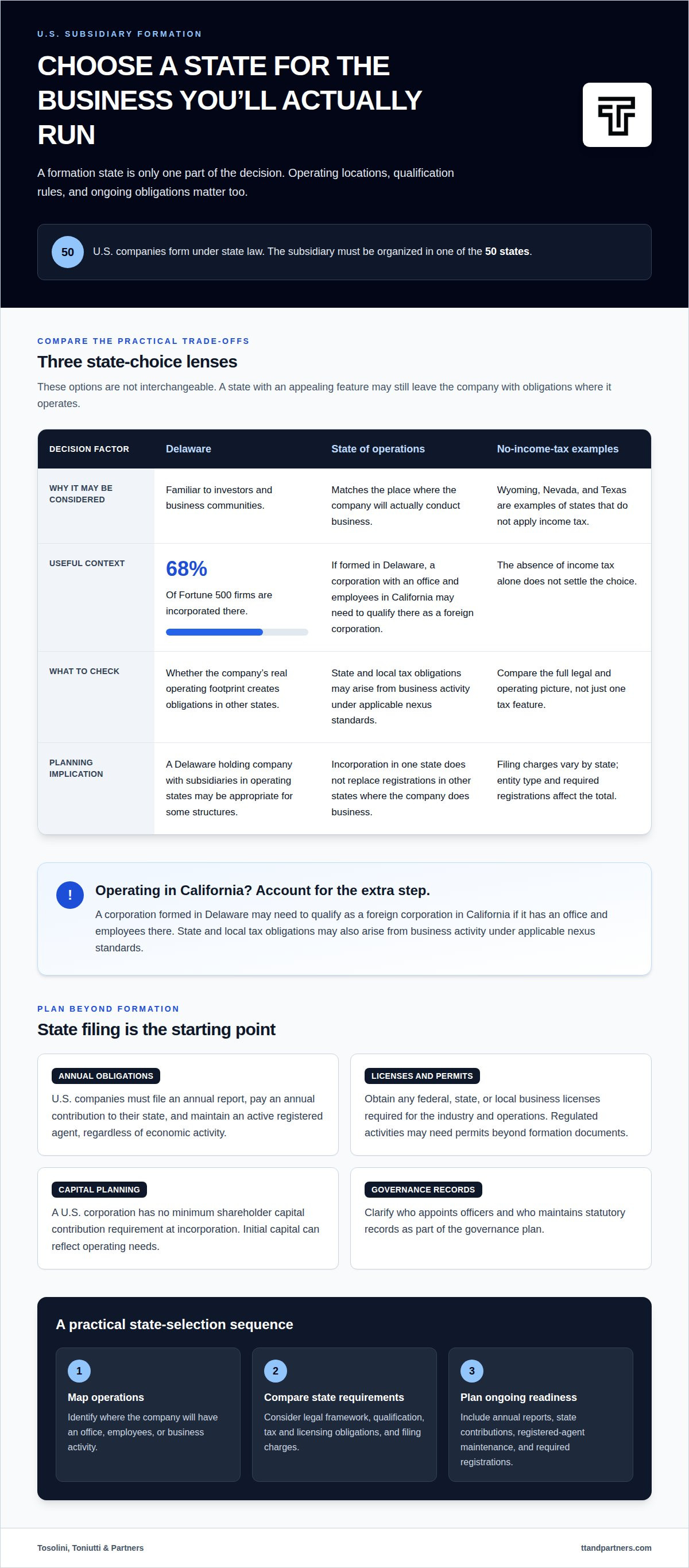
Choose a state by matching its legal framework to the subsidiary’s actual operations. U.S. companies form under state law, and the subsidiary must be organized in one of the 50 states. Delaware is familiar to investors and business communities; 68% of Fortune 500 firms are incorporated there. Wyoming, Nevada, and Texas are examples of states that do not apply income tax, but that alone doesn’t settle the choice.
Map where the company will operate before choosing its formation state. A corporation formed in Delaware may need to qualify as a foreign corporation in California if it has an office and employees there. State and local tax obligations may also arise from business activity under the applicable nexus standards. For some structures, a Delaware holding company with subsidiaries in states where the group operates may be appropriate.
Budget for formation and ongoing state obligations separately. Filing charges vary by state, and the entity type and required registrations affect the total. A U.S. corporation has no minimum shareholder capital contribution requirement at incorporation, so its initial capital plan can reflect its operating needs. Governance planning should also clarify who appoints officers and maintains statutory records.
Plan post-incorporation requirements alongside the state filing. U.S. companies must file an annual report, pay an annual contribution to their state, and maintain an active registered agent, regardless of economic activity. Obtain any federal, state, or local business licenses required for the industry and operations. For example, a regulated activity may require permits beyond the company’s formation documents.
Coordinate banking and registrations with the subsidiary’s operating footprint. Banks may require formation records, ownership details, and authorized signatory information to open an account. Incorporating in one state does not replace registrations in other states where the company does business. For an LLC, align formation choices with the broader legal plan through LLC incorporation planning.
Choosing between an S.r.l., S.p.A., subsidiary, and branch
Distinguish the Italian parent’s legal form from its U.S. entry structure. An S.r.l. or S.p.A. describes the Italian company; a subsidiary or branch describes its U.S. presence. US subsidiary formation for Italian companies starts with deciding whether the operation needs its own legal entity, contracts, and governance. A U.S. subsidiary is separate from its foreign parent, although that separation does not eliminate every risk.
Assess whether the Italian parent’s structure fits its ownership and financing plans. An S.r.l. is often preferred by small and midsized foreign investors for flexibility and simpler management. An S.p.A. may suit larger operations, regulated sectors, or more complex financing and governance needs. An Italian S.p.A. requires minimum share capital of EUR 50,000. These Italian choices concern the parent, not the form of its US subsidiary.
Review the S.r.l.s restrictions before considering it for an Italian parent. Under Article 2463-bis, a corporate parent cannot form an Italian S.r.l.s because its shareholders must be natural persons. For a US presence, compare a subsidiary with a branch against the intended operating scope. A branch or another structure may be more efficient when the foreign company’s presence is limited and temporary. Consider liability, employees, and contracts.
Set intercompany arrangements before the parent and subsidiary begin trading. In planning US subsidiary formation for Italian companies, account for how equity funding or intercompany debt may carry different legal and tax consequences. Management services, licensing, and procurement also need clear terms and consistent records. U.S. subsidiaries must comply with IRS Section 482 arm’s-length pricing rules for intercompany transactions, according to the Internal Revenue Service. Retain support for the pricing of services, goods, and financing.
Formation timelines and operational readiness
Set the opening date around the full launch sequence, not the state filing alone. Basic U.S. subsidiary formation can take 1 to 2 weeks, depending on the state. That period covers establishing the entity, but it doesn’t include every task needed to begin trading. Assign an attorney or internal lead to coordinate documents, approvals, and operational decisions in parallel.
Separate formation from operational readiness in the project schedule. An LLC can be formed in less than 48 hours, but a filed entity may still lack an EIN, bank account, or local registrations. The full process, including banking, an EIN, and local tax or license registrations, may take 3 to 6 weeks. Treat those dependencies as distinct workstreams, with owners and completion points.
Settle governance and personnel decisions before filing. Identify the initial directors or managers, authorized signatories, and who can approve contracts for the new entity. These decisions affect account opening and the subsidiary’s ability to make operational commitments. Ensure the parent’s approval documents match the roles recorded in the formation paperwork.
Build a launch checklist that tracks the state filing, EIN, banking, registrations, and contract readiness as separate milestones. Begin banking preparations while formation documents are being processed, since account opening can extend the schedule. If the launch also involves acquiring business premises, include real estate closing support in the plan. Start trading only after essential operational tasks are complete.
Tosolini, Toniutti & Partners: ITALIAN IMMIGRATION
Tosolini, Toniutti & Partners assists individuals and businesses with immigration needs connected to cross-border operations. If an Italian company’s U.S. expansion involves an owner or employee relocating, include immigration planning alongside entity and operational decisions, rather than treating it as an afterthought.
The firm assists with E-1 and E-2 visas, O-1 visas, and Green Cards. For E-2 eligibility, an Italian investor must demonstrate at least 50% ownership of the US business and operational control, according to U.S. Citizenship and Immigration Services. The appropriate pathway depends on the person’s role and the business’s circumstances, so consider immigration questions while planning the company’s ownership and staffing structure.
Contact Tosolini, Toniutti & Partners to discuss immigration considerations for your U.S. expansion.
Set the Next Stage of Expansion in Motion
A U.S. presence involves more than forming an entity. It creates a framework for decisions about leadership, investment, and the people who will carry the business forward. A thoughtful approach to US subsidiary formation for Italian companies connects these decisions from the outset, so the legal structure supports the business direction.
As your plans take shape, consider whether an owner or key employee will need an immigration pathway aligned with the company’s role and future in the United States. Tosolini, Toniutti & Partners assists with E-1 and E-2 visas, O-1 visas, and Green Cards as part of its cross-border legal work.
For guidance on the legal considerations connected to your expansion, contact Tosolini, Toniutti & Partners. A considered first step can help bring your next chapter into clearer focus.
Frequently Asked Questions
Company, branch, or representative office?
Choose a subsidiary when the U.S. operation needs a separate legal entity owned by the Italian parent. A branch extends the foreign company’s presence directly, while a representative office suits a limited presence rather than a full operating business. For example, a company planning U.S. sales, employees, and contracts may need a different structure from one assessing the market before committing to operations.
How long does it take?
Basic formation typically takes 1 to 2 weeks, depending on the state, while the wider setup may take 3 to 6 weeks. The longer schedule includes banking, obtaining an EIN, and local tax or license registrations. To plan a realistic opening, separate the state filing date from operational milestones, then sequence account opening and permits around the entity’s approved formation documents.
How much does it cost to establish a company in the US?
The total depends on the state, entity structure, registered-agent needs, and the licenses or registrations required for operations. These costs are distinct from capital contributed to the company and from later operating expenses. Because the state and business activity shape the requirements, the price depends on the case and is given after a quote request. Avoid treating filing alone as the full setup budget.
Step 10: How do you activate the bank account?
Complete the bank’s onboarding process after the subsidiary is formed and its EIN is available. Provide the accepted formation record, EIN details, parent ownership information, and authorization identifying account signers. The Italian parent should keep these records consistent with the subsidiary’s formation documents. Once the bank completes its review, authorized signers can use the account for business transactions.
Which US state should an Italian company choose to form a subsidiary?
Choose a state that aligns with the subsidiary’s actual operating footprint, not simply one that seems easiest to incorporate in. Delaware is familiar to investors and the business community, while a company operating elsewhere may need additional registration there. Compare the formation state with expected offices, employees, customers, and state tax exposure. This helps distinguish incorporation from permission to do business.
What are the steps and documents to form a US subsidiary owned by an Italian company?
First select the state and entity type, then prepare the state formation filing and the Italian parent’s approval authorizing ownership and funding. Submit the filing to establish the subsidiary, obtain its EIN using IRS Form SS-4 when applicable, and arrange banking and required registrations. Keep the accepted formation record, parent approval, tax identification details, and account-authority records together for future filings and operational use.



Comments