

How to Prove a Bona Fide Marriage for a Green Card

A marriage certificate proves that you’re legally married, but it doesn’t, by itself, show that the marriage began in good faith. To understand how to prove a good-faith marriage for a green card, think of the evidence as a clear account of your life together, not one decisive document. No single type of evidence is required. The strength lies in how the records and your shared history fit together.
It’s natural to focus on official paperwork, but personal and practical details can also show how your relationship developed. Living arrangements, finances, parenting, and time spent together may all contribute, even when your circumstances don’t follow a conventional pattern.
This article explains what a good-faith marriage means and how to organize evidence that reflects your relationship. It also covers what to consider when you live apart, how to document shared parenting, and how to prepare to discuss your marriage at an interview.
Table of Contents
Children and shared parenting evidence
Children’s records can show how spouses share family responsibilities. A birth or adoption certificate listing both spouses as parents connects them to the same child. Alongside other evidence of the couple’s life together, it can support a genuine marriage. The certificate documents parentage, while day-to-day records can show how each spouse participates in raising the child.
Medical and school records may add practical detail. For example, records identifying both spouses as parents can reflect their involvement in appointments, school communications, or care decisions. Keep relevant documents that accurately show the relationship. A consistent record of shared responsibility is more informative than an isolated reference. Statements from a school or medical provider may also help explain each spouse’s role.
Pregnancy evidence can document a current or planned family life. Ultrasounds and fertility-treatment records, for example, may provide context for a couple’s relationship. These materials are personal, so include them only when relevant and appropriate. Children aren’t required to establish a good-faith marriage, and couples can have valid marriages without children, shared housing, or combined finances.
Other family and household documents may complete the picture. An employer record naming a spouse as an emergency contact shows a practical connection. A will or life insurance policy naming a spouse as beneficiary can reflect future planning. Joint credit cards or household accounts may also show shared responsibilities, but each document should reflect the couple’s actual circumstances.
Organize children’s records by date, with brief explanations, and place them alongside related family evidence. For instance, a school record and an emergency-contact form can show different aspects of parenting. No single document establishes a genuine marriage on its own; together, the records describe a relationship entered into in good faith.
Relationship history and communication evidence
Relationship evidence traces shared experiences, communication, and practical decisions over time. A chronological record helps USCIS understand how the marriage developed.
Comparing Stronger and Weaker Evidence
Stronger evidence connects dated records to a consistent relationship history. Wedding photographs, travel reservations, and correspondence from different periods, for example, can show how a couple’s life together evolved. A few recent images may provide less context than photos from across the relationship, while many photos from a single month offer a narrower view. Letters, greeting cards, phone records, and social media exchanges can add context when they reflect genuine communication between spouses. Friends’ statements may describe what they observed, but are most useful alongside records created during the relationship, rather than on their own.
Evidence for Interviews and Living Apart
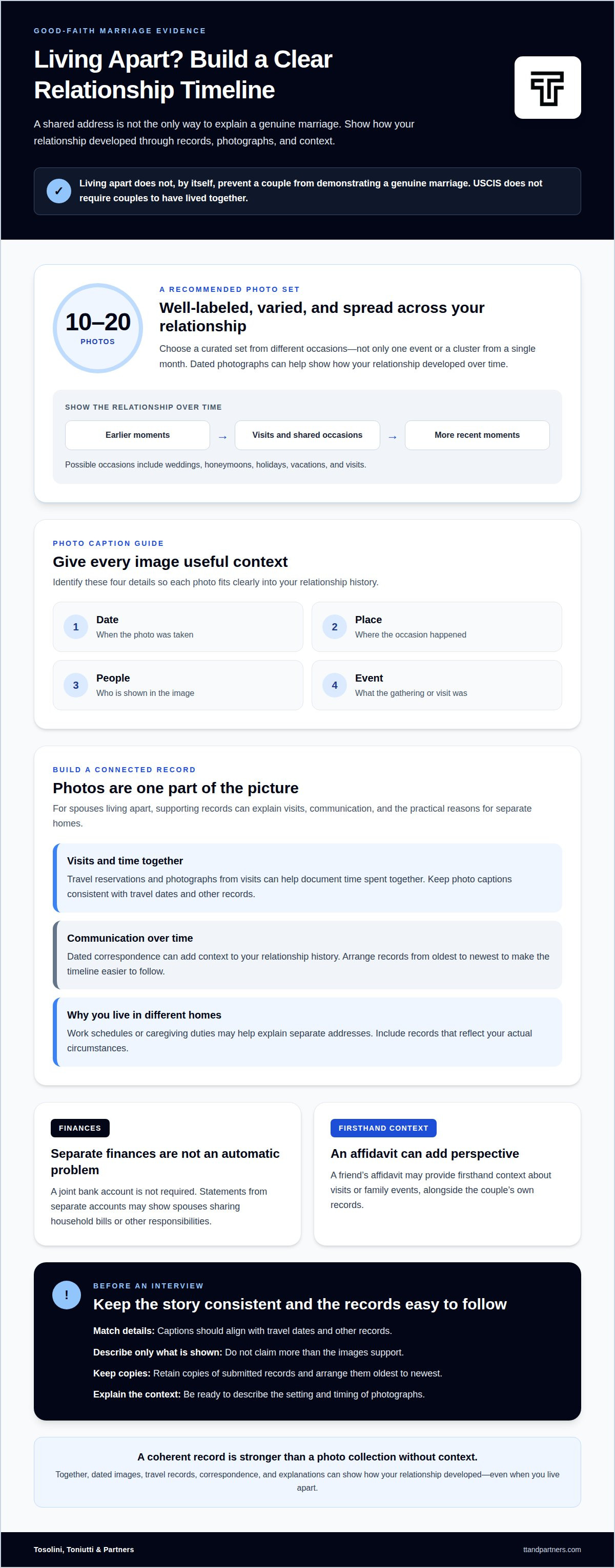
Interview evidence is an organized record spouses can use to explain their relationship consistently. USCIS may revisit whether a marriage is genuine at an interview, whether it takes place at a USCIS office or a U.S. embassy abroad. Couples living apart can include travel reservations, photographs from visits, and dated correspondence. Captions identifying the people, place, and occasion help explain each photo. Keep copies of submitted records and arrange them from oldest to newest to make the relationship timeline clear.
The evidence categories generally apply to both adjustment of status and consular processing. A spouse already in the United States typically pursues adjustment of status using Form I-485. USCIS doesn’t publish one required document list; the marriage petition and supporting records should reflect the couple’s circumstances.
Joint bank statements, jointly filed tax returns, and insurance documents naming a spouse as beneficiary can show shared finances. Officers assess how records fit together, including communication, shared responsibilities, and relationship history. For help organizing a marriage-based green card case, discuss your case.
What if the couple does not live together?
Living apart does not, by itself, prevent a couple from demonstrating a genuine marriage. USCIS does not require couples to have lived together to prove a genuine marriage.
Relationship History and Couple Photographs
Relationship history supported by dated photographs can show how the couple developed over time. Select images from weddings, honeymoons, holidays, vacations, and visits rather than relying on one occasion. A curated set of 10 to 20 well-labeled photos is recommended. Captions should identify the date, place, people, and event, such as a family wedding or holiday gathering. This context explains how each image fits the relationship.
Limited Joint Documents and Separate Finances
Limited joint paperwork or separate finances don’t automatically undermine a marriage. A joint bank account isn’t required, and couples may have valid marriages without merged finances. Statements from separate accounts may show spouses sharing household bills or other responsibilities. Add records that explain the arrangement, such as work schedules or caregiving duties that keep spouses in different homes. An immigration lawyer can help organize these details for a filing.
At a consular interview, photos are useful when spouses can explain their setting and timing. Captions should match travel dates and other records, and should not claim more than the images show. A friend’s affidavit can add firsthand context about visits or family events. Together, these materials can explain separate addresses without treating cohabitation as the only measure of a genuine marriage.
Marriage-based green card interview preparation
An interview gives officers the opportunity to revisit whether spouses entered their marriage in good faith. Prepare to explain how each document reflects your shared life, rather than relying on a marriage certificate alone.
Start with a clear copy of the filed evidence. Arrange documents by date and topic, such as housing, finances, and family life. Include a joint lease or mortgage, utility bills showing a shared address, and jointly held account or insurance records. If you have many statements, select representative records across the relevant period instead of submitting an unorganized stack.
Affidavits from friends or relatives can describe how they know the couple and what they personally observed. Statements should include specific examples, such as attending a wedding or seeing the spouses share household responsibilities. Support letters add context, but work best alongside records created during ordinary life.
Review the submitted forms and supporting documents together before the interview. Make sure both spouses can describe the timeline, current living arrangements, and shared responsibilities in their own words. If a utility bill lists only one spouse, accurately explain the account arrangement. If spouses live apart, be ready to explain why and how they maintain their relationship.
Bring requested documents and relevant updates, including records that clarify changes since filing. Be prepared to discuss immigration status and the facts in the application consistently. Don’t guess if you’re unsure. Answer accurately and distinguish what each spouse personally knows. If evidence is limited, identify records that explain the circumstances, such as separate finances or work-related housing. USCIS may request more evidence or deny a petition if it doubts the marriage’s genuineness.
For focused guidance on preparing your marriage-based green card case, contact Tosolini, Toniutti & Partners.
Tosolini, Toniutti & Partners: GREEN CARD
Tosolini, Toniutti & Partners provides Green Card legal assistance for individuals and corporate clients. In a marriage-based case, the central task is to present an accurate account of the relationship, supported by records that reflect the spouses’ actual circumstances. Legal guidance can help align the application strategy with the available evidence and address questions about unusual living arrangements, separate finances, or gaps in documentation.
Consider seeking legal assistance as you prepare the filing, respond to questions about the evidence, or get ready for an interview. A lawyer can review how relationship records, financial documents, family evidence, and explanations fit together. For example, if a couple lives apart for work or maintains separate accounts, the context should be clear and consistent with the documents. A focused review can also help identify which records best explain the marriage’s history and current circumstances.
Preparation matters because a collection of documents should tell a coherent, truthful story, not simply accumulate paperwork. The evidence should reflect the couple’s real life, whether it includes shared parenting, visits, household responsibilities, or financial arrangements. Legal support can help organize that account and prepare spouses to discuss it clearly, while keeping the application aligned with their facts. Tosolini, Toniutti & Partners also assists with E-1, E-2, and O-1 visas, but a Green Card matter is the relevant starting point for marriage-based immigration questions. If you’re preparing a marriage-based application or interview, contact Tosolini, Toniutti & Partners.
Move Forward With a Clear Case Strategy
A marriage-based immigration filing is also a personal account of how two lives are joined. A clear strategy for how to prove a good-faith marriage for green card eligibility starts with the couple’s actual circumstances, not an attempt to fit every relationship into one model. That perspective can guide decisions about the application and the next steps.
As you consider how to prove a good-faith marriage for green card purposes, focus on presenting an accurate, coherent account of your relationship. If an unusual circumstance needs context, explain it clearly and keep the focus on the facts. Thoughtful preparation can make the process more manageable and help spouses discuss their application with confidence.
For legal support with a marriage-based Green Card matter, start a conversation with Tosolini, Toniutti & Partners. A considered next step can bring clarity to the work ahead and help you move forward with care.
Frequently Asked Questions
What Is a Good-Faith Marriage?
A good-faith marriage is entered into in good faith for legitimate reasons, not solely to obtain a green card or evade U.S. immigration laws. The focus is the spouses’ intent when they married, considered alongside the life and relationship they have built. For example, wedding expenses, shared plans, and ordinary decisions made together may help provide context for that intent.
How Many Affidavits Do You Need for a Marriage Green Card?
There is no fixed required number of affidavits. A commonly recommended approach is to provide 2 to 4 detailed statements from people who know the couple, such as relatives, friends, neighbors, or a landlord. Each person should describe how they know the spouses and give specific, firsthand examples. Affidavits can support other records, but they are not a substitute for evidence reflecting the couple’s own life.
How Much Evidence Is Enough?
No single document or set number of pages establishes a genuine marriage. The evidence should provide a coherent account across relevant areas, not overwhelm the application with repetitive paperwork. For example, a concise sample of financial statements from different periods may show continuity more clearly than an undifferentiated stack. Include records that add context, and make sure dates and names are consistent with the relationship history.
What happens if USCIS does not believe my marriage is real?
USCIS may issue a Request for Evidence or deny the Form I-130 petition if it doubts the marriage is genuine. Officers may also refer a case for a fraud investigation when they have reason to suspect the marriage isn’t genuine. If USCIS requests more evidence, respond to the stated concerns with relevant records and clear explanations, rather than sending unrelated documents.
What evidence proves a good-faith marriage for a marriage-based green card?
No one type of evidence proves every marriage. Depending on the couple’s circumstances, useful records may include wedding invitations, religious marriage documents, receipts for shared purchases, or an employer record reflecting a spouse’s marital status. A jointly owned automobile or documents naming a spouse as a will or life insurance beneficiary may also show practical ties. Select evidence that accurately reflects the couple’s relationship.
What household, insurance, travel, and communication records can support a marriage petition?
Household records can include rent receipts, a landlord’s letter confirming residence dates, or utility bills. Insurance policies naming a spouse as beneficiary, travel itineraries and hotel bills, and dated correspondence or call records can add distinct context. For example, an itinerary paired with messages about a visit can connect travel to ongoing communication. Submit copies and organize records so their dates and relevance are easy to understand.

Comments