

International Asset Recovery Between the US and Italy: Trace and Return Funds

Cross-border asset recovery between the United States and Italy can trace, freeze, confiscate, and return criminal assets through coordinated investigative and legal action. International asset recovery between the US and Italy is a sequence, not a single step: tracing identifies assets, freezing helps preserve them, confiscation follows legal process, and return addresses how recovered property is handled.
When funds or property cross borders, a domestic case may not reach every asset or the evidence needed to locate it. Recovery depends on where assets are held, which authorities and courts have jurisdiction, and how proceedings in each country fit together.
This article explains how international asset recovery US Italy cases work, the difference between tracing, freezing, and confiscation, and how international cooperation can support recovery. It also explains when legal coordination matters, from identifying suspected proceeds to pursuing assets across the US-Italy connection.
Table of Contents
Need Help with Cross-Border Asset Recovery?
International asset recovery between the US and Italy requires evidence and legal action to connect assets, transactions, and proceedings across borders. The route depends on where property is held and whether the claim involves criminal proceeds, a private dispute, or both.
US Laws for Assets in Italy
US law governs the US-side claim and proceedings, while action involving assets in Italy must follow relevant Italian procedures. A US court’s involvement does not, by itself, authorize measures against property in Italy. The appropriate legal route depends on the claim, the evidence, and the relief sought.
For a US-Italy case, build a clear record linking the claimant, relevant transactions, and suspected assets. Useful materials may include transaction records, ownership documents, court filings, and a dated account of events. Cross-border information sharing can help authorities connect intelligence from different jurisdictions, while Eurojust supports cooperation between national judicial authorities.
Italian Procedures for US Claimants
Italian procedures determine how a claim involving property in Italy may be investigated and addressed. The applicable route depends on the claim’s legal basis, the asset’s location and ownership, and whether the matter involves alleged criminal proceeds or a private dispute. Those distinctions shape which documents and proceedings are relevant.
Prepare a coherent evidence file: identify the people and entities involved, organize transaction and ownership records, and connect each item to the suspected asset. Italian authorities may use international cooperation tools to trace assets across borders. The European Union states that the Eurojust Regulation has applied since 12 December 2019, providing a framework for judicial cooperation.
Risks, Costs, Deadlines, and Timing
Risks and timing depend on asset movements, ownership disputes, gaps in the evidence, and the procedures required in each country. Deadlines may arise from the specific claim or proceeding, so delay can affect available remedies. There is no single timetable for every US-Italy case: tracing, court action, and enforcement each involve different decisions.
Legal and investigative costs depend on the case and are given after a quote request; key factors include the number of jurisdictions, asset complexity, evidence volume, and proceedings required. Eurojust coordination may help address cross-border judicial cooperation, but it does not replace the evidence or legal steps needed in either country. Organizing records early helps clarify the issues and next actions.
Tracing, freezing, confiscating, and returning criminal assets
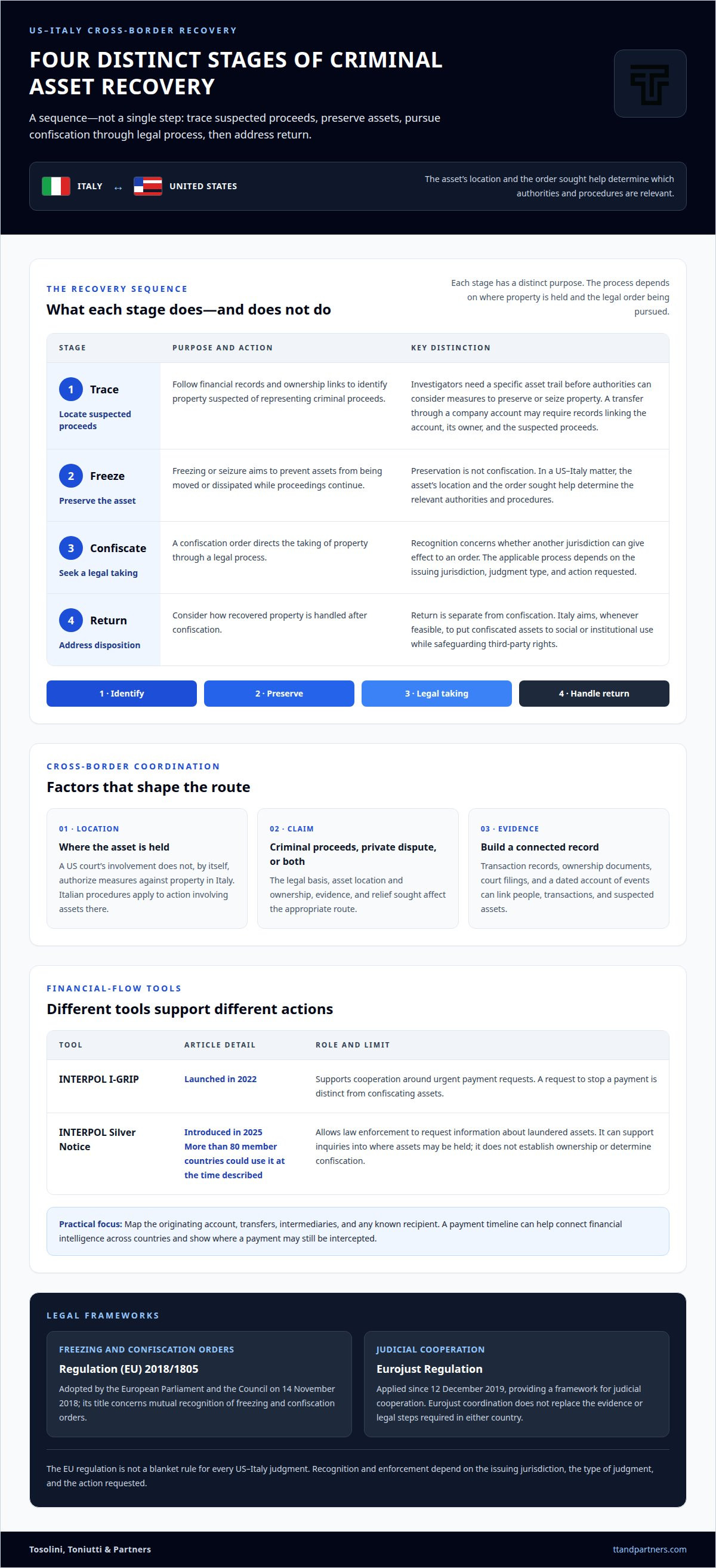
Recovery involves four distinct actions: locating suspected proceeds, preserving them, seeking confiscation, and addressing their return. Each stage depends on where the asset is held and the legal order being pursued.
Tracing and Seizing Criminal Assets
Tracing follows financial records and ownership links to identify property suspected of representing criminal proceeds. Investigators need a specific asset trail before authorities can consider measures to preserve or seize property. For example, a transfer through a company account may require records connecting the account, its owner, and the suspected proceeds.
Freezing or seizure aims to prevent assets from being moved or dissipated while proceedings continue. These measures differ from confiscation, which determines whether property may ultimately be taken. In a US-Italy matter, the asset’s location and the order sought determine which authorities and procedures are relevant.
Confiscation Orders and Judgment Enforcement
A confiscation order directs the taking of property through a legal process; recognition concerns whether another jurisdiction can give effect to that order. The European Union states that Regulation (EU) 2018/1805 on the mutual recognition of freezing and confiscation orders was adopted by the European Parliament and the Council on 14 November 2018.
How do US and Italian courts recognize and enforce each other’s judgments? Recognition and enforcement depend on the issuing jurisdiction, the type of judgment, and the action requested. The EU regulation’s title concerns mutual recognition of freezing and confiscation orders; it is not a blanket rule for every US-Italy judgment.
Return is a separate stage from confiscation. Italy aims, whenever feasible, to put confiscated assets to social or institutional use while safeguarding third-party rights. Recovery analysis should therefore distinguish the state’s confiscation process from questions about affected owners and the eventual disposition of property.
Tracking and intercepting illicit financial flows
Illicit financial flows can pass through multiple accounts, companies, and jurisdictions before investigators identify their destination. Start by mapping the movement of funds: note the originating account, transfers, intermediaries, and any known recipient. In a US-Italy matter, this timeline can help connect financial intelligence from each country and show where a payment may still be intercepted.
INTERPOL launched its I-GRIP stop-payment mechanism in 2022. It supports cooperation around urgent payment requests, but a request to stop a payment is distinct from confiscating assets. The practical objective is to act while funds remain traceable or movable, then preserve records that show the route and parties involved.
INTERPOL introduced the Silver Notice in 2025 as a tool for law enforcement cooperation. At the time described, more than 80 INTERPOL member countries could use it to request information about laundered assets. It can support inquiries into where assets may be held; it does not itself establish ownership or determine whether property should be confiscated.
That figure concerns assets authorities sought to trace, not funds recovered. In a US-Italy investigation, a notice may connect an asset lead with information held in another country, while court or enforcement action remains a separate step.
The scale of the challenge is stark: countries recover less than 1% of global illicit financial flows. This makes the timing and quality of financial intelligence important. A transfer record, corporate ownership link, or payment instruction can help investigators follow funds across accounts. Organizing those clues by date and transaction creates a clearer picture for authorities assessing where to direct further inquiries.
Asset tracing and asset recovery offices
Asset tracing offices help authorities identify, analyze, and coordinate information about property suspected of criminal origins. Their role differs from a court’s: tracing can produce leads, while legal authorities decide whether to seek measures against assets. In a US-Italy case, a documented chain of transfers can connect an account, an owner, and property held across borders.
Which US and Italian agencies handle cross-border asset recovery? Relevant US prosecutors and law-enforcement authorities work on the US side, while Italian national authorities address assets and proceedings in Italy. Italy’s Guardia di Finanza is a named participant in this field and has hosted an asset-targeting and recovery forum. Eurojust supports judicial cooperation between national authorities.
Information systems can also help practitioners understand how recovery efforts develop. The StAR Asset Recovery Watch tracks prosecution authorities’ efforts to pursue assets stemming from corruption. Its database organizes completed and ongoing international recovery efforts involving corruption proceeds. It provides a structured view of cases, not an investigative office that traces or freezes property.
For a specific investigation, identify the suspected asset, establish its connection to relevant people or transactions, and direct the information to the appropriate national authorities. A company registry entry, account record, or court document may point to a lead, but each item needs context. A consistent timeline helps distinguish direct ownership from indirect links and shows where cross-border cooperation may matter.
The World Bank and the United Nations state that they do not guarantee the accuracy of data in the StAR database. Treat it as a research resource, not proof of ownership or wrongdoing. Underlying records and proceedings remain central to case analysis; database entries can help frame questions, but they cannot settle them.
If your matter involves assets or proceedings in both countries, cross-border legal coordination can clarify how the relevant jurisdictions fit together.
Tosolini, Toniutti & Partners: INTERNATIONAL LITIGATION
Tosolini, Toniutti & Partners provides international litigation for matters involving legal proceedings across borders. If a recovery dispute connects US parties, Italian assets, or proceedings in both jurisdictions, the firm’s litigation support can help assess the claims, evidence, and procedural issues shaping the case.
Consider international litigation when an asset-related dispute requires coordinated legal analysis across jurisdictions, such as interpreting a judgment alongside property or transaction records held in another country. The appropriate route depends on the claim, the asset, and proceedings already underway. Clear coordination helps define the issues and available legal steps.
For guidance on an international dispute involving the United States and Italy, contact Tosolini, Toniutti & Partners to discuss your matter.
Set a Clear Direction for Your Cross-Border Matter
Start by defining the legal objective before deciding how to proceed. A recovery effort may involve preserving a claim, addressing a dispute, or coordinating proceedings connected to assets in another country. The right direction depends on the parties, the property, and the legal action under consideration.
For international asset recovery between the US and Italy, that initial legal framing can help keep cross-border decisions aligned. Tosolini, Toniutti & Partners handles international litigation and also assists clients with E-2, E-1, and O-1 visas. These are distinct legal matters, but each calls for careful attention to the rules and documents relevant to its context.
If you’re considering a legal response to a dispute involving both countries, contact Tosolini, Toniutti & Partners to discuss the matter. A considered next step can bring greater clarity to a complex cross-border situation.
Frequently Asked Questions
What is international asset recovery between the US and Italy?
International asset recovery between the US and Italy involves coordinated legal and investigative work concerning assets connected to alleged crime in both countries. For example, a payment originating in the United States may lead investigators to property or accounts in Italy. The case must connect suspected proceeds to specific assets and address the legal process in each relevant jurisdiction.
What steps are required to trace, freeze, and seize assets in Italy?
The process generally moves from identifying a specific asset to requesting measures through the relevant Italian procedures. Investigators may use transaction information, ownership records, and cross-border cooperation to establish where property is held. Italy’s system includes preventive and non-conviction-based confiscation measures, but the appropriate route depends on the case and the legal basis for the requested action.
How can a US claimant request mutual legal assistance or asset freezing in Italy?
A US claimant typically needs to pursue a request through the appropriate legal authorities; a private request is not an order to freeze property. The request should identify the suspected assets and explain their connection to the matter. Italy has international cooperation tools for tracing assets across borders, and judicial coordination may also matter when proceedings involve both countries.
How are recovered assets returned or shared between the US and Italy?
Return or sharing depends on the proceedings, the legal orders involved, and the rights of affected third parties. Confiscation alone does not determine how property will ultimately be allocated. Italy aims, whenever feasible, to put confiscated assets to social or institutional use while safeguarding third-party rights. A cross-border case therefore requires separate consideration of the asset’s disposition.



Comments