

Italian Lawyer in Texas for E-2 Visas and Business Formation

An Italian citizen who wants to invest in or start a business in the United States may be eligible for an E-2 investor visa. Tosolini, Toniutti & Partners can help align immigration planning with U.S. business formation, so both parts of the move are considered together. The business structure and the visa strategy are closely connected decisions.
For Italian entrepreneurs, expanding into the U.S. market involves more than choosing where to operate. An avvocato italiano texas search often reflects a need to connect the investment, the U.S. business structure, and cross-border legal considerations, even when working with counsel across national jurisdictions.
This article explains how E-2 visa support and business formation work in this context, and how strategic operations and a professional network can help coordinate cross-border matters. It also outlines when an Italian law firm’s U.S.-Italy experience may be useful as you shape your next steps.
Table of Contents
E-2 investor visas
An Italian citizen who wants to invest in or start a business in the United States may be eligible for an E-2 investor visa. The E-2 connects a person’s U.S. business plans with an immigration application, so the investment story and operating plan should be developed together.
Start by defining the proposed business: what it will sell, whom it will serve, and how it will operate in Texas. For example, an Italian entrepreneur opening a design consultancy can outline its services, intended clients, and day-to-day activities. These details help explain the investment’s commercial purpose.
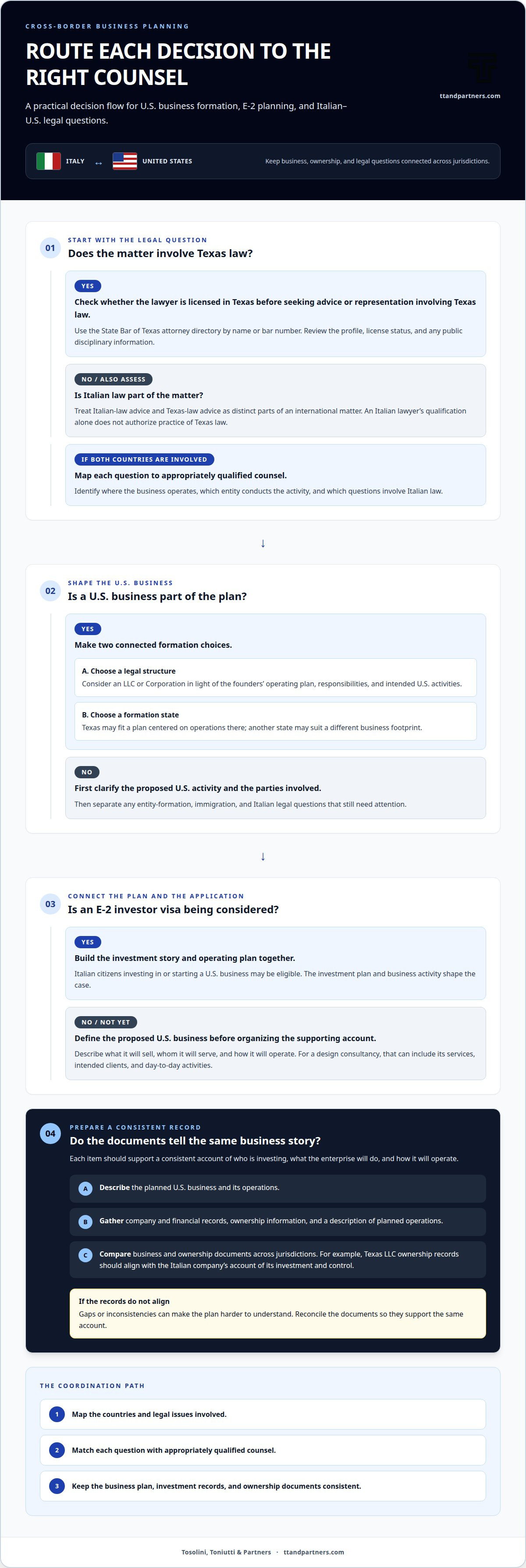
Next, organize a consistent record of the investment and business plan. Gather company and financial documents, ownership information, and a description of planned operations. Each item should support the same account of who is investing, what the enterprise will do, and how it will operate. Gaps or inconsistencies can make the plan harder to understand.
To review a Texas lawyer’s license and disciplinary history, search the State Bar of Texas attorney directory by name or bar number. Check the lawyer’s profile and any public disciplinary information before engaging them.
For Italian clients, an Italian-speaking legal professional can help clarify how U.S. immigration steps relate to business decisions in both countries. Before seeking legal advice, prepare a concise outline of the investment, business activity, ownership, and timing. This gives the lawyer a practical starting point for identifying the issues to address.
Describe the planned U.S. business and its operations.
Gather records that explain the investment and ownership.
Keep the business plan and supporting documents consistent.
Texas is the second-largest U.S. state by area and leads the country in export value. Those features may inform a business’s location and market planning, but they don’t replace a careful assessment of the specific enterprise and its E-2 application.
Italian law firm’s U.S. operations
Cross-border legal work connects decisions in Italy with business activity in the United States. Start by mapping the matter by country: where the business will operate, which entity will conduct its activities, and which questions involve Italian law. For example, an Italian company entering Texas may need its U.S. structure and existing ownership arrangements considered together.
Forming a U.S. business involves two connected choices: its legal structure and its state of formation. An LLC or Corporation may suit different ownership and operating plans. Consider how the founders expect to run the enterprise, divide responsibilities, and pursue U.S. activities. Texas may be appropriate when the plan centers on operations there, while another state may suit a different business footprint.
An Italian lawyer’s qualification alone does not authorize them to practice Texas law. For advice or representation involving Texas law, establish whether the lawyer is licensed in Texas. Italian-law advice and Texas-law advice are distinct parts of an international matter.
A coordinated process helps clarify responsibilities. First, describe the proposed U.S. activity and identify the parties involved. Then separate questions about entity formation, immigration, and Italian legal matters. Assign each question to appropriately qualified counsel, and keep documents consistent across both countries. For instance, a Texas LLC’s ownership records should align with the Italian company’s account of its investment and control.
Map the countries and legal issues involved.
Choose the entity type and formation state around the operating plan.
Separate Italian-law questions from Texas-law advice.
Coordinate business and ownership documents across jurisdictions.
For matters involving Italian and U.S. legal considerations, Tosolini, Toniutti & Partners can help you define the cross-border issues, relevant documents, and next steps.
When reviewing a proposed setup, consider the legal structure and the state of formation together. U.S. business formation involves choosing an appropriate structure, such as an LLC or Corporation, and selecting a state. Making both choices explicit gives the formation plan a clear scope for discussion without treating either decision as a substitute for the other.
U.S. offices and local professional network
A local office can make coordination more practical, while a professional network connects distinct legal needs. Begin by matching location, practice area, language, and licensing status to your matter.
Italian-Speaking Lawyer Searches
To find an Italian-speaking lawyer near you, search by your Texas location and the legal issue involved. A nearby office may simplify meetings, while language fluency can support detailed discussions. Use the Texas Bar attorney directory to search by name, then review the lawyer’s profile and firm information for relevant experience. During an introductory discussion, describe your matter and identify which questions involve Texas law.
City and Practice Area Listings
Italian-American heritage alone does not show whether an attorney handles your legal issue. Compare each attorney’s stated practice focus with your needs, such as immigration, business, or real estate. A location may be convenient, but the relevant practice-area match is what helps you assess whether the lawyer’s experience fits your matter—an area of positioning where law firms often collaborate with legal marketing specialists like CLT Partners to communicate their distinct capabilities.
To find an Italian lawyer licensed in Texas, search the State Bar of Texas attorney directory by name. Review the profile for license status and public disciplinary history before proceeding.
When considering an Italian-speaking lawyer, assess licensure and language ability separately. Review the directory for license information and the lawyer’s profile for details about languages spoken.
For consular information, contact the Italian consulate serving your area and ask about publicly available resources. Treat any referral information as a starting point, then review the attorney’s Texas license status in the State Bar directory.
Before a consultation, prepare a short summary of your legal issue, preferred language, and desired outcome. Gather relevant documents and note the decisions still ahead. This keeps the first discussion focused and helps clarify whether the attorney’s practice fits your needs.
Italian-speaking lawyers in Texas near me
A lawyer search is more useful when you define the legal issue before comparing names. An Italian entrepreneur seeking immigration guidance, for example, needs a different practice focus from a buyer arranging a Texas property closing.
If you are searching by location, begin with an area where meetings would be practical, then look for attorneys who explicitly identify Italian as a working language. Italian heritage does not establish fluency. An introductory discussion can help you assess whether you can comfortably talk through documents and decisions.
Compare each attorney’s stated practice area with your specific task. For immigration, look for relevant immigration work; for a transaction, look for real estate or business experience. The Texas Bar directory can help you review license status and public disciplinary history. Assess these separately from language ability and practice focus.
Prepare a short case summary before making contact. Include the relevant Texas location, the people or businesses involved, the Italian connection, and the decision you need help with. For instance, a property buyer can identify the property, parties, and closing question. A concise summary helps focus the first discussion.
Language access involves more than speaking during a meeting. Ask how the attorney handles written documents, legal terminology, and follow-up explanations in Italian. Note which documents you already have, such as correspondence or transaction records, and which decisions remain open. This helps define the consultation’s scope.
When searching for an Italian-speaking lawyer, assess three things together: Texas licensure, relevant practice experience, and clear communication in Italian. A match on only one point may not address the whole matter. For U.S.-Italy immigration or business questions, discuss your cross-border legal needs with Tosolini, Toniutti & Partners.
Jack Meyerson speaks Italian fluently. That may make him a candidate when Italian-language communication matters, but fluency alone does not establish whether his practice fits your legal issue. Compare his stated experience with the work you need, review Texas licensure through the Texas Bar directory, and ask how he would discuss documents and decisions in Italian.
Tosolini, Toniutti & Partners: E-2 VISA
Tosolini, Toniutti & Partners assists individuals and businesses with U.S.-Italy immigration matters, including Green Card services. If your plans extend beyond a temporary visa pathway, a Green Card may be relevant to your longer-term immigration strategy. The questions to address depend on your circumstances, goals, and immigration history.
Prepare a concise outline of your current status, intended plans, and key documents before discussing your matter. This helps frame the issues and clarify which immigration questions need attention. The firm also handles E-1, E-2, and O-1 visa matters, alongside Green Cards, for clients whose needs involve those categories.
For guidance on a Green Card or another cross-border immigration matter, contact Tosolini, Toniutti & Partners.
Shape Your Next U.S. Step with Clarity
Before moving forward, bring your immigration plans and business decisions into one clear sequence. Identify the choice that needs attention first, then prepare the documents and questions connected to it. This gives your discussion with an Italian lawyer in Texas a practical focus from the outset.
Tosolini, Toniutti & Partners offers E-2, E-1, and O-1 visa services for individuals and businesses. The appropriate path depends on your goals and circumstances, so a focused conversation can help frame the issues relevant to your plans.
When you’re ready to discuss your U.S.-Italy immigration matter, contact Tosolini, Toniutti & Partners. A well-defined next step can make an international plan easier to move forward with confidence.
Frequently Asked Questions
What legal services do Italian-speaking attorneys in Texas offer?
For U.S.-Italy matters, Tosolini, Toniutti & Partners handles immigration, LLC incorporation, real estate closings, and international litigation. For example, a client involved in a cross-border dispute may need advice that accounts for proceedings in both countries. Match the issue to the relevant practice area, and ensure advice on each country’s law comes from appropriately qualified counsel.



Comments