

Legal Advice for Italian Entrepreneurs in the US

Incorporating in the United States is not automatically the right first step for an Italian business. Sound legal advice for Italian entrepreneurs in the US starts with the company’s goals, planned operations, and the consequences of connecting two legal systems.
A U.S. company may seem like a straightforward way to expand, but its structure can affect taxation, governance, and cross-border operations. The right decisions depend on where the company will do business and how its U.S. activities fit with its existing or planned operations in Italy.
This article explains when U.S. incorporation may make sense, when to involve a U.S.-licensed attorney, and why legal matters in both countries need coordinated consideration. It also outlines how immigration options such as the E-2 or E-1 visa may relate to a business plan, so you can see which legal questions belong together before moving forward.
Table of Contents
When incorporating in the United States makes business sense
U.S. formation makes sense when planned operations, customers, or investment call for a U.S. entity. For Italian founders, legal advice for Italian entrepreneurs in the US can connect that decision to the company’s objectives, operating plans, and immigration considerations.
Italian Business Structure Choices
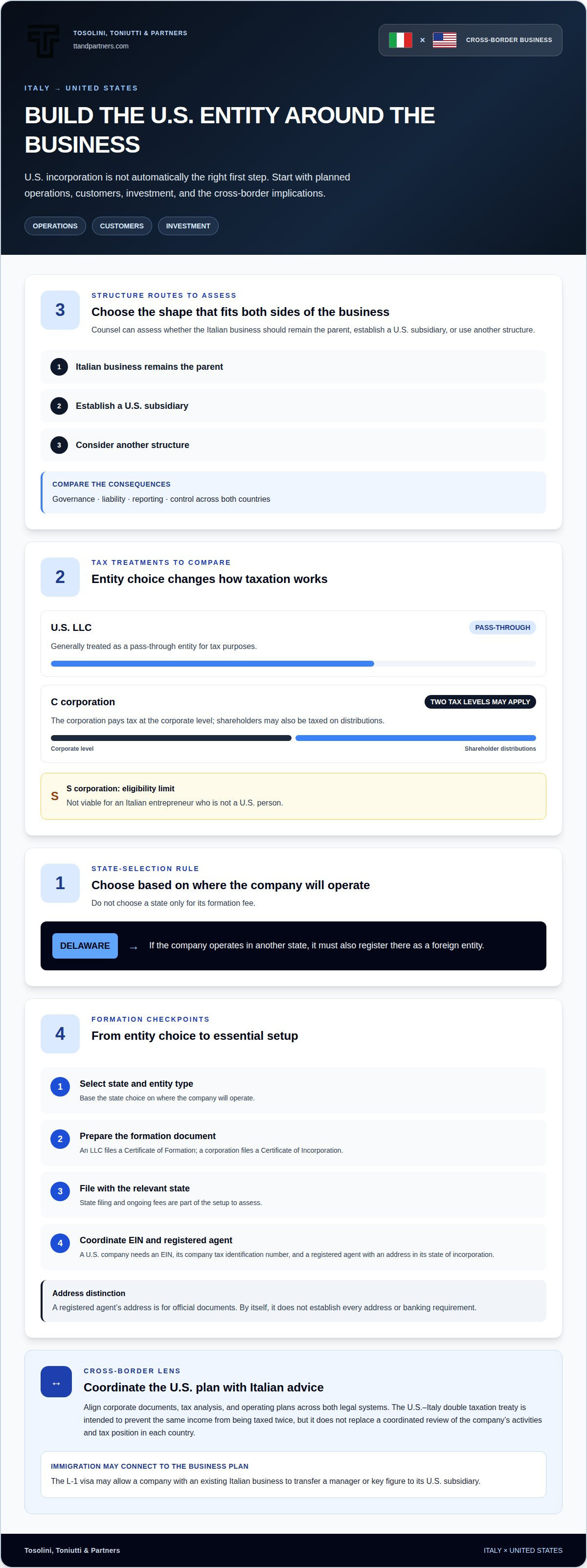
Legal counsel can assess whether the Italian business should remain the parent, establish a U.S. subsidiary, or use another structure. Each option affects governance, liability, reporting, and control across both countries. A U.S. LLC is generally treated as a pass-through entity for tax purposes, while a C corporation pays tax at the corporate level and shareholders may also be taxed on distributions. An S corporation is not viable for an Italian entrepreneur who is not a U.S. person.
Choose a state based on where the company will operate, not just its formation fee. A Delaware company operating in another state must also register there as a foreign entity.
Banking and Business Setup Requirements
Legal counsel can coordinate formation documents and clarify the information needed for banking arrangements. A U.S. company needs an EIN, its company tax identification number, according to the Internal Revenue Service. It must also appoint a registered agent with an address in its state of incorporation to receive official documents.
A registered agent’s address is used for official documents. It does not, by itself, establish every address or banking requirement. Counsel can identify the documents and address details relevant to the chosen state and planned activity. This is one practical part of legal advice for Italian entrepreneurs in the US, alongside planning ownership and operations.
Workforce Rules and Company Registration
Registration generally starts with selecting a state and entity type, preparing the formation document, and filing it with the relevant state. An LLC files a Certificate of Formation; a corporation files a Certificate of Incorporation. Counsel can coordinate related steps, including obtaining an EIN and appointing a registered agent, and assess state filing and ongoing fees.
For employment, payroll, and contractor arrangements, counsel can identify rules relevant to where people work and how each relationship functions. U.S. Citizenship and Immigration Services states that the L-1 visa may allow a company with an existing Italian business to transfer a manager or key figure to its U.S. subsidiary.
When Italian entrepreneurs need a U.S.-licensed attorney
U.S.-licensed counsel is important when a decision depends on U.S. law, state requirements, or a transaction involving U.S. assets. An Italian attorney may advise on Italian law and appear before Italian courts only if licensed in Italy. Avv. Dott. Massimo Leonardi is qualified in Italy and is not admitted to practise law in the United States, illustrating why the relevant jurisdiction matters.
For a U.S. corporate transaction, a lawyer can review contracts, investor rights, liability provisions, and real estate documents under the applicable law. The review should clarify who owns intellectual property, how it may be used, and what happens to those rights if a business relationship ends. U.S. data privacy obligations also depend on the company’s activities: compliance with the California Consumer Privacy Act or HIPAA may be required when applicable.
Licensing and regulatory requirements matter especially before opening a restaurant, bar, or other regulated business. In New York City, liquor license applications for restaurants and bars may take several weeks to a few months to process. Counsel can identify the applications and supporting documents relevant to the proposed activity, then account for that timing in lease, investment, and opening decisions.
Industry permits can shape both the business plan and capital commitments. A restaurant’s licensing process differs from that of a company buying commercial property or offering services subject to specific regulatory requirements. Legal review connects the proposed activity, location, contracts, and compliance obligations before the business commits to a lease or investment.
For cross-border matters, assign each legal question to counsel qualified in the relevant jurisdiction, then coordinate decisions affecting both sides. This is especially useful when U.S. contracts, data handling, or real estate intersect with Italian ownership or operations. Discuss cross-border legal coordination when a decision spans both countries.
Cross-border legal coordination between Italy and the United States
U.S. and Italian legal decisions can affect the same business, even when made on opposite sides of the border. Coordination aligns corporate documents, tax analysis, and operating plans across both national systems.
Coordination with Italian Advisers
Set a shared process for U.S. attorneys, Italian legal advisers, and accountants. Start by defining who handles the legal questions in each jurisdiction and who gathers the business facts, ownership records, and transaction documents. For example, a planned U.S. subsidiary should be considered alongside its Italian parent’s governance and reporting. This makes assumptions visible before either side finalizes documents or advises on a transaction.
Aligning U.S. Legal Work with Italian Law and Tax
The United States and Italy have a double taxation treaty intended to prevent the same income from being taxed twice. The treaty does not replace a coordinated review of the company’s activities and tax position in each country. U.S. counsel can address American law, while Italian advisers assess Italian legal and tax implications. Aligning those analyses helps show how a contract, investment, or ownership decision in one country may affect the other.
U.S. attorneys in Italy may act as legal consultants on American law. For U.S. legal services, clients engage U.S. attorneys directly; Italian advice and coordination are handled separately. Clear responsibility for each workstream helps prevent an opinion on American law from being treated as Italian-law advice, or vice versa.
Operating a U.S. Business from Italy
Managing a U.S. company from Italy can raise questions about where its business activity creates tax obligations. U.S. activity can trigger U.S. tax obligations through a permanent establishment, which may also affect tax treatment in Italy. The analysis should reflect the actual operating model and the company’s U.S. and Italian positions, not just its place of formation.
State tax exposure also deserves attention. U.S. companies may face state taxes in addition to federal taxes, and the burden depends partly on where they incorporate and operate. Counsel and accounting advisers can map business activity across relevant states, then coordinate state and federal issues with Italian tax advice.
Choosing an attorney based on jurisdiction
The right lawyer depends on where the venture operates, which law governs its agreements, and where a dispute may be heard. A company formed in one state may do business elsewhere, so incorporation alone does not settle every legal question. Identify the relevant states and issues before beginning a consultation.
For example, Delaware has a specialized commercial court, the Court of Chancery. That may matter when owners are structuring governance agreements or anticipating a corporate dispute. It does not mean every Italian-owned business should incorporate in Delaware. The attorney’s analysis should connect the venture’s operations, ownership arrangements, governing documents, and likely dispute forum.
Jurisdiction also shapes contract review. Counsel should examine which law an agreement selects, where claims may be filed, and how its terms address reporting, decision-making, and transfers between owners. For a U.S. subsidiary with an Italian parent, those provisions should fit the company’s actual structure. A contract drafted for one state may not address obligations arising from activity in another.
Match the legal work to the question. A state-specific formation or commercial matter calls for counsel familiar with that jurisdiction; Italian-law questions require advice from an Italian-qualified attorney. If a transaction touches both systems, define who addresses each issue and how the advice will be coordinated. This helps ensure an opinion on one jurisdiction is not treated as advice on another.
Before retaining counsel, organize the key documents: formation records, ownership agreements, contracts, and any notices related to a dispute. These materials help frame the legal questions, identify the governing jurisdiction, and clarify whether the matter concerns a transaction, ongoing operations, or litigation. The decision should turn on the issue and applicable law, not simply the company’s formation state.
Tosolini, Toniutti & Partners
Tosolini, Toniutti & Partners helps Italian entrepreneurs connect U.S. business plans with relevant cross-border immigration matters. Its work includes Green Card assistance, which may be relevant when long-term U.S. residence forms part of an entrepreneur’s plans. The firm also handles E-1, E-2, and O-1 visa matters, each of which may align with different business or professional circumstances.
Consider legal support when an investment, U.S. expansion, or immigration plan calls for coordinated attention across Italy and the United States. A clear discussion of your business structure, intended U.S. activities, and objectives can help define the legal questions and next steps.
For guidance on your cross-border plans, contact Tosolini, Toniutti & Partners.
Set a Clear Direction for Your U.S. Plans
The next step is to turn your business objectives into a coordinated legal plan. Thoughtful legal advice for Italian entrepreneurs in the US can clarify which decisions need attention first, which jurisdiction applies, and how U.S. plans relate to your Italian interests. Bring those priorities into one discussion before committing to a course of action.
Tosolini, Toniutti & Partners assists with E-2, E-1, and O-1 visa matters alongside cross-border legal needs. The relevant path depends on the entrepreneur’s circumstances and goals, so a focused conversation can help frame the questions that matter to your next decision.
Contact Tosolini, Toniutti & Partners to discuss your plans and identify a considered next step. A well-structured approach can make a complex expansion easier to assess, giving your business a clearer foundation for moving forward.
Frequently Asked Questions
What U.S. business entity should an Italian entrepreneur choose: LLC, C corporation, or S corporation?
The best fit depends on ownership, planned operations, and how profits will be handled. An LLC may suit an owner seeking pass-through tax treatment, while a C corporation may fit a venture planning to retain or distribute profits under a corporate structure. An S corporation is generally unavailable to an Italian entrepreneur who is not a U.S. person. Compare these effects with the Italian parent’s governance and tax position.
What visas allow Italian entrepreneurs to start and operate a business in the United States, including the E-2 treaty investor visa?
Relevant routes include the E-2 for Italian nationals investing in and controlling a real, operating U.S. business, and the E-1 for treaty traders. L-1 may support transferring a manager or key figure from an existing Italian business to its U.S. subsidiary, according to U.S. Citizenship and Immigration Services. The O-1 is temporary; an EB-1A is a Green Card category. The appropriate route depends on the entrepreneur’s role and business circumstances.
How do U.S. federal and state taxes apply to Italian-owned businesses and their owners?
U.S. tax exposure can involve federal and state rules, while Italian tax treatment may also matter. The United States and Italy have a double taxation treaty intended to prevent the same income from being taxed twice. For example, a business operating across state lines may need to assess state obligations alongside federal ones. Italian controlled foreign company and tax-residence rules can also affect how an overseas structure is treated.
How can Italian entrepreneurs find an attorney or accountant experienced in U.S.-Italy cross-border business?
Start by defining whether the immediate need concerns U.S. law, Italian law, tax, or a transaction involving both countries. In an initial consultation, explain the ownership structure, planned operations, and decisions ahead, and share relevant company documents and contracts. Confirm that U.S. legal questions are handled by U.S.-licensed counsel, while Italian-law advice comes from an Italian-qualified attorney. A shared scope helps advisers coordinate without blurring their roles.



Comments