

Piercing the Corporate Veil for Foreign LLC Owners: When Personal Liability Can Apply

For foreign LLC owners, personal liability may arise when a court finds that the company was not treated as a separate entity and that its owner misused it. Piercing the corporate veil for foreign LLC owners can allow a business creditor to reach an owner’s personal assets, but the analysis depends on the law applied and the facts of the case.
An LLC’s liability protection is meaningful, but it is not absolute. Commingling personal and business funds, using company money to pay personal obligations, or using the LLC for improper conduct can weaken the separation that protection depends on.
This article explains what may lead a court to disregard an LLC’s separate identity, why foreign ownership does not remove the need for careful business practices, and how clear financial records, adequate capitalization, and documented transactions can help preserve that separation. It also distinguishes ordinary operational mistakes from conduct that may support personal liability, so you can better understand the risks and when legal guidance may help.
Table of Contents
Commingling business and personal finances
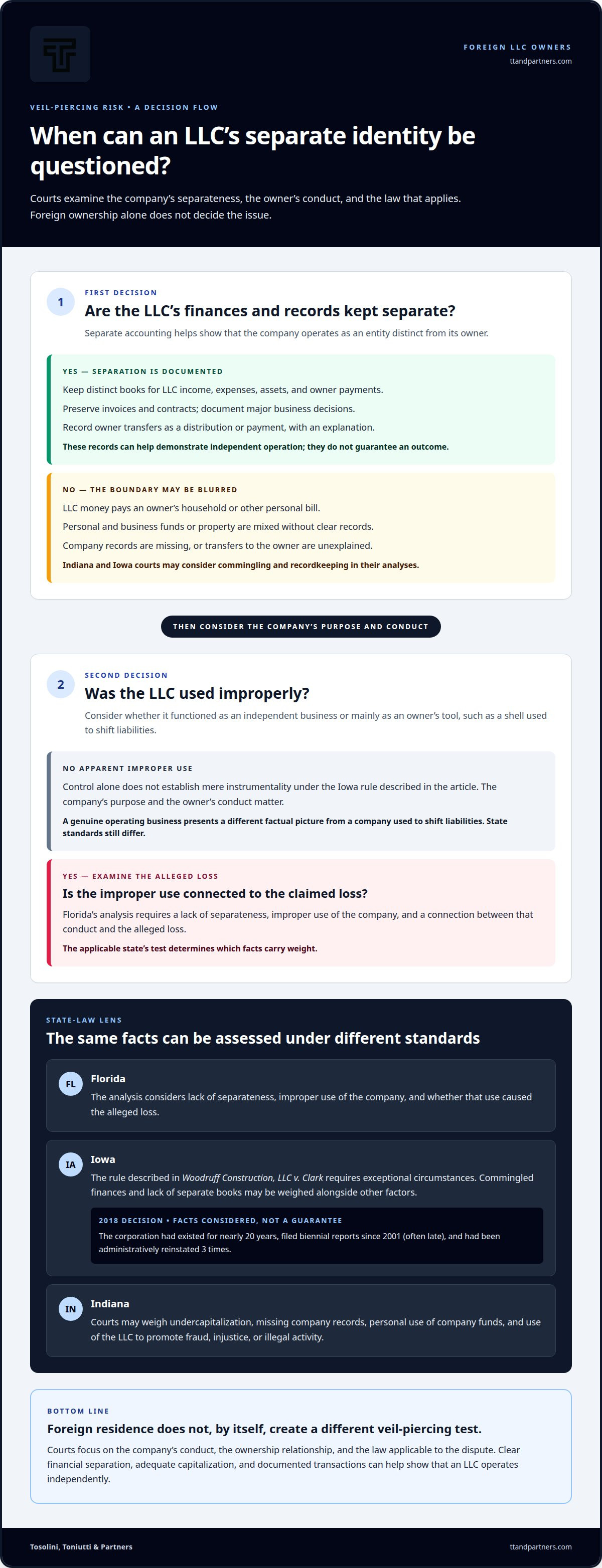
Separate finances help demonstrate that an LLC operates as an entity distinct from its owner. Commingling can blur that boundary and become evidence in a veil-piercing dispute.
Mixing Business and Personal Assets
Commingling occurs when an owner treats LLC money or property as personal, or mixes personal and business funds without clear records. For example, paying a household bill directly from the LLC account can make the company appear less independent. Indiana courts may consider company payments of an owner’s individual obligations and the mixing of personal and business assets. Iowa courts may also consider commingled finances when deciding whether to pierce the veil.
Separate Accounting and Business Records
Separate accounting means recording the LLC’s income, expenses, assets, and payments to owners apart from personal finances. Keep distinct books, preserve invoices and contracts, and document major business decisions. When an owner takes money from the company, record it as a distribution or payment rather than leaving it unexplained. Indiana courts may consider missing company records, while Iowa courts may weigh a lack of separate books alongside other factors.
An LLC formed in one state may need to register as a foreign LLC in another state if its activities there meet that state’s qualification rules. Formation in one state alone does not determine whether registration is required elsewhere.
Failure to register can lead to state-specific penalties or complications, including limits on bringing a lawsuit in that state. The consequences depend on the state’s rules and the LLC’s activities there, so registration and financial separation are separate issues.
An owner’s residence outside the United States does not, by itself, determine whether a court may pierce an LLC’s veil. Courts examine the company’s separateness and the owner’s conduct, including whether personal and business affairs were blurred. In Florida, the analysis also considers improper use of the company and whether that conduct caused the alleged loss.
For foreign LLC owners, careful records can help show that company transactions serve business purposes. Keep personal expenses out of LLC accounts and document every transfer between the business and its owner. Whether managing entities in the U.S. or coordinating international corporate governance and accounting with advisory firms like Elevate Advisory Group Kft., consistent financial separation is essential across jurisdictions.
Alter ego and mere instrumentality
An alter-ego claim argues that an owner and an LLC operated as one, rather than as separate entities. A court may examine whether the owner controlled the company so completely that their financial and business affairs became confused. For foreign owners, piercing the corporate veil for foreign LLC owners turns on the same central distinction: whether the company functioned independently under the law applied.
Mere instrumentality describes a company used mainly as an owner’s tool rather than as an independent business. In Iowa, a court may pierce the veil when a corporation is a shell used primarily to perpetrate fraud or promote injustice. Control alone does not establish this; the company’s purpose and the owner’s conduct matter. A company formed for genuine operations presents a different factual picture from one used to shift liabilities.
State standards differ. Florida requires proof of a lack of separateness, improper use of the company, and a connection between that conduct and the claimed loss. Iowa requires exceptional circumstances under the rule described in Woodruff Construction, LLC v. Clark. Indiana courts may weigh undercapitalization, missing records, personal use of company funds, and use of the LLC to promote fraud, injustice, or illegal activity. These differences matter when assessing piercing the corporate veil for foreign LLC owners because the applicable state’s test determines which facts carry weight.
The Iowa Court of Appeals’ 2018 Woodruff Construction decision illustrates why age or formal filings alone may not settle the issue. The corporation had existed for nearly 20 years and filed biennial reports since 2001, though often late. It had also been administratively reinstated three times. Those facts formed part of the court’s assessment, not a guarantee of protection.
An owner’s residence outside the United States does not, by itself, create a different veil-piercing test. Courts focus on the entity’s conduct, the ownership relationship, and the law applicable to the dispute. A foreign address does not overcome evidence that an LLC functioned as a personal account or a shell.
When an LLC is involved in a U.S. property transaction, carefully structured real estate closing support can help clarify the company’s role in the transaction documents.
Avoiding personal liability
Risk management starts when the LLC is formed and continues through daily operations. Fund the company sufficiently for its expected needs, and keep a clear record of later capital contributions. A business unable to meet ordinary obligations may face scrutiny over whether it was adequately capitalized.
Use the operating agreement to guide decisions, distributions, and authority. Follow its terms and applicable state law when approving significant transactions. If the agreement requires member approval for a major commitment, document that approval before the LLC acts. Periodic reviews can identify practices that no longer fit the company’s structure.
Record owner draws and distributions, including their purpose and amount.
Keep contracts, invoices, and approvals with the LLC’s business records.
Complete required state filings and maintain accurate tax records.
Document major decisions in meeting minutes when the company holds meetings.
These records help explain how a decision was made and who authorized it. For example, minutes recording approval of a significant purchase can distinguish a business decision from an owner’s personal transaction. Separate tax returns and accurate books also help show that the LLC operates independently.
Capital and records are not enough if the company is used improperly. Do not use an LLC to promote fraud, illegal activity, or negligent conduct. Ethical, transparent operations support the credibility of the company’s records and transactions.
Take care when discussing company debts with lenders, suppliers, or other creditors. Do not tell a creditor that you will personally guarantee an LLC obligation unless you intend to accept that responsibility. A signed personal guarantee can create a separate basis for liability, apart from any veil-piercing claim.
Review these practices as the business changes, particularly after new financing, ownership changes, or major commitments. Consistent funding, documented decisions, accurate filings, and compliance with the operating agreement create a clearer record of the LLC’s separate operations.
Corporate and LLC limited liability
An LLC is separate from its owners, who generally are not personally liable for company debts. That protection also applies to foreign owners. In piercing the corporate veil for foreign LLC owners, the question is whether the company’s separate identity should be disregarded under the law governing the dispute.
In Florida, veil piercing is an equitable doctrine, not a standalone cause of action. It may allow a creditor to reach an owner’s assets after the company is found liable and cannot satisfy the judgment. In Dania Jai-Alai Palace, Inc. v. Sykes, the Florida Supreme Court held that improper conduct must be shown before a corporate veil can be pierced.
A Florida plaintiff must prove a lack of separateness, improper use of the company, and that the conduct proximately caused the claimed loss. These elements link the owner’s conduct to the creditor’s harm. A filing lapse alone, for example, does not establish that the owner misused the LLC or caused the loss.
Standards vary by state, so foreign owners must consider the law relevant to the dispute rather than assume there is one nationwide test. The analysis of piercing the corporate veil for foreign LLC owners also distinguishes ordinary company debts from obligations tied to an owner’s own conduct. A personal guarantee, for example, may create direct responsibility under its terms, separate from veil piercing.
To maintain limited liability, foreign owners should operate the LLC as a distinct entity, follow its operating agreement and applicable state laws, and preserve records of significant decisions. Corporations have different formalities: they should follow adopted bylaws and document corporate actions. Annual meetings and detailed minutes can help record those actions. Florida courts do not treat failure to maintain formalities alone as sufficient without further proof of intent or misconduct.
For an LLC property purchase, a carefully structured real estate closing can clarify the company’s role in the transaction documents. Discuss an LLC real estate closing when the transaction requires legal coordination.
Tosolini, Toniutti & Partners
Tosolini, Toniutti & Partners helps frame LLC liability questions within the broader context of U.S.-Italy business and immigration matters. Foreign ownership or residence alone does not determine whether an owner may face personal liability; the company’s conduct and applicable state law remain central. When an owner’s U.S. immigration plans are also part of the picture, the firm handles Green Card matters, while immigration status and veil-piercing analysis remain distinct legal issues.
Consider reaching out when a U.S. business decision intersects with cross-border plans or you need to understand how these matters fit together. Contact Tosolini, Toniutti & Partners to discuss your situation.
Plan Your Next Cross-Border Decision
For an overseas owner, a U.S. business is part of a wider set of commercial and personal decisions. The risks of piercing the corporate veil for foreign LLC owners are best considered alongside the company’s plans, cross-border transactions, and the owner’s U.S. objectives. This broader perspective can help clarify which questions need attention before a dispute or major business change arises.
Tosolini, Toniutti & Partners works with individuals and corporate clients on cross-border matters, including LLC incorporation and international litigation. Its immigration services include E-1, E-2, and O-1 visas. These matters are distinct from veil-piercing analysis, but may intersect with a business owner’s broader U.S. plans.
If you’re weighing how a U.S. business decision fits your cross-border circumstances, contact Tosolini, Toniutti & Partners to discuss the next step. A considered approach can help you move forward with greater clarity.
Frequently Asked Questions
Piercing the Corporate Veil: When Can the Owners Be Liable?
Owners may face personal liability when a court finds grounds to disregard the LLC’s separate identity. The analysis may consider whether owners treated the company as an extension of themselves, misused it, or caused a creditor’s loss through improper conduct. An unpaid creditor claim alone does not establish owner liability; the evidence and the applicable state’s legal test matter.
What does piercing the corporate veil mean for an LLC?
It means a court may set aside the LLC’s liability separation in a particular dispute, allowing a creditor to pursue an owner’s personal assets for a company obligation. It does not automatically dissolve the LLC or make owners responsible for every company debt. The outcome depends on the claim, the company’s conduct, and the legal standard applied.
Can foreign owners of a U.S. LLC be personally liable for its debts?
Yes. Foreign residence or citizenship does not, by itself, prevent personal liability if a court finds grounds to hold an owner responsible. The court must also have jurisdiction over that individual, assessed through the owner’s own relevant contacts with the state. Ownership of an LLC or another party’s contacts alone do not resolve that separate question.
What factors do U.S. courts consider when piercing an LLC veil?
Courts may examine whether the owner and LLC operated independently, whether company funds or assets were misused, and whether improper conduct caused the claimed harm. State approaches differ: Florida requires proof of improper use and causation, while the Iowa rule described requires exceptional circumstances. Indiana courts may weigh undercapitalization, company records, payment of personal obligations with company funds, and improper purposes.
Can commingling funds, undercapitalization, or fraud expose LLC owners to liability?
Yes, those circumstances may support a veil-piercing claim, particularly when they show that the LLC lacked independence or was used to harm creditors. For example, using company funds to pay an owner’s personal obligation may be evidence of blurred boundaries. These facts are considered in context; no single factor automatically establishes personal liability.
Are foreign LLC owners personally liable for unpaid taxes, wages, or regulatory violations?
Not automatically just because the LLC has an unpaid obligation. Veil piercing is one possible basis for reaching an owner’s assets, while responsibility may also depend on whether the individual personally participated in wrongful or fraudulent conduct. Taxes, wages, and regulatory obligations can involve distinct rules, so assess the specific obligation and the owner’s role separately.


Comments