

Proving Uninterrupted Italian Lineage for Citizenship by Descent

An Italian mother may be the starting point for a citizenship claim, but her connection alone does not establish an uninterrupted line. Proving uninterrupted Italian lineage means showing how citizenship passed from one generation to the next and whether an event, such as naturalization or renunciation, interrupted that transmission.
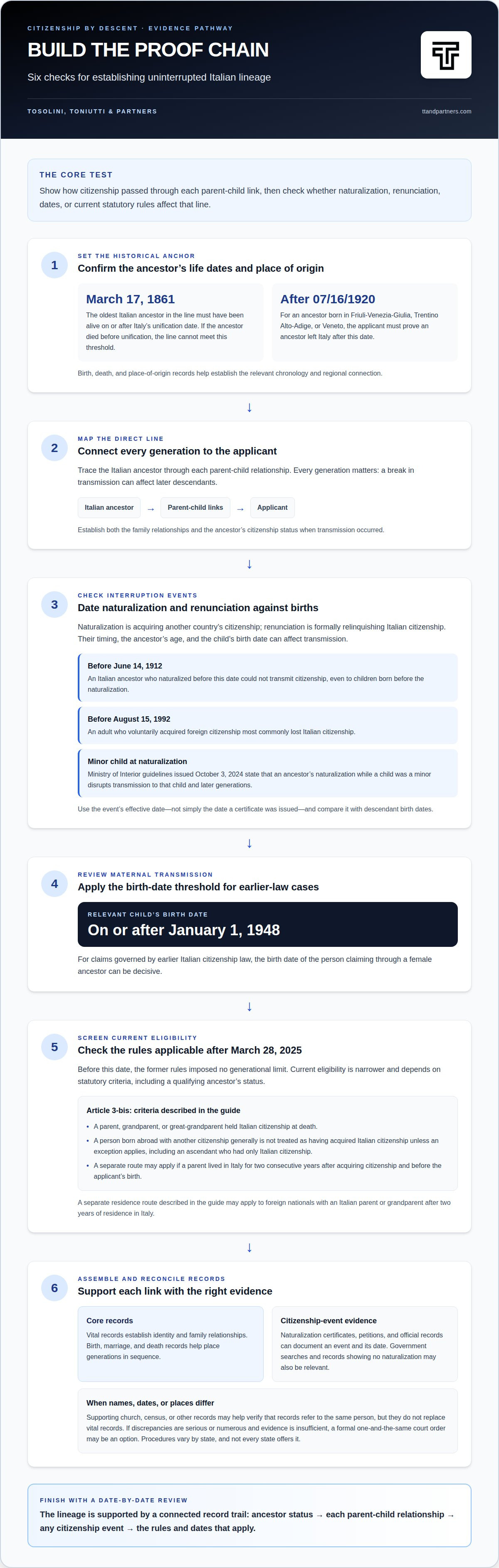
If your mother is Italian, you may be eligible for recognition, but the relevant dates and documents matter. Under the rules described for earlier Italian citizenship law, a claim through a female ancestor generally requires the child in the relevant generation to have been born on or after January 1, 1948.
This guide explains what an unbroken lineage means, how naturalization and renunciation can affect a claim, and which records help establish identity and family relationships. It also outlines how Italy’s newer descent rules may affect eligibility, so you can see what evidence your family history needs to support.
Table of Contents
What is Italian citizenship by descent?
Italian citizenship by descent is citizenship transmitted through a family line, rather than obtained through residence. Eligibility now depends on the applicable rules and evidence connecting each generation.
Citizenship Through a Direct Line
A direct line traces citizenship from an Italian ancestor through parent-child relationships to the applicant. Each generation matters because a break in transmission can affect every later descendant. The Presidenza del Consiglio dei Ministri states that citizenship by birth passes to a child of an Italian-citizen father or mother. A citizenship application therefore needs to establish both family relationships and the ancestor’s citizenship status when transmission occurred.
Naturalization and Descendant Transmission
Naturalization is an ancestor’s voluntary acquisition of another country’s citizenship, and its timing can affect descendants. An Italian ancestor who naturalized before June 14, 1912, could not transmit citizenship, even to children born before naturalization. Ministry of Interior guidelines issued October 3, 2024, state that an ancestor’s naturalization while a child was a minor disrupts transmission to that child and later generations.
Evidence may include naturalization certificates, petitions, or official records documenting an event and its date. To establish that an ancestor had not naturalized before a child’s birth, relevant evidence may include government searches and records showing no naturalization, together with any later certificate or court record. Compare the dates with the child’s birth and the rules that apply to that line.
Citizenship Through a Parent or Grandparent
A parent or grandparent may provide the link for a descent claim, but relationship alone does not establish current eligibility. Italy’s revised rules include Article 3-bis, paragraph 1, letter c of Law 91/1992, which addresses a parent, grandparent, or great-grandparent who held Italian citizenship at death. Normattiva states that a person born abroad with another citizenship generally is not treated as having acquired Italian citizenship unless an exception applies, including an ascendant who had only Italian citizenship.
The former rules imposed no generational limit before March 28, 2025; current eligibility is narrower and depends on statutory criteria, including the qualifying ancestor’s status. A separate route under Article 3-bis may apply when a parent lived in Italy for two consecutive years after acquiring citizenship and before the applicant’s birth.
Record collection and certification costs depend on the documents, issuing jurisdictions, and required formalities; processing time depends on locating and preparing those records. The €600 adult application fee is separate from record-related expenses.
Italian unification and the ancestor's required birth and life dates
Italy’s unification date sets a historical starting point for a descent claim. The oldest Italian ancestor in the line must have been alive on or after March 17, 1861.
This date concerns the ancestor’s life, not the applicant’s birth or the date the family moved to the United States. A family tree should connect the applicant to the Italian ancestor and establish the ancestor’s dates. Birth, marriage, and death records can help put each generation in sequence. If the ancestor died before unification, the descent line cannot meet this threshold.
Geography can add another date. For an ancestor born in Friuli-Venezia-Giulia, Trentino Alto-Adige, or Veneto, the applicant must prove that an ancestor left Italy after 07/16/1920. The ancestor’s birthplace and departure history therefore matter alongside family relationships. Records identifying a municipality or place of origin can help clarify which regional rule applies.
A separate route may be based on residence rather than descent. Foreign nationals with an Italian parent or grandparent may qualify for citizenship by residency after two years of residence in Italy. This route is distinct from proving direct lineage. Italian-language ability also cannot establish an ancestor’s birth, life, or departure dates: this historical test depends on records and chronology, not spoken fluency.
Address differences in names, dates, or places by showing that the records refer to the same person and explaining discrepancies with supporting evidence. Church, census, or other records may help verify identity, but they cannot replace vital records. If discrepancies are serious or numerous and supporting documents are insufficient, a formal one-and-the-same court order may be an option. Procedures vary by state, and not every state offers this option.
When records show different places or spellings, a focused review can clarify how they fit the lineage timeline. You can discuss a citizenship matter if the dates or identity evidence raise questions.
Naturalization and renunciation in the ancestry line
For a descent claim, citizenship must pass through each generation without a disqualifying loss. Naturalization and renunciation are distinct events: naturalization is the acquisition of foreign citizenship, while renunciation is the formal relinquishment of Italian citizenship. The record’s date, the ancestor’s age, and the child’s birth date help determine how either event affects a particular line.
Before August 15, 1992, an adult who voluntarily acquired foreign citizenship most commonly lost Italian citizenship. The sequence matters: compare the naturalization date with the births of descendants, then determine whether the ancestor remained an Italian citizen when the next generation was born. A certificate issued years later may document an earlier event, so the recorded effective date is more important than the document’s issue date.
Maternal transmission has a separate historical threshold. Under rules described for cases governed by earlier Italian citizenship law, a child claiming through a female ancestor must have been born on or after January 1, 1948. The date to examine is the birth date of the child in the generation where citizenship passed through the maternal line, not simply the applicant’s birth date. A pre-1948 birth can therefore change the route for recognition.
For a pre-1948 maternal-line case, the ordinary administrative rule may not resolve the claim. The line still needs records establishing the Italian ancestor, each parent-child relationship, and relevant foreign naturalization or renunciation dates. A municipality’s civil records may help establish births and marriages, while foreign naturalization records clarify whether citizenship changed before a descendant’s birth.
Build the chronology from original records and certified versions: the ancestor’s Italian birth, each marriage and child’s birth, then any foreign naturalization or renunciation. Without the date of an event, the transmission sequence may remain unresolved. Records from different authorities may use different spellings or calendar conventions. For cases governed by pre-reform legislation, distinguish the maternal birth threshold from the naturalization timeline, as each addresses a different point in the claim.
Proof of uninterrupted Italian lineage
Proving uninterrupted Italian lineage means showing that each generation connects to the next and that citizenship transmission remained legally intact. The evidence should present a consistent account of identity, family relationships, and citizenship history.
Application Routes for Proving Lineage
Consular, judicial, and municipality procedures involve different authorities and purposes. For applications abroad, a consulate reviews the claim and must certify that neither direct ascendants nor the applicant renounced citizenship under Article 7 of Law 13 June 1912, no. 555. A court can hear a judicial claim, while an Italian municipality maintains civil records and may issue certificates confirming identity. The route determines where the evidence is assessed.
Apostilles and Certified Translations
An apostille authenticates a public document for cross-border use, while a translation makes its contents readable to the receiving authority. An Italian birth record used in the United States to support an amendment must be apostilled, and both the record and apostille must be translated into English. This requirement applies to that specific use and should not be assumed to apply in the same way to every document in a citizenship file.
Documentation Gaps and Rejection Risks
Missing vital records, unexplained name differences, or gaps between generations can weaken an application. A baptism record generally cannot replace an Italian ancestor’s birth record, except when the municipality’s registry did not exist at the time of birth. If the certificate is unavailable, a copy may be held by a church in the ancestor’s municipality, a state archive, or a court.
Church, census, Social Security Numident, and draft-card records may help verify identity or support an amendment, but they cannot replace vital records. A municipality may issue a certificate confirming that differently recorded entries identify the same person. Reconciling these records carefully is central to proving uninterrupted Italian lineage, especially when a grandparent’s name differs across birth and marriage documents.
For a structured review of lineage evidence and application documents, discuss your citizenship matter.
Tosolini, Toniutti & Partners
Tosolini, Toniutti & Partners helps individuals assess Italian citizenship questions involving family records, naturalization history, and cross-border legal considerations. If records appear inconsistent or a relative’s foreign citizenship timeline is unclear, legal guidance can clarify how those issues relate to a descent claim and its supporting documents.
The firm also advises on U.S.-Italy immigration matters, including Green Card concerns where relevant to a person’s broader plans. This can help when a citizenship question arises alongside separate immigration considerations, without replacing the need to establish the lineage itself.
For guidance on your circumstances, contact Tosolini, Toniutti & Partners.
Give your family record a clear next step
The next step is to organize your family history into a coherent record of identity, relationships, and citizenship status. Note any missing documents, differences in names, or naturalization dates that need clarification. This gives a legal review a focused starting point and keeps the evidence connected to the claim.
For broader US-Italy plans, Tosolini, Toniutti & Partners also handles E-1, E-2, and O-1 visa matters. Its Italian citizenship practice can help assess questions arising from proving uninterrupted Italian lineage and the records supporting a descent claim.
To discuss your circumstances, contact Tosolini, Toniutti & Partners. A considered review can help you move forward with greater clarity.
Frequently Asked Questions
Can I get an Italian passport if my mother is Italian?
An Italian mother may provide a basis for citizenship recognition, but having an Italian parent alone doesn’t establish eligibility under current rules. The route depends on the applicant’s birth circumstances and the applicable descent requirements. For example, Article 3-bis includes a route where a parent lived in Italy for two consecutive years after acquiring citizenship and before the applicant’s birth. A passport follows recognition of citizenship.
How do I find out if I am a citizen of Italy?
Start by establishing your family line and the citizenship status of the Italian relative connected to it. Then assess whether the current legal criteria apply to your circumstances, including relevant residence or citizenship history. Recognition is a formal determination, not something proved by an Italian-sounding surname or a family story. A passport is evidence used after citizenship is recognized, not a way to establish eligibility by itself.
What is Jure Sanguinis?
Jure sanguinis is the principle of citizenship by descent, often described in English as citizenship through family lineage. In an Italian claim, it refers to citizenship passing from an Italian citizen to a child, subject to the laws that apply to the generations involved. For example, an applicant may need to document the connection through a parent and earlier ancestor and meet current eligibility rules.
What is law of blood?
“Law of blood” is the English expression for the principle commonly called jure sanguinis. It describes citizenship acquired through a parent’s nationality rather than through birthplace alone. The phrase is a general legal concept, not a separate Italian application category. For an Italian citizenship claim, the family connection must be assessed under Italian law, including rules affecting transmission and recognition for people born abroad.
What does uninterrupted Italian lineage mean for Italian citizenship by descent?
It means the applicant can connect each relevant generation to an Italian ancestor without a legally disqualifying break in transmission. For example, each parent-child relationship may be documented while the ancestor’s citizenship history is assessed at the relevant births. The phrase describes the evidentiary and legal continuity a claim must establish; ancestry alone does not automatically grant citizenship.
How can I prove each generation in an Italian lineage with birth, marriage, and death records?
Build a generation-by-generation set of records connecting each person to the next. A birth record can identify a child’s parents, a marriage record may connect name changes, and a death record can help distinguish relatives with similar names. For example, if a grandparent’s name appears with different spellings, records from relevant life events can help explain the identity link. Keep each record tied to the person and relationship it supports.



Comments