

US LLC Formation Costs and Tax Rules for Italian Businesses

The lowest state filing fee is not the full cost of US LLC formation for an Italian business.
It is reasonable to start with the formation fee, but the right structure matters long after registration. An LLC, C corporation, and S corporation differ in eligibility and tax treatment, so a low setup cost alone does not show which option suits an Italian owner.
This article explains key formation costs and recurring deadlines, outlines US tax filing obligations for foreign-owned LLCs, and compares the three structures for Italian businesses. It shows how state fees, annual reports, and cross-border filing considerations fit together, so you can assess the decision as a whole rather than focusing on one registration expense.
Table of Contents
State filing costs and annual compliance deadlines
A professional typically needs the proposed business name, formation state, member details, business address, and ownership information. Registered-agent and EIN filings also require the agent’s details and identifying information for the responsible party. These records help align the formation documents with the company’s tax and contact information.
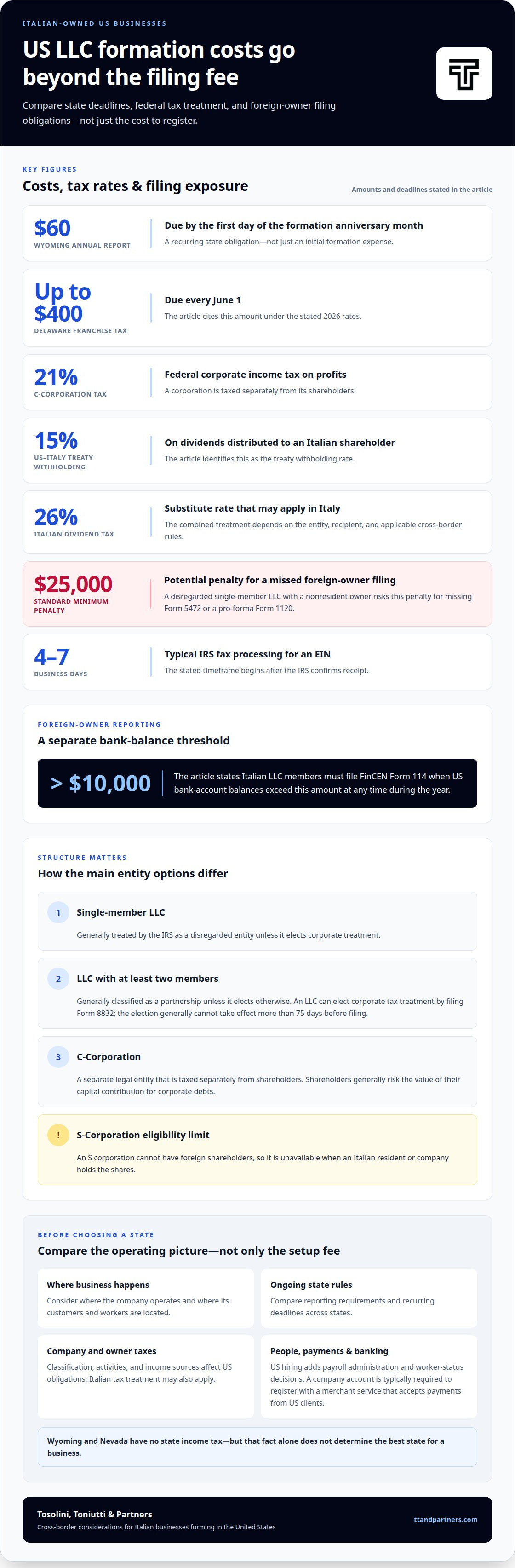
State filing fees vary. Wyoming’s annual report costs $60 per year and is due by the first day of the formation anniversary month. Delaware’s franchise tax is up to $400 under the stated 2026 rates and is due every June 1.
Choosing a state involves more than comparing initial fees. Consider where the business will operate, where its customers and workers are located, each state’s ongoing reporting rules, and the company’s expected income. The proposed name must meet that state’s registration requirements. If it is unavailable, the formation documents will need a different name. Wyoming and Nevada, for example, have no state income tax, but that fact alone does not determine the best choice.
For US and Italian tax obligations, the company’s classification, activities, and income sources matter. State requirements vary, and Italian tax treatment may also apply to an Italian owner or business. Cross-border planning should account for both systems rather than assume that registering in one US state resolves every tax question.
Hiring in the United States adds payroll administration and decisions about worker status and work location. Banking also affects operations: a company account is typically required to register with a merchant service that accepts payments from US clients.
Choosing between an LLC and a C-Corporation
The distinction involves more than legal form: federal tax classification changes how profits are reported and taxed. For an Italian owner, the choice also affects dividend payments, liability structure, and international tax planning.
Tax Treatment of LLCs and Corporations
Federal tax treatment determines whether income is reported by the business or flows through to its owners. The Internal Revenue Service generally treats a domestic LLC with one member as a disregarded entity, unless it elects corporate treatment; an LLC with at least two members is generally classified as a partnership unless it elects otherwise. A corporation is taxed separately from its shareholders. These distinctions shape the company’s tax return and the owners’ reporting obligations.
LLC Elections for Corporate Tax Treatment
An LLC can elect to be taxed as a corporation by filing Form 8832 with the Internal Revenue Service. This allows an LLC to retain its legal form while changing its federal tax classification. The Internal Revenue Service says an election generally cannot take effect more than 75 days before the filing date. Timing matters: the requested effective date influences which tax treatment applies to a period of income.
A C-Corporation pays federal corporate income tax at a rate of 21% on profits, according to the Internal Revenue Service. If it distributes profits as dividends to an Italian shareholder, the US-Italy treaty withholding rate is 15%, according to the U.S. Department of the Treasury. Italy may also tax dividends received from foreign companies at a 26% substitute rate. The resulting treatment depends on the entity, recipient, and applicable cross-border rules, so corporate and shareholder taxation should be assessed together.
A US corporation is a legal entity separate from its shareholders. It can enter contracts, sue, or be sued in its own name. Shareholders generally risk the value of their capital contribution for corporate debts. This separation can matter when an international business signs contracts, holds assets, or faces potential claims. For Italian businesses comparing a corporation with an LLC, cross-border legal guidance can help frame the decision around ownership, operations, and exposure.
US tax filing obligations for foreign-owned LLCs
Foreign ownership does not remove US filing obligations. For an Italian owner, the LLC’s tax classification, ownership structure, and income sources determine which returns may apply.
For formation, a professional typically gathers the proposed name, state, member and ownership details, business address, and registered-agent information. The responsible party’s identifying details are also needed for an EIN request. A nonresident Italian owner can obtain an EIN without a Social Security number; IRS fax processing typically takes 4-7 business days after the IRS confirms receipt.
Foreign Ownership and S-Corp Restrictions
Foreign ownership can affect which US entity elections are available, even if the owner never travels to the United States. A foreign company can form a US corporation without being physically present, and US citizenship or residency is not required. However, an S corporation cannot have foreign shareholders, so it is unavailable when an Italian resident or company holds the shares.
Foreign Entities and LLC Ownership
Foreign entities may own membership interests in an LLC, allowing an Italian company to participate as a member. The ownership chain matters because the LLC’s classification determines how income and reporting are handled. A disregarded single-member LLC with a nonresident owner risks a standard minimum penalty of $25,000 for missing Form 5472 or a pro-forma Form 1120, according to the Internal Revenue Service.
U.S. Taxation of Italian-Owned LLCs
The United States taxes an Italian-owned LLC according to its federal classification and the income involved. A single-member LLC is generally disregarded for federal income tax purposes unless it elects corporate treatment; a multi-member LLC is generally classified as a partnership. The Italian owner’s residence and whether the LLC has US-connected income affect the filing analysis, so ownership alone does not determine the tax result.
Foreign-asset reporting may also matter. The stated rule requires Italian LLC members to file FinCEN Form 114 when US bank-account balances exceed $10,000 at any time during the year. Separately, an Italian bank account exceeding $10,000 at any point in the year triggers an FBAR filing requirement under the stated guidance. These reporting questions should be assessed alongside the LLC’s annual federal filings.
LLC, C-Corp, and S-Corp comparison for Italian businesses
The choice typically turns on ownership, federal tax treatment, and plans for distributing profits. For an Italian business, shareholder eligibility can rule out an S corporation before its other features are considered.
A limited liability company offers flexible federal tax classification. The Internal Revenue Service generally treats a domestic LLC with one member as a disregarded entity, and one with two or more members as a partnership, unless it elects corporate treatment. US LLC formation for Italian business owners should account for how the company will report income and manage ownership. An LLC can elect corporate taxation while retaining its legal form.
A C-Corp is a separate legal entity, and the Internal Revenue Service taxes its profits at 21%. If profits are distributed, dividends may also face withholding tax. The US-Italy treaty rate is 15% for dividends, and a 5% rate may apply when an Italian shareholder holds more than 25% of the capital for over 12 months. Retained earnings and distributed profits therefore have different implications for Italian owners.
S-corporation ownership eligibility can be a concern for Italian business owners, so it is worth checking before choosing this structure. Eligibility is therefore a decisive filter, not just another tax feature. By contrast, a US corporation may have a single shareholder and requires no minimum shareholder capital contribution at incorporation.
Liability and operating plans also shape the comparison. Shareholders of a US corporation generally risk the value of their capital contribution for corporate debts, while an LLC separates members from the business. A foreign company does not need a physical US presence to form a US corporation. Assess US LLC formation for Italian business expansion in light of ownership, planned distributions, and reporting before choosing. Changing structure later can involve substantial costs.
Discuss your cross-border business considerations as part of evaluating the structure that fits your Italian business.
Tosolini, Toniutti & Partners
Tosolini, Toniutti & Partners helps Italian business owners consider how US expansion connects with cross-border immigration needs. If forming a US company is part of a broader plan to work or invest in the United States, immigration considerations may also shape the next decisions. The firm’s related services include E-1 and E-2 visas, O-1 visas, and Green Cards. These matters are distinct from choosing an LLC or corporation, but can be relevant to an owner’s wider US business plans.
For guidance on how business and immigration considerations intersect, contact Tosolini, Toniutti & Partners.
Align the structure with your next move
Treat the entity choice as part of a broader US-Italy operating plan, not an isolated filing. Before committing, define how the business will earn revenue, who will own it, how profits may be used, and whether the owner expects to relocate or remain abroad. These priorities give US LLC formation for an Italian business a practical direction and help align legal, tax, and personal plans. The right sequence depends on intended ownership, the owner’s role in operations, and whether a US presence is part of the plan.
That alignment can matter when commercial expansion and a move to the United States are being considered together. Tosolini, Toniutti & Partners handles E-1, E-2, and O-1 visa matters, allowing business planning and immigration considerations to be considered together while remaining distinct decisions.
To discuss how your cross-border objectives relate to company formation and immigration planning, contact Tosolini, Toniutti & Partners. A considered next step can help turn an expansion goal into a coherent plan.
Frequently Asked Questions
How much does it cost to establish a company in the US?
That figure is a starting point, not a complete operating budget. Annual reports, franchise taxes, registered-agent services, and tax compliance can add recurring expenses. For example, distinguish formation charges from costs that continue after registration when planning the first year’s budget.
How much does it cost to form an LLC in the USA?
An LLC’s state filing fee depends on where it is formed. These figures cover the stated incorporation or formation cost, not every ongoing expense. For an Italian business, compare the state fee with annual obligations and the company’s actual operating footprint.
Is an Italian limited liability company the same as a US LLC?
No. An Italian limited liability company and a US LLC are distinct legal forms created under different national systems, even though both can provide limited liability. Their tax treatment, ownership rules, and reporting requirements do not automatically match. An Italian company considering a US LLC should assess how the US entity will be classified and how its ownership relates to the Italian business.
What are the Costs and Registration Fees for Incorporating a Company in the USA?
The total budget may also include a registered agent, annual state filings, and tax-return preparation. An EIN requested from the Internal Revenue Service is free. Separate one-time formation expenses from recurring compliance costs so the initial filing fee does not stand in for the full budget.
Can an Italian citizen or Italian company form a US LLC without living in the United States?
Yes. A foreign owner does not need US citizenship or residency to form a US corporation, and a foreign company can form one without being physically present. US states may also allow foreign entities to own LLC membership interests. Formation eligibility is separate from immigration permission to work in the United States, so business ownership alone does not determine whether a person can live or work there.
Which US state is best for an Italian business to form an LLC, and how do state costs compare?
No state is best for every Italian business; weigh where the company will operate, its customers, and the state’s ongoing requirements. Wyoming’s annual report costs $60 per year; Delaware’s franchise tax is due every June 1.



Comments