

2026 E-2 Visa Investment Requirements for Italians
- Gianni Mendes Toniutti, Esq.

- 2 minutes ago
- 12 min read
Did you know that the E-2 visa approval rate for Italian citizens reached 77.2% in 2025? This statistic highlights a robust path for Italian entrepreneurs, yet the journey often begins with uncertainty regarding the "substantial" investment mandate. You're likely seeking clarity on the specific E-2 visa investment requirements for Italian citizens, particularly when defining "at risk" capital or tracing funds through intricate Italian entities. It's a process where professional precision must align with your vision for a scalable American enterprise.
We recognize that moving capital across borders involves more than just financial risk; it's about securing a future for your family. This article provides the intellectual framework needed to master the proportionality test and manage the 2026 legal requirements with absolute confidence. We'll examine practical investment thresholds, which often range from $120,000 to $150,000, while detailing the documentation necessary for a successful application at the US Embassy in Rome. You'll gain a strategic perspective on transforming your investment into a compliant, thriving US entity.
Table of Contents
Understanding the US-Italy E-2 Treaty Framework
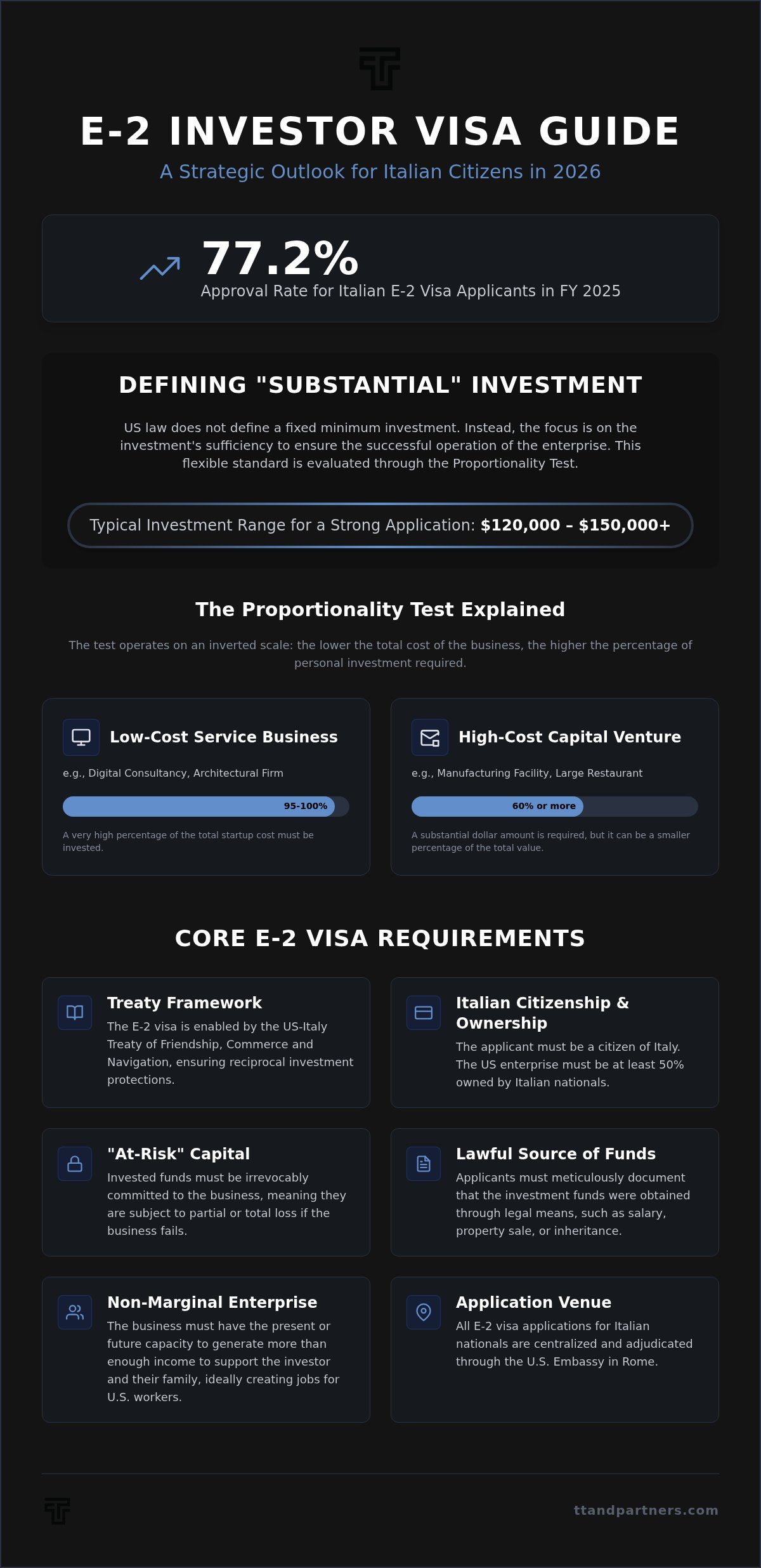
The legal architecture of the E-2 Investor Visa rests upon a foundation of bilateral cooperation. For Italian nationals, this pathway isn't merely an administrative procedure but a privilege granted through the Treaty of Friendship, Commerce and Navigation. This historic agreement ensures that Italian capital receives specific protections and recognition within the United States. As we move through 2026, the strategic importance of this framework has intensified. With an approval rate of 77.2% for Italian applicants in fiscal year 2025, the data suggests a welcoming environment for those who meet the rigorous E-2 visa investment requirements for Italian citizens.
Unlike the E-1 Treaty Trader status, which focuses on the volume of international trade, the E-2 category prioritizes the infusion of capital into the American economy. It's a visionary choice for entrepreneurs looking to build a tangible presence. The 2026 landscape offers unique stability for Italian expansion, particularly as US-Italy commercial ties continue to deepen. Establishing a US presence now allows Italian brands to leverage a market that values European craftsmanship and innovation. It's a moment where professional precision in filing can yield a lifetime of opportunity.
The Treaty of Commerce and Navigation
The US-Italy bilateral agreement serves as a protective canopy for the investor. It establishes the principle of reciprocity, allowing Italian citizens to secure visas for up to five years, with the possibility of indefinite renewals. This longevity provides the necessary timeline to nurture a scalable business entity. The treaty also ensures that Italian investors are treated with a level of fairness and security that mirrors the treatment of domestic entrepreneurs, fostering a sense of harmony between the two markets. All applications are centralized through the US Embassy in Rome, which maintains specific pre-screening protocols for treaty investors.
Eligibility Criteria for Italian Nationals
Securing this status requires clear proof of Italian citizenship. Whether obtained through birth, naturalization, or Jure Sanguinis, your passport must be valid and the lineage documented with precision. The enterprise itself must maintain at least 50% Italian ownership to qualify under the treaty. This rule applies whether the owner is an individual or a corporate entity based in Italy. While the E-2 is a non-immigrant visa, meaning you must demonstrate an intent to depart eventually, its renewable nature allows for long-term residency. Understanding these E-2 visa investment requirements for Italian citizens is the first step toward a successful US-Italy legal strategy. It's a process that demands both technical accuracy and a strategic vision for the future.
Defining the Substantial Investment Requirement in 2026
The 2026 market landscape demands a sophisticated approach to capital allocation. Inflation and rising entry costs in major US hubs mean that what was considered substantial a few years ago may now face increased scrutiny. The goal is to prove that the investment is sufficient to ensure your financial commitment to the successful operation of the enterprise. This requires more than just a bank statement; it necessitates a visionary business plan that aligns your capital with the real-world costs of your specific industry.
The Proportionality Test Explained
The proportionality test functions as an inverted scale. If you're launching a low-cost service business, such as a boutique architectural firm or a digital consultancy, the government expects you to invest a very high percentage, often near 100%, of the startup costs. Conversely, a high-capital venture like a manufacturing facility requires a smaller percentage of the total value to be considered substantial. According to the USCIS E-2 Investor Qualifications, the investment must be significant enough to support the business's growth. Professional valuations become essential here to justify lower investment amounts by proving the business is fully operational at that level.
Qualifying Investment Expenses
To satisfy the E-2 visa investment requirements for Italian citizens, your capital must be deployed toward legitimate business needs. This includes a mix of tangible and intangible assets:
Tangible Assets: Specialized equipment, initial inventory, and the costs associated with securing a physical commercial space.
Intangible Assets: Intellectual property rights, software development, and proprietary technology essential to the brand’s unique value proposition.
Operating Capital: Prepaid rent, marketing budgets, and professional fees for LLC incorporation and legal counsel.
Every dollar must be traceable and purposefully spent to demonstrate a real, active commercial undertaking. This meticulous approach ensures the business isn't viewed as marginal, but as a robust contributor to the US economy. It's a process where the quality of the investment often speaks louder than the quantity.
The At-Risk Capital and Source of Funds Mandate
The requirement for capital to be "at risk" is often the most demanding aspect of the E-2 visa investment requirements for Italian citizens. It's a mandate that goes beyond simple possession. To qualify, you must demonstrate that the funds are subject to partial or total loss should the business fail. This means that capital sitting in a personal bank account, even if earmarked for the US entity, is insufficient. The US government requires a level of personal liability that proves your commitment to the venture's success. It's a test of your willingness to integrate your financial future with the American market.
Tracing the source of these funds is equally critical. For Italian nationals, this often involves a complex paper trail spanning years of professional activity. Whether the capital originates from personal savings, the sale of property in Tuscany, or business dividends from a Milanese firm, the legality of the source must be beyond reproach. This is where the bridge between Italian financial records and US immigration standards becomes essential. The goal is to provide a narrative of wealth that's both transparent and legally sound.
Tracing Italian Source of Funds
Documenting the journey of capital from Italy requires a meticulous collection of bank statements, tax returns, and corporate records. If your investment comes from Italian business dividends, you must show the underlying profitability of that entity and the lawful distribution of those funds. Gifts and inheritances are also valid sources, provided they are accompanied by a clear paper trail from the original owner to you. The US Consulate in Rome scrutinizes the path of funds across borders to ensure compliance with anti-money laundering regulations. Precision in this documentation is the difference between a seamless approval and a request for evidence.
Irrevocable Commitment of Capital
One of the most counterintuitive E-2 visa investment requirements for Italian citizens is the necessity of spending the money before the visa is granted. You can't wait for approval to begin your investment. Instead, you must show an "irrevocable commitment" of funds. This involves purchasing equipment, signing leases, and paying for professional services like LLC incorporation and strategic legal counsel. To mitigate this risk, many investors use escrow accounts. These allow for the release of funds only upon the fulfillment of specific conditions, such as the issuance of the visa. This strategy balances the legal requirement for committed capital with the practical need to protect your assets. Differentiating between idle funds and committed capital is a nuanced task that requires a visionary approach to business planning.
Proving the Enterprise is Real and Non-Marginal
Beyond the initial infusion of capital, the E-2 visa investment requirements for Italian citizens demand proof that the enterprise is a "bona fide" commercial undertaking. This means the business must be active, offering services or goods for profit, and possessing all necessary US licenses and permits. A static investment is a denial waiting to happen. The US government seeks to welcome entrepreneurs who contribute to the national economy, not just those seeking a residency permit. Your business must possess the present or future capacity to make a significant economic contribution that extends beyond your immediate household.
This is where the concept of marginality becomes a pivotal legal hurdle. A marginal business is one that lacks the capacity to generate more than a minimal living for the investor and their family. To overcome this, your application must present a vision of growth, scalability, and job creation. It's about demonstrating that your Italian heritage and professional expertise will foster a venture that enriches the American community. Every element of your filing should reinforce the narrative of a robust, self-sustaining entity.
The 5-Year Financial Projection
The 5-year business plan is the intellectual heart of your application. It must architect a realistic revenue growth model that aligns with current US market data and industry-specific benchmarks. Consular officers look for projections that are grounded in reality yet ambitious in scope. The marginality test is fundamentally a measure of economic contribution, where a business is deemed insufficient if its projected net income fails to exceed the basic living expenses of the investor and their dependents within a five-year period. Your projections must show that the enterprise will eventually hire US workers and generate a profit that reflects a successful commercial venture.
Staffing and Organizational Structure
Job creation is a primary metric for non-marginality. While there is no set number of employees required, a plan that includes hiring US citizens or permanent residents carries significant weight. Distinguishing between W-2 employees and 1099 contractors is essential; W-2 staff generally demonstrate a higher level of commitment and organizational stability. Professional LLC incorporation serves as the structural foundation for this staffing model, providing a clear framework for management tiers and operational growth. A well-defined organizational chart shows that you aren't just an individual worker, but a leader managing a complex US entity. If you're ready to refine your organizational narrative, contact our legal team for a comprehensive business plan review.
Strategic US-Italy Filing with Tosolini, Toniutti & Partners
Tosolini, Toniutti & Partners operates at the intersection of two distinct legal landscapes. We aren't just an immigration firm; we're a strategic bridge between Italian capital and the American market. Our strategic presence in the United States and Italy allows us to manage the E-2 visa investment requirements for Italian citizens with a level of granularity that remote firms simply can't match. We coordinate directly with the US Consulate in Rome and Milan, ensuring that every document reflects the dual-jurisdiction precision required for high-stakes filings in 2026. This local presence is vital for navigating the pre-screening protocols that define the Italian application process.
Our approach integrates visa strategy with broader corporate needs. We handle the complexities of international litigation and corporate structuring to protect your assets before you even set foot on US soil. This foresight is critical for Italian entities moving significant capital across borders. For many of our clients, the E-2 is only the first step of a larger journey. We strategically plan for the long term, managing the eventual transition from E-2 to Green Card to ensure your family's permanent security in the United States. It's a holistic vision that treats your business as a living, growing entity.
Comprehensive Cross-Border Support
Expanding a business involves more than just securing a visa. Our team provides end-to-end support, from professional LLC incorporation to the intricacies of real estate closings for your commercial or residential spaces. We understand that your life remains rooted in both countries. That's why we also assist with Italian immigration matters, such as the Permesso di Soggiorno for family members who may maintain ongoing ties to Italy. We offer a service that manages the legal nuances of your transition, allowing you to focus on the vision and growth of your brand. Our goal is to create a seamless experience where the legal architecture supports your entrepreneurial ambition.
Schedule a Consultation for Your E-2 Strategy
Every investment portfolio is unique. We invite you to schedule a consultation where we'll review your specific assets and business goals to ensure they align with the 2026 E-2 visa investment requirements for Italian citizens. Preparing for the consulate interview in Italy requires more than just knowing the facts; it's about presenting a cohesive narrative of professional success and economic contribution. We'll guide you through the pre-screening protocols and the high-stakes questions you'll face at the US Embassy. Don't leave your American dream to chance. Contact us to start your US business journey today and build a legacy that spans continents.
Building Your American Legacy with Precision
The journey from Italian entrepreneur to US treaty investor is defined by more than just capital. It requires a meticulous alignment with the E-2 visa investment requirements for Italian citizens, where success hinges on the proportionality of your investment and the irrevocable commitment of your assets. By mastering the nuances of the "at risk" mandate and architecting a non-marginal business entity, you transform a legal necessity into a strategic foundation for scalable growth. This process demands a synthesis of visionary ambition and engineering-level legal accuracy.
Tosolini, Toniutti & Partners offers the dual-jurisdiction expertise needed to bridge the gap between Italian capital and American opportunity. Our decades of experience in successful E-2 petitions, coupled with comprehensive support for LLC incorporation and real estate closings, ensure your transition is handled with professional elegance and technical accuracy. We manage the complexity of cross-border law so you can focus on your vision for the future. Secure your US investment future with Tosolini, Toniutti & Partners. Your expansion into the United States is a testament to your ambition; we're here to ensure the legal architecture is as robust as your business model.
Frequently Asked Questions
Is there a minimum investment amount for an E-2 visa for Italians?
No statutory minimum dollar amount exists under US law. Instead, the investment must be "substantial" relative to the business's total value. For a service-based entity, you might need to invest nearly 100% of the startup costs. In 2026, most legal professionals recommend a threshold of $120,000 to $150,000 to satisfy the E-2 visa investment requirements for Italian citizens and demonstrate a credible commitment to the American market.
Can I use a loan to fund my E-2 visa investment?
You may use loan proceeds, provided the debt is secured by your personal assets rather than the assets of the US enterprise. The capital must be "at risk," meaning you're personally liable for the funds. Loans secured by the business itself don't meet this criteria. It's essential to document the lawful source of the collateral used to secure the loan to ensure full compliance with consular tracing requirements.
How long does the E-2 visa process take for Italian citizens in 2026?
Consular processing for Italian nationals typically takes between 90 and 180 days from submission to visa issuance. As of August 2026, the US Embassy in Rome recommends initiating the application at least six months before your intended travel date. This timeline includes a mandatory pre-screening phase before an interview is scheduled. High-volume periods may extend these windows, so early preparation of your corporate documentation is a strategic necessity.
Can my spouse and children work in the US on an E-2 visa?
Your spouse is eligible for employment in the United States and may apply for work authorization upon arrival. Unmarried children under the age of 21 are granted dependent E-2 status, allowing them to attend school but not to engage in professional employment. This family-centric benefit makes the E-2 a visionary choice for Italian entrepreneurs seeking to establish a long-term presence while ensuring a high quality of life for their dependents.
Does buying a house in the US count as an E-2 visa investment?
Purchasing a primary residence doesn't qualify as a substantial investment for E-2 purposes. The capital must be directed toward an active, commercial undertaking that produces goods or services for profit. While real estate can be part of a larger business model, such as a property management firm, a passive investment in a home fails the "bona fide enterprise" test. The focus remains on economic contribution and job creation.
Can I change my status from an E-2 visa to a Green Card?
The E-2 is a non-immigrant visa, but it doesn't preclude you from pursuing permanent residency through other legal pathways. While the E-2 doesn't lead directly to a Green Card, many investors eventually transition to categories like EB-5 for large-scale investments or EB-1 for extraordinary ability. This transition requires a sophisticated legal strategy to manage the "intent to depart" requirement while building a permanent US business architecture.
What happens if my E-2 visa business fails?
If the enterprise ceases operations, your E-2 status is no longer valid. You must either change to another visa category or depart the United States. Because the visa is tied to the active management of the specific business entity, the failure of that entity terminates your legal residency. This highlights why the E-2 visa investment requirements for Italian citizens emphasize "at risk" capital; the government wants to ensure you have a strong financial incentive to succeed.
Do I need to live in the US full-time on an E-2 visa?
You aren't required to reside in the United States full-time, but you must be in a position to "develop and direct" the enterprise. Many Italian investors maintain a transatlantic lifestyle, balancing their US operations with existing interests in Italy. However, you must demonstrate that your physical presence is sufficient to manage the business's growth and fulfill the commitments outlined in your five-year business plan.


Comments