

Italian Immigration Lawyer Boston: A 2026 Guide to US-Italy Cross-Border Law
- Gianni Mendes Toniutti, Esq.

- 4 days ago
- 12 min read
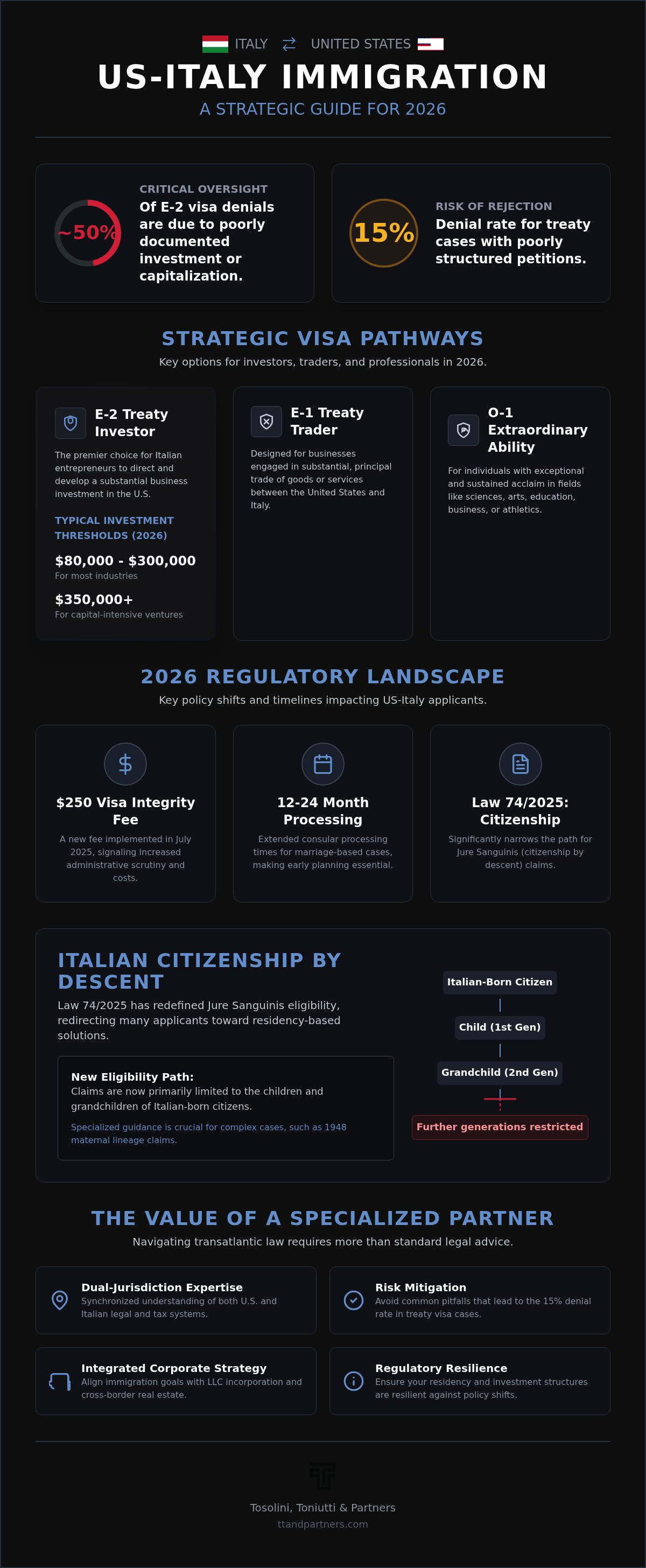
Did you know that nearly half of all E-2 visa denials in 2026 are caused by a single oversight: a poorly documented investment structure or insufficient capitalization? For the modern visionary, the Atlantic represents a corridor of opportunity, yet the path is often obscured by the intricate layers of cross-border law. You've likely felt the weight of these complexities, where language barriers and shifting regulations can stall even the most ambitious plans. Securing an Italian immigration lawyer Boston provides the intellectual partnership necessary to navigate these high-stakes requirements with professional precision.
We believe that legal strategy should be as elegant as the results it produces. This 2026 guide offers a strategic framework to help you obtain E-2 or O-1 visas, understand the implications of Law 74/2025 on Italian citizenship by descent, and manage international business expansion. We'll preview the essential updates for this year, from the new Visa Integrity Fee to the specific investment thresholds that satisfy current scrutiny. By aligning technical excellence with your long-term goals, we'll ensure your transition between the United States and Italy is both compliant and seamless.
Table of Contents
The Strategic Landscape of US-Italy Immigration in 2026
The US-Italy legal corridor isn't just a route for travel; it's a sophisticated architectural structure built on decades of bilateral agreements and shared economic interests. For professionals and families moving between these jurisdictions, the stakes in 2026 have never been higher. Relying on a standard local firm often proves insufficient because cross-border law requires a synchronized understanding of two distinct legal systems. This is where the specialized expertise of an Italian immigration lawyer Boston becomes indispensable. They act as a strategic bridge, ensuring that a decision made in Massachusetts doesn't create a tax, corporate, or residency conflict in Lombardy or Lazio.
The history of Italian immigration shows a transition from mass migration to highly strategic, investment-driven relocations. Today, this movement is governed by treaties that favor entrepreneurs, yet recent administrative changes have added layers of friction. The introduction of the 250 dollar Visa Integrity Fee in July 2025 signals a broader trend of increased scrutiny and rising costs within the U.S. system. Success in this environment demands a vision that anticipates regulatory hurdles before they arise, treating immigration as a component of a larger transatlantic life or business plan.
Understanding the US-Italy Treaty Relationship
The foundation of this corridor is the Treaty of Commerce and Navigation. This agreement grants Italian nationals a unique status, allowing them access to E-1 and E-2 visas which aren't available to citizens of many other countries. For an Italian entrepreneur, this means the ability to direct and develop a business in the U.S. based on a substantial investment. In 2026, successful E-2 applications generally require capital commitments between 80,000 and 300,000 dollars, depending on the industry. These treaties turn immigration into a tool for international business expansion rather than just a bureaucratic hurdle.
Regulatory Shifts to Watch in 2026
The landscape changed significantly with Italy's Law 74/2025, which narrowed the path for Jure Sanguinis claims to children and grandchildren of Italian-born citizens. This shift, upheld by the Constitutional Court in April 2026, has redirected many toward residency-based solutions like the Permesso di Soggiorno. Consular processing times for marriage-based cases now stretch between 12 and 24 months, making early strategic planning vital. Dual-jurisdiction counsel ensures that your application reflects the most current administrative standards, protecting your investment from the 15 percent denial rate often seen in poorly structured petitions. For those ready to begin this journey, reaching out through a contact portal is the first step toward a secure transatlantic future.
Strategic Pathways: Visas for Investors and Professionals
Visa acquisition is more than a bureaucratic box to check; it's a foundational element of your transatlantic business architecture. For Italian nationals, the path to the United States is uniquely paved by treaty status, yet the complexity of 2026 regulations requires more than just administrative filing. Consulting with an Italian immigration lawyer Boston ensures your investment or professional move is structured to meet the high evidentiary standards of the U.S. Department of State. Whether you're expanding a luxury brand or launching a tech startup, your legal framework must be as resilient as your business model.
The choice between investment, trade, or talent based pathways depends on your long term vision. While some firms treat these as generic applications, we view them as strategic maneuvers. You must adhere to the latest U.S. visa requirements for Italians to avoid the pitfalls that lead to the 15 percent denial rate currently observed in treaty cases. Each path has distinct advantages that must be weighed against your corporate structure and personal residency goals.
E-2 Visa: The Investor’s Strategic Advantage
The E-2 Treaty Investor Visa remains the premier choice for entrepreneurs. While there's no statutory minimum investment, successful applications in 2026 typically range from 80,000 to 300,000 dollars depending on the industry. For capital intensive ventures like manufacturing, this threshold often starts around 350,000 dollars. The critical factor is demonstrating that the capital is "at risk" and "irrevocably committed" to the enterprise. We outline these nuances in our E-2 Visa Guide 2026, focusing on how to structure your US business for total compliance.
O-1 and E-1: Alternatives for Traders and Experts
If your operation focuses on the high volume exchange of goods or services rather than direct capital investment, the E-1 Treaty Trader Visa is often the superior tool. It facilitates substantial trade between Italy and the U.S., provided that at least 50 percent of the international trade is between the two nations. For individuals who have achieved sustained national or international acclaim, the O-1 visa provides a prestigious alternative. You can explore the O-1 Visa for Entrepreneurs to see if your profile meets the criteria for extraordinary ability in science, education, or business. If you aren't sure which pathway fits your specific profile, you can always reach out for a professional evaluation of your case.
Securing a Green Card remains the ultimate goal for many Italian professionals. Pathways like the EB-1 for extraordinary ability or the EB-2 National Interest Waiver allow experts to bypass the traditional labor certification process. This transition from a nonimmigrant visa to permanent residency requires a multi year strategy that starts on day one of your relocation. By integrating your immigration needs with corporate law and international litigation support, an Italian immigration lawyer Boston provides the holistic oversight necessary for a successful life in the United States.
Italian Citizenship and Residency: Jure Sanguinis to Soggiorno
Reclaiming a connection to Italy often begins with the recognition of heritage, yet the legal path has become increasingly narrow. While previous sections focused on moving toward the United States, the reverse journey requires a deep understanding of Italian administrative law. For individuals in New England, an Italian immigration lawyer Boston acts as the vital link between local historical records and the rigorous requirements of Italian consulates. The process is no longer a simple matter of genealogy; it's a high-stakes legal verification of lineage and intent.
Claiming Citizenship Jure Sanguinis
The enactment of Law 74/2025 on March 27, 2025, fundamentally reshaped the landscape for citizenship by descent. This regulation generally limits Jure Sanguinis claims to the children and grandchildren of Italian-born citizens. Since the Italian Constitutional Court upheld this law in April 2026, the documentary burden has intensified. You must provide a complete chain of birth, marriage, and death certificates, each authenticated with an apostille and translated with professional precision. Minor discrepancies in names or dates can stall an application for years. Successful recognition depends on proving that the Italian ancestor never renounced their citizenship before the next generation was born, a task that demands exhaustive research in both US naturalization records and Italian civil registries.
Special provisions exist for those who lost their citizenship prior to 1992. A window for reacquisition is open until December 31, 2027, requiring a formal declaration and a government fee of 250 euros. For those whose lineage involves a female ancestor who gave birth before 1948, a judicial "1948 Case" remains the only pathway. These court-based claims bypass the consulate entirely, challenging old discriminatory laws directly in the Italian judicial system. This strategic litigation allows families to reclaim rights that were previously denied due to historical gender biases.
Residency and the Permesso di Soggiorno
When citizenship isn't the immediate goal, the Permesso di Soggiorno provides a structured framework for residency. US nationals often pursue the Elective Residency visa or permits for self-employment. Each type carries specific requirements for passive income or business viability that must be documented months in advance. You must also consider the fiscal implications of residency. Staying in Italy for more than 183 days in a calendar year typically establishes tax domicile, requiring a sophisticated approach to dual-country tax planning. Transitioning from a temporary permit to permanent status involves long-term compliance and a consistent physical presence within the country. If you're managing these dual requirements, you can contact our team to discuss how to align your residency status with your broader financial and professional objectives.
Holding an Italian passport offers unparalleled mobility within the European Union. It simplifies the process of LLC incorporation in Italy and streamlines real estate closing for those looking to invest in the Mediterranean market. For the US business owner, this status is a strategic asset that removes the barriers of traditional work permits across 27 nations. This freedom of movement ensures that your professional reach is not limited by borders, allowing for a truly integrated transatlantic lifestyle.
Key Criteria for Selecting an International Legal Partner
Choosing an Italian immigration lawyer Boston is a decision that shapes the future of your transatlantic enterprise. It's not merely a search for someone to file paperwork; it's about securing a legal infrastructure that spans two continents. The complexity of 2026 regulations means a local practitioner without Italian credentials or a corporate background will likely miss the strategic intersections that define a successful relocation. You need a partner who understands the architectural relationship between two distinct legal systems, ensuring that every filing in Massachusetts respects the requirements of Italian civil law.
Dual-jurisdiction admission is a non-negotiable standard for high-stakes immigration. When your counsel is admitted to practice in both the United States and Italy, they can provide a seamless defense of your interests. This dual perspective prevents the common errors that occur when advice is siloed. A strategy that works for a U.S. visa must also be sustainable for your Italian tax and residency status. Without this holistic oversight, you risk creating liabilities that could take years of international litigation to resolve.
The Importance of Multidisciplinary Expertise
Immigration doesn't exist in a vacuum. For an investor, the visa is often secondary to the business itself. Your legal partner must be proficient in LLC incorporation to ensure the corporate entity is structured for E-2 or E-1 compliance from the start. Beyond the initial setup, the ability to handle international litigation is vital. Disputes over cross-border contracts or intellectual property require a team that can represent you in both jurisdictions without losing precision in translation or legal nuance.
Transparency and Strategic Planning
Avoid attorneys who act as simple "form-fillers." These practitioners lack the visionary approach needed to navigate the 15 percent denial rate currently seen in treaty petitions. You deserve clear, upfront communication regarding timelines and expenses. For those pursuing permanent residency, understanding How Much Is a Green Card? involves more than just accounting for government fees. It's a multi-year investment in your future. A strategic partner will provide a comprehensive roadmap that covers everything from the initial filing to the final adjustment of status.
Bilingual precision is the final pillar of a strong legal partnership. Legal terminology doesn't always have direct equivalents between English and Italian, and a minor mistranslation in a business plan or a birth certificate can lead to a rejection. Finally, assess whether the firm can facilitate secondary services like real estate closing. Having a single point of contact for your visa and your Italian property purchase ensures that your entire relocation remains harmonious. If you're ready to secure this level of professional oversight for your cross-border needs, contact us today to begin your strategic consultation.
The TT&P Approach: Bridging the Transatlantic Legal Gap
At Tosolini, Toniutti & Partners, we don't view law as a series of isolated transactions. We see it as a deliberate architectural process where every visa, corporate structure, and property acquisition is a component of a larger, harmonious vision. Most practitioners specialize in either the U.S. or the Italian system, leaving a gap where critical details can fall through. As your Italian immigration lawyer Boston, we provide the transatlantic infrastructure necessary to bridge this divide with intellectual depth and technical accuracy. Our approach is rooted in the belief that a successful relocation requires a synchronized strategy that respects the legal heritage of the past while embracing the technological solutions of the future.
We operate as a strategic partner for individuals and businesses who demand more than just administrative filing. By maintaining a dual presence, we ensure that your transition is seamless and your assets are protected across both jurisdictions. Whether you're navigating the 15 percent denial rate of treaty visas or managing the complexities of Law 74/2025, our firm provides a steady, visionary hand. We prioritize a human centered approach, recognizing that behind every case is a family's legacy or an entrepreneur's life work.
Comprehensive Cross-Border Solutions
Our firm integrates multiple legal disciplines to provide a holistic framework for your move. This isn't just about obtaining an E-2 visa; it's about ensuring your LLC incorporation is structured for long term tax efficiency and U.S. compliance. We handle the entire lifecycle of your investment, from the initial visa acquisition to the final real estate closing on your Mediterranean or New England property. If disputes arise, our international litigation team is prepared to defend your interests in both U.S. and Italian courts, providing a level of continuity that single-market firms simply cannot match. This multidisciplinary expertise allows us to manage Italian citizenship claims with the same precision we apply to high stakes corporate expansion.
Your Next Steps in Transatlantic Expansion
Initiating your journey requires a clear roadmap and an early start. Given that U.S. marriage based cases currently take between 12 and 24 months, and the reacquisition of Italian citizenship has a strict deadline of December 31, 2027, time is a critical asset. We recommend gathering your primary documentation, such as birth records and evidence of investment capital, before your initial consultation. This preparation allows us to focus on the high level strategy during our first meeting. When you're ready to secure your future through a professional legal partnership, Contact Tosolini, Toniutti & Partners for a Consultation. We'll help you navigate the 2026 legal landscape with the confidence that comes from expert, dual-market oversight.
Defining the New Standard for Transatlantic Success
The landscape of US-Italy immigration in 2026 is defined by a shift toward direct connections and strategic capitalization. Whether you're navigating the narrowed requirements of Law 74/2025 or structuring an investment to satisfy the latest E-2 visa scrutiny, success depends on a legal framework that bridges two continents. Partnering with a specialized Italian immigration lawyer Boston ensures that your residency goals and corporate ambitions remain in perfect harmony. We've seen that the most resilient relocations are those that integrate immigration with corporate law and international litigation support from the very beginning.
As you prepare for your next chapter, remember that professional precision is the most effective tool for overcoming administrative hurdles. Our team is specialized in US-Italy treaty law and provides bilingual, dual-market corporate support for E-1, E-2, and O-1 visas. You don't have to face these complexities alone. Schedule your strategic consultation with our cross-border experts to ensure your vision is realized with the elegance and accuracy it deserves. We look forward to building your bridge to a secure and prosperous future.
Frequently Asked Questions
Do I need an Italian immigration lawyer for a Jure Sanguinis claim?
Legal counsel is essential for navigating the restrictive 2026 landscape. Since the enactment of Law 74/2025, which limits descent to children and grandchildren of Italian born citizens, every application faces heightened scrutiny. An Italian immigration lawyer Boston provides the technical oversight needed to verify complex lineages and manage the mandatory judicial appeals required for 1948 maternal lineage cases where administrative paths are closed.
How much investment is required for an E-2 visa for an Italian citizen in 2026?
While there's no statutory minimum, successful 2026 applications generally range from 80,000 to 300,000 dollars. For service oriented startups, a lower threshold of 70,000 dollars may be acceptable, whereas capital intensive industries like manufacturing often start around 350,000 dollars. The key is demonstrating that the investment is substantial and proportional to the specific business model you're establishing in the United States.
Can an Italian national apply for a Green Card through an E-2 visa?
An E-2 visa doesn't lead directly to permanent residency, but it serves as a strategic foundation for a Green Card application. Many Italian entrepreneurs use their time on an E-2 visa to build a business that eventually qualifies them for EB-1 extraordinary ability or EB-2 National Interest Waiver categories. This transition requires a long term legal plan to ensure your nonimmigrant status remains valid throughout the adjustment process.
What is the "1948 Case" in Italian citizenship law?
A 1948 Case is a judicial path for descendants of Italian women who gave birth before January 1, 1948. Prior to this date, Italian law didn't permit women to pass citizenship to their children. These claims bypass the consulate and are filed directly in Italian courts to challenge this historical gender discrimination. Success in these cases allows families to reclaim their rights despite administrative roadblocks.
Does an Italian immigration lawyer also handle US corporate setup?
Yes, a specialized Italian immigration lawyer Boston typically integrates LLC incorporation and corporate structuring into your immigration strategy. This holistic approach ensures that your business entity meets the specific "at-risk" capital requirements of the E-1 or E-2 treaty categories from day one. Managing these two components together prevents the common documentation errors that lead to the 15 percent denial rate seen in treaty petitions.
How long does it take to get a Permesso di Soggiorno in 2026?
The administrative cycle for a Permesso di Soggiorno usually spans three to six months in 2026, depending on the specific region in Italy. You'll receive an official receipt immediately upon filing, which grants you temporary legal residency while your physical card is processed. Early strategic planning is essential to manage this timeline alongside your international tax liabilities and business commitments.
Is an O-1 visa better than an E-2 for an Italian entrepreneur?
The O-1 visa is superior for individuals with documented extraordinary ability in business or science, as it requires no financial investment. However, the E-2 visa is often more practical for entrepreneurs whose primary asset is their capital rather than their public reputation. Your choice should depend on whether you can provide the high level of evidentiary proof required for O-1 acclaim or the substantial investment proof for E-2.
What documents are required for an Italian citizenship application?
You must provide a complete chain of long form birth, marriage, and death certificates for every person in your lineage. Each US document requires an apostille and a certified translation to be valid in Italy. You must also include proof of your Italian ancestor's naturalization status to confirm they didn't renounce their citizenship before the next generation was born, a requirement that's become more scrutinized under 2026 regulations.


Comments