

Permesso di Soggiorno Requirements for US Citizens 2026
- Gianni Mendes Toniutti, Esq.

- 2 days ago
- 12 min read
Did you know that your approved Italian visa is merely a preliminary entry ticket, not a legal guarantee of your right to reside in the country? Many US citizens arrive in Italy with a sense of triumph, only to face the immediate, high-stakes pressure of the eight-day filing deadline. It's a common point of anxiety where the distinction between a consular visa and a residency permit becomes a critical legal hurdle. We understand that the complexity of Italian bureaucracy often feels like an architectural maze. You deserve a transition that reflects the harmony of your future life in Italy rather than the stress of administrative friction.
By mastering the specific Permesso di Soggiorno requirements, you can transform this daunting process into a structured, manageable path toward your new home. Our expertise allows you to navigate the legal framework and documentation with professional precision, ensuring your residency is built on a solid foundation. This guide provides a definitive checklist of documentation, explains the 2026 fee structures, and outlines the precise timeline from your first arrival to the final issuance of your electronic permit. We'll ensure you navigate every procedural nuance with the professional precision your international move demands.
Table of Contents
Understanding the Permesso di Soggiorno: The Essential Residency Framework
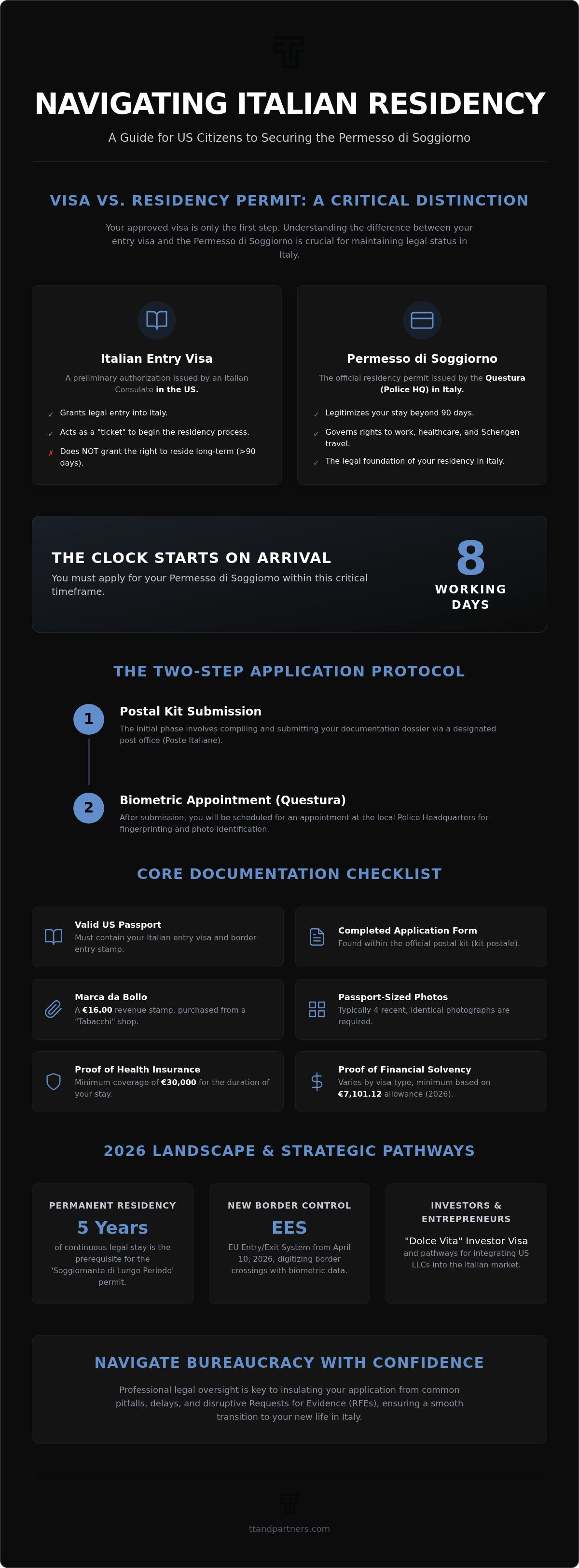
For US citizens planning a life in Italy, the journey begins with an entry visa but culminates in the acquisition of a residence permit. While a visa grants entry, the Permesso di Soggiorno is the only document that legitimizes a stay exceeding 90 days. Understanding the Permesso di Soggiorno requirements is essential because this permit serves as the legal backbone of your residency, governing your rights to work, access healthcare, and travel within the Schengen Area. It's not a mere formality; it's a strategic legal architecture that aligns your presence with Italian law.
Upon crossing the Italian border, a critical countdown begins. Non-EU nationals must apply for their permit within eight working days of entry. This narrow window leaves little room for error. Failure to act within this timeframe can jeopardize your legal status, making immediate coordination with local authorities a priority. Whether you're arriving for elective residence, professional purposes, or as a high-net-worth investor, the Permesso di Soggiorno framework provides the necessary structure to transition from a visitor to a legitimate resident.
Visa vs. Permesso: Navigating the Transition
The entry visa, issued by an Italian Consulate in the US, acts as the gateway. However, it doesn't grant residency. The residency permit is issued by the local Questura (Police Headquarters) once you're on Italian soil. Your visa type dictates the specific Permesso di Soggiorno requirements you must fulfill. For instance, an Elective Residence Visa requires proof of passive income, while a work visa necessitates employment documentation. This transition requires moving from the diplomatic oversight of the Consulate to the administrative jurisdiction of the Italian police.
The 2026 Legal Landscape for US Citizens
As of 2026, the procedural landscape has become more digitized and rigorous. The implementation of the EU Entry and Exit System (EES) on April 10, 2026, means entry data is now recorded with biometric precision. For those seeking long-term stability, the path toward the 'Soggiornante di Lungo Periodo' (Permanent Residency) remains a goal after five years of continuous legal stay. Securing residency isn't just about compliance. It offers strategic advantages for tax planning and business expansion, especially for those establishing a branch of a US LLC. If you find the bureaucracy overwhelming, reaching out for expert guidance at our contact page can provide the clarity needed to navigate these complexities.
Core Permesso di Soggiorno Requirements: A Documentation Checklist
Securing your residency permit requires more than just gathering papers; it demands the assembly of a cohesive legal dossier. The cornerstone of your application is a valid US passport containing the specific Italian entry visa and, crucially, the entry stamp received at the border. This stamp marks the beginning of your eight-day window. Without it, you may face difficulties proving exactly when your countdown to the filing deadline began.
You'll also need to procure a Marca da Bollo, a revenue stamp costing €16.00, available at local tobacco shops (Tabacchi). This physical stamp is a non-negotiable tax requirement for the validity of your application kit. Verification of health coverage is another pillar of the Permesso di Soggiorno requirements. You must provide evidence of a policy with a minimum coverage of €30,000 for emergency medical expenses, hospitalization, and repatriation. The Italian Ministry of the Interior - Visa and Permit of Stay guidelines emphasize that this coverage must be valid for the entire duration of your requested stay.
Financial Solvency and Proof of Income
Demonstrating financial stability is vital to ensure you won't become a burden on the Italian social system. For 2026, the means of subsistence requirement is anchored to the annual social security allowance of €7,101.12, though specific visa categories demand significantly higher thresholds. If you're applying for an Elective Residence permit, you must demonstrate a passive income of at least €31,000 per year, which increases to €38,000 for married couples. Digital nomads are subject to a minimum annual income of €28,000. Acceptable evidence includes certified bank statements, pension records, or diversified investment portfolios that prove long-term stability without the need for local employment.
Housing and Accommodation Requirements
Your residence permit is tied to a verified physical address in Italy. You must provide a registered lease agreement (Contratto di Affitto) or a deed of property ownership. If you're staying with a resident, a Dichiarazione di Ospitalità is required to formally document your living arrangements. This address will eventually be verified by the local Anagrafe office during your residency registration. Ensuring these Permesso di Soggiorno requirements are met with meticulous detail prevents the stress of administrative delays. To ensure your documentation aligns perfectly with current standards, you might choose to consult with a legal strategist who understands the nuances of cross-border transitions.
Specialized Residency Pathways: Investors and Entrepreneurs
High-net-worth individuals and business owners require a more sophisticated approach than the standard residency path. For these applicants, the Permesso di Soggiorno requirements shift from basic subsistence proofs to complex investment and corporate documentation. This strategic alignment ensures that your Italian residency supports your broader US-Italy business architecture rather than creating administrative friction. It's about building a legal structure that mirrors your professional ambitions.
The 'Lavoro Autonomo' (self-employment) permit remains a primary route for independent professionals and freelancers. This category is often considered one of the most rigorous Permesso di Soggiorno requirements due to the annual quota system and the need for a declaration of parameters from the local Chamber of Commerce. You'll need to demonstrate that your professional activity generates sufficient income to exceed the social security allowance thresholds while proving you possess the necessary licenses to operate within your specific industry in Italy.
The Investor Visa Framework
The Italian Investor Visa, frequently referred to as the Dolce Vita Visa, offers a streamlined route for those committing significant capital to the Italian economy. To qualify, you must invest at least €250,000 in an innovative startup or €2 million in government bonds. The preliminary step involves obtaining a 'Nulla Osta' (Certificate of No Impediment) through a centralized online portal. This digital-first approach reflects Italy's move toward a modern, efficient immigration system. Once you're in Italy, the investor permit grants a two-year residency period, which is renewable for three years as long as the investment remains intact.
Residency for Corporate Executives
Expanding a US business into the Italian market offers a unique opportunity for entrepreneurial residency. Establishing a branch of a US LLC allows for Intra-company transfer (ICT) permits, facilitating the relocation of key executives and specialized staff. This pathway requires meticulous documentation of the US-based entity's financial health and its operational link to the Italian subsidiary. It's a strategic bridge for firms looking to maintain leadership continuity across borders. For those managing complex cross-border interests, understanding the synergy between different legal frameworks is vital. You can explore our E-2 Visa Guide 2026 to see how these strategies compare with US-bound investment paths. Each corporate move must be executed with precision to ensure your residency status remains as robust as your business growth.
The Two-Step Application Protocol: Execution and Timelines
Transitioning from the gathering of documentation to the actual physical filing requires a shift from archival precision to administrative execution. The Italian residency path is structured into two distinct phases, each demanding a high level of procedural accuracy to ensure your stay remains legally protected. Navigating this protocol effectively is what separates a seamless relocation from a period of bureaucratic uncertainty.
The Post Office Submission
Phase one begins at a designated Poste Italiane location featuring a 'Sportello Amico' counter. This is where you submit the 'Kit Giallo' (Yellow Kit), a comprehensive envelope containing Modulo 1 for personal data and, depending on your visa type, Modulo 2 for professional or financial details. Completing these forms with professional precision is vital to meet the initial Permesso di Soggiorno requirements. During this transaction, you'll pay the €30.00 postal service fee and the €30.46 electronic permit production fee. Additionally, you must settle the government contribution fee, which for 2026 ranges from €40.00 to €100.00 depending on the permit's duration. Upon submission, the clerk provides an 'Assicurata' receipt and a printed slip detailing your future appointment at the Questura. This receipt is your temporary legal shield. It serves as proof of your right to reside in Italy while your official permit is being processed.
Digital transparency is a hallmark of the 2026 system. You can monitor your application's progress through the Portale Immigrazione using the specific User ID and Password found on your post office receipt. This allows you to track the status of your file in real-time, ensuring you're prepared for the next step in the sequence.
The Questura Appointment and Biometrics
The second phase involves a physical appearance at the Questura (Police Headquarters) for your scheduled appointment. You must bring the original versions of every document included in your initial kit, alongside your passport, four identical passport-sized photos, and updated financial evidence. During this session, officials will perform a security background check and collect your biometric data, including digital fingerprints. In the current 2026 regulatory environment, the wait time for the final physical smart-card can range from 4 to 12 months from this date. Any discrepancy in your file at this stage can trigger a Request for Evidence (RFE), which significantly extends the processing timeline. To ensure your interview and biometric submission are handled without administrative friction, consult our immigration specialists for comprehensive procedural support and strategic oversight.
Navigating Italian Bureaucracy: Strategic Legal Support
Beyond the technical mechanics of the application kit and the biometric appointment, securing long-term legal status in Italy requires a forward-thinking strategy. For US citizens, the complexity of the transition often lies in the subtle discrepancies between American financial documentation and Italian administrative expectations. Navigating the Permesso di Soggiorno requirements isn't merely a matter of compliance; it's about ensuring your residency serves as a stable foundation for your broader lifestyle and business objectives. Without a holistic approach, the procedural friction of Italian bureaucracy can become a significant barrier to your cross-border goals.
Requests for Evidence (RFEs) represent the most common cause of administrative stagnation. These formal inquiries are often triggered by minor inconsistencies in financial reporting or a perceived lack of continuity between the initial visa dossier and the residency permit kit. An RFE doesn't necessarily signal a rejection, but it certainly complicates the timeline, often adding months of uncertainty to an already lengthy process. Avoiding these pitfalls requires a level of legal precision that anticipates the specific scrutiny of the Questura before the first document is ever signed.
Avoiding Administrative Delays
Consistency is the primary defense against administrative delays. Every document submitted during your initial arrival must align perfectly with the evidence provided during subsequent renewals. Managing the transition from a temporary permit to the 'permesso illimitato' (long-term residency) demands meticulous record-keeping over several years. For entrepreneurs, this often involves synchronizing residency status with corporate structures. If you're expanding your professional footprint, understanding LLC Incorporation is vital for creating a strategic US-Italy business architecture. Ensuring your professional permits and corporate filings are in harmony prevents the kind of legal contradictions that often stall residency renewals.
The Tosolini, Toniutti & Partners Advantage
As a boutique legal counsel specializing in the unique needs of high-net-worth US citizens, our firm serves as an essential bridge between the American and Italian legal systems. We provide a comprehensive cross-border strategy that extends from our New York roots to our presence in Rome and Milan. We don't just help you meet the Permesso di Soggiorno requirements; we architect a legal path that integrates residency with property acquisition, international litigation, and eventual Italian citizenship. Our vision is rooted in professional precision and a deep respect for the intellectual content of the law. To ensure your transition to Italy is defined by harmony and legal certainty, contact our experts for a strategic residency consultation today. We believe in building structures that endure, allowing you to focus on the aesthetic and professional rewards of your new life abroad.
Your Future in Italy: Architecting a Seamless Transition
Navigating the Italian residency landscape is an exercise in both legal precision and strategic foresight. By distinguishing between your initial entry visa and the subsequent residency permit, you ensure your first steps on Italian soil are legally sound. Mastering the Permesso di Soggiorno requirements, from financial solvency to health insurance verification, protects your transition from disruptive administrative delays. It's about more than just compliance; it's about building a life that honors both your American heritage and your Italian ambitions.
At Tosolini, Toniutti & Partners, we provide tailored solutions for investors and corporate executives, ensuring seamless management of all administrative hurdles. Our expertise in complex US-Italy cross-border immigration allows you to focus on your vision while we handle the technical execution. Secure your Italian residency with strategic legal counsel and move forward with the confidence that your legal foundation is as robust as it is refined. Italy is waiting. Your journey deserves a partner who values excellence as much as you do.
Frequently Asked Questions
What happens if I miss the 8-day deadline to apply for my Permesso di Soggiorno?
Missing the eight-day deadline can lead to the immediate rejection of your residency application or even a formal expulsion order. While Italian authorities may occasionally overlook minor delays caused by documented force majeure, regular non-compliance is treated as an illegal stay. You must present your application kit at a designated post office immediately upon arrival to secure your temporary legal status and avoid severe administrative penalties.
Can I travel outside of Italy while my residency permit application is being processed?
You can travel back to the United States while your application is pending, provided you carry the original post office receipt known as the assicurata. However, you must utilize direct flights or transit through non-Schengen countries to avoid entry complications. You cannot travel to other Schengen Area nations until you hold the physical electronic card, as the receipt is only recognized by Italian border authorities.
Do I need to show a minimum bank balance to qualify for an Italian residency permit?
Yes, you must demonstrate a bank balance that satisfies the specific Permesso di Soggiorno requirements for your visa category. For 2026, the baseline is anchored to the annual social security allowance of €7,101.12. However, elective residence applicants need at least €31,000 in passive income, while digital nomads require €28,000. These figures must be substantiated by certified statements showing consistent, accessible liquidity.
Is health insurance mandatory for the Permesso di Soggiorno, and what kind is accepted?
Health insurance is mandatory and must provide a minimum coverage of €30,000 for medical emergencies, hospitalization, and repatriation. Accepted policies include private international plans or voluntary enrollment in the Italian National Health Service (SSN). For those on an Elective Residency Visa, the 2026 minimum annual fee for voluntary SSN enrollment is €2,000, ensuring your medical needs are integrated into the Italian healthcare architecture.
How long is the Permesso di Soggiorno valid, and how do I renew it?
The permit is typically valid for one or two years, mirroring the duration and purpose of your initial entry visa. You should initiate the renewal process at least 60 days before the current permit expires to prevent any lapse in your legal status. The renewal involves submitting a new application kit with updated financial and housing documentation, maintaining the same level of professional precision as your initial filing.
Can I work in Italy with a Permesso di Soggiorno issued for family reasons or elective residence?
A permit issued for family reasons generally allows you to seek employment, but a permit for elective residence strictly prohibits any local work activity. Elective residents must rely entirely on passive income or foreign-sourced funds to meet the Permesso di Soggiorno requirements. If your future goals include professional activity in Italy, it's vital to ensure your initial visa category aligns with your intent to work.
What is the difference between a Permesso di Soggiorno and a Carta di Soggiorno?
The Permesso di Soggiorno is a temporary residence permit that requires periodic renewal, whereas the Carta di Soggiorno refers to a permanent residency status. After five years of continuous legal stay, you can apply for the EU Long-Term Residence Permit. This permanent status offers significantly greater stability, fewer administrative burdens, and expanded rights for living and working within the European Union's regulatory framework.
Does holding a Permesso di Soggiorno help me on the path to Italian citizenship?
Holding a residency permit is a fundamental prerequisite for naturalization, as it establishes the required period of continuous legal residency in Italy. For non-EU citizens, ten years of registered residency is usually necessary to apply for Italian citizenship by naturalization. Each year of your stay must be documented through a valid permit, making the meticulous management of your residency status the essential foundation of your future citizenship goals.


Comments