

Cost of Italian Citizenship by Descent: The 2026 Comprehensive Price Guide

In 2026, the pursuit of an Italian passport is no longer just a genealogical journey; it's a strategic legal investment where a single administrative error can result in a total loss of capital. Understanding the comprehensive cost of Italian citizenship by descent requires looking far beyond the surface of simple application fees. With the recent implementation of Decree-Law 36/25 and the doubling of the consular application fee to 600 Euros, which translates to 699.10 USD for the third quarter of 2026, the financial landscape has shifted into a more complex, regulated territory. It's natural to feel overwhelmed by these rising costs and the prospect of hidden fees lurking within document retrieval and historical research.
We've designed this guide to provide the clarity you need to move forward with confidence. You'll find a definitive line-item budget that accounts for everything from the new 300 Euro research fees for century-old records to the nuances of USCIS genealogy searches. We'll also explore why professional legal strategy isn't just an optional expense but a vital safeguard against the 2025 legislative changes. By the end of this analysis, you'll have a transparent roadmap to secure your heritage without the fear of wasting resources on an ineligible claim.
Table of Contents
Understanding the Right of Blood and the 2025 Legislative Impact on Costs
Breaking Down Fixed Costs: Consular Fees and Document Procurement
Professional Legal Fees vs. DIY: Evaluating the Real Cost of Success
Litigation Costs: 1948 Cases and Court-Based Citizenship Applications
Long-Term ROI: Why Professional Guidance is a Strategic Investment
Understanding the Right of Blood and the 2025 Legislative Impact on Costs
The Right of Blood serves as the legal foundation for claim-based citizenship in 2026. By understanding the Right of Blood, applicants recognize that citizenship is a birthright passed through the bloodline, independent of geographical location. This principle ensures that heritage is preserved across generations, provided the chain of transmission remains unbroken by naturalization or specific historical restrictions. However, the legal landscape surrounding this right has become increasingly complex, requiring a more analytical approach to budgeting for your application.
The 2025 Decree-Law 36/25: A New Financial Hurdle?
The implementation of Decree-Law 36/25 represents a pivot in administrative philosophy. Since the March 27, 2025, deadline, the government has intensified the requirements for automatic recognition, particularly for those born abroad. Applicants must now provide more exhaustive evidence regarding the "only Italian" status of their ancestors at the time of the descendant's birth. This shift moved the burden of proof firmly onto the applicant, requiring a deeper dive into historical records. This heightened evidentiary standard directly impacts the cost of Italian citizenship by descent, as it necessitates additional historical searches and certified statements from foreign authorities to prove non-naturalization or the specific timing of citizenship shifts. In some instances, these new requirements may force applicants into the court system if administrative paths are deemed insufficient, adding litigation fees to the initial budget.
Eligibility Audits: The First (and Most Important) Expense
An eligibility audit acts as the architectural blueprint for your entire application. Investing in a professional review before purchasing a single birth certificate prevents the accumulation of "zombie" files; these are claims that are legally dead on arrival due to early ancestor naturalization. This audit is particularly vital for identifying 1948 cases, where a female ancestor could not pass citizenship to a child born before January 1, 1948. Recognizing this hurdle early allows for accurate budgeting of litigation costs, rather than discovering the need for a judge after spending thousands on standard consular documents. This strategic foresight ensures that the initial cost of Italian citizenship by descent remains a controlled investment rather than an open-ended expense. To secure a precise assessment of your lineage, professional counsel can bridge the gap between historical data and current legal requirements. You can begin this process by arranging a formal review through our contact page.
Breaking Down Fixed Costs: Consular Fees and Document Procurement
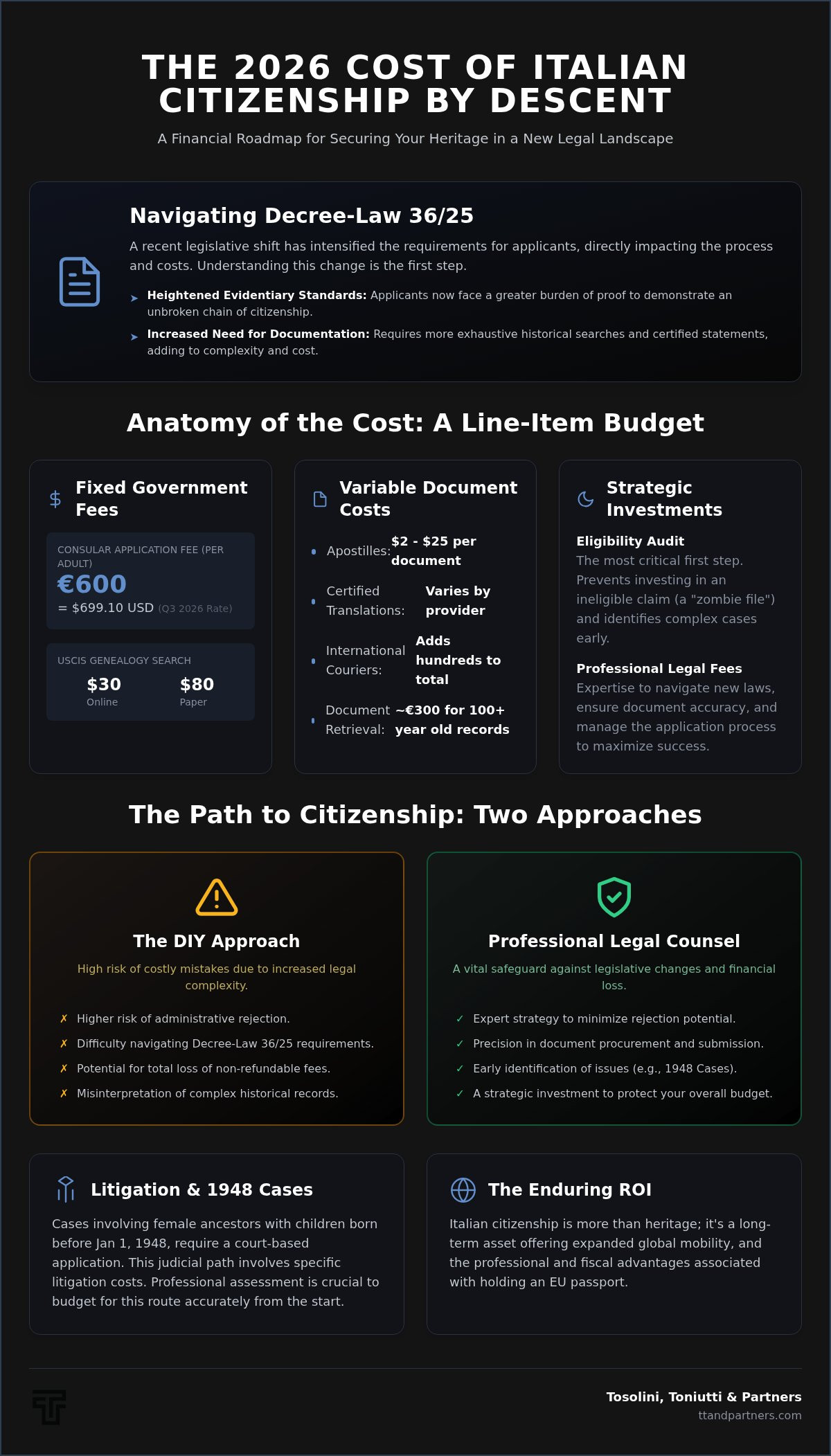
The primary administrative pillar of your application is the official consular fee. As of 2026, the government has set this at 600 Euros per adult applicant. For the third quarter of 2026, the Consular Fees and Document Procurement guidelines specify a locked exchange rate of 699.10 USD. This non-refundable payment is the baseline for calculating the overall cost of Italian citizenship by descent, and it's collected at the time of your appointment regardless of the final outcome.
Beyond the application fee, you must account for naturalization records to prove your ancestor never renounced their citizenship. As of May 29, 2026, a USCIS genealogy index search costs $30 for online filings and $80 for paper submissions. If records are found, additional fees apply for the actual copies. Logistics also play a silent role in your budget; international courier services and certified mailings for sensitive vital records can easily add several hundred dollars to your total expenditure.
Apostilles and Translations: The Variable Expenses
Every US document in your portfolio must be authenticated with an apostille from the Secretary of State where the record originated. Fees for these certifications fluctuate by state, typically ranging from $2 to $25 per document. Once authenticated, every non-Italian record requires a professional translation. Because consulates demand high linguistic precision, cutting costs with automated tools is a risk that often leads to rejection. Certified translations generally cost between $30 and $75 per document, depending on length and complexity. Many consulates also request "non-line" documents, such as records for spouses not in the direct bloodline, which further expands these variable costs.
Italian Vital Records Retrieval
Securing birth, marriage, or death certificates from an Italian municipality involves its own set of financial considerations. Under Law 207/2024, town halls can now charge research fees of up to 300 Euros per document for historical records older than 100 years. This fee is mandatory even if the search is unsuccessful. If a town hall is unresponsive or records are difficult to locate, you may need to hire a local researcher in Italy. This specialized assistance ensures your cost of Italian citizenship by descent is spent on viable records rather than endless administrative delays. Managing these cross-border requirements is often the most taxing part of the journey. If you find the coordination of international records daunting, a professional consultation on document compliance can provide the necessary structure for your file.
Professional Legal Fees vs. DIY: Evaluating the Real Cost of Success
Choosing between an independent filing and specialized legal counsel is an exercise in risk assessment. While the upfront cost of Italian citizenship by descent is lower for those who choose the DIY path, the hidden expenses of time and administrative friction can be substantial. Professional fees in 2026 reflect the complexity of post-2025 compliance, serving as a safeguard against the stricter scrutiny introduced by recent legislative changes. For many, the investment in a full-service solution provides a level of certainty that an unassisted application simply cannot match. It's not just about document collection; it's about building a legally resilient file.
The Cost of Errors: Why a Rejection is More Expensive Than a Lawyer
A single discrepancy in a historical record, such as a misspelled surname or a mismatched birth date, can lead to an immediate administrative rejection. When this happens, the financial impact isn't just the loss of the initial filing fee. You must factor in the cost of re-procuring documents, paying for new apostilles, and starting the multi-year wait for a consulate appointment from scratch. Specialized Italian citizenship lawyers provide strategic value by identifying these anomalies before they reach a consular officer's desk. They act as a bridge, ensuring your file meets the precise standards required by Italian authorities while managing the nuances of consulate appointment systems.
DIY vs. Professional Service Comparison
The opportunity cost of the DIY approach is often measured in years. With consulate backlogs currently ranging from 2 to 4 years, an error-free first submission is paramount. Some applicants find a middle ground through guided assistance, which focuses on document review rather than full-service management. This approach mitigates risk without the full investment of comprehensive representation. However, the cost of Italian citizenship by descent should always be viewed through the lens of the probability of success.
Ultimately, the right path depends on your tolerance for administrative labor and your desire for a predictable outcome. For those facing complex lineages or seeking Court-Based Citizenship Applications, the value of legal precision far outweighs the initial expense. Success in 2026 requires more than just bloodline proof; it requires an impeccable legal strategy that accounts for every legislative shift.
Litigation Costs: 1948 Cases and Court-Based Citizenship Applications
Judicial recognition is often the most strategic path for applicants facing historical gender discrimination or insurmountable administrative backlogs. A 1948 Case arises when a maternal ancestor could not legally pass citizenship to her child born before January 1, 1948. Although the Supreme Court ruled this discriminatory in 2009, the recognition process hasn't been transferred to consulates. It remains a judicial matter requiring a formal lawsuit in the civil courts. Similarly, the 'Against the Wait' lawsuit serves as a vital tool for those facing five-year consulate queues. Since the law mandates that applications be processed within two years, applicants can sue for recognition through the court system when consulates exceed this limit.
Attorney fees for court proceedings are a central component of the cost of Italian citizenship by descent in 2026. Beyond legal representation, you must budget for the unified court tax and various administrative filing fees. The comprehensive translation and authentication of the entire legal file also represent a significant upfront expense. These costs are fixed by the judicial system and are independent of the complexity of your lineage, making them a predictable part of a well-structured legal budget.
Budgeting for Italian Court Proceedings
Retainer structures for international litigation often involve a staged payment schedule, with an initial deposit followed by a final fee upon the successful recognition of your rights. One of the most effective ways to manage the financial burden is through family pooling. When siblings, cousins, or other relatives join the same lawsuit, they share the primary attorney fees and unified court taxes. This economy of scale reduces the individual cost of Italian citizenship by descent, making the judicial path surprisingly competitive compared to individual consulate applications, especially when accounting for the years of time saved.
The 2025 Law and Potential Legal Challenges
The implementation of Decree-Law 36/25 introduces new administrative hurdles that may influence judicial interpretations. If lower courts apply these new rules in a restrictive manner, you might need to budget for potential appeals or constitutional challenges in the high courts. Expert legal counsel is non-negotiable in this environment. You need a team capable of navigating complex jurisdictions to protect your lineage's rights. Despite these variables, the financial benefit of a single court case for an entire family remains a powerful incentive for those seeking a definitive resolution.
If your lineage involves a 1948 ancestor or you're tired of indefinite consulate delays, contact our litigation team to discuss a judicial strategy tailored to your family's needs.
Long-Term ROI: Why Professional Guidance is a Strategic Investment
Viewing the cost of Italian citizenship by descent as a simple administrative expense overlooks its nature as a high-yield generational asset. In 2026, the value of an Italian passport extends far beyond sentimental heritage; it's a versatile tool for global mobility and fiscal optimization. By securing citizenship, you unlock the right to live, work, and access healthcare across all 27 European Union member states. This mobility provides an unparalleled safety net and professional advantage for you and your descendants, transforming a complex legal process into a permanent legacy of opportunity.
For those interested in the Italian landscape, citizenship facilitates smoother real estate transactions and grants access to favorable tax structures. Italian citizens often enjoy lower property taxes on primary residences and a simplified path for capital investment within the Eurozone. Because the transmission of citizenship to minor children born after your recognition is typically administrative and involves no additional government fees, the initial investment amortizes across every future generation of your family tree. It's a one-time capital allocation for an infinite return.
Beyond the Passport: Strategic Benefits for Investors
For business owners and high-net-worth individuals, Italian citizenship often acts as a complementary pillar to broader international goals. It integrates seamlessly with E-2 visa strategies, providing a robust treaty-based foundation for US-Italy commercial activities. Dual residency allows for sophisticated tax planning and the ability to pivot operations between the North American and European markets with minimal friction. When you factor in the average 2026 total cost of approximately $2,300 for a standard consulate application, the ratio of upfront expenditure to long-term wealth preservation is exceptionally favorable.
Next Steps: Starting Your Citizenship Journey
The most effective way to minimize the cost of Italian citizenship by descent is to begin with a precise roadmap. Before committing to extensive document retrieval, you should organize your ancestry tree with specific dates and locations of vital events. This preparation allows legal experts to identify potential hurdles, such as the 1948 rule or naturalization conflicts, before they become expensive errors. A strategic evaluation ensures that every dollar spent on apostilles and translations moves you closer to a successful recognition. If you're ready to define your path through the 2026 legal framework, you can Contact Tosolini, Toniutti & Partners for a strategic citizenship evaluation. Our team provides the professional precision required to turn your genealogical history into a recognized legal reality.
Securing Your Legacy in a Shifting Legal Landscape
Success in 2026 demands a meticulous balance between historical research and modern legal strategy. While the base cost of Italian citizenship by descent is defined by consular fees and document procurement, the true investment lies in the precision of your legal file. The 2025 legislative shifts have eliminated the margin for error, making professional oversight a strategic necessity for those who value their time and resources. By choosing a path rooted in expert counsel, you protect your family from the financial drain of administrative rejections and the uncertainty of systemic backlogs.
Tosolini, Toniutti & Partners provides specialized US-Italy cross-border legal expertise to navigate these evolving complexities. Our proven track record in Italian court litigation and comprehensive support for 2025 law compliance ensure your application meets the exacting standards of the Italian judiciary. It's time to transform your genealogical history into a tangible legacy of opportunity and global mobility. Secure your Italian heritage; schedule a consultation with our expert immigration team today. Your journey toward a recognized bloodline is a visionary step for your family's future, and we're honored to bridge the gap between your history and your European future.
Frequently Asked Questions
Is the consular application fee refundable if my citizenship is denied?
The 600 Euro consular application fee is strictly non-refundable regardless of the final decision on your file. This payment is a processing fee required by the Italian government at the time of your appointment. Because the state retains this fee even in the event of a rejection, it's vital to ensure your documentation is flawless. Any error in your lineage proof could result in a denial, requiring you to pay the fee again for a future attempt.
How much should I budget for a typical Jure Sanguinis case in 2026?
The total cost of Italian citizenship by descent for a standard three-generation case in 2026 typically averages around $2,300 for those managing the process independently. This estimate covers the 699.10 USD consular fee, document procurement, and mandatory translations. However, more complex cases requiring judicial intervention or full-service legal management will see higher initial investments. These professional costs reflect the strategic value of navigating the 2025 legislative changes and ensuring a successful, predictable recognition.
Does the 2025 Decree-Law 36/25 make the process more expensive for US citizens?
This legislation has increased the financial burden on US applicants by doubling the primary consular fee to 600 Euros and introducing more rigorous evidentiary standards. The law requires exhaustive proof regarding an ancestor's naturalization status, which often leads to higher document procurement and historical research costs. Applicants frequently find that this increased complexity necessitates professional legal audits to avoid expensive administrative rejections or multi-year delays in the recognition process.
Can I save money by applying in Italy instead of at a US consulate?
Applying directly in Italy involves establishing legal residency, which carries significant costs for housing, utilities, and local administrative assistance. While this route can be faster than waiting for a US consulate appointment, the total cash outlay is often substantially higher than the cost of Italian citizenship by descent processed abroad. You must weigh the benefit of speed against the thousands of dollars required for a temporary relocation and the associated legal residency requirements.
Are there additional costs for adding my minor children to my application?
There are currently no additional government fees for adding minor children to your citizenship application. Since January 1, 2026, the Italian government waived the previous 250 Euro declaration fee for parents registering their children born abroad. The window for this declaration has also been extended to three years from the child's birth. This change simplifies the process for families looking to pass their Italian heritage to the next generation without incurring extra financial friction.
What is the average cost of a 1948 court case in Italy?
For cases requiring judicial recognition, attorney fees generally range between $3,000 and $10,000 in 2026. These proceedings also involve court filing fees and administrative taxes that are set by the Italian Ministry of Justice. Families can significantly reduce the per-person cost by pooling multiple relatives into a single lawsuit. This collective approach makes litigation a fiscally responsible alternative to navigating years of consulate backlogs individually, while providing a definitive legal resolution.
How much do translations and apostilles typically cost for a three-generation claim?
Budgeting for these variable expenses is essential, as they scale with the number of documents in your file. Certified translations typically cost between $30 and $75 per page, while apostilles from US Secretaries of State range from $2 to $25 per document. A typical three-generation claim involving a dozen documents can easily incur 1,000 USD in these secondary costs. Precision in these documents is non-negotiable to meet the strict standards required by Italian authorities.
Can a lawyer help me bypass the long wait times at the Italian consulate?
Legal counsel can assist in bypassing consulate delays by filing an 'Against the Wait' lawsuit in the Italian civil courts. Italian law requires citizenship applications to be resolved within 730 days. When consulates cannot meet this deadline due to backlogs, a specialized lawyer can petition an Italian judge to recognize your citizenship directly. This judicial path often resolves cases faster than waiting for a standard appointment in high-demand consular districts, providing a strategic shortcut.


Comments