

Cross-Border Litigation Attorney for U.S. Cases Involving Italy

A U.S. lawsuit can involve an Italian party without making an Italian court the right forum. A cross-border litigation attorney for U.S.-Italy cases helps assess whether a U.S. court can hear the dispute and how to manage proceedings across borders. When documents must be served in Italy, the Hague Service Convention has been in force there since January 24, 1982.
It’s understandable to focus first on finding counsel familiar with both countries. But the key questions are where the case belongs, which law applies, and whether steps taken in one country will be effective in the other. Only licensed Italian attorneys may practice before Italian courts or advise on Italian law.
This article explains how U.S. litigation can serve Italian and other foreign clients, how jurisdiction shapes the choice of attorney, and what to know about serving U.S. court documents in Italy. It also covers the experience that matters when a dispute crosses borders, so you can understand how U.S. litigation support fits into the broader legal picture.
Table of Contents
U.S. litigation for Italian and other foreign clients
Italian parties may need U.S. counsel when a dispute involves U.S. operations, investments, or agreements. Cross-border disputes can also arise from financing, acquisitions, trade secrets, and family-business succession.
Cross-Border Representation
U.S. legal representation can help Italian clients assess claims, prepare filings, and coordinate evidence related to U.S. business activity. For financing involving Italian, English, and U.S. law, review loan agreements, borrower obligations, guarantees, and enforcement provisions as one connected structure. An Italian company expanding into U.S. markets should also map its corporate relationships and compliance obligations, including data protection, employment, and reporting.
For a family-business succession or acquisition, due diligence should identify ownership, decision-making authority, existing agreements, and potential disputes before transaction terms are finalized. This helps clarify which records and parties may matter in U.S. litigation.
Fees and Court Costs
Attorney fees and court costs vary with the claims, forum, number of parties, evidence volume, and work required across borders. The price depends on the case and is provided after a quote request; cost factors include procedural complexity, document review, service, and coordination involving Italian records or counsel.
U.S. and Italian litigation procedures and timelines vary by forum and case. Pleadings, evidence, hearings, and service may follow different processes; the claims, court schedule, and procedural disputes all affect the pace.
Relevant Litigation Experience
Look for experience coordinating U.S. representation with Italian business realities, not just familiarity with international legal terminology. In a bank-financing dispute, counsel should be able to trace obligations across agreements, entities, and relevant records. In an acquisition, experience with due diligence and corporate disputes can help identify issues that may affect litigation strategy.
Trade-secret matters require attention to the governing legal framework in each country. United States Congress identifies the U.S. Defend Trade Secrets Act (DTSA) as a 2016 law relevant to trade-secret enforcement. The European Union states that Directive (EU) 2016/943 concerns the protection of trade secrets.
Judgment Enforcement and Parallel Proceedings
Recognition and enforcement of an Italian judgment in the United States require a separate assessment of the judgment and applicable U.S. requirements. Gather the judgment, supporting court records, and evidence of the proceedings. The analysis may consider jurisdiction, notice, finality, and any available grounds to resist recognition.
Parallel proceedings can duplicate work, produce inconsistent decisions, and prompt disputes over which court should proceed. Before filing in both countries, compare the parties, claims, available remedies, and status of each case. Coordinate filings and settlement positions so that steps in one forum do not undermine the strategy in the other.
Choosing an attorney by jurisdiction
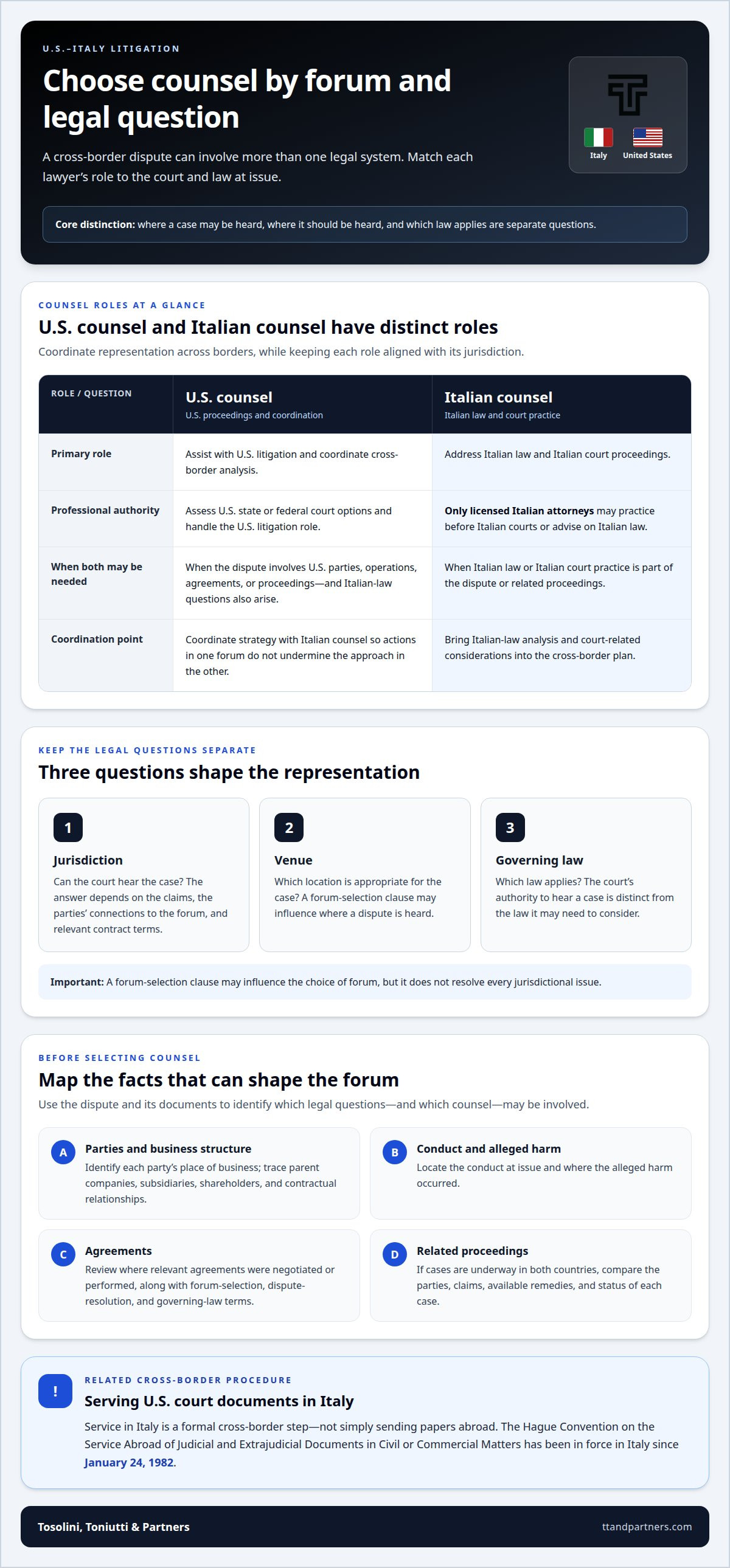
For disputes involving U.S. and Italian parties, jurisdiction concerns whether a court can hear the case; venue identifies the appropriate location. The answer depends on the claims, the parties’ connections to the forum, and relevant contract terms. A forum-selection clause in a corporate agreement may influence where a dispute is heard, but it does not resolve every jurisdictional issue.
Start by mapping the dispute. Identify each party’s place of business, the conduct at issue, where relevant agreements were negotiated or performed, and where the alleged harm occurred. For example, a dispute over equity in a U.S. subsidiary may raise different forum questions from a dispute over an Italian property transaction. These facts help counsel assess U.S. state or federal court options and any related Italian proceedings.
Next, distinguish the governing law from the court’s authority to hear the case. A U.S. court may need to consider Italian law in a contract or corporate dispute, while an Italian court may address issues tied to U.S. business conduct. Only licensed Italian attorneys may practice before Italian courts or advise on Italian law. U.S. counsel can assist with U.S. litigation and coordinate cross-border analysis, while Italian counsel addresses Italian law.
For a national or global company, review the corporate structure before selecting counsel. Trace parent companies, subsidiaries, shareholders, and contractual relationships. Then review forum clauses, dispute-resolution provisions, and governing-law terms in the relevant agreements. This helps identify which lawyers should advise on each issue and where coordinated representation may be needed.
Choose counsel whose role matches the forum and legal questions, rather than assuming one lawyer covers both systems. A cross-border litigation attorney handling U.S. proceedings can coordinate with Italian counsel where Italian law or court practice is involved. For help organizing jurisdiction questions and representation across borders, use the firm’s international legal contact channel.
Service of U.S. judicial documents in Italy
Serving court papers in Italy requires attention to the destination country’s procedures, not simply dispatching documents from a U.S. court. The Hague Convention on the Service Abroad of Judicial and Extrajudicial Documents in Civil or Commercial Matters has been in force in Italy since January 24, 1982. Its framework is relevant when U.S. litigation requires formal service there.
For a private lawsuit, don’t assume a U.S. consulate can deliver papers. Under 22 CFR 92.85, U.S. consular officers generally may not serve legal process for private litigants or appoint others to do so, except for subpoenas and orders issued by Federal Courts. Treat the service method as a procedural step to plan with counsel, not as a routine private delivery.
Language and evidence also shape preparation. Identify the documents to be served, the recipient’s correct details, and the court record showing what must be delivered. Counsel should assess whether translations are needed for the documents or recipient, and organize supporting evidence so each exhibit can be traced to its source. In a private acquisition dispute, relevant material may include transaction agreements, corporate records, and correspondence.
Choice-of-law clauses identify the law the parties selected for an agreement; treaties address cross-border procedures such as service. Review the contract and applicable treaty separately, since one does not replace the other. Recognition and enforcement of a U.S. judgment in Italy also require a separate process. Italian counsel can assess the judgment, service record, and procedural history under Italian law.
Before filing, prepare a document checklist: identify the recipient, court papers, supporting records, and service pathway. This helps litigation counsel coordinate compliance with the U.S. proceeding and Italy’s service framework. For guidance on a dispute involving service or international transactions, arrange a cross-border litigation discussion.
What experience should a lawyer have handling US-Italy litigation
Look for a lawyer who can connect U.S. courtroom work with the commercial facts behind an Italian party’s dispute. Relevant experience includes analyzing contracts, tracing relationships between parent companies and subsidiaries, and organizing records from both sides of a transaction. For example, a claim involving a U.S. distributor and an Italian manufacturer may require a clear chronology of negotiations, performance, and alleged losses.
Some U.S. attorneys in Italy act as legal consultants on American law. That role can help an Italian client understand U.S. legal issues, but it is different from representation before a U.S. court. Ask how counsel will manage pleadings, evidence, court communications, and coordination with Italian counsel when the matter also involves Italian-law questions.
Relevant experience also means understanding how the subject of a dispute changes the work. A trade-secret claim may involve technical records and employee communications; a shareholder dispute may turn on corporate agreements, ownership documents, and decision-making history. In either case, counsel should identify key evidence early, distinguish verified records from assumptions, and explain how each item supports or challenges a claim.
Assess the lawyer’s process, not just the matter’s international label. A useful case plan should identify the parties, possible forums, governing documents, service needs, evidence sources, and any related proceedings. It should also clarify who handles each task, including translation and coordination across time zones, and how the client will receive updates. These details show whether the strategy accounts for both the U.S. proceeding and the Italian connection.
For a dispute involving U.S. proceedings and Italian parties, choose counsel who can coordinate legal analysis across jurisdictions and explain the next procedural steps plainly. Discuss international litigation support for a matter involving U.S. and Italian interests.
Tosolini, Toniutti & Partners: E-2 VISA
Tosolini, Toniutti & Partners can assist when a U.S. business matter intersects with an individual’s immigration needs. For Italian and other foreign clients, Green Card support may be relevant when planning a longer-term U.S. presence alongside business operations. Immigration and litigation are distinct legal matters, so clarify which issue needs attention and how each affects your broader plans.
Consider reaching out to discuss a Green Card matter connected to your U.S. circumstances. Share the basic context, such as your immigration objective and related business considerations, to frame the conversation. Contact Tosolini, Toniutti & Partners to discuss your situation, or visit ttandpartners.com.
Set a Clear Direction for Your U.S.-Italy Matter
A cross-border litigation attorney for U.S.-Italy matters can help bring the dispute’s legal and business priorities into focus. Before taking the next step, consider the outcome that matters most, which decisions need attention now, and how the dispute affects your broader plans. This clarity can make an initial legal discussion more focused and productive.
Tosolini, Toniutti & Partners provides international litigation support and assists clients with E-1, E-2, and O-1 visas. These offerings may be relevant when a U.S. legal matter sits alongside business or immigration planning. The right starting point is a conversation centered on your circumstances and objectives, without assuming that one legal path fits every situation.
For a considered discussion of your U.S.-Italy matter, contact Tosolini, Toniutti & Partners. A clear next step can help you move forward with purpose.
Frequently Asked Questions
How to find a US-Italy cross-border litigation attorney?
Choose a cross-border litigation attorney for U.S.-Italy matters who can assess the dispute’s connection to each country and coordinate legal work across jurisdictions. Ask how they would address jurisdiction, evidence located abroad, service of process, and any steps needed to recognize or enforce a judgment. Tosolini, Toniutti & Partners provides international litigation support for disputes involving the United States and Italy. An initial case evaluation can help clarify whether this service fits your situation.
How do US courts serve legal papers in Italy under the Hague Service Convention?
U.S. courts generally use the Hague Service Convention’s Central Authority procedure to serve documents in Italy. The requesting party prepares the required request and documents, including Italian translations where required, and submits them through the appropriate channel to Italy’s designated Central Authority. The authority arranges service and returns a certificate recording the result. The Hague Conference on Private International Law provides the Convention framework; confirm the required procedure with counsel for the court and case involved.



Comments