

Hague Convention Service of Process in Italy: Procedures

For Hague Convention service of process in Italy, the standard route is to submit a formal request to Italy’s Central Authority, which forwards it to a local judicial officer. Processing typically takes approximately 3-6 months. Documents must be written in or translated into Italian for Article 5 service, while Italy has made no opposition to the Article 10(a) mail method, whose use and recognition can depend on the circumstances.
It’s understandable to focus on the paperwork and timing: an incomplete request or unsuitable service method can complicate a cross-border case. The key is to match the procedure to the documents, the recipient’s location, and the requirements of the court handling the matter.
This guide explains how to prepare and submit a Central Authority request, what Italy’s translation rules require, and what Article 10 does and doesn’t establish about mail service. It also outlines the practical choices that shape the process, so you can approach service with a clearer view of the steps ahead.
Table of Contents
Italy's Central Authority for service requests
Italy’s Central Authority receives Hague service requests and directs them into the local judicial system. For Article 5(1)(2) service, it forwards the request to a local bailiff.
Submitting Requests to the Central Authority
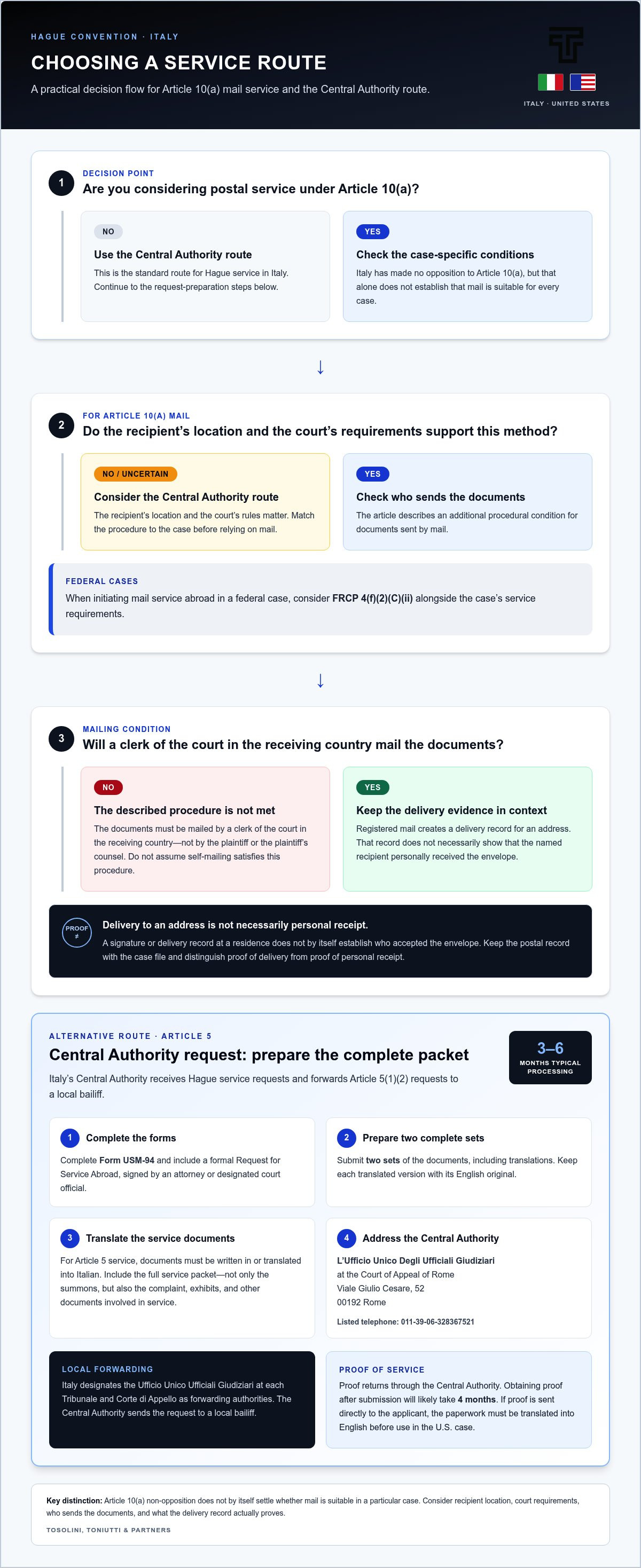
A Central Authority request is the formal submission that asks Italian authorities to serve judicial documents. Complete Form USM-94 and include a formal Request for Service Abroad, signed by an attorney or designated court official. Submit two sets of the documents, including translations. Address the request to L’Ufficio Unico Degli Ufficiali Giudiziari at the Court of Appeal of Rome, Viale Giulio Cesare, 52, 00192 Rome. The listed telephone number is 011-39-06-328367521.
Local Forwarding Authorities
Local forwarding authorities are Italian court offices that transmit Convention requests to the appropriate local judicial officer. Under Article 3(1), Italy designates the Ufficio Unico Ufficiali Giudiziari at each Tribunale and Corte di Appello as forwarding authorities. After receiving a request, Italy’s Central Authority sends it to a local bailiff under Article 5(1)(2). The relevant court area therefore connects the central submission with the authority handling service locally.
Proof and Certificates of Service
Proof of service is the official record showing whether and how the documents were delivered. After the local authority acts, it returns proof through the Central Authority; obtaining proof after submission will likely take 4 months. If a local authority sends proof directly to the applicant, service remains valid, but the paperwork must be translated into English before use in the U.S. case. Keep the certificate with the case records to document the result.
Unsuccessful Service and Unlocated Recipients
An unsuccessful return records that the requested service was not completed; it does not establish completed service. If the recipient cannot be located, use the returned record to document the attempt, correct the address details if available, and determine the next step under the court’s service rules. Keep the Central Authority request and response together so the U.S. court can see what was attempted and what the Italian authority reported.
Translation requirements for Article 5 service
Article 5(3) service in Italy requires the documents for service to be translated into Italian. Italy’s declaration under Article 5(3) establishes this requirement, so an English-only packet does not meet the stated translation rule.
The translation covers the full set of legal documents, not just the summons. Include the complaint, case exhibits, and any other documents involved in service. For example, translating the summons while leaving the complaint and exhibits in English would leave parts of the service packet untranslated. Review each item before assembling the request.
Documents sent to Italy’s Central Authority must be written in or translated into Italian. This applies to all documents submitted for service, and the translation should correspond to the complete document being served. Keep each translated version with its English original so every page and exhibit can be identified clearly in both sets.
Older descriptions of Italy’s declaration can cause confusion. Until 2018, declaration information indicated that translation was not required, although translation was still advisable. The current stated requirement is translation into Italian. Relying on the earlier description risks preparing a packet that does not meet the current translation rule.
A separate translation may address the recipient’s ability to understand the documents. A plaintiff serving a defendant who speaks neither English nor Italian may need to translate the documents into the defendant’s primary language. The Hague Service Convention does not require this additional translation, which is separate from the required Italian translation for service.
Translation can also matter after delivery. Proof or an affidavit of delivery may need translation before filing in the country of origin. Keep it with the returned service records, and arrange an English translation for filing when required. This step concerns evidence of service, not the Italian-language packet sent to the Central Authority.
Mail service under Article 10
Article 10(a) is the Convention provision concerning service by postal channels. Italy has made no opposition to this method, but that does not make mail suitable for every case. The recipient’s location and the court’s rules still matter. In federal cases, the stated procedure to follow when initiating mail service abroad is FRCP 4(f)(2)(C)(ii). Consider that rule alongside the case’s service requirements before sending documents.
Registered mail is a postal method that creates a delivery record for an address. In Italy, international service by registered mail is allowed, but the record shows delivery to an address, not necessarily to the named recipient personally. A signature or delivery record at a residence, for example, does not by itself establish who accepted the envelope. Keep the postal record with the case file, and distinguish proof of delivery from proof of personal receipt.
Mail service in Italy is an alternative method, and its use can depend on the recipient’s location. Documents sent by mail must be mailed by a clerk of the court in the receiving country, not by the plaintiff or the plaintiff’s counsel. This distinction determines who sends the packet. Do not assume that mailing the documents yourself satisfies this procedure.
Article 10(b) and 10(c) concern other Convention channels, not ordinary postal delivery. Italy has made no opposition to either method, but only judicial officers working for Italian courts may serve documents through them. Private attorneys and individuals are not authorized to perform that service in Italy. Mail or judicial-officer service may be permitted yet still may not be recognized by local courts. The practical question is therefore both whether the method is available and whether it fits the governing court’s requirements.
Hague Service Convention procedures in Italy
Italy’s procedure combines the Convention’s service channels with its own declarations and court structure. The practical takeaway is to identify the permitted method and account for any restrictions and costs.
Italy’s Convention Status
Convention status establishes whether the Hague Service Convention applies between participating countries. Italy acceded on November 25, 1981, and the Convention entered into effect there on January 24, 1982. For a U.S. case seeking service in Italy, this framework provides the route for transmitting judicial and extrajudicial documents in civil or commercial matters. The date of accession and the effective date describe separate legal events.
Declared Objections and Restrictions
Declarations state how Italy accepts or limits particular Convention methods. Italy has made no opposition to Article 8(2), Article 10(a), Article 10(b), or Article 10(c), and no declaration that Article 15(2) or Article 16(3) applies. Its Article 5(3) declaration requires translated documents. The Convention does not apply to subpoenas, so a subpoena should not be treated as an ordinary service request under this process.
Service Costs and Fees
Service costs are the charges associated with executing a request and any additional steps needed for a particular method. Under Article 12, Italy charges no costs for executing a Hague Service Convention request. A separate route may involve retaining Italian counsel to petition a local court for a service order, which adds expense. Distinguish that additional legal work from the execution of the Central Authority request.
For a U.S.-Italy matter involving service requirements, discuss the legal issues with Tosolini, Toniutti & Partners before choosing a method. Keep the selected method, applicable declaration, and court requirements aligned in the case record.
Tosolini, Toniutti & Partners: E-2 VISA
Tosolini, Toniutti & Partners assists individuals and corporate clients with Green Card matters when a cross-border legal issue also involves U.S. permanent-residence planning. Hague service concerns the delivery of legal documents abroad; it is distinct from immigration planning, though both may arise in a wider international matter.
If your situation involves both service in Italy and a U.S. immigration concern, Tosolini, Toniutti & Partners can assist with the Green Card component. Clearly defining the service procedure and immigration question helps direct each issue to the relevant legal work.
Contact Tosolini, Toniutti & Partners to discuss Green Card assistance and your cross-border circumstances.
Set a Clear Direction for Your Cross-Border Matter
Treat Hague Convention service of process in Italy as one part of a wider cross-border legal strategy. Start by defining what the service must accomplish, identifying the court’s requirements, and keeping related legal matters distinct. That clarity can help you organize decisions and communicate the relevant facts to counsel.
For U.S. immigration planning connected to your broader international circumstances, Tosolini, Toniutti & Partners offers E-1, E-2, and O-1 visa assistance, as well as Green Card services. The right focus depends on your goals and the details of your situation, so a useful discussion begins with the outcome you are working toward and the issues that need legal attention.
Contact Tosolini, Toniutti & Partners to discuss your next step. A considered plan can bring greater structure to a complex cross-border process.
Frequently Asked Questions
Which Italian authority handles requests for service under the Hague Convention?
For Hague Convention service of process in Italy, requests go to L’Ufficio Unico Degli Ufficiali Giudiziari at the Court of Appeal of Rome. This Central Authority directs each request to the local judicial officer responsible for service. The recipient’s location determines the relevant local court area. Identify the service destination before preparing the request so it can be submitted through the appropriate Italian authority.
What documents and forms are required to serve process in Italy under the Hague Convention?
Prepare Form USM-94 and a formal Request for Service Abroad of Judicial or Extrajudicial Documents. An attorney or designated court official must sign the request. Include two sets of the documents for service, with their Italian translations. The applicant should identify their professional title in the relevant identity, address, and signature or stamp fields. This helps Italian authorities identify who submitted and authenticated the request.
How do you complete the Hague Convention Model Form for service in Italy?
Complete Form USM-94 with the service request and identifying information for the applicant and recipient. The applicant should be an attorney or court clerk, and should include that title in the identity and address fields, as well as the signature or stamp fields. An attorney, court official, or person commissioned by the court should sign. Attach the documents and translations as matching sets.
What languages must documents be translated into for service in Italy?
Documents submitted for service must be in Italian or translated into Italian. Translate the entire legal packet, including the summons, complaint, and exhibits, rather than just its first document. If the defendant speaks neither English nor Italian, translating the papers into the defendant’s primary language may help them understand the documents, although the Convention does not require this additional translation. Returned proof may also need an English translation before filing.
Can Hague Convention service in Italy be completed by mail or through a private process server?
Mail service may be available in some circumstances, and Italy has made no opposition to Article 10(a). In federal cases, the stated procedure is FRCP 4(f)(2)(C)(ii); documents mailed under the described process must be sent by a clerk of the court in the receiving country. A private process server cannot perform Article 10(b) or 10(c) service in Italy. Those methods are limited to Italian court judicial officers.
What are the steps and typical timeline for serving process in Italy under the Hague Convention?
A request for Hague Convention service of process in Italy should include the required signature, two document sets, and Italian translations. Submit it to the Central Authority, which routes it to a local judicial officer for service and return of proof. Processing typically takes approximately 3-6 months. Include time to prepare translations and review the returned record when planning the case schedule.



Comments