

US Product Liability for Italian Manufacturers: Defect Costs

A product claim can cross the Atlantic. US product liability for Italian manufacturers may arise when a company is subject to a state court’s jurisdiction and the claim is connected to its business there. A plaintiff generally must prove a product defect, harm, and a causal link between them. Strict liability may apply even if the manufacturer did not know about the risk.
For manufacturers, the key question is not just where a product was made, but how it entered the US market and which businesses took part in its distribution. This article explains when a US court may hear a claim, what a plaintiff must establish, how discovery can expose company records, and how manufacturing, design, and warning allegations differ. It also explains why distributors and component suppliers may face claims alongside the manufacturer, helping you understand where a claim may reach and what the legal process can involve.
Table of Contents
When does product liability arise?
US product liability for Italian manufacturers may arise when a product allegedly causes harm and a court has jurisdiction over the company. The analysis connects the company’s business activity in the state to the claim and alleged injury.
Strict Liability and Compensation Requirements
Strict liability may make a manufacturer responsible for a product defect without proof that it knew about the risk. A compensation claim generally requires a defect, personal injury or property damage, and a causal link. Negligence concerns alleged conduct, while warranty claims concern promises or assurances about a product. These US claims differ from Italy’s product liability framework, so similar legal terms should not be assumed to have identical requirements.
For US product liability for Italian manufacturers, evidence must connect the alleged defect to the specific harm. Showing only that the product was present is not enough.
Business Activity and Claim Connection
Purposeful business activity is deliberate commercial conduct directed toward a state, such as supplying goods there; the claim must relate to that conduct. Under New York’s long-arm statute, CPLR 302 (a) (1), courts may exercise personal jurisdiction over a non-domiciliary who transacts business in New York or contracts to supply goods or services there.
In Rushaid v Pictet & Cie, 20 NY3d 316, 323 [2016], New York’s Court of Appeals said specific jurisdiction may apply when state activities are purposeful and substantially related to the claim, even if the defendant never enters New York. This makes sales channels and claim connections relevant.
State and Product Category Variations
Product liability rules vary by state, including requirements for documentation and warnings. The product category also shapes which alleged defect and evidence matter. A machinery claim may focus on safeguards, while another product claim may center on its instructions or physical condition. The applicable state law and the facts guide the analysis.
There is no single deadline across the United States. The filing period depends on the state’s limitation rules and the circumstances of the claim. After an injury claim or recall, preserve the product and related records, notify the relevant insurer, and document the reported hazard. For US product liability for Italian manufacturers, these steps help preserve evidence and clarify the alleged defect, injury, and causal connection.
Burden of proof and discovery
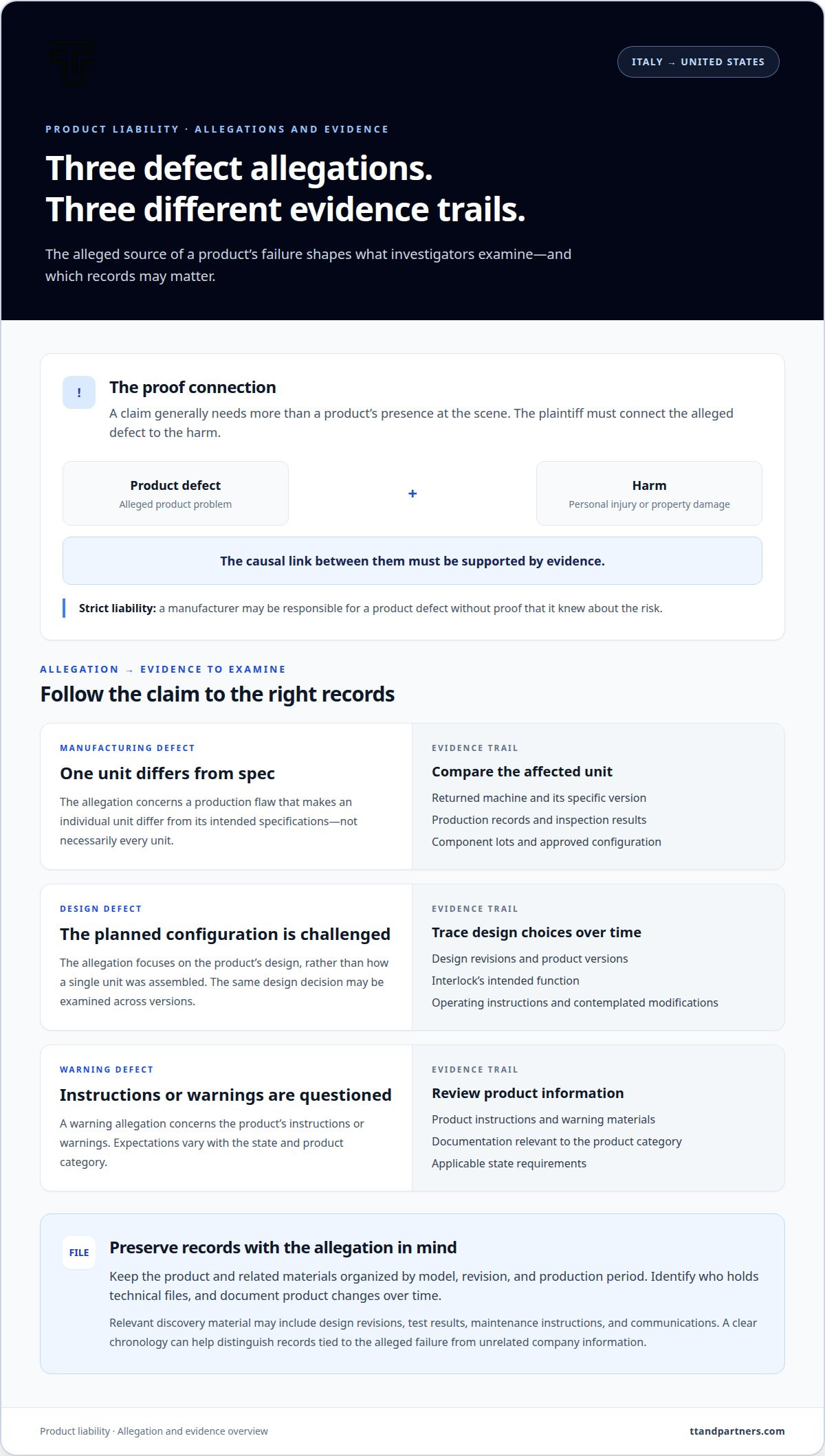
In a US product liability case, the plaintiff must prove that a product defect caused the alleged harm. An injury during product use does not establish that connection by itself. Evidence must link the product’s condition, the event, and the resulting harm. That causal chain helps determine which records may matter to an Italian manufacturer’s response.
During discovery, parties can request relevant material from opposing companies. In some cases, requests may reach confidential business records. A dispute about a machine guard, for example, may involve design revisions, test results, maintenance instructions, and communications about the guard’s function. These records can help show how the product was configured and used, and whether an alleged defect contributed to the injury.
In the CLEI Furniture case, a New York Supreme Court judge denied the company’s motion to dismiss, allowing the matter to proceed through discovery. The decision did not establish that the furniture was defective or that CLEI was liable. It allowed the parties to continue developing evidence relevant to the claims and the company’s connection to New York.
Discovery can also continue for an extended period. A product liability case involving a leading Italian flexible-packaging-equipment manufacturer included an eight-year discovery dispute. Prolonged document disputes underscore the importance of preserving complaint-related records and tracking who holds technical files. Manufacturers can organize relevant materials by product model, revision, and production period. A clear chronology helps distinguish records tied to the alleged failure from unrelated company information.
When a claim arrives, preserve the product and related records, including design files, test materials, service histories, and communications. Identify who is responsible for those records, and document product changes over time. A consistent filing system can help the company locate responsive material and compare the plaintiff’s account of causation with the product’s actual configuration.
Manufacturing, design, and warning defects
US claims distinguish manufacturing, design, and warning allegations, each pointing to different evidence. Safety and labeling expectations vary by state and product category, so assess the relevant market before sale.
Manufacturing Defects
A manufacturing defect is a production flaw that makes an individual unit differ from its intended specifications. The distinction matters because a claim may concern one machine or batch, rather than every unit. Investigators may compare the returned machine with production records and inspection results. Component lots and the approved configuration may also matter. An assembly mismatch or missing component can draw attention to factory controls. Preserve the affected unit and records for its specific version, since later modifications may complicate comparisons.
Design Defects
A design defect allegation challenges the product’s planned configuration, rather than the assembly of a single unit. The same design decision may be examined across product versions. In machinery disputes, allegations may concern design defects or interlocks, and may ask whether equipment modifications were foreseeable. A review can map the interlock’s intended function, design revision, operating instructions, and contemplated modifications. Those records show which safety choices shaped the product and help assess whether the disputed change relates to the alleged hazard.
Warning Defects
A warning defect concerns hazard information, instructions, or limitations communicated with a product. US documentation and warning standards can vary by state, so a label used in one market may not resolve the analysis elsewhere. Before sale, assess the product category and destination state. Review labels and manuals for the hazards, intended use, installation, and maintenance guidance they cover. For a machine with an interlock, assess whether the manual explains the safeguard and operating limits. Keep dated revisions and the technical basis for changes, since warning placement and wording may become central evidence.
US product liability exposure for manufacturers and distributors
US product liability for Italian manufacturers can involve state law, businesses across the supply chain, insurance terms, and assets in different countries. The claim and each company’s role shape the potential exposure.
Applicable U.S. Product Liability Laws
US product claims generally rely on state law, and the available legal theories and standards vary by state. An Italian manufacturer selling into the United States may face strict liability, negligence, or warranty allegations. The applicable state law and facts guide the analysis. For US product liability for Italian manufacturers, the law governing the claim may affect which evidence matters and which defenses are relevant.
Manufacturer and Distributor Exposure
A business may face a claim because it manufactured, imported, distributed, or sold the product. Component suppliers may also be treated as potential manufacturers when a product contains multiple components. A distributor’s position in the chain does not automatically eliminate exposure. Mapping the roles of suppliers, importers, distributors, and retailers can clarify how each participated in bringing the product to market.
Insurance Coverage and Typical Costs
Review whether product liability insurance specifically covers the United States, as US distributors may require. Policies do not cover punitive damages, although proceeding costs are usually covered. Each party bears its own legal costs, regardless of the verdict. No typical cost applies across all cases: premiums and litigation expenses depend on policy terms, product exposure, and how the dispute proceeds.
Defenses in U.S. Product Liability Cases
Potential defenses depend on the facts and evidence. A manufacturer may argue that equipment modifications or a plaintiff’s negligence contributed to an accident, as raised in a case involving modified equipment. Such arguments require evidence about the product’s condition and use. Enforcing a US judgment against assets in Italy involves a separate cross-border process from deciding liability.
For cross-border legal considerations connected to your business, discuss your situation with the firm.
Tosolini, Toniutti & Partners: E-2 VISA
Tosolini, Toniutti & Partners supports individuals and corporate clients with US-Italy cross-border immigration matters. Product liability analysis concerns a company’s legal exposure, while immigration planning is a separate consideration for owners, executives, or employees whose US business plans involve a move or longer-term presence.
For eligible individuals considering a permanent move, the firm assists with Green Card matters. This may be relevant when a manufacturer’s US expansion also involves assessing the immigration needs of key personnel or owners. Keeping these workstreams distinct helps businesses address product risks while also considering the personal immigration questions involved in operating across borders.
Contact Tosolini, Toniutti & Partners to discuss your US-Italy immigration needs.
Build cross-border responsibility into your next step
Treat US market entry as an ongoing governance decision, not a one-time export milestone. Assign responsibility for product changes, technical records, distributor coordination, and insurance review so decisions remain traceable as products and commercial relationships evolve.
This operating discipline can help leadership connect product decisions with the broader structure of its US expansion. Keep responsibilities clear across teams, and establish a defined process for escalating incidents or new claims. This makes cross-border accountability part of daily business planning.
Before entering a new market, map who controls product design, customer communications, and distribution decisions. This governance map can clarify who coordinates a response when a concern arises. Consider US product liability for Italian manufacturers separately from immigration planning for people supporting an expansion.
Tosolini, Toniutti & Partners offers E-2 VISA, E-1 VISA, and O-1 VISA support for individuals and corporate clients. To discuss your US-Italy plans, contact Tosolini, Toniutti & Partners and take the next step with a clear view of your business priorities.
Frequently Asked Questions
What Makes Foreign Manufacturers Responsible for Defective Products?
Foreign manufacturers may face responsibility when their products enter the US market and a defect is linked to personal injury or property damage. Their location outside the United States does not settle the question by itself. For example, a component maker may be named in a claim involving an assembled machine. Assess the component’s function, the alleged failure, and the evidence connecting that failure to the reported harm.
Who can be sued?
Potential defendants include manufacturers, component suppliers, importers, distributors, and retailers, depending on their roles and the applicable state law. A supplier of one component may be treated as a potential manufacturer when a finished product combines multiple parts. Being named in a lawsuit does not establish liability. A useful first step is to map which businesses made, supplied, imported, or distributed the product at issue.
Can U.S. courts exercise jurisdiction over Italian manufacturers for product liability claims?
Yes, when the state has a sufficient jurisdictional connection to the defendant and dispute. In New York, CPLR 302 (a) (1) addresses business transacted or contracts to supply goods or services there. The U.S. Supreme Court’s 2011 Goodyear decision illustrates that foreign manufacturers’ general business contacts alone don’t automatically establish general jurisdiction. The Court found Goodyear Luxembourg’s North Carolina connections insufficient.
Who can be held liable in the U.S. product supply chain: manufacturer, importer, distributor, or retailer?
Any of these businesses may face a claim if its role places it within the relevant manufacturing or distribution chain. Their legal roles differ: a manufacturer makes the product, an importer brings it into the market, and distributors and retailers participate in its onward sale. A supplier may also be treated as a potential manufacturer when a product contains multiple components. Liability depends on the claim and applicable law.
How are product liability damages and compensation calculated in U.S. lawsuits?
Compensation is assessed based on the harm the plaintiff proves and its connection to the alleged defect. The claimed loss may involve personal injury or property damage, with evidence establishing what happened and what losses followed. Punitive damages are additional to actual damages and face high barriers to award. There is no single calculation for every case: the injury, evidence, and governing state law shape the assessment.
How do U.S. strict liability, negligence, and warranty claims differ from Italian product liability rules?
Strict liability may apply regardless of what the manufacturer knew about a risk. Negligence focuses on alleged conduct, while warranty claims concern product promises or assurances. These US claim types differ from Italy’s product liability framework, so similar terms do not necessarily have identical requirements.



Comments