

Cross-Border Litigation Attorney US Italy: Navigating Transatlantic Legal Disputes in 2026
- Gianni Mendes Toniutti, Esq.

- 1 day ago
- 12 min read
What if the greatest risk to your transatlantic enterprise isn't a breach of contract, but the procedural void that exists between the American legal landscape and Rome? Many executives believe a standard choice-of-law clause provides a total safety net, yet the reality of dual-jurisdiction litigation often reveals a complex web of conflicting rules and enforcement hurdles. You've likely felt the frustration of watching legal fees climb while your case stalls in a jurisdictional deadlock. It's a common pain point where the precision of a cross-border contract dispute attorney US Italy becomes the bridge between two disparate legal worlds.
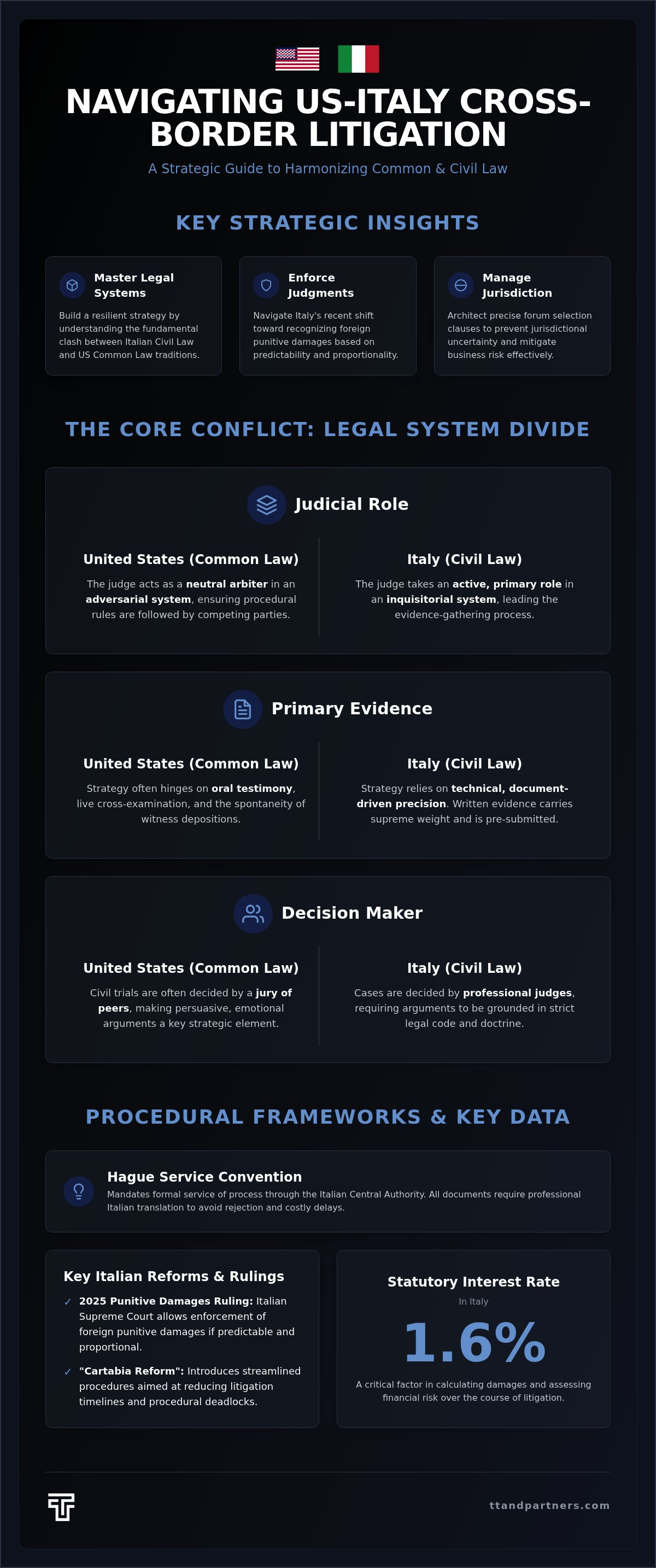
We'll show you how to master these complexities by harmonizing common law expectations with the latest civil law reforms. You'll gain a clear roadmap for enforcing foreign judgments under the 2026 Hague protocols and the landmark 2025 Italian Supreme Court rulings on punitive damages. From understanding the 1.6 percent statutory interest rate in Italy to leveraging the streamlined "Cartabia Reform" procedures, this article previews the essential strategies needed to protect your assets and minimize transatlantic legal risk with professional confidence.
Table of Contents
Understanding the Architecture of US-Italy Cross-Border Litigation
Essential Procedural Frameworks: Service and Evidence Gathering
Enforcing Foreign Judgments: Bridging the US and Italian Courts
Strategic Risk Management for International Business Disputes
The TT&P Advantage: Specialized Counsel for US-Italy Success
Understanding the Architecture of US-Italy Cross-Border Litigation
Cross-border litigation defines a conflict where parties, assets, or contractual obligations span two distinct legal systems. In the transatlantic corridor, this typically manifests as a collision between the Italian Civil Law tradition and the US Common Law system. It's not simply a matter of translating words. It's about translating the very philosophy of justice. For an American corporation or an Italian exporter, a dispute isn't just a financial risk; it's a structural challenge that requires a deep understanding of how these two worlds interact. Engaging a specialized cross-border contract dispute attorney US Italy is the first step in architecting a successful defense or claim.
The stakes in these disputes are exceptionally high. A single jurisdictional error in the early stages can lead to years of procedural deadlock. If a court in Milan and a court in New York both claim authority, or worse, both decline it, your assets can remain frozen while legal teams argue over the venue rather than the merits of the case. This friction often results in runaway costs that far exceed the original value of the contract. A dual-lens strategy, which views the dispute through both legal cultures simultaneously, is the only way to maintain momentum and protect your commercial interests.
The Civil Law vs. Common Law Divide
The Italian judiciary operates on an inquisitorial model where the judge takes a primary role in evidence gathering. This stands in stark contrast to the adversarial nature of US courts, where the judge acts as a neutral arbiter between competing parties. In Italy, civil trials are decided by professional judges rather than juries. This shifts the strategy away from emotional persuasion toward technical, document-driven precision. Written evidence carries supreme weight in Italy, whereas US litigation often hinges on the spontaneity of oral testimony and cross-examination. This adversarial model is particularly vital to understand if you need to explore Car Accident Representation or manage other tort-related claims in the US. Understanding these nuances prevents a US party from being blindsided by the lack of a "day in court" or an Italian party from being overwhelmed by the intensity of US depositions.
Why Generalist Firms Struggle with Italy-US Disputes
Large, multi-practice firms often treat international disputes as standard litigation with a thin translation layer. This perspective fails to account for the nuances of discovery, a concept that lacks a direct equivalent in the Italian system. Without a precise grasp of the Hague Service Convention, the initial service of process can be deemed invalid, resetting the legal clock by months or years. Boutique firms, such as Tosolini, Toniutti & Partners, provide the specialized focus required to handle these complexities. They recognize that US recognition of foreign judgments varies by state law and requires a nuanced national perspective. A generalist might miss the subtle cultural cues in an Italian courtroom or the strict procedural deadlines of a US District Court, but a specialized cross-border contract dispute attorney US Italy ensures every structural element is aligned for success.
Essential Procedural Frameworks: Service and Evidence Gathering
The success of transatlantic litigation often hinges on the mechanical precision of the initial procedural steps. While the architecture of the case defines the legal theory, the procedural framework determines whether that theory ever reaches a judge. Navigating these treaties requires the strategic foresight of a cross-border contract dispute attorney US Italy who understands that procedural missteps are often fatal to high-stakes claims. As of 2026, both the United States and Italy remain active parties to the Hague conventions, yet the practical application of these rules continues to evolve.
Mastering the Hague Service Convention
Initiating a lawsuit against an Italian defendant from a US court isn't as simple as hiring a private process server. You must follow the formal channels dictated by the Hague Service Convention. This involves sending the summons and complaint through the Italian Central Authority, typically the Ministry of Justice. Every document must be professionally translated into Italian, as failure to provide an accurate translation is a primary reason for service being contested or rejected. Don't rely on informal methods like international registered mail; while some US courts might initially accept it, Italian courts frequently view such service as a violation of sovereignty. This can lead to the total dismissal of your case or, more commonly, a refusal to recognize the eventual judgment in Italy.
Evidence Gathering and the Discovery Clash
The most significant friction point in US-Italy disputes is the concept of discovery. US common law allows for broad, party-driven searches for information, which Italian civil law often views as invasive "fishing expeditions." To bridge this gap, litigants use the Hague Evidence Convention to issue Letters of Request. This process allows a US court to ask an Italian court to compel testimony or document production. However, the Italian judge maintains control over the scope, ensuring it aligns with local civil codes.
Conversely, Italian parties can utilize US procedural strengths to their advantage. Under 28 U.S.C. § 1782, foreign litigants can petition a US federal court to order testimony or document production from a person or entity located within its district for use in a proceeding before a foreign tribunal. This statute is a powerful tool for Italian companies needing evidence held by a US parent company or partner. In many instances, the involvement of the Italian Consulate is necessary to facilitate depositions or certify evidence for use abroad. If you're facing these procedural hurdles, it's wise to consult with strategic legal architects who can synchronize these conflicting systems to preserve your evidence and your rights.
Enforcing Foreign Judgments: Bridging the US and Italian Courts
A common misconception among international litigants is that a court victory in one country automatically translates to asset seizure in another. The "full faith and credit" clause, which facilitates the seamless recognition of judgments between US states, doesn't extend across the Atlantic. Since no bilateral treaty exists between the US and Italy specifically for judgment recognition, the process relies on local statutes and the principle of comity. A skilled cross-border contract dispute attorney US Italy recognizes that winning the trial is only the midpoint of the journey; true success is measured by the actual recovery of assets through a foreign court's endorsement.
In the United States, the recognition of foreign money judgments is governed by state law, typically through the Uniform Foreign-Country Money Judgments Recognition Act. This act provides a streamlined path for enforcement, provided the foreign proceeding met basic standards of fairness. Conversely, Italy relies on the "delibazione" process, primarily governed by Article 64 of the Private International Law Act (Law 218/1995). Both systems share a common gatekeeper: the "public policy" exception. If a foreign judgment is deemed to violate the fundamental legal or moral principles of the enforcing nation, it becomes unenforceable. This is why strategic architects must draft their initial claims with an eye on the final enforcement venue.
Enforcing an Italian Judgment in the United States
US courts don't re-examine the merits of an Italian case. Instead, they scrutinize the procedural integrity of the Italian court. To secure recognition, you must demonstrate that the defendant was served properly and that the court had personal jurisdiction. If the Italian proceeding lacked due process or was obtained through fraud, the US court will likely refuse enforcement. The procedural path usually involves filing a new action to domesticate the foreign judgment, a process detailed in our International Litigation 2026: A Strategic Guide. Once domesticated, the Italian judgment carries the same weight as a local decision.
Enforcing a US Judgment in Italy
The Italian appellate courts handle the recognition of US judgments through a specific review of the foreign record. Historically, US awards containing punitive damages were often rejected as being contrary to Italian public policy. However, following the landmark Italian Supreme Court decision on November 30, 2025, Italy now recognizes foreign judgments with punitive or multiple damages, provided they meet clear standards of proportionality and predictability. This shift significantly enhances the leverage of US litigants in 2026. Still, the Italian court will verify that the US decision doesn't conflict with an existing Italian judgment and that the defendant's right to a defense was respected. Strategic planning is essential to ensure that a US jury's verdict isn't diluted or dismissed upon reaching Italian soil.
Strategic Risk Management for International Business Disputes
Strategic risk management isn't a reaction to a legal crisis; it's a foundational element of the business architecture itself. For companies operating across the Atlantic, the contract serves as the primary blueprint for stability. A proactive cross-border contract dispute attorney US Italy ensures that the terms of engagement are not just legally sound but strategically advantageous. This involves anticipating how a dispute might impact corporate assets or even the residency status of key personnel. By treating legal planning as a form of engineering, businesses can build structures that withstand the friction of two different legal systems. For those managing a portfolio that includes assets in the United Kingdom, you can visit Feltons Solicitors LLP for specialized legal services in property and private client matters.
Drafting Resilient Cross-Border Contracts
Choosing the governing law is a nuanced decision that requires more than a default selection of New York law. While New York provides a robust commercial framework, certain Italian civil law protections might offer better safeguards for specific types of intellectual property or agency agreements. Precision in the language of the contract is equally vital. Bilingual contracts often lead to interpretation errors unless a prevailing language clause is clearly established. Beyond the words on the page, the corporate structure itself acts as a defensive layer. Proper LLC incorporation can shield personal assets from the reach of cross-border claims, creating a clear boundary between the enterprise and the individual.
Arbitration vs. Litigation: The Transatlantic Choice
International arbitration often provides a more streamlined path than traditional court systems. Under the New York Convention, arbitral awards are generally easier to enforce in both the US and Italy than court judgments. High-stakes partners often prefer the specialized expertise of the ICC or AAA over the generalist nature of national courts. For those seeking to bypass the public nature of the judiciary, a cross-border contract dispute attorney US Italy may recommend arbitration as a confidential alternative. Arbitration typically resolves disputes much faster than the 511 day average required for a first-instance civil case in the Italian court system.
We must also consider the holistic impact of legal conflicts on the individual. A protracted dispute can jeopardize an investor's immigration status, particularly if the business operations tied to a treaty visa are disrupted. Managing these overlapping risks requires a counsel that understands both the courtroom and the consulate. If you're looking to fortify your transatlantic operations against future uncertainty, contact our strategic legal architects to evaluate your current contractual safeguards.
The TT&P Advantage: Specialized Counsel for US-Italy Success
The choice of legal representation in a transatlantic dispute is a decision of structural importance. For organizations building these elite teams, Esquire Talent Consultants provides the specialized recruitment expertise needed to source attorney and partner-level professionals with deep cross-border experience. While large, multi-national firms often rely on volume and standardized protocols, the complexities of the US-Italy corridor demand a more surgical precision. A boutique firm offers the strategic agility necessary to pivot as jurisdictional challenges arise. By choosing a specialized cross-border contract dispute attorney US Italy, you ensure that your counsel isn't just reacting to the opposition but is actively architecting a path toward resolution. We believe that legal disputes aren't just isolated events; they're critical moments that require a deep understanding of both the common law and civil law legacies.
Bridging the cultural gap is perhaps our most vital function. It's not enough to speak the language; a legal team must understand the underlying expectations of an Italian magistrate or a US federal judge. Our "dual-lens" philosophy allows us to anticipate how evidence presented in New York will be perceived in Milan. This foresight prevents the misunderstandings that often lead to costly delays or the unintended waiver of rights. We operate as strategic partners, ensuring that every move in the courtroom aligns with your broader commercial objectives and maintains the harmony of your international operations.
A Holistic Approach to International Legal Conflicts
International litigation rarely exists in a vacuum. A commercial dispute often ripples through other areas of a client's life, affecting corporate standing or residency. Our litigation team works in close harmony with our Green Card and O-1 Visa experts to ensure that a legal battle doesn't compromise your immigration status or future investment opportunities. This integrated approach provides a single point of contact for multi-jurisdictional matters, replacing the fragmented communication of traditional legal teams with a unified, visionary strategy. We don't just solve a case; we protect the entire ecosystem of your transatlantic presence.
Taking the Next Step in Your Legal Strategy
Early intervention is the most effective way to mitigate legal risk. Waiting for a formal summons often means losing the opportunity to shape the jurisdictional landscape or secure provisional remedies in the Italian courts. Whether you're facing a potential breach of contract or seeking to enforce a judgment, a confidential consultation allows us to evaluate the structural integrity of your position. Our international team is ready to provide the precision and magisterial oversight your case deserves. To begin architecting your solution, Contact Tosolini, Toniutti & Partners for expert counsel tailored to the unique demands of US-Italy law.
Architecting Resilience in Transatlantic Legal Strategy
Navigating the structural divide between US Common Law and Italian Civil Law requires more than a standard legal approach. It demands a visionary perspective that anticipates procedural friction before it causes a jurisdictional deadlock. We've explored how mastering the Hague conventions and understanding the 2026 shifts in Italian judgment enforcement can turn a potential crisis into a manageable business event. By integrating corporate structure with a dual-lens litigation strategy, you create a defensive layer that protects both assets and operational continuity across the Atlantic.
Partnering with a specialized cross-border contract dispute attorney US Italy provides the boutique precision necessary to bridge these two complex systems effectively. With decades of cross-border expertise and total fluency in both legal traditions, Tosolini, Toniutti & Partners serves as a strategic architect for your international success. Our firm focuses on delivering intellectual depth and technical accuracy to every high-stakes matter. Secure your transatlantic interests with a strategic legal consultation. We look forward to harmonizing your legal needs with your long-term business vision.
Frequently Asked Questions
Can a US court exercise jurisdiction over an Italian company?
A US court can exercise jurisdiction over an Italian company if that entity has sufficient "minimum contacts" with the forum state. This usually occurs when the company enters into a contract performed in the US or targets the US market through specific commercial activities. A cross-border contract dispute attorney US Italy will analyze these contacts to determine if the exercise of power aligns with constitutional due process and state long-arm statutes.
How long does it typically take to enforce a foreign judgment between the US and Italy?
Enforcing a foreign judgment typically takes between 12 and 24 months, depending on the complexity of the case and the specific court's docket. In Italy, the "delibazione" process involves a formal review by the Court of Appeals to ensure the judgment doesn't violate fundamental public policy. US domestication can be more efficient under the Uniform Foreign-Country Money Judgments Recognition Act, provided the defendant doesn't raise valid procedural objections regarding the fairness of the original trial.
What is the Hague Service Convention and why does it matter for my case?
The Hague Service Convention is a multilateral treaty that provides a standardized, reliable channel for serving judicial documents across international borders. It matters because it eliminates the uncertainty of informal service methods that could lead to your case being dismissed for lack of proper notice. Following these protocols ensures that a US court maintains its jurisdiction and that an Italian court will later recognize the resulting judgment as procedurally valid.
Are Italian court judgments easily recognized in all US states?
Italian judgments are generally recognized in most US states, but the process isn't automatic. Most jurisdictions apply the Uniform Foreign-Country Money Judgments Recognition Act, which requires a US judge to confirm that the Italian proceeding was fair and impartial. If the Italian court lacked personal jurisdiction or the judgment was obtained through fraud, a US court has the authority to refuse to domesticate the award.
Can I use evidence from an Italian proceeding in a US lawsuit?
You can use evidence from an Italian proceeding in a US lawsuit by utilizing the Hague Evidence Convention or the powerful discovery tool found in 28 U.S.C. § 1782. US federal courts frequently assist foreign litigants in obtaining discovery from entities located within their districts. Authenticated documents and sworn testimony from Italian phases can often be admitted in the US if they meet local standards for relevance and authenticity.
What are the main differences between litigation in Italy and the United States?
The primary difference lies in the procedural philosophy; Italy follows an inquisitorial model while the US utilizes an adversarial system. In Italian civil courts, professional judges manage the evidence and there are no juries. US litigation relies heavily on party-driven discovery and oral testimony, whereas the Italian system prioritizes written documentation and technical expert reports commissioned directly by the court.
Should I choose arbitration or litigation for my US-Italy business contract?
Choosing between arbitration and litigation depends on your priorities regarding speed, privacy, and ease of enforcement. Arbitration is often the superior choice for international contracts because arbitral awards are recognized in over 170 countries under the New York Convention. Litigation might be preferable if you require the immediate provisional remedies or the specific appellate rights offered by national court systems in Italy or the US.
How do attorney fees work in international cross-border litigation?
Attorney fee structures vary significantly between the two systems. The US generally follows the "American Rule" where each party bears its own costs regardless of the outcome. In contrast, Italy applies a "loser pays" principle, where the prevailing party can recover a portion of their legal expenses based on statutory scales. Consulting a cross-border contract dispute attorney US Italy helps you budget for these disparate rules and manage the financial risks of transatlantic litigation.


Comments