

How to Get Italian Dual Citizenship in 2026: The Strategic Post-Law 74 Guide
- Gianni Mendes Toniutti, Esq.

- 1 day ago
- 12 min read
The era of unlimited Italian citizenship by descent has officially come to an end with the enforcement of Law No. 74/2025. This legislative shift transforms a birthright into a strategic legal pursuit, requiring meticulous alignment with the new two-generation limit. You likely feel the weight of this transition as you face extended consulate backlogs and the reality that the italian citizenship processing time has now legally increased to three years. It's a complex landscape where the rules of the past no longer apply, leaving many applicants questioning if their ancestral connection remains a valid gateway to Europe.
We understand that the path to a second passport shouldn't feel like a bureaucratic maze. This guide provides the clarity you need to confirm your eligibility under current 2026 standards and navigate mandatory Italy-based interviews with precision. You'll find a clear roadmap for procuring unbroken line records and a strategic overview of the judicial alternatives available when consulates fail to meet their obligations. By the end of this article, you'll possess the professional framework required to secure your Italian passport through descent, marriage, or residency with absolute confidence.
Table of Contents
Understanding the 2025 Legal Shift in Italian Citizenship
The architecture of Italian nationality law underwent its most profound transformation in decades with the enactment of Law No. 74/2025. For over thirty years, Law No. 91/1992 provided a generous framework for the global diaspora to reclaim their heritage through the principle of jure sanguinis. This open-door policy eventually created an administrative burden that the Italian state couldn't sustain. The new legislation, effective for applications filed after March 27, 2025, represents a pivot toward a more controlled definition of citizenship. It moves away from the concept of blood as an infinite right. Instead, it demands a closer, more contemporary link to the Italian republic.
Key Changes Under Article 3-bis
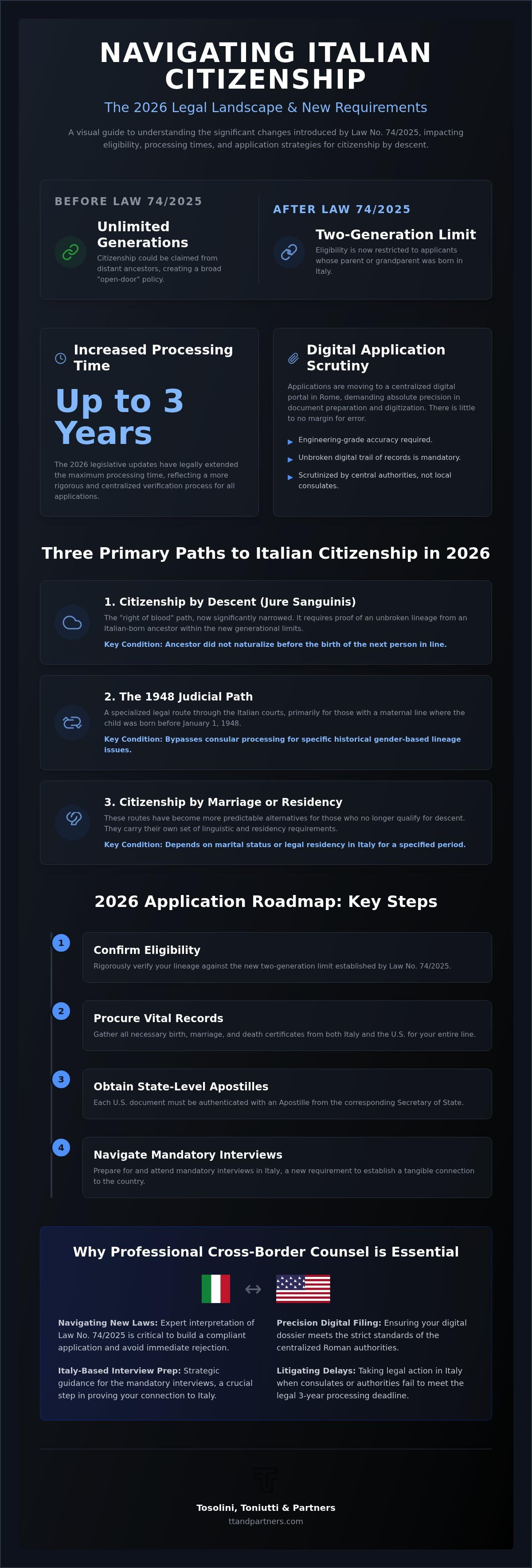
The centerpiece of this reform is Article 3-bis, which introduces a "two-generation limit" for most new applications. This change fundamentally disrupts the plans of many in the US who sought to claim citizenship through great-grandparents or even more distant ancestors. Under the current 2026 rules, the standard pathway is now largely restricted to those whose parent or grandparent was born in Italy. This narrowing of the eligibility window aims to reduce the massive backlog at consulates, yet it places a higher burden of proof on the applicant. Beyond lineage, the law introduces markers for cultural and linguistic connection, signaling that the Italian passport is intended for those who actively engage with the nation's identity. There are also emerging discussions regarding the residency and tax implications for those holding dual status, making it vital to consult with a specialized law firm before proceeding.
The Move to Digital Processing
The era of physical paper dossiers at local consulates is rapidly fading. The Ministry of Foreign Affairs has accelerated the transition to a centralized digital portal, a move designed to harmonize the review process across all global jurisdictions. While consulates will continue to accept filings through 2028, the January 2026 Senate bill has already impacted expectations by extending the legal italian citizenship processing time to a maximum of three years. This centralization requires engineering-grade precision in document preparation. Every vital record and apostille must be digitized and indexed with absolute accuracy. The centralized office in Rome allows for very little margin of error. The increased italian citizenship processing time reflects a more rigorous verification phase, where the digital trail must be unbroken and beyond reproach. This technological shift necessitates professional oversight to ensure your digital application is resilient enough to withstand the scrutiny of the Roman central authorities.
The Three Primary Paths to Italian Dual Citizenship in 2026
Securing Italian status requires more than just a biological link; it demands a deliberate choice between three distinct legal frameworks. While descent remains the most sought-after route for the US diaspora, the 2025 legal shift for citizenship has forced many applicants to reconsider marriage or residency as more predictable alternatives. Each path carries its own set of evidentiary standards, linguistic requirements, and bureaucratic hurdles. Choosing the correct strategy depends on your genealogical history, your current residence, and your long-term lifestyle goals in the European Union.
Italian Citizenship by Descent (Jure Sanguinis)
The principle of jure sanguinis, or the right of blood, allows individuals to claim citizenship if they can prove an unbroken line of transmission from an Italian-born ancestor. The critical legal threshold is ensuring that the "Senior Italian" ancestor did not naturalize in the United States before the birth of the next person in the lineage. This path requires a comprehensive dossier of birth, marriage, and death certificates, all of which must be accompanied by state-level Apostilles and professional translations. Because of the high volume of claims, the official italian citizenship processing time for descent applications was legally extended in 2026 to a maximum of three years. This timeline reflects the rigorous verification now performed by the centralized processing office in Rome.
Citizenship by Marriage or Civil Union
Known as jure matrimonii, this route is available to spouses of Italian citizens. The requirements are notably different from descent cases. Applicants must demonstrate a B1 level of proficiency in the Italian language, verified through a recognized certification. The timeline for eligibility is also strictly defined:
Two years of legal residence in Italy after the marriage or civil union.
Three years if the couple resides outside of Italy.
These periods are reduced by 50% if the couple has children under the age of 18. While the
italian citizenship processing time
for marriage is generally 24 months, the Ministry of the Interior may extend this to 36 months for complex files. This path is often more streamlined than descent, provided the language requirement is met.
For those without ancestral or marital ties, naturalization through residency remains an option. This requires ten years of legal residency in Italy for non-EU citizens, reduced to four years for EU nationals. This path demands consistent tax compliance and social integration within the Italian state. If you are uncertain which route provides the most efficient timeline for your specific circumstances, you may find it beneficial to consult with our legal team for a detailed eligibility assessment.
Navigating the 'Jure Sanguinis' Requirements and the 1948 Judicial Path
The success of a citizenship claim hinges on the "Senior Italian" ancestor, the first individual in your lineage born on Italian soil. Under the 2026 regulatory framework, identifying this ancestor's naturalization status is the single most critical data point in your dossier. If your ancestor became a US citizen before the birth of the next person in your line, the chain of transmission was legally severed. You must secure definitive proof of when, or if, this naturalization occurred. The official rules for Jure Sanguinis now require exhaustive documentation from the US Citizenship and Immigration Services (USCIS) and National Archives to confirm that the Italian bloodline remained intact throughout the migration process.
Managing non-renunciation certificates adds another layer of complexity to the procurement phase. These documents, issued by various consulates where your ancestors resided, verify that the individual never formally renounced their Italian citizenship. While the italian citizenship processing time for these specific certificates varies by jurisdiction, they are non-negotiable components of a resilient application. Even minor discrepancies in names or birthdates across centuries of records can trigger a rejection, making it essential to reconcile historical data through legal amendments or "one and the same" court orders before submission.
The 1948 Case: Overcoming Gender Discrimination
For many applicants, the traditional administrative route is blocked by the "1948 Rule." Before the Italian Constitution took effect on January 1, 1948, women could not transmit citizenship to their children. If your lineage involves an Italian woman whose child was born before this date, you must pursue a judicial path through the Italian court system. These cases aren't filed at consulates but are litigated in the civil courts of the ancestor's native province. The italian citizenship processing time for judicial cases is often more predictable than the years-long wait at certain US consulates, typically ranging from 18 to 36 months. This route effectively bypasses the restrictive Law 74 generation limits by seeking a court order to recognize a right that was previously denied due to gender discrimination.
Proving the Unbroken Line
The evidentiary burden requires a Certificate of Non-Existence if your ancestor never naturalized. This search must be thorough, covering every variation of the ancestor's name used in the US. Once gathered, every American vital record must be legalized for international use. An Apostille is a multi-national treaty certification that authenticates the origin of a public document for use in another participating country. Precision in this phase is paramount; a single missing record or an incorrect translation can stall your progress for years. If you encounter complex obstacles in your genealogical line, contact our legal team to discuss strategic litigation options.
The 2026 Application Roadmap: From Digital Filing to Mandatory Interviews
The journey toward an Italian passport in 2026 is a multi-phase architectural project that demands both historical research and modern technical precision. It begins with the procurement of Italian vital records from the ancestral comune, followed by the gathering of US birth, marriage, and death certificates. These domestic documents must be legalized through state-level Apostilles, which serve as a multi-national treaty certification for legal records. Once the dossier is complete, it undergoes a rigorous legal review to ensure the unbroken line of citizenship is documented without a single discrepancy. Only then is the application ready for digital submission via the centralized Ministry of Foreign Affairs portal, a process that has fundamentally changed the italian citizenship processing time for the US diaspora.
The Digital Portal and Pre-Screening
Navigating the Prenot@mi and centralized application systems requires more than just basic data entry. It's a sophisticated pre-screening environment where the Ministry of Foreign Affairs identifies potential flaws before a physical interview is even granted. Common Request for Evidence (RFE) triggers include mismatched names across generations or poor-quality digital scans of original Apostilles. Applicants must also manage the required application fee, which is currently set at €300 for online filings, ensuring that payment verification is correctly indexed within the portal. This digital pre-screening phase is a critical determinant of your overall italian citizenship processing time, as an incomplete file can lead to immediate rejection or years of administrative delay.
The Mandatory Italy-Based Interview
One of the most significant shifts under the 2026 framework is the requirement for a face-to-face interview within Italy for many applicants. This phase moves the final recognition from the consulate to the Italian territory, requiring logistics that include travel and potential temporary residency. During this interview, authorities verify the original paper dossier against the digital filing and assess the applicant's connection to the Italian state. It's a formal proceeding that marks the transition from applicant to citizen. Once the interview is successfully concluded, the final step is the issuance of the Italian passport and registration in the Registry of Italians Residing Abroad (AIRE). If you need assistance navigating the complexities of the digital portal or preparing for your mandatory interview, consult with our specialized legal team to ensure your roadmap is strategically sound.
Why Professional Cross-Border Counsel is Mandatory Under Law 74
The 2025 legislative overhaul has moved Italian citizenship from the realm of genealogical research into the sphere of complex international litigation. Law No. 74/2025 introduces nuances that a simple document scout cannot navigate. Bridging the gap between US vital records and Italian civil law requires a dual-presence firm that understands the friction between these two jurisdictions. When you're facing a three-year italian citizenship processing time, every document must be resilient enough to withstand the scrutiny of the centralized Ministry of Foreign Affairs. A strategic legal partner doesn't just collect papers; they architect a comprehensive filing that anticipates the new cultural and linguistic requirements of the Italian state.
Beyond the Passport: Cross-Border Legal Integration
The acquisition of an Italian passport is rarely a standalone event for high-net-worth individuals. Citizenship fundamentally alters the landscape of real estate closing and inheritance planning within the European Union. For entrepreneurs, it offers distinct strategic advantages, especially for E-2 Visa holders who wish to leverage their dual status for transatlantic expansion. Managing the tax implications of dual residency requires a unified legal vision that spans both continents. To ensure your global assets are protected while you pursue your heritage, you should contact our US-Italy legal team for a comprehensive eligibility and asset audit.
Managing International Litigation and Disputes
The judicial path is often the most efficient route when consulates fail to act. If you're stuck in a backlog that exceeds the legal italian citizenship processing time, we can file "Against the Consulate" lawsuits in the Italian courts to force a decision. This is also the only way to resolve 1948 cases or manage international litigation involving Italian assets. Enforcing US judgments in Italy or managing complex disputes requires a firm that can litigate directly in the ancestral province's civil court. We provide the intellectual depth needed to handle these high-stakes proceedings with the precision they demand.
Law 74 makes professional legal review mandatory for all applications because the interplay between the new two-generation limit and the mandatory Italy-based interview creates a high-stakes environment where any evidentiary error results in permanent disqualification. It's no longer enough to have the right bloodline. You must have the right legal strategy to protect it.
Securing Your Italian Legacy in a Changing Legal Landscape
The transition from a simple heritage claim to a sophisticated legal strategy is now a necessity. As explored throughout this guide, the enactment of Law No. 74/2025 has fundamentally narrowed the eligibility window and extended the official italian citizenship processing time to a three-year horizon. Success in 2026 depends on your ability to navigate the digital centralized portal and prepare for mandatory interviews with absolute precision. Whether you're pursuing a standard descent claim or litigating a complex 1948 judicial case, the quality of your legal architecture will determine your final outcome.
Our specialized US-Italy cross-border legal team bridges the gap between your American vital records and Italian civil law. We provide comprehensive support that spans the entire process, from initial document procurement to the final recognition phase on Italian soil. We possess deep expertise in Law 74/2025 compliance and the nuances of 1948 judicial claims. Don't let bureaucratic shifts stand between you and your ancestry. We invite you to Schedule a Strategic Citizenship Consultation with Tosolini, Toniutti & Partners to conduct a professional eligibility audit. Your ancestral journey deserves the certainty of expert legal precision, and we're ready to help you reclaim your place in Italy's future.
Frequently Asked Questions
Do I still qualify for Italian citizenship if my great-grandparent was the last one born in Italy?
Under the restrictive framework of Law No. 74/2025, you generally don't qualify through the standard consular route if your lineage relies on a great-grandparent. The new legislation effectively limits most new claims to those with an Italian parent or grandparent. This shift aims to manage the global backlog by prioritizing closer ancestral ties. However, certain judicial paths or residency-based applications may still offer alternative solutions depending on the specific dates of naturalization and the nature of your family's records.
What is the 1948 case, and does it apply to my Italian citizenship application?
A 1948 case is a judicial proceeding for descendants of Italian women whose children were born before January 1, 1948. Before this date, Italian law discriminated against women by preventing them from passing citizenship to their offspring. These cases are litigated directly in the Italian civil courts rather than through a consulate. Because these are court-ordered recognitions based on constitutional equality, they often bypass the standard generation limits imposed by Law 74/2025, making them a strategic choice for many US families.
How long does the Italian dual citizenship process take in 2026?
The official italian citizenship processing time for descent applications has legally increased to three years as of January 2026. This period begins once your application is formally accepted by the centralized processing office in Rome. You must also account for consulate appointment wait times, which currently range from two to four years in major cities like New York. Pursuing a judicial filing in Italy can often provide a more predictable timeline for those facing excessive consular delays.
Do I have to speak Italian to get dual citizenship by descent?
Standard citizenship by descent currently doesn't require a formal B1 language proficiency exam like the one mandated for marriage-based applications. However, Law 74/2025 introduces a stronger emphasis on cultural and linguistic connection markers. While you don't need to be fluent for a jure sanguinis claim, demonstrating a basic understanding of Italian culture and language is increasingly viewed as a critical component of the mandatory face-to-face interview process now required by the Italian state.
Can I lose my US citizenship if I become an Italian citizen?
You won't lose your US citizenship by acquiring an Italian passport. Both the United States and Italy recognize dual nationality, allowing you to maintain your American status while enjoying the benefits of EU citizenship. You'll continue to use your US passport for entry and exit from the United States. This dual status provides expanded freedom of movement and the right to live, work, or study anywhere within the European Union without a visa.
What are the tax implications of holding an Italian dual passport?
Holding an Italian passport doesn't automatically trigger Italian tax obligations if you reside outside of Italy. Italy taxes individuals based on their legal residency rather than their citizenship, which is a significant departure from the US tax system. However, if you establish residency in Italy or hold significant Italian assets, you'll need a strategic cross-border tax plan. We recommend a professional audit to ensure you remain compliant with both US and Italian reporting requirements for global income.
Is there a mandatory interview in Italy for citizenship by descent?
Yes, Law 74/2025 has introduced a requirement for a face-to-face interview within Italy for many citizenship by descent applicants. This shift moves the final recognition phase from the consulate to the Italian territory. You'll need to appear before Italian authorities to verify your original dossier against your digital filing. This interview serves as a formal assessment of your connection to the Italian state and is the final step before the issuance of your Italian passport.
How much does it cost to get Italian dual citizenship with legal assistance?
The total investment involves both government fees and professional legal representation. As of July 2026, the Italian government charges a $699.10 application fee for descent claims at US consulates, while online applications for marriage or residency cost €250. Legal fees vary based on the complexity of your lineage, the number of records requiring procurement, and whether your case requires litigation in the Italian courts. Investing in professional counsel ensures your dossier is resilient enough to avoid costly rejections.


Comments