

E-2 Visa Cost for Italian Investors: The 2026 Strategic Budgeting Guide
- Gianni Mendes Toniutti, Esq.
- 4 hours ago
- 12 min read
What if the greatest hurdle to your American expansion isn't the total capital required, but how you distinguish between a sunk cost and a strategic investment? For many Italian entrepreneurs, the ambiguity surrounding the "substantial" investment threshold creates a persistent sense of financial exposure. It's natural to feel concerned about the dual-jurisdiction legal requirements or the possibility of a Request for Evidence that could stall your vision. This guide provides a definitive breakdown of the E-2 visa cost for Italian investors, offering the clarity needed to approach the 2026 fiscal landscape with professional confidence.
We'll examine the mandatory government fees, such as the $315 DS-160 and the $308 reciprocity fee specific to Italian citizens, while clarifying how your capital remains an active asset within your new venture. By the end of this analysis, you'll understand the precise requirements of the U.S. Embassy in Rome and how to structure your budget for both compliance and long term growth. We'll move beyond the confusion of filing fees to focus on the intellectual and financial engineering of a successful transition to the United States market.
Table of Contents
Navigating the E-2 Visa Financial Landscape for Italians in 2026
The year 2026 presents a stable horizon for Italian entrepreneurs seeking to bridge the Atlantic. The United States continues to offer a fertile environment for innovation, provided the entry strategy is built on financial precision. When calculating the total E-2 visa cost for Italian investors, you must move beyond a simple tally of expenses. It's a strategic allocation of resources where administrative compliance meets operational readiness. The U.S. Embassy in Rome maintains rigorous standards, requiring a budget that accounts for both the mechanics of the application and the substance of the business itself. Total financial commitment involves a journey from the initial filing to the eventual business launch, requiring a clear vision of each fiscal milestone.
Cost vs. Investment: A Vital Distinction
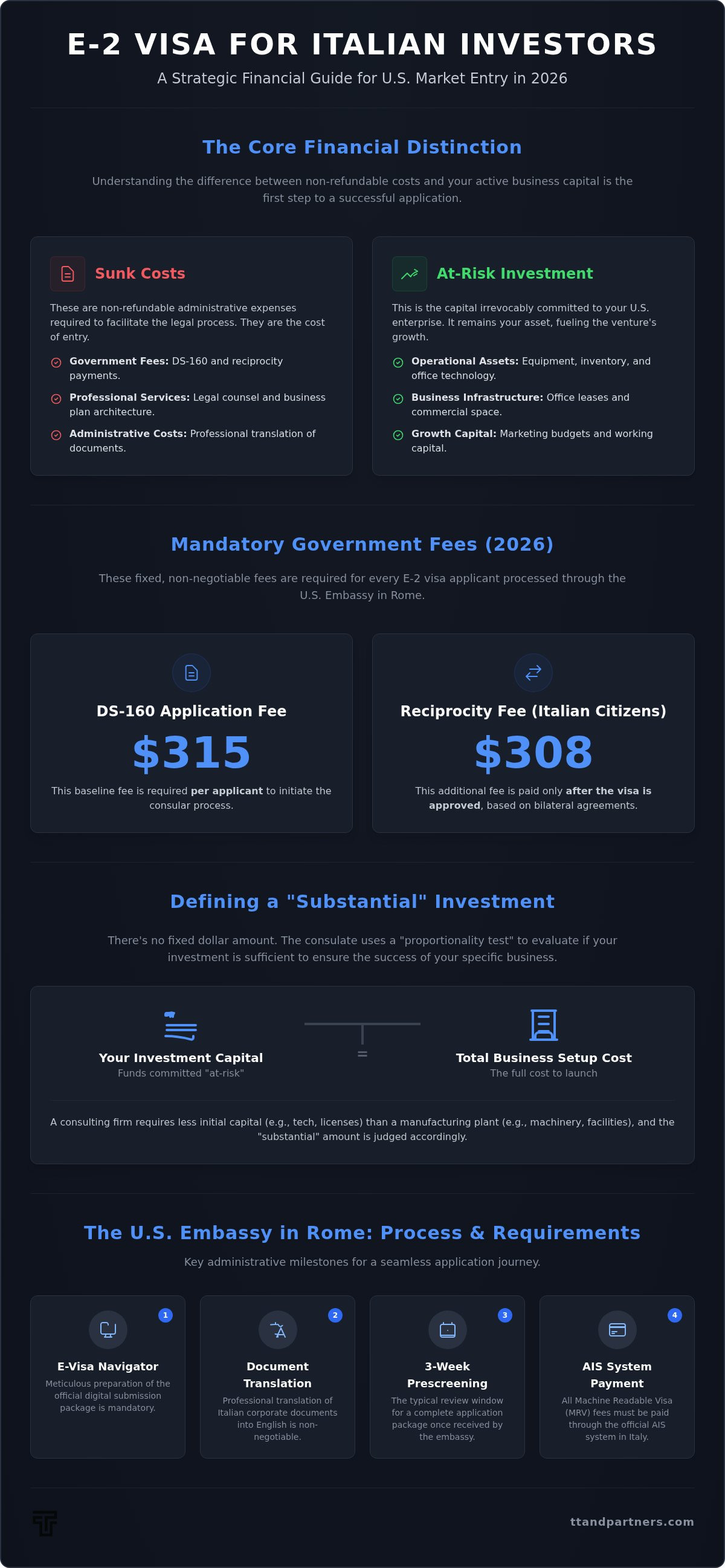
A successful budget separates "sunk costs" from "at-risk capital." Sunk costs include non-refundable government fees and professional services that facilitate the legal process. These are the costs of entry. Conversely, the at-risk investment represents the funds irrevocably committed to your enterprise. This capital remains your asset, fueling the growth of your U.S. entity. Consular officers in Rome apply a proportionality test to the E-2 Investor Visa application. They evaluate whether your spending is sufficient to ensure the successful operation of the business. For a consulting firm, this might involve lower initial capital than a manufacturing plant. The commitment must always be substantial relative to the total setup cost. Rome's officers look for a balance where the investor's personal financial risk mirrors their commitment to the American economy.
The Role of the Rome E-Visa Navigator
The U.S. Embassy in Rome utilizes a specific digital platform known as the E-Visa Navigator. This system dictates the structure of your submission and directly influences your administrative budget. Preparing a prescreening package requires meticulous attention to detail. Professional translation of Italian corporate documents into English is a mandatory expense that cannot be overlooked. Precision in these translations prevents misunderstandings that lead to Requests for Evidence. You should align your financial planning with Rome's typical processing cycles. Currently, the embassy operates within a three week prescreening window once a complete package is received. Managing your capital flow to meet these administrative milestones is essential for a seamless transition. If you require personalized guidance on these initial steps, you can contact our team to discuss your specific corporate structure.
Mandatory Government Fees and Administrative Filing Costs
The financial architecture of a cross-border expansion requires a dual focus on both the capital at work and the administrative fees that secure legal standing. For an entrepreneur transitioning from the Italian market, the E-2 visa cost for Italian investors includes several fixed government charges that are independent of the business's scale. These are the non-negotiable costs of entry. Every fiscal plan must account for these payments at the start of the journey to ensure the process remains fluid and professional.
The primary expense is the Form DS-160 application fee, which is $315 per applicant in 2026. This serves as the baseline for the consular process at the U.S. Embassy in Rome. If the visa is successfully approved, Italian citizens are required to pay an additional reciprocity fee of $308. This specific amount is a result of bilateral agreements between the United States and Italy. When evaluating the official E-2 investor qualifications, it's essential to recognize that these fees apply to each individual rather than the business entity as a whole. While the investment itself is the engine of the visa, these fees are the necessary fuel for the administrative machinery.
Consular Fees for the U.S. Embassy in Rome
All E-treaty applicants must settle their Machine Readable Visa (MRV) fees through the official AIS system in Italy. This digital gateway tracks your payment and links it to your appointment profile. You should be aware that these payments have a specific validity period, typically one year from the date of purchase. If your preparation phase exceeds this timeframe, you might need to repay the fee. Paying once your documentation is nearly complete ensures your spot in the queue without risking expiration. This precision in timing reflects the engineering mindset required for a successful move.
Derivative Costs for Family Members
Spouses and children under 21 are entitled to derivative status, but they incur their own set of costs. Each family member must pay the $315 DS-160 fee and the $308 reciprocity fee. For spouses who intend to pursue professional opportunities in the U.S., there are additional considerations for work authorization. While many now receive authorization incident to their status, specific administrative filings may still be required depending on the entry path. Budgeting for these individual interviews at the Rome consulate is a vital part of the total E-2 visa cost for Italian investors.
Incidental expenses like secure courier services for passport delivery, biometric appointments, and potential medical exams add a final layer to the budget. These are often small in isolation but essential for a complete application package. If you're looking for a clear roadmap for your family's transition, you can discuss your case with us to ensure every administrative detail is professionally managed.
Professional Fees: Legal Counsel and Business Architecture
Professional fees represent the intellectual foundation of your American venture. While government filings are fixed, the investment in legal and corporate architecture determines the structural integrity of your application. For an entrepreneur, the E-2 visa cost for Italian investors must account for specialized guidance that bridges the gap between Italian civil law and the U.S. common law system. This process isn't merely about filling forms; it's about engineering a corporate entity that fulfills the treaty's requirements while remaining operationally viable. A well-structured legal strategy ensures that your capital is deployed effectively from the very beginning.
Why Specialized US-Italy Counsel Matters
Navigating the "substantiality" test requires an attorney who understands both the U.S. regulations and the Italian industrial landscape. A legal partner who understands the nuances of both jurisdictions can effectively translate your Italian professional history into a narrative that resonates with the U.S. Embassy in Rome. Bundling LLC incorporation with your visa strategy ensures that your corporate bylaws and ownership structures are compliant from day one. This level of precision is the most effective way to avoid a Request for Evidence (RFE), which can cause months of delay. With a 15% denial rate reported by USCIS for E-2 petitions in recent years, the cost-benefit of expert counsel becomes clear. It's an insurance policy against the most expensive outcome: a rejected vision.
Business Plan and Market Analysis Expenses
A generic business plan often fails the "marginality" test. This test requires proof that the business will do more than just provide a living for the investor and their family. Rome's consular officers expect a five-year professional roadmap with detailed financial projections. Industry data suggests that E-2 compliant business plans typically range from $1,500 to $5,000. These plans must include comprehensive market research and localized competitive analysis. Viewing these expenses as part of your qualifying "at-risk" investment is a strategic way to manage your budget while strengthening your case. Every data point in your plan should reflect the reality of the U.S. market you intend to enter.
Beyond the plan, cross-border compliance requires accounting and tax advisory services. Establishing a U.S. entity involves navigating international tax treaties to avoid double taxation. These professional fees ensure that your financial structure is as robust as your business model. To align your corporate architecture with your immigration goals, you may reach out to our professionals for a tailored evaluation of your specific needs.
Defining the 'Substantial' Investment for Italians in 2026
The concept of a "substantial" investment is often the most misunderstood element of the E-2 visa cost for Italian investors. Unlike other visa categories that may require a fixed dollar amount, the E-2 relies on a proportionality test. Consular officers at the U.S. Embassy in Rome evaluate the investment by comparing the capital committed against the total cost of either purchasing an existing business or establishing a new one. This relative approach ensures that the investment is sufficient to ensure the successful operation of the specific enterprise. A service based startup in the technology sector may require significantly less capital than a high end restaurant in Manhattan or a manufacturing facility in the Midwest.
Recent benchmarks for 2026 suggest that while there is no legal minimum, successful applications from Italy typically involve investments ranging from $80,000 to $150,000. For capital intensive industries, this figure must scale upward to remain proportional. To mitigate the financial risk during the application phase, many entrepreneurs utilize escrow accounts. These legal instruments allow funds to be committed to a business purchase or lease agreement while ensuring they are only released upon the successful issuance of the visa. This strategy provides a professional layer of protection for your capital while satisfying the requirement that funds be irrevocably committed and "at-risk" before the consular interview.
Qualifying Investment Expenses
Proving the investment requires a meticulous paper trail of every dollar spent or committed. Qualifying expenses are not limited to cash in a bank account; in fact, idle cash does not count toward the investment total. You can include several categories of spending:
Lease Deposits: You may typically count up to 12 months of prepaid rent or security deposits for your business premises.
Tangible Assets: The purchase of inventory, specialized equipment, and office furniture supported by clear invoices.
Intellectual Property: Valuations for proprietary software, trademarks, or patents essential to the business architecture.
Professional Launch Costs: Marketing expenses, website development, and initial corporate branding are valid uses of capital.
The 'Marginality' Trap
A frequent cause for denial is "marginality," which occurs when a business appears to exist solely to provide a minimal living for the investor and their family. Rome's officers look for a vision that contributes to the American economy through job creation. Budgeting for U.S. employees from the outset is a powerful signal of a non-marginal enterprise. The marginality rule dictates that the enterprise must have the present or future capacity to generate significantly more than a minimal living for the investor within five years of operation. Proving this requires a robust five year financial projection that demonstrates growth and the ability to support a local workforce. To ensure your investment structure meets these rigorous standards, you should consult with our legal team for a strategic review of your capital allocation.
Strategic Cost Management with TT&P Legal Experts
Managing the E-2 visa cost for Italian investors requires more than a simple spreadsheet; it demands a holistic understanding of how two distinct legal systems intersect. Tosolini, Toniutti & Partners functions as a strategic bridge, ensuring that the corporate architecture built in the United States remains in harmony with the investor's Italian origins. The financial engineering of a transatlantic move is often compromised by a lack of coordination between local Italian advisors and U.S. counsel. By integrating your E-2 Visa strategy with broader corporate and real estate law, we prevent the fragmentation of your legal interests. This unified approach transforms a series of administrative hurdles into a cohesive plan for growth.
Avoiding Hidden Cross-Border Costs
The true cost of an expansion isn't always found in the filing fees. It often resides in the friction between U.S. business setup and Italian tax obligations. Our expertise allows us to coordinate your American entity's formation with your existing fiscal profile in Italy, preventing unforeseen liabilities. If your business model requires a physical footprint, we provide specialized support for real estate closings, ensuring that your lease or purchase agreements are E-2 compliant from the outset. Protecting your investment through robust corporate governance isn't just a legal requirement; it's a way to safeguard your capital against the risks of a new market. We focus on the precision of your corporate bylaws and operating agreements to ensure long term stability.
Your Path to the United States
A successful entry into the American market is rarely a static event. For high-net-worth investors, the E-2 status is often a foundational step toward a more permanent residency. We view your initial application as part of a larger trajectory. Our firm provides a single point of contact for your US-Italy legal needs, eliminating the inefficiencies of managing multiple disconnected firms. This continuity is essential for preserving the integrity of your legal and financial narrative as you transition from a treaty investor to a permanent resident. Strategic planning today prevents the need for expensive corrective measures tomorrow. Every decision we make is designed to support both your immediate visa goals and your future American legacy. To begin building your personalized roadmap, you can consult with our E-2 experts today for a comprehensive evaluation of your strategic needs.
The Visionary Path to U.S. Market Entry
The transition to the United States market is an act of calculated ambition. Success hinges on a clear understanding of the E-2 visa cost for Italian investors, where every dollar spent on administrative fees or professional architecture serves a specific purpose. By distinguishing between non-refundable filing costs and the active capital at work within your enterprise, you create a robust foundation for growth. Precision in your initial budgeting ensures that your focus remains on operational excellence rather than administrative delays. A well-engineered fiscal plan isn't just a requirement; it's the first milestone of your American success story.
Our firm brings bilingual US-Italy legal expertise and decades of experience with the U.S. Embassy in Rome to every case. We provide comprehensive corporate and immigration support that bridges the gap between these two distinct legal landscapes. Your American legacy begins with a single, well-structured step. We invite you to Secure your E-2 investment strategy with TT&P and transform your vision into a sustainable reality. The future of your international enterprise is within reach.
Frequently Asked Questions
Is the E-2 visa investment refundable if my application is denied?
Investment funds are generally not refundable once they're committed to the business, as the "at-risk" requirement is a core pillar of the visa. To protect your capital, you can use an E-2 compliant escrow agreement that only releases the funds to a seller once the visa is approved. This mechanism balances the legal requirement for an irrevocable commitment with the practical need to manage financial risk during the application process.
Can I use a gift from a family member in Italy as my E-2 investment?
You can use a gift from a family member in Italy as your E-2 investment, provided you can document the legitimate source of those funds. The U.S. Embassy in Rome requires a clear paper trail showing that the gift isn't a disguised loan and that the donor obtained the money through legal means. This documentation is essential to satisfy the rigorous "source of funds" scrutiny applied to the total E-2 visa cost for Italian investors.
How much does it cost to include my spouse and children in the E-2 petition?
Including a spouse and children in the petition involves paying the mandatory $315 DS-160 fee and the $308 reciprocity fee for each individual. For a family of three, these government charges total $1,869. You should also consider potential costs for dependent work authorization filings if your spouse intends to seek employment outside the family business once you arrive in the United States.
Does the investment money have to be spent before I go to the Rome interview?
Yes, the investment money must be irrevocably committed and the business must be nearly ready to operate before you attend the interview in Rome. Simply holding funds in a bank account doesn't meet the "at-risk" requirement. You must demonstrate that the capital has been spent on tangible assets, inventory, or legal obligations that would be lost if the business fails.
Are there specific reciprocity fees for Italian citizens in 2026?
Italian citizens are required to pay a specific visa issuance reciprocity fee of $308 as of July 2026. This fee is only paid after the visa is approved and is separate from the initial $315 application fee. Understanding these specific charges is a vital component of calculating the total E-2 visa cost for Italian investors before beginning the formal submission process.
What is the typical attorney fee for an E-2 visa for an Italian startup?
Attorney fees for an E-2 visa application vary based on the complexity of the corporate structure and the industry involved. Professional legal counsel ensures that your LLC incorporation and treaty strategy are perfectly aligned with both U.S. law and the specific prescreening requirements of the embassy. While costs vary across the industry, the value of avoiding a Request for Evidence often outweighs the initial expenditure.
How much should I budget for a professional E-2 business plan?
You should budget between $1,500 and $5,000 for a professional, E-2 compliant business plan that meets the specific "marginality" and "proportionality" tests. A generic plan is often insufficient for the U.S. Embassy in Rome's standards. A high-quality plan must include localized market research and five-year financial projections that demonstrate the enterprise's capacity to grow and hire American workers.
Can I count the cost of my flight and initial US housing as part of the investment?
Costs for international flights and initial personal housing are generally considered personal expenses and cannot be counted toward the qualifying business investment. The investment must be focused on the setup and operation of the commercial enterprise itself. However, business-related travel for site visits or equipment inspections may be qualifying capital if properly documented as a necessary startup expense.