

E-2 Visa Business Plan: 2026 Guide for Italian Investors
- Gianni Mendes Toniutti, Esq.

- 22 hours ago
- 12 min read
For a sophisticated Italian entrepreneur, the distance between a creative vision in Milan and an operational reality in the United States isn't measured in miles, but in the structural integrity of a single document. You likely recognize that the U.S. Embassy in Rome maintains some of the most rigorous standards globally, where a single oversight can lead to a Request for Evidence or a flat denial. With current consular wait times exceeding three months, the stakes for your E-2 visa business plan for Italian investors have never been higher. It's no longer enough to present a generic forecast; you need a blueprint that harmonizes Italian business ingenuity with the precise "Matter of Ho" legal standards required by American adjudicators.
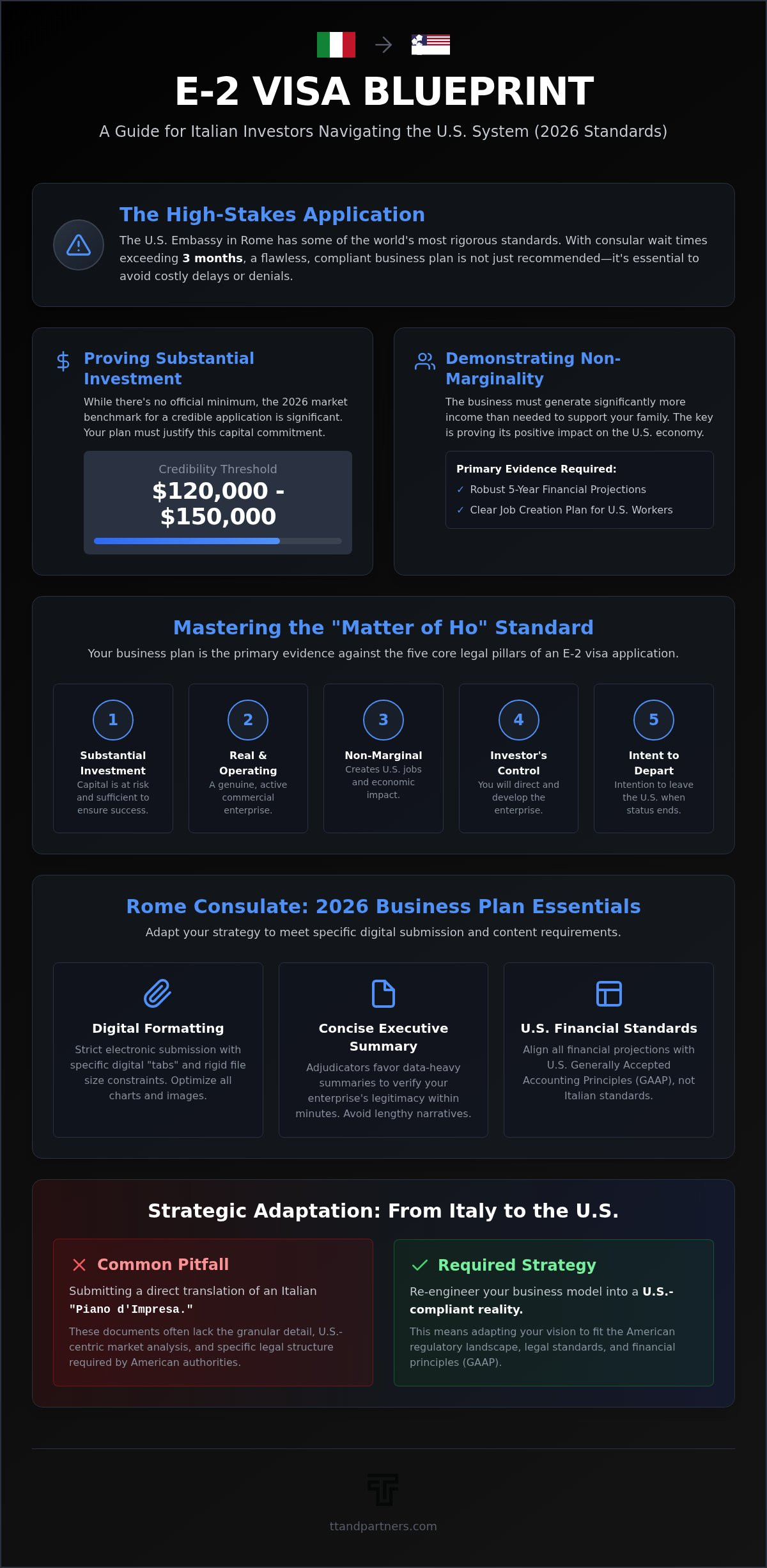
We'll guide you through mastering these specific consular expectations to build a visa-ready plan that secures your future in the United States. This 2026 guide clarifies the nuances of what constitutes a substantial investment, often starting between $120,000 and $150,000 in the current market, and how to demonstrate non-marginality through robust job creation. You'll gain a clear roadmap for your LLC incorporation and a strategy to minimize the risk of rejection, ensuring your transition to the American market is as seamless as the architecture of a well-designed space.
Table of Contents
Why the Business Plan is the Heart of an Italian E-2 Application
The business plan serves as the architectural foundation of your entire application. It's the primary evidence that you possess the genuine intent to direct and develop your enterprise, which is a core requirement for the E-2 investor visa. In Rome, consular officers don't just look for a profitable idea; they seek proof that your investment is substantial and irrevocably committed to the U.S. market. A well-structured plan acts as a preemptive defense. It answers silent questions about your source of funds and the long-term viability of your operations before an officer even voices them. Without this narrative, your capital is merely a number; with it, your capital becomes a living business entity.
This document bridges the conceptual gap between an Italian entrepreneurial vision and the rigid frameworks of the U.S. Department of State. Consular officers in Rome utilize the plan to verify that your investment isn't "marginal." Under 2026 standards, this means the business must generate significantly more income than what's needed to simply support you and your family. By presenting a clear, data-driven five-year outlook, you demonstrate that the business will contribute to the American economy through job creation and local growth. A robust E-2 visa business plan for Italian investors transforms abstract goals into a compliant, professional roadmap that resonates with the specific expectations of the Rome Consulate.
The Role of the Treaty of Commerce and Navigation
Italian nationals benefit from a historic Treaty of Commerce and Navigation, yet this privilege comes with specific expectations. Your business plan must explicitly demonstrate how your venture aligns with these treaty rights. Unlike applicants from other treaty countries, Italian investors often face unique scrutiny regarding the "substantiality" of their capital in relation to the specific industry they're entering. In 2026, while there's no set minimum, a realistic threshold of $120,000 to $150,000 is often the benchmark for a credible application. The plan must prove that your presence is vital to the success of the American entity and that the investment is sufficient to ensure the business's success.
Beyond Translation: Adapting Italian Success for the US Market
A common pitfall is submitting a direct translation of an Italian "Piano d'Impresa." These documents often lack the granular detail and specific legal structure required by U.S. immigration authorities. Adapting your success requires more than changing the language; it involves re-engineering your market leadership into a U.S.-centric competitive advantage. This means aligning financial projections with U.S. Generally Accepted Accounting Principles (GAAP) and ensuring all technical terminology reflects American legal standards. You aren't just moving a business; you're translating a vision into a structured, compliant reality that fits the American regulatory landscape.
Meeting the Rome Consulate's Specific 2026 Standards
Precision is the hallmark of a successful filing. The digital portal used by the U.S. Embassy in Rome requires a level of organizational discipline that mirrors the architectural rigor of a high-end construction project. As of 2026, consular wait times in Rome frequently exceed three months. This backlog makes the initial quality of your E-2 visa business plan for Italian investors paramount. Adjudicators no longer have the patience for sprawling, hundred-page narratives. Instead, the current trend favors concise, data-heavy executive summaries that allow an officer to verify the legitimacy of your enterprise within minutes of opening the file. If you represent a firm on the "vetted company" list, your plan must still demonstrate that the specific U.S. role requires executive or essential skills, ensuring the continuity of your corporate identity across borders.
Digital Submission Requirements in Rome
The Rome Consulate mandates a strict electronic submission format that demands careful indexing. Your application must be divided into specific digital "tabs," with the business plan serving as the narrative glue between the "Investment" and "Real and Operating" sections. File size constraints are rigid; therefore, every chart and image must be optimized for clarity without bloating the document. Visual evidence has become a non-negotiable standard in 2026. Including high-resolution photographs of your U.S. premises, specialized equipment, and inventory provides the tangible proof officers need to see that the business is more than a paper entity. If you are unsure how to structure these complex digital folders, consulting with a cross-border legal specialist can prevent technical rejections.
The Consular Interview: Defending Your Plan
The written plan is your script for the final interview. Rome adjudicators often pull specific figures from your Strategic Financial Projections to test your personal knowledge of the venture. You must be prepared to defend the logic behind your revenue targets and hiring timelines. Discrepancies between your verbal testimony and the written data are a leading cause of administrative processing delays or denials. Preparation should focus heavily on the "marginality" line of questioning. You must articulate how the business will grow beyond a solo operation to support U.S. workers, using the five-year personnel plan in your E-2 visa business plan for Italian investors as your primary evidence. Your ability to speak fluently about these projections demonstrates the "direct and develop" requirement that is central to the visa's approval.
Navigating the 'Matter of Ho' Requirements for Italian Investors
Matter of Ho is the legal framework requiring credible, comprehensive, and feasible business projections. This precedent serves as the definitive structural benchmark for any E-2 visa business plan for Italian investors. Beyond a simple statement of intent, the U.S. government requires a granular demonstration of how the business will function as a viable economic entity. The five essential pillars of this standard include a comprehensive business description, a precise marketing strategy, a defined organizational structure, a five-year personnel plan, and substantiated financial projections. Crucially, the investment must be shown to be "at risk." This means your capital is irrevocably committed to the U.S. enterprise through executed leases, equipment purchases, or binding contracts. Funds sitting passively in a corporate bank account do not meet the legal threshold for an E-2 commitment.
Personnel and Job Creation Projections
A robust hiring plan is the most effective way to satisfy the non-marginality requirement. Your plan should outline a clear trajectory for the next five years, specifically identifying when and why U.S. workers will be added to the payroll. It's essential to distinguish between Italian specialized employees, who bring unique cultural or technical expertise, and the local workforce. Adjudicators expect to see detailed job descriptions that align with standard U.S. labor categories. Including salary benchmarks based on local economic data proves that your hiring strategy is both realistic and sustainable within the American market. This level of detail confirms that your presence in the U.S. is intended to scale the business and support the local economy.
Market Analysis and Competitive Positioning
Proving that your enterprise is "real and operating" requires more than just a signed lease; it demands a deep dive into verified market data. You must identify direct U.S. competitors and articulate the specific "Italian edge" that gives your venture a niche advantage. Whether it's a unique manufacturing process or a specialized service model, your competitive positioning must be backed by credible U.S. industry statistics. Sourcing data from recognized trade associations or government reports adds a layer of intellectual authority to your claims. This objective evidence transforms a speculative idea into a feasible business model that justifies your long-term presence in the United States. If you need assistance aligning your market research with U.S. legal standards, our team can provide the necessary cross-border expertise.
Strategic Financial Projections: Proving Non-Marginality
The fiscal narrative within an E-2 visa business plan for Italian investors acts as the quantitative proof of your commitment. While previous sections addressed the "Matter of Ho" structure, the financial projections must specifically pass the "marginality test." A business is considered marginal if it lacks the present or future capacity to generate more than a minimal living for the investor and their family. To overcome this, your plan needs detailed five-year pro forma income statements, balance sheets, and cash flow statements. These documents shouldn't just show survival; they must illustrate growth. Documenting the source of funds is equally vital. You need a transparent paper trail showing the movement of capital from your Italian accounts to the U.S. corporate entity, ensuring every Euro is accounted for before it becomes a U.S. Dollar investment.
Defining 'Substantial' for Your Industry
Substantiality is relative, not absolute. A $100,000 investment might be perfectly acceptable for a high-margin consulting firm, but it'll likely fail the "proportionality test" for a capital-intensive manufacturing plant. This test compares the amount of funds invested against the total cost of either purchasing an established business or creating a new one. Your business plan must justify the initial capital by linking it to high-growth projections. If the initial investment is lower, the plan's narrative must work harder to prove that the capital is sufficient to reach the operational milestones defined in your five-year strategy. Adjudicators in Rome look for a logical connection between the starting capital and the eventual scale of the enterprise.
Proving the Economic Impact on the US
The U.S. government views your enterprise as a vehicle for local economic stimulus. Beyond direct hiring, your financial projections should quantify tax contributions and the role of secondary job creation. If you're expanding an existing Italian brand, the plan should highlight the parent company's fiscal strength to suggest the U.S. subsidiary's stability. This cross-border synergy provides a safety net that adjudicators value. Proving that your business will contribute to the American tax base and support local vendors is the most effective way to secure a favorable decision. If you're ready to translate your Italian success into a compliant U.S. financial model, contact our cross-border legal team to begin your expansion.
Securing Your US Expansion with a Cross-Border Legal Strategy
Success in the American market requires a foundation that extends far beyond the visa interview. For an Italian entrepreneur, the synergy between LLC incorporation and visa approval is absolute. Your E-2 visa business plan for Italian investors must reflect a corporate structure that satisfies both tax efficiency and immigration requirements. Tosolini, Toniutti & Partners manages this transatlantic transition by bridging the gap between Italian civil law and the U.S. legal system. We ensure that your physical office setup and real estate closings are not just logistical milestones, but documented proofs of your irrevocable commitment to the U.S. economy. By aligning your corporate architecture with your immigration goals, you create a resilient framework for growth.
Establishing the US Corporate Architecture
Choosing between an LLC and a C-Corp is a pivotal decision for treaty investors. While an LLC offers flexibility, your corporate bylaws must explicitly reflect your role to "direct and develop" the enterprise. In the "real and operating" section of your plan, the inclusion of your Employer Identification Number (EIN) and a funded U.S. bank account is non-negotiable. These elements prove that the business exists beyond a theoretical framework. Adjudicators in Rome look for these concrete indicators to confirm that the Italian S.r.l. has successfully birthed a functional American subsidiary that is ready to trade.
Natural Next Steps: From E-2 to Permanent Residency
While the E-2 is a non-immigrant category, it often serves as a strategic precursor to permanent residency. Many investors eventually ask, How Much Is a Green Card?, as they look to secure their family's long-term future in the United States. Strategic planning for spouses and children is a core component of this transition. An E-2 spouse is eligible for work authorization, and children can attend U.S. schools, making the move a holistic family endeavor. To maintain compliance and explore these future pathways, consulting with a cross-border legal expert is essential. We provide the continuity needed to navigate from your initial setup in Rome to your eventual success in the American market, ensuring every legal detail supports your broader vision.
Advancing Your Vision Beyond the Atlantic
Establishing a successful presence in the United States requires more than a simple investment. It demands a meticulous translation of your Italian entrepreneurial spirit into a compliant regulatory framework. We have explored the necessity of a robust E-2 visa business plan for Italian investors, from satisfying the "Matter of Ho" standard to navigating the specific digital submission protocols required by the U.S. Embassy in Rome. A well-crafted plan doesn't just secure a visa; it serves as the architectural blueprint for your U.S. enterprise, ensuring that your LLC incorporation and financial projections are built on a foundation of long-term stability.
Tosolini, Toniutti & Partners provides the specialized legal bridge necessary to manage this complex transatlantic transition. With decades of experience at the Rome Consulate and a comprehensive approach to cross-border expansion, we ensure every technical detail aligns with your visionary goals. The path to the American market is sophisticated, yet with the right structural support, your expansion can be as enduring as the values that define your original business. Schedule your E-2 visa strategy consultation with our cross-border experts today to begin your journey with confidence.
Frequently Asked Questions
Do I need a business plan if I am buying an existing US franchise for an E-2 visa?
Yes, a comprehensive business plan is mandatory even when acquiring a franchise with a proven model. While the franchisor provides a general operational framework, your specific E-2 visa business plan for Italian investors must detail your local market analysis, territory-specific projections, and your personal role in directing the enterprise. Consular officers in Rome need to see how your specific location will realistically meet the substantiality and non-marginality requirements.
Can I write my own E-2 business plan using a template?
Using a generic template is highly discouraged for sophisticated cross-border applications. Templates often fail to address the specific "Matter of Ho" requirements or the unique financial nuances required by the Rome Consulate. A successful filing requires a bespoke narrative that translates your Italian entrepreneurial vision into a legally compliant American framework, ensuring all terminology and projections align with U.S. regulatory and accounting standards.
What is the minimum investment amount the Rome Consulate expects for an E-2 visa?
There is no official minimum investment, but the capital must be substantial relative to the business type. In 2026, a realistic benchmark for a credible application typically ranges between $120,000 and $150,000. While lower amounts are possible for certain service-based industries, they require a significantly more robust business plan to justify the enterprise's viability and its ability to scale beyond a marginal level.
How long should the financial projections be in an E-2 business plan?
Financial projections must cover a five-year period to satisfy U.S. immigration standards. This duration allows adjudicators to evaluate the business's growth trajectory and its capacity to contribute to the U.S. economy. Your E-2 visa business plan for Italian investors should include pro forma income statements, balance sheets, and cash flow statements for all five years, proving the venture will eventually support more than just the investor's family.
What happens if my US business does not meet the hiring goals in the business plan?
Failure to meet hiring goals can jeopardize your visa extension during the renewal process. The business plan is viewed as a good-faith roadmap; while adjudicators understand that market conditions change, significant deviations from your personnel plan may be seen as a failure to meet the non-marginality requirement. It's vital to maintain detailed records explaining any strategic shifts in your hiring timeline or operational structure.
Is a business plan required for an E-2 visa extension?
Yes, an updated business plan is generally required when applying for an extension of your E-2 status. This document must compare your historical performance against your initial projections and provide a new five-year outlook. You must demonstrate that the business is currently "real and operating" and that it remains a non-marginal enterprise capable of supporting U.S. workers and contributing to the local economy.
Can my Italian business plan be used for my US LLC incorporation?
An Italian "Piano d'Impresa" is rarely suitable for U.S. corporate or immigration purposes. The legal architecture of a U.S. LLC and the requirements of the E-2 treaty require a document structured around U.S. GAAP and specific federal regulations. Translating a vision is not enough; you must re-engineer the plan to reflect American market dynamics, labor costs, and the specific "direct and develop" legal standards.
What are the most common reasons the Rome Consulate rejects an E-2 business plan?
The most frequent rejection reasons include "marginality" and a lack of "at-risk" capital. If the plan fails to prove the business will grow beyond a solo operation, or if the funds are not irrevocably committed to the U.S. entity, the application will likely fail. Additionally, a lack of detailed source-of-funds documentation for capital moving from Italian accounts often leads to significant administrative delays or denials in Rome.


Comments