

Enforce US Judgment in Italy: The 2026 Strategic Legal Guide
- Gianni Mendes Toniutti, Esq.

- May 15
- 13 min read
Did you know that Italian Courts of Appeal saw a 24% reduction in pending civil proceedings between 2021 and 2024? This measurable shift toward efficiency suggests that the path to cross-border justice is more streamlined than many international creditors realize. You've likely invested significant intellectual and financial capital to secure a victory in the United States, yet the prospect of facing Italian bureaucracy or a "public policy" rejection often feels like a daunting second trial. It's natural to feel uncertain about locating assets in a foreign jurisdiction or wondering how to effectively enforce US judgment in Italy under current standards.
This guide provides a clear, strategic roadmap to navigate the complexities of Italian Private International Law with professional precision. You'll gain a thorough understanding of the Exequatur process, the 1.6% legal interest rate for 2026, and the evolving judicial stance on punitive damages. We'll examine how to transform your American court order into a powerful instrument for asset recovery within the Italian legal framework, ensuring your hard-won victory translates into tangible results.
Key Takeaways
Understand the precise architecture of Law 218/1995 to transform a foreign court decision into a locally enforceable title through the Exequatur process.
Verify compliance with mandatory jurisdictional standards and Hague Convention service requirements to ensure your judgment meets Italian procedural thresholds.
Navigate the evolving "Public Policy" landscape to enforce US judgment in Italy, leveraging recent Supreme Court precedents regarding punitive damages.
Implement a strategic asset recovery plan using the "Precetto" notice and "Pignoramento" mechanisms to effectively secure real estate or financial holdings.
Align your recovery expectations with the 2026 legal interest rates and the documented efficiency gains within the Italian Court of Appeal system.
Table of Contents
The Legal Framework for Enforcing US Judgments in Italy (2026)
Securing a favorable verdict in a United States court is often a monumental achievement, yet its geographic utility stops at the Atlantic without the correct procedural architecture. Unlike judgments originating within the European Union, which benefit from streamlined automatic enforcement protocols, American orders must navigate the specific domestic requirements of the Italian legal system. There's no bilateral treaty between Italy and the US for the mutual recognition of civil judgments. Instead, the process relies on the Legal Framework for Enforcing Foreign Judgments established by Italian domestic law. This creates a distinct pathway where precision in documentation becomes the primary driver of success when you seek to enforce US judgment in Italy.
Understanding Law No. 218/1995
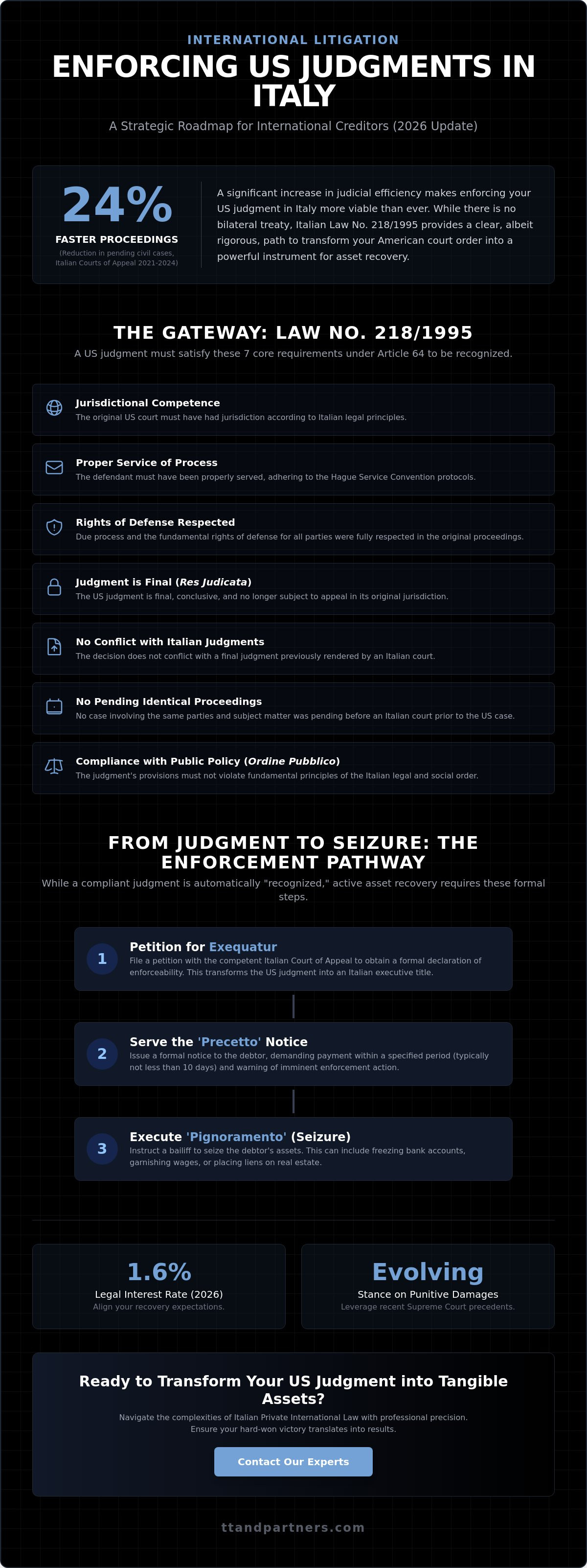
The Italian Private International Law Act, known as Law No. 218/1995, serves as the definitive statute for non-EU judicial effectiveness. It moved Italy away from a system of constant re-litigation toward a more modern, pro-enforcement stance. Article 64 of this law outlines seven specific requirements that a US judgment must satisfy to be recognized. These include:
The US court had jurisdiction according to Italian principles.
The defendant was properly served under the Hague Convention.
The parties' fundamental rights of defense were respected.
The judgment has reached "res judicata" status, meaning it's final and non-appealable.
The decision doesn't conflict with a final Italian judgment.
No identical proceedings are currently pending in Italy.
The order doesn't violate Italian public policy (ordine pubblico).
This statutory framework effectively bypasses the need for a specific treaty, allowing for a predictable, albeit rigorous, recognition process. In the 2026 judicial landscape, these criteria remain the bedrock of any successful cross-border claim.
Recognition vs. Enforcement: The Crucial Distinction
A common misconception involves the difference between recognition and enforcement. Recognition concerns the legal status of the judgment. In many cases, Law 218/1995 allows for the automatic recognition of foreign judgments without a formal court procedure, provided they meet the Article 64 criteria. This is useful for status declarations or corporate acknowledgments.
If your objective is asset recovery, recognition isn't enough. To freeze bank accounts, seize real estate, or garnish wages, you must obtain an "Exequatur." This is a formal declaration of enforceability issued by the Italian Court of Appeal. Without this decree, the US judgment remains a valid document but lacks the executive force required for bailiffs to act. Strategic International Litigation advice is essential here to ensure the petition for Exequatur is filed in the correct jurisdiction where the debtor’s assets are actually located. Since Italian Courts of Appeal have recently shown a 24% reduction in pending civil proceedings, obtaining this decree is now faster than in previous years, provided the initial filing is flawless.
Mandatory Requirements for a US Judgment to be Recognized
The recognition of an American court order within the Italian Republic isn't a mere formality. While the U.S.-Italy bilateral relationship ensures a high level of cooperation in administrative and diplomatic matters, the judicial sphere remains strictly guarded by the principles of Law 218/1995. To successfully enforce US judgment in Italy, the creditor must demonstrate that the original proceedings met specific Italian standards of fairness, jurisdiction, and finality. It's a meticulous process where technical oversights during the US litigation phase can lead to a total rejection by the Italian Court of Appeal.
Procedural Fairness and Due Process (Article 64)
Article 64 of the Private International Law Act requires that the rights of defense were fully respected in the original forum. The most frequent point of failure in these cases is the service of process. Italian courts insist that service follows the Hague Service Convention protocols. If a plaintiff relied on informal service methods permitted in some US states, such as simple mail or drop-service without a central authority's involvement, the Italian judge may deem the judgment unrecognizable. Default judgments, where the defendant failed to appear, aren't inherently barred. However, they're scrutinized heavily. You must prove the defendant was given sufficient time and clear notice to appear and defend themselves. Documentation must include a certified copy of the proof of service to ensure every procedural step is verified.
The 'Res Judicata' Requirement in 2026
Finality is the second pillar of recognition. A US judgment must be "Res Judicata," meaning it's final and no longer subject to ordinary appeal in its home jurisdiction. This requirement is often confusing for practitioners because state and federal rules on what constitutes a "final judgment" can vary significantly. In Italy, you must present a "Certificate of Non-Appeal" signed by the US court clerk to satisfy the court. If an appeal is currently pending in the US, the Italian recognition process will be suspended. Italian judges require absolute certainty that they aren't enforcing an order that could be overturned by a higher American court. This prevents the risk of conflicting international rulings and protects the integrity of the Italian legal system.
The judgment must also pass the "Public Policy" (Ordine Pubblico) litmus test. It cannot contradict the fundamental legal principles of Italy or conflict with an existing Italian court ruling between the same parties. Navigating these procedural hurdles requires a deep understanding of how two distinct legal cultures intersect. If you're managing complex cross-border claims, engaging an expert in International Litigation ensures your US victory isn't lost in translation or blocked by a procedural technicality.
The Procedural Path: Navigating the Italian Court of Appeal
Turning a US court order into a functional instrument of recovery in Italy requires moving beyond administrative transcription into the specialized arena of the Italian Court of Appeal (Corte d'Appello). This isn't a task for consular officials, who primarily handle vital records; it's a judicial process where the choice of venue is determined by the geographic location of the debtor's assets. If real estate is held in Milan, the petition must be filed there. If multiple bank accounts are scattered across the peninsula, strategic selection of the primary enforcement site becomes paramount. This stage is where the architecture of your US litigation meets the engineering of Italian civil procedure to enforce US judgment in Italy with absolute precision.
Filing the Petition for Exequatur
The Exequatur is the formal mechanism that grants your US judgment the same executive force as an Italian ruling. For uncontested US orders, a summary proceeding is often available, which significantly accelerates the timeline. While the typical timeframe for an uncontested Exequatur is estimated between one and six months, the 24% reduction in pending civil proceedings at the Court of Appeal level between 2021 and 2024 suggests a system becoming increasingly responsive to international claims. During the hearing, a Public Prosecutor reviews the file to ensure the judgment doesn't offend Italian legal principles, a necessary safeguard before the court issues the final Decreto or Sentenza granting enforcement power.
Documentation, Legalization, and Translation Needs
Success at the Court of Appeal level depends on the absolute integrity of your documentation. You must provide an original or certified copy of the US judgment, authenticated with an Apostille to satisfy international legalization standards. It's helpful to consult U.S. Department of Justice guidance regarding the specific requirements for foreign litigation support. Beyond authentication, every document must undergo a sworn or "certified" translation into Italian. Common clerical errors in US judgments, such as misspelled names or incorrect addresses, can cause months of delay, as the Italian court requires perfect alignment between the foreign document and the local enforcement order. To avoid these setbacks, ensure your filing includes:
Apostille Authentication: Legalization of the US court documents through the Secretary of State.
Sworn Translations: Every English-language document must be accompanied by a translation certified by an Italian court-appointed translator.
Res Judicata Evidence: Proof that the judgment is final, often through a clerk-issued certificate of non-appeal.
Once the Exequatur is granted, the case transitions to the Ufficiale Giudiziario, or bailiff, who possesses the legal authority to begin physical asset seizure. Navigating these procedural nuances requires more than just legal knowledge; it demands a visionary approach to cross-border strategy. If you're ready to initiate this process, reaching out for specialized support in International Litigation can ensure your petition is drafted with the precision required for a swift resolution.
Overcoming 'Public Policy' and Other Strategic Barriers
The Italian legal system maintains a protective threshold known as "Public Policy" (Ordine Pubblico). This isn't a static list of administrative regulations; it's a dynamic set of fundamental values that ensures foreign rulings don't undermine the local constitutional order. When you attempt to enforce US judgment in Italy, the debtor's primary defense often involves an allegation that the US order violates these core principles. Successfully navigating this barrier requires more than just procedural knowledge. It demands a strategic alignment of your US victory with Italian legal philosophy to ensure the recognition process remains uninterrupted.
The Punitive Damages Hurdle
Historically, Italian courts viewed US punitive damages with skepticism, often blocking them as "penal" awards that exceeded the scope of civil compensation. A landmark shift occurred with the 2017 Supreme Court (Sezioni Unite) ruling, which clarified that punitive damages aren't inherently incompatible with Italian public policy. For a US award to pass this test in 2026, it must meet strict proportionality requirements. The award must be provided for by the specific foreign law and cannot be "excessive" relative to the harm suffered. Framing your US judgment as a compensatory and proportional remedy is essential. If the award appears purely arbitrary, the Court of Appeal may still invoke the public policy exception to limit the enforceable amount.
Ensuring Proper Service under the Hague Convention
Procedural defects in the initial stages of US litigation frequently resurface as insurmountable barriers in Italy. US "certified mail" service or private process servers often fail the Italian enforcement test because they don't always align with the Hague Service Convention requirements. Italian judges insist on proof that the defendant was notified through the Central Authority or other sanctioned channels. If service was defective under Italian standards, the judgment is considered a violation of the right to a defense. Remedying these defects before the Italian recognition phase begins is critical. It's often necessary to provide a detailed certificate of service that leaves no room for ambiguity regarding the defendant's awareness of the proceedings.
Strategic barriers also arise when US judgments rely on broad "discovery" methods or pre-trial testimonies that don't exist in the Italian civil code. While Italy is becoming more receptive to international standards, conflicts with existing Italian litigation on the same subject can still freeze your progress. If you're facing resistance based on public policy claims or complex service issues, contact our experts in International Litigation to architect a robust response that secures your assets.
Strategic Asset Recovery: Collecting on Your Judgment in Italy
Recognition is merely the threshold; the true objective is the physical recovery of assets. Once the Court of Appeal grants the Exequatur, the US judgment is vested with executive power, transforming it into a title that Italian bailiffs must respect. The first tactical step in this phase is serving an atto di precetto, or Notice to Comply. This formal demand grants the debtor a final 10-day window to satisfy the debt before compulsory enforcement begins. If this deadline passes without payment, the process shifts to pignoramento, where the legal architecture you've built turns into direct action against the debtor's holdings. This is the moment where your victory in a foreign forum finally yields tangible financial results.
Investigating Assets and Bank Accounts in Italy
Identifying where to strike is as critical as the legal authority to do so. Competitors often overlook the investigative phase, yet finding the money is where many international claims fail. Creditors can leverage the Anagrafe Tributaria, a comprehensive tax register that allows for the identification of bank accounts, employment relationships, and pension assets. For tangible property, the Trascrizione process in the Italian land registry ensures that real estate holdings are properly identified and encumbered. Utilizing international litigation strategies allows for a more aggressive approach to uncovering hidden corporate holdings or complex ownership structures that might otherwise remain opaque. This investigative depth ensures that when you move to enforce US judgment in Italy, your efforts are directed at verified liquidity.
Why Expert US-Italy Legal Counsel is Essential
Bridging the divide between the American Common Law tradition and the Italian Civil Law system requires a nuanced, visionary approach. The transition from a US court victory to an Italian asset seizure involves a shift in legal logic that only experienced cross-border counsel can manage. Whether you're dealing with LLC incorporation issues or managing the corporate presence of a multinational during a dispute, precision is non-negotiable. Every step, from the initial service of process to the final auction of seized property, must be executed with a deep understanding of local court habits and the 2026 regulatory environment.
Successfully executing a strategy to enforce US judgment in Italy depends on the harmony between procedural accuracy and investigative depth. The 2026 landscape offers increased efficiency, but it doesn't forgive technical errors or lack of local insight. We invite you to reach out to our team for a strategic consultation to ensure your recovery plan is as robust as the judgment it's based upon.
Securing Cross-Border Assets with Procedural Precision
The transition from a domestic victory to international recovery requires more than just legal knowledge; it demands a strategic vision that bridges two distinct judicial cultures. By mastering the nuances of Law 218/1995 and ensuring your US proceedings align with Italian standards of due process, you transform a distant court order into a powerful local instrument. Success depends on the architectural integrity of your filing, from the initial Hague Convention service to the final asset tracing within the Italian Tax Register. The path to enforce US judgment in Italy is now more efficient than ever, provided you navigate the Exequatur process with meticulous attention to detail.
Our firm brings decades of experience to this complex intersection of law. With bilingual attorneys admitted in both jurisdictions, we provide the technical expertise and local insight necessary to manage sophisticated Exequatur proceedings and asset seizures. We believe that every legal challenge is an opportunity to build a more secure future for your international interests. Our proven track record ensures that your legal strategy remains as resilient as the assets you seek to protect.
Secure your cross-border interests: Contact our US-Italy litigation experts and ensure your hard-won judgment yields the results you deserve.
Frequently Asked Questions
Can I enforce a US default judgment in Italy?
Yes, you can enforce a US default judgment, provided the defendant was served in accordance with the Hague Service Convention. The Italian court will verify that the defendant had a genuine opportunity to appear and defend themselves. If service was defective or didn't follow international protocols, the recognition will likely be rejected. It's essential to provide the certificate of service from the US court to satisfy these procedural requirements.
How long does the recognition process take in the Italian Court of Appeal?
An uncontested recognition proceeding typically takes between one and six months in the Italian Court of Appeal. Recent data shows a 24% reduction in pending civil proceedings between 2021 and 2024, which suggests that courts are processing these petitions more efficiently than in previous years. Contested cases or those with complex service issues may extend this timeline. Selecting a court in a district with lower caseloads can also impact the speed of your case.
Will an Italian court re-examine the facts of my US case?
No, the Italian Court of Appeal won't re-examine the underlying facts or the merits of your US case. Under Law 218/1995, the court’s role is limited to a procedural review to ensure the judgment meets Italian standards for recognition. This isn't a retrial. The judge focuses on jurisdiction, proper service, and public policy compliance rather than whether the US jury reached the correct factual conclusion.
Does Italy recognize US punitive damages in 2026?
Yes, Italy recognizes US punitive damages as long as they meet specific proportionality standards. Following a landmark 2017 Supreme Court ruling, these awards are no longer blocked as "penal" in nature. To enforce US judgment in Italy that includes punitive damages, the award must be provided for by the applicable foreign law and shouldn't be excessive relative to the actual harm. Italian judges will scrutinize the award's compensatory function during the Exequatur phase.
What documents do I need from the US court for enforcement in Italy?
You need a certified copy of the US judgment, an Apostille from the Secretary of State, and a Certificate of Non-Appeal. These documents must be translated into Italian by a court-appointed translator. Any clerical errors in the US documents can cause significant delays. It's also helpful to include a copy of the proof of service to demonstrate that the defendant was properly notified under international law.
Can I seize an Italian citizen's bank account based on a US judgment?
Yes, you can seize an Italian citizen's bank account once you've obtained the Exequatur decree and served a formal "Precetto" notice. This notice gives the debtor 10 days to pay voluntarily. If they don't comply, you can initiate a third-party attachment to freeze and collect funds directly from their bank. This process is a standard part of judgment collection within the Italian civil system once the foreign order is recognized.
What is the statute of limitations for enforcing a foreign judgment in Italy?
The statute of limitations to enforce US judgment in Italy is generally 10 years from the date the judgment becomes final and non-appealable. This matches the prescriptive period for domestic Italian judgments. However, it's vital to act quickly to secure assets before they're moved or liquidated. Interrupting the limitation period is possible through formal legal actions, but a proactive approach is always the most effective strategy for successful recovery.
Do I need to hire a lawyer in both the US and Italy?
While you'll need an Italian lawyer for the Court of Appeal filing, maintaining your US counsel is often beneficial for document coordination. Only an attorney admitted in Italy can represent you in the Exequatur and enforcement proceedings. A bilingual team that understands both Common Law and Civil Law systems provides the best bridge between the two jurisdictions. This ensures that the technical requirements of US litigation are correctly presented to the Italian court.


Comments