

What Is the Italian Golden Visa Program? The 2026 Strategic Investor Guide
- Gianni Mendes Toniutti, Esq.

- May 14
- 12 min read
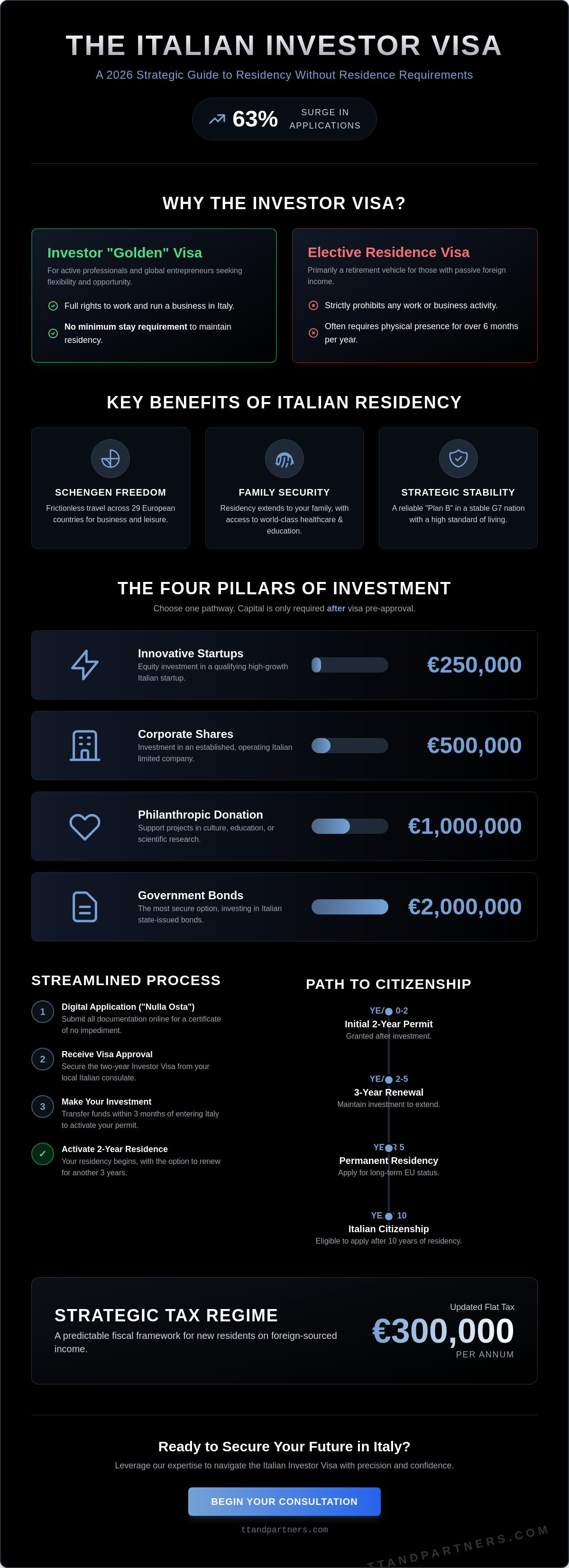
While neighboring European nations have curtailed their residency pathways, applications for the Italian Investor Visa surged by 63% last year. This shift marks a new era for high-net-worth individuals who seek a "Plan B" that offers both global mobility and intellectual depth. You might be asking, what is the Italian golden visa program and how does it integrate into a modern, cross-border lifestyle? It's a sophisticated legal framework designed for those who demand excellence without the burden of traditional bureaucracy.
We understand that the prospect of Italian "red tape" or the uncertainty of physical stay requirements can feel like a barrier to your vision. You've likely heard of the complexities; however, the reality is a streamlined process that respects your time and global commitments. This guide promises a clear, strategic roadmap to residency, navigating the 2026 legal requirements and tax benefits with expert precision. We'll explore the updated €300,000 flat tax regime, the lack of minimum stay mandates, and the specific investment thresholds that define the current landscape.
Key Takeaways
Identify what is the Italian golden visa program and why its lack of physical stay requirements makes it a premier residency asset in 2026.
Analyze the four distinct investment pillars, including corporate shares and innovative startups, to select the pathway that best aligns with your capital strategy.
Leverage the strategic tax benefits available to neo-residents, providing a predictable fiscal framework for your foreign-sourced wealth.
Master the streamlined digital application protocol to secure your initial two-year residence permit with professional precision and minimal friction.
Establish a long-term roadmap for transitioning from an investor visa to permanent residency and the eventual pursuit of Italian citizenship.
Table of Contents
Understanding the Investor Visa for Italy: A Premium Residency Pathway
The Investor Visa for Italy is a specialized two-year residence permit designed for non-EU citizens who wish to align their capital with the enduring strength of the Italian economy. To truly grasp what is the Italian golden visa program, one must view it as a sophisticated instrument of mobility rather than a standard immigration process. As of 2026, this program has emerged as a leading choice for high-net-worth individuals, specifically because it offers a level of flexibility that other European jurisdictions have recently restricted. It's a gateway to a G7 nation that values the intellectual and financial contributions of global visionaries who seek more than just a passport.
The core philosophy of this pathway is rooted in strategic exchange. In return for a significant investment in Italian assets, the state provides a residency status that prioritizes the investor's autonomy. By engaging with Immigrant Investor Programs, you secure a foothold in Europe that balances the precision of law with the fluidity of a modern lifestyle. In the 2026 landscape, Italy stands out by offering a streamlined, digital-first approach that respects the time and global commitments of the modern executive. This focus on efficiency ensures that your transition into the European market is as seamless as possible.
Golden Visa vs. Elective Residence: Which Is Right for You?
A frequent point of confusion when researching what is the Italian golden visa program is its relationship to the Elective Residence Visa. The distinction is vital for active professionals. The Elective Residence Visa is essentially a retirement vehicle; it strictly prohibits the holder from engaging in any work or business activity within Italy. Conversely, the Investor Visa grants you the full right to maintain employment or manage your own Italian ventures. The Golden Visa removes the restrictive "six-month rule." You aren't required to spend a minimum number of days in the country to keep your permit active. It's residency on your terms, allowing you to move freely between your global interests and your Italian home without fear of losing your legal status.
Key Benefits of Italian Residency in 2026
Securing residency through investment provides a suite of benefits that extend far beyond a simple travel document. It's a holistic integration into the European lifestyle.
Schengen Freedom: Move without friction across the 29 countries of the Schengen Area, facilitating effortless business travel and leisure.
Family Security: Your residency extends to your spouse and dependent children, granting them full access to Italy's world-class healthcare and historic educational systems.
Strategic Stability: In an unpredictable global climate, Italy offers the "Plan B" security of a stable, culturally rich environment with a high standard of living.
This program is more than a legal status; it's a commitment to a future of harmony and growth in one of the world's most beautiful settings. If you're ready to explore how these benefits apply to your specific portfolio, you can connect with our team at Tosolini, Toniutti & Partners for a confidential consultation on your residency strategy.
The Four Pillars of Investment: Choosing Your Path to Residency
The architecture of the Italian residency by investment system rests upon four distinct financial pillars. Each pathway offers a different balance of risk, liquidity, and social impact, allowing you to tailor your entry to your personal philosophy. To understand what is the Italian golden visa program in a practical sense, one must analyze these categories not just as legal requirements, but as strategic assets within a global portfolio. A unique advantage of this program is that your capital commitment is only required after your initial application has been approved. This "approval first" structure provides a layer of security that is rare in international residency programs.
As applications for the Official Investor Visa for Italy Program surged by 63% last year, the Ministry has maintained strict definitions for qualifying assets. You must maintain your chosen investment for the entire duration of your residency permit. If the investment is liquidated or falls below the threshold, the permit may be revoked. This ensures a long term alignment between the investor's interests and the Italian economy's growth.
Government Bonds and Philanthropic Initiatives
The €2 million investment in Italian government bonds remains the "safe haven" for those prioritizing capital preservation. These bonds, typically BTPs, offer a predictable exit strategy and high liquidity compared to private equity. For those driven by a legacy of impact, the €1 million philanthropic donation offers a different kind of return. This non refundable contribution supports projects of public interest in culture, education, or research. Regardless of the choice, the legal verification of the source of funds is paramount. You'll need to provide transparent documentation proving that the capital was legally acquired and is readily transferable.
Corporate Investments and Innovative Startups
The €500,000 investment in an Italian limited company (S.p.A. or S.r.l.) has historically been the most popular choice among investors. It allows for direct engagement with established Italian enterprises. Alternatively, the €250,000 entry point into "Innovative Startups" is seeing rapid growth. This pathway targets high growth potential companies listed on a specific official registry. While the startup route offers the lowest capital threshold, it requires rigorous legal due diligence. You must verify the entity's standing and ensure it meets the Ministry's criteria for innovation. Selecting the right partner or entity is a delicate process that requires professional oversight. If you require assistance in evaluating these corporate opportunities, our team can provide the necessary legal and strategic guidance to secure your position.
The Application Process: Navigating the Nulla Osta and Beyond
Obtaining residency is a process defined by legal symmetry and intellectual diligence. While the investment itself is the foundation, the procedural execution determines your ultimate success. To grasp what is the Italian golden visa program in its entirety, you must navigate two distinct phases: the centralized digital application for the Nulla Osta and the subsequent consular visa issuance. The 2026 digital portal has improved efficiency, yet it demands a level of technical precision that leaves little room for error. It's a journey that balances digital speed with the traditional rigor of Italian administrative law.
Preparation is the most time-consuming element of this journey. While the Committee reviews the Nulla Osta in 30 days, the overall processing time to secure your physical permit in 2026 is estimated between 3 to 6 months. This discrepancy exists because gathering the necessary international documentation requires significant lead time. For instance, investors often underestimate the time needed to secure apostilles or specific bank letters that meet the exacting standards of the Italian Ministry. A single oversight in these early stages can stall the entire vision.
Phase 1: Securing the Nulla Osta (No Impediment)
The digital portal at the Ministry of Economic Development is the starting line. You'll submit a formal Declaration of Commitment alongside comprehensive proof of funds. The Committee is legally bound to issue a decision within 30 days. This timeline is remarkably efficient, but the preparation phase is where most investors face hurdles. Generic guides often overlook the complexities of international document verification. North American investors, in particular, frequently encounter issues with source of funds documentation that doesn't precisely mirror Italian legal requirements. Consulting an Italy Residence by Investment Guide provides broader context, but the technical precision of your specific file remains the deciding factor for approval.
Phase 2: From the Consulate to the Questura
Once the Nulla Osta is issued, you have six months to apply for the actual Investor Visa at the Italian Consulate in your jurisdiction. This initial permit is valid for two years. The most critical moment occurs after you land on Italian soil. You have exactly eight days to report to the local Questura (Police Headquarters) to apply for your physical residence permit, the Permesso di Soggiorno per Investitori. This final step involves the collection of biometric data and fingerprints. It's a moment of transition where your strategic investment finally manifests as a tangible legal right. If the technicalities of the digital portal or the strict timelines of the Questura feel daunting, securing professional legal representation can ensure your arrival is as seamless as the lifestyle you're building.
Strategic Tax Planning: The 300,000 Euro Flat Tax Regime
A primary driver for those asking what is the Italian golden visa program is the accompanying fiscal framework. Italy's "Neo-Resident" regime offers an unparalleled advantage for high-net-worth individuals who maintain a global footprint. For the 2026 fiscal year, this regime allows new residents to pay a flat tax of €300,000 per year on all foreign-sourced income. This lump-sum payment replaces the standard progressive income tax rates, regardless of the actual amount of wealth generated outside Italian borders. It's a system built for simplicity and predictability in a complex global economy.
This fiscal privilege extends for a maximum of 15 years, providing a long-term horizon for wealth management. You can also include family members in this arrangement for an additional €50,000 per member each year. By decoupling your residency status from your global tax exposure, Italy transforms from a destination into a strategic headquarters. It's a vision of residency that prioritizes financial harmony and the protection of your legacy.
Wealth Preservation and Inheritance Tax
The flat tax regime provides significant relief beyond annual income. Participants are typically exempt from reporting foreign assets under the IVIE and IVAFE frameworks. This exemption reduces the administrative burden of becoming a resident. Crucially, inheritance and gift taxes are only applied to assets located within Italy. For global investors, this makes Italy an effective "tax haven" for non-Italian assets, ensuring that your international holdings remain sheltered from local succession duties.
US-Italy Cross-Border Considerations
American investors must navigate this landscape with unique care due to the US-Italy Tax Treaty. The "Savings Clause" in the treaty allows the United States to tax its citizens as if the treaty didn't exist. However, strategic use of the Foreign Tax Credit can often mitigate double taxation. You'll need to carefully structure your Italian flat tax payments to ensure they're creditable against your US tax liabilities. For non-US citizens, becoming an Italian resident doesn't trigger US tax obligations but may require specific disclosures if you hold US-based assets or business interests.
Navigating the intersection of Italian immigration law and international tax treaties requires a bespoke approach. If you're ready to align your global wealth with your new European life, our team provides the cross-border tax expertise necessary for a seamless transition.
The Path to Permanent Residency and Italian Citizenship
The initial two-year permit is merely the first chapter in a decade-long narrative of integration. Understanding what is the Italian golden visa program requires looking beyond the immediate entry and focusing on the long-term evolution of your status. If the investment is maintained, the permit can be renewed for a subsequent three-year period. This total of five years of continuous legal residence serves as the threshold for applying for an EC Long-Term Residence Permit, commonly known as permanent residency. This status provides an even greater level of stability, removing the need for frequent renewals while preserving your rights within the European Union.
The ultimate milestone for many is naturalization. After ten years of legal residency, investors become eligible to apply for full citizenship. This journey is often non-linear and can be complemented by other legal avenues. For those with ancestral ties, the process of securing Italian citizenship through heritage may run parallel to the investor pathway, potentially accelerating the timeline for certain family members. It's a holistic approach to identity and mobility in a modern, borderless era.
Maintaining Your Status: Compliance and Reporting
Your residency remains valid only as long as the underlying investment stays "active" and "at risk." This means you can't simply liquidate your government bonds or sell your corporate shares without jeopardizing your permit. If an innovative startup fails, you must navigate the legal implications with precision to protect your residency status. In cases of complex corporate shifts or investment disputes, having access to international litigation support is vital. It's not just about the initial capital; it's about the ongoing stewardship of your legal standing.
Why Legal Counsel is Essential for Global Investors
Generic visa agencies often lack the intellectual depth required to manage the complexities of cross-border law. A licensed law firm provides a level of professional precision that ensures your global interests are harmonized. For families moving between the United States and Italy, managing an E-2 Visa and the Golden Visa simultaneously requires a sophisticated legal framework. We don't just process papers; we build enduring structures for your life and wealth. If you're ready to define your future in Italy, contact our team for a strategic consultation on your residency goals.
Defining Your Future in the Heart of Europe
Italy's 2026 landscape offers a rare intersection of cultural heritage and fiscal foresight. By understanding what is the Italian golden visa program, you've identified a pathway that prioritizes your autonomy while securing a permanent foothold in a G7 economy. This journey isn't merely about obtaining a permit; it's about the deliberate construction of a life that spans borders with ease. You've explored the four investment pillars and the unique advantages of the €300,000 flat tax regime. Now, the transition from vision to reality requires a partner who understands the intricate nuances of both Italian and international law.
Success in these matters is the result of meticulous planning and intellectual stewardship. To ensure your transition is seamless and your wealth is optimized, you can schedule a strategic residency consultation with our cross-border legal team. We offer decades of US-Italy experience and specialized expertise in dual-jurisdiction immigration and tax optimization for high-net-worth individuals. Your future in Italy is a well-designed structure; let's begin the process of building it together.
Frequently Asked Questions
Does the Italian Golden Visa require me to live in Italy for 183 days a year?
No, there's no minimum stay requirement to maintain your residency under this program. This flexibility is a primary reason why many ask what is the Italian golden visa program when seeking a "Plan B" residency that doesn't disrupt their global lifestyle. You can maintain your permit without becoming a tax resident, provided you don't spend more than 183 days in the country or establish your center of interests there.
Can I include my family members in the Italian Golden Visa application?
Yes, your spouse and dependent children are eligible to be included in your application. This extension of residency rights ensures that your strategic relocation supports the entire family unit from the outset. Each family member receives a residence permit that grants them the same access to Italian healthcare and education systems as the primary investor, fostering a shared experience of European mobility.
Is the investment for the Italian Golden Visa refundable after I get my permit?
The capital you commit is a private investment or a donation, not a government fee, meaning it remains your asset or a contribution to a specific cause. While it isn't "refundable" like a deposit, you're free to liquidate your bonds or corporate shares once you no longer require the visa or after you've transitioned to permanent residency. You must maintain the full investment amount throughout the initial two-year and subsequent three-year renewal periods.
What is the minimum investment for the Italian Golden Visa in 2026?
In 2026, the entry points are €250,000 for innovative startups and €500,000 for Italian limited companies. For those seeking capital preservation, the €2 million government bond option remains a stable choice. These thresholds define what is the Italian golden visa program in a financial sense, ensuring that all participants contribute meaningfully to the nation's strategic assets and economic growth.
How long does it take to get the Italian Investor Visa from start to finish?
The end-to-end process typically spans 3 to 6 months in the 2026 administrative climate. This timeline includes the 30-day statutory window for the Ministry to issue the Nulla Osta and the subsequent time for consular visa processing in your home country. The exact duration often depends on how quickly you can assemble the necessary international documentation, such as bank letters and apostilled records.
Can I work in Italy if I have an Investor Visa?
Yes, the Investor Visa grants you the full right to work or manage a business within Italy. This is a critical legal distinction from the Elective Residence Visa, which strictly prohibits any form of employment or income-generating activity within the country. It allows you to remain economically active, whether you're launching a new venture or continuing your role as a global executive from an Italian base.
What happens to my Golden Visa if I sell my investment?
Selling your investment before your residency status is finalized or transitioned to permanent residency will lead to the revocation of your permit. The Ministry requires that the investment remains active and "at risk" for the entire duration of the residency permit's validity. If you liquidate your bonds or corporate shares early, you'll lose the legal basis for your stay, requiring a transition to another permit type if you wish to remain.
Do I need to speak Italian to qualify for the Golden Visa program?
No, there's no Italian language requirement to qualify for the Investor Visa or to obtain your initial residence permits. This lowers the barrier for international investors who wish to secure residency quickly without immediate linguistic integration. However, if your long-term goal is to pursue Italian citizenship after ten years of residency, you'll need to demonstrate a B1 level of proficiency in the language at that stage.


Comments