

Italian Citizenship by Marriage Requirements: The 2026 Strategic Guide
- Gianni Mendes Toniutti, Esq.

- May 16
- 12 min read
What if the path to an Italian passport isn't just about the person you love, but about the strategic synchronization of legal timelines and linguistic mastery? Many couples find the journey toward dual nationality fraught with uncertainty, particularly when navigating the nuances of Italian citizenship by marriage requirements during a period of heightened regulatory scrutiny. It's natural to feel anxious about the mandatory intermediate language exam or the discrepancy between eighteen month and three year processing windows.
This guide serves as your professional roadmap for 2026, offering a clear legal framework to secure your citizenship with precision and confidence. You'll gain a comprehensive understanding of language certification mandates, government fees, and the specific residency durations required both within Italy and for those living abroad. We'll also provide a structured checklist of documents to ensure your submission to the Ministry of the Interior is flawless, helping you move beyond the confusion of bureaucratic registration toward a successful outcome.
Key Takeaways
Determine your specific eligibility window by understanding how residency and family status can reduce wait times from three years to as little as eighteen months.
Master the mandatory B1 Italian language certification requirement to ensure your application meets the linguistic standards established under current security decrees.
Navigate the essential documentation process, including the transcription of your marriage in an Italian Comune, to fulfill all Italian citizenship by marriage requirements.
Streamline your submission through the Ministry of the Interior's digital portal while coordinating effectively with the Italian Consulate for the final evaluation.
Adopt a strategic approach to background clearances and fiscal mandates to prevent administrative rejections and secure your path to dual nationality.
Table of Contents
The Legal Framework of Italian Citizenship Through Marriage
The foundation of acquiring a passport through your spouse lies within the Italian Nationality Law, specifically Law number 91 of 1992. Unlike citizenship by descent, which traces ancestral bloodlines without limit, citizenship through marriage is a benefit granted through the legal union with an Italian citizen. It's a pathway built on the principle of family unity. However, it's not an automatic right. You must meet specific Italian citizenship by marriage requirements that focus on the stability and duration of the relationship. The state views this acquisition as a conscious integration into the national fabric rather than a mere administrative formality.
The law requires the marriage to remain active throughout the entire administrative process. This means the bond must exist from the moment you submit the online application until the day you take your oath of allegiance. If a legal separation, divorce, or annulment occurs during this window, the application terminates immediately. Italy views this process as a commitment to the national community through the marital unit. Interestingly, the death of the Italian spouse during the processing period doesn't terminate the applicant's eligibility, reflecting a respectful nod to the permanence of the marital bond in Italian culture.
Marriage versus Civil Unions: Equal Rights in 2026
Since the implementation of Law 76 of 2016, Italy has established legal parity between traditional marriages and civil unions. This is particularly relevant for same-sex couples who registered their unions in the United States or other foreign jurisdictions. For these unions to be valid for citizenship purposes, they must be recorded in the Italian Vital Records Registry at the relevant municipality. This recording isn't just a formality; it's the specific legal act that triggers your eligibility to apply under the same timelines as any other couple. Without this registration in Italy, the Ministry of the Interior cannot recognize the union, regardless of its legal status in your home country.
The Italian Spouse's Status
Your spouse's legal standing is just as critical as your own. They must hold valid Italian citizenship at the time you file the application and maintain it until the process concludes. If the spouse renounces their citizenship, your eligibility vanishes. For those living outside of Italy, ensuring your spouse is correctly registered in the Registry of Italians Residing Abroad is a non-negotiable step. Discrepancies in these records often lead to significant delays or rejections. If you're unsure about your spouse's current registration status, you should contact a professional to verify these records before initiating the formal filing. Meeting all Italian citizenship by marriage requirements starts with ensuring the Italian partner's paperwork is in perfect order.
The Eligibility Timeline: When Can You Apply?
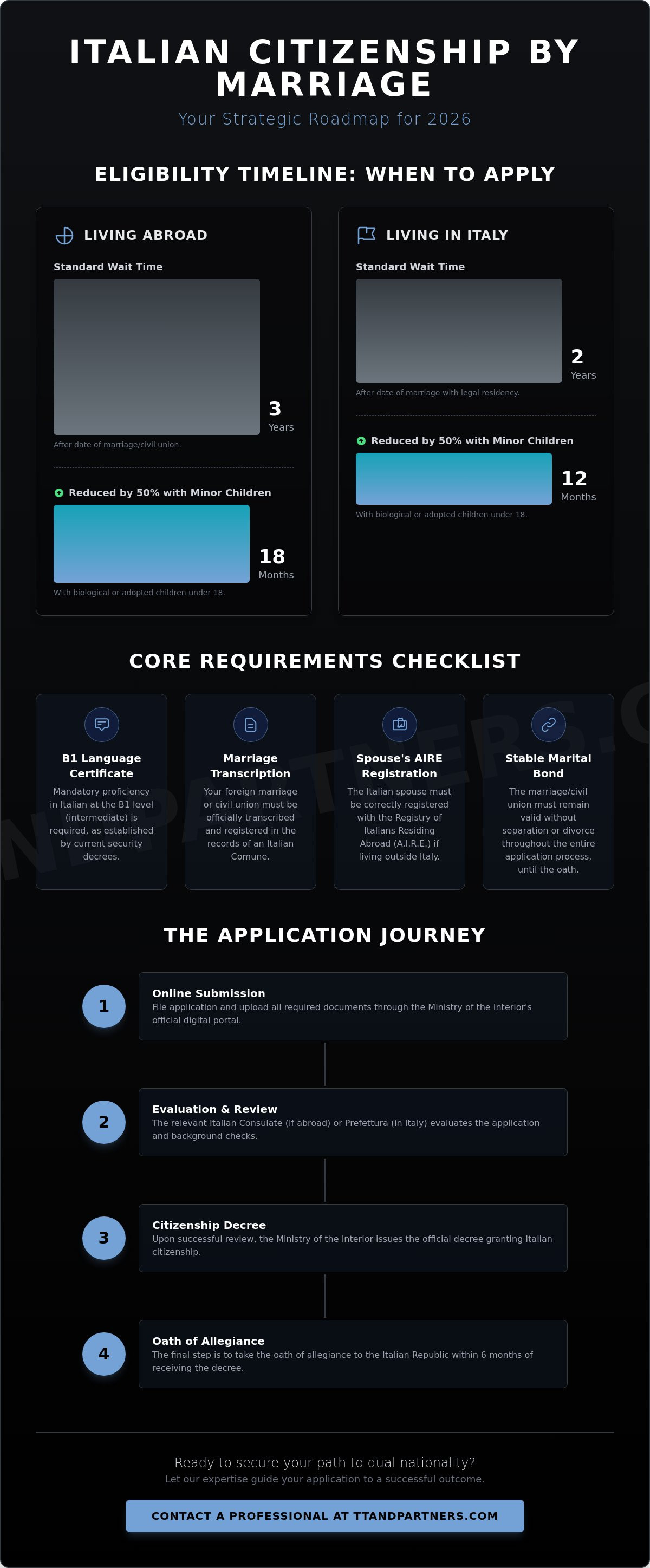
Timing acts as the silent architect of your application strategy. While the previous section detailed the legal standing of your union, the specific eligibility dates dictate exactly when you can transition from preparation to formal action. The primary timeline for Italian citizenship by marriage requirements hinges on your official place of residence. If you're legally residing within the Italian borders, you can submit your file after two years. For those living abroad, such as in the United States, the standard waiting period extends to three years from the date of the wedding.
A significant catalyst in this process is the presence of minor children. Whether they're biological or legally adopted, children under the age of eighteen reduce these statutory waiting periods by exactly fifty percent. Consequently, a resident in Italy with a child can apply after just twelve months of residency. Those living outside the country see their three year requirement drop to eighteen months. This acceleration recognizes the family unit's role in fostering cultural ties. It's a strategic advantage for families looking to secure their European future more rapidly.
Calculating the Residency Window
Legal residence is a specific administrative status, not merely time spent on Italian soil as a visitor. To be considered a resident, you must be registered in the population registry of an Italian municipality. For those living in the United States, the three year clock typically begins on the date of the marriage, provided the Italian spouse is already a citizen. As detailed by the Italian Consulate in Miami, the marriage must be recorded in the national vital records before the application can proceed. If you're unsure about your specific filing date, you might consult with a specialist to avoid a premature submission that could lead to immediate rejection.
The Naturalization Reset Caveat
One of the most misunderstood aspects of the timeline involves the naturalization reset rule. If your spouse wasn't an Italian citizen on your wedding day but acquired citizenship later through descent or naturalization, your marriage date doesn't determine the start of the clock. The eligibility period for your application begins only on the day your spouse officially became an Italian citizen. For example, if you married in 2021 but your spouse obtained their Italian passport in 2024, your three year waiting period starts in 2024. You'd be eligible to apply in 2027. This nuance is vital for couples currently in the process of reclaiming their heritage. It requires a different strategic approach to document preparation and language testing to ensure you meet all Italian citizenship by marriage requirements at the correct moment.
The B1 Language Requirement: A Mandatory Hurdle
Since December 2018, the legal landscape for spouses seeking nationality has undergone a significant shift. The introduction of the B1 language mandate transformed the application from a purely administrative filing into a demonstration of cultural integration. This requirement ensures that new citizens possess an intermediate level of proficiency, allowing them to participate fully in Italian civic life. It's now one of the most critical Italian citizenship by marriage requirements to address early in your planning. You shouldn't wait until your documents are ready to begin studying; the certification process often takes months to complete.
The B1 level, as defined by the Common European Framework of Reference for Languages (CEFR), signifies a "threshold" or intermediate level. You don't need to be fluent or discuss complex philosophy. Instead, you must prove you can understand the main points of clear standard input on familiar matters. This includes the ability to deal with most situations likely to arise while traveling and producing simple connected text on topics of personal interest. The exam is rigorous, testing your skills in listening, reading, writing, and speaking in a synchronized manner.
Approved Certification Bodies (CLIQ)
Italy only accepts certifications from the CLIQ (Certificazione Lingua Italiana di Qualità) association. The four accredited bodies are CILS (Siena), CELI (Perugia), IT (Roma Tre), and PLIDA (Dante Alighieri). Private language school diplomas are insufficient unless they provide the specific CLIQ-stamped certificate. Preparation should focus on the specific format of these exams, as even comfortable speakers can fail due to the technical structure of the writing or listening sections.
Exemptions and Special Cases
Not every applicant needs to sit for an exam. If you've already completed your education within the Italian school system, you're likely exempt. Specifically, holding a diploma from an Italian middle school or high school serves as sufficient proof. Similarly, graduates from recognized Italian universities are cleared of this requirement. A March 2025 Constitutional Court ruling also introduced narrow exemptions for individuals with severe, documented limitations that prevent language learning, though these cases require extensive medical evidence.
Mandatory Documentation and 2026 Fiscal Requirements
The administrative phase of your application is where architectural precision meets legal mandate. Collecting the necessary paperwork requires a disciplined timeline. You'll need a long-form birth certificate, which must be apostilled and translated by a certified professional. The most critical document is the Italian marriage record extract. This is an abbreviated version of your marriage record issued by the Italian municipality where your union was transcribed. Without this specific document, the Ministry of the Interior cannot verify your marital status under national law.
Every foreign document in your portfolio must undergo a specific verification process. This includes obtaining an apostille from the Secretary of State or relevant authority in the country of origin. Once apostilled, these records must be translated by a professional recognized by the Italian consulate. Meeting the Italian citizenship by marriage requirements involves ensuring that every name, date, and place matches across all documents. Minor discrepancies can lead to months of delays or a full rejection of your file.
The 2026 Fee Structure
As of May 2026, the primary government application fee is €250. You'll process this payment through the government electronic payment system before submitting your digital file. A notable change introduced by 2025 legislation is the removal of the revenue stamp tax for those applying from outside Italy. While this simplifies the fiscal burden for the global community, you should still account for administrative costs. These include professional translation fees and the costs of obtaining legalizations for every non-Italian document. To ensure your document portfolio is compliant, contact our legal team for a precise review.
Background Check Strategy
Timing is everything when managing criminal record clearances. Italy enforces a strict six month rule for foreign background checks. This means your federal background report and any state level clearances must be less than six months old at the moment of submission. You must provide records from every country where you've resided since the age of 14. If you've lived in multiple jurisdictions, coordinating these requests is essential to ensure no document expires while waiting for another. Every foreign record requires an apostille to be recognized as a valid component of the Italian citizenship by marriage requirements. You don't want to risk a rejection because a single background check expired by a few days.
The Application Journey: From Submission to the Oath
The final phase of meeting Italian citizenship by marriage requirements begins with the digital migration of your physical portfolio into the Ministry of the Interior's 'ALI' portal. This isn't a simple upload process. Each scan must meet strict technical parameters regarding file size and legibility to ensure the administrative review can proceed without interruption. Errors at this stage often lead to immediate rejection or significant delays. Once you've submitted the application, the Italian Consulate or the local Prefecture begins a meticulous evaluation. They don't just check for the presence of documents; they verify the authenticity of every apostille and the accuracy of every translation against the original records transcribed in Italy.
During this review, you might receive a notice under Article 10-bis. This is a "Pre-Refusal" notification indicating that the administration has found a deficiency in your application. You have a narrow ten day window to respond with corrective evidence. Handling these notices with legal precision is often the difference between a successful decree and a total loss of your application fee. It's a moment that requires calm, professional intervention to protect your progress.
Portal Submission and Consular Review
The digital submission is the gateway to the evaluation phase. The Ministry's portal requires a Secure Electronic Identity (SPID) for those in Italy or a dedicated account for those abroad. Behind the scenes, the Consulate assesses your integration and background. They coordinate with the Ministry of Justice and the Ministry of Foreign Affairs to ensure you meet all security criteria. If the administration exceeds the 36 month legal limit without issuing a decision, applicants may have grounds for a legal appeal to compel a response. This legal boundary exists to ensure that the process remains transparent and accountable to the applicant.
Approval and the Citizenship Oath
In 2026, the legal maximum processing time for Italian citizenship by marriage is 36 months. While some applications are processed in 18 to 24 months, the state reserves the right to use the full three year window. Once approved, you'll receive a notification of the Decree of Granting of Citizenship. You then have a strict six month deadline to schedule and perform the Oath of Allegiance (Giuramento) at your local Consulate or Comune. Missing this window nullifies the decree, forcing you to restart the entire application process. After the oath, you can apply for your first Italian passport, gaining the full freedom of movement and residence afforded by EU citizenship.
Strategic Legal Support
Navigating the intersection of international law requires a strategic vision that looks beyond the simple filing of paperwork. Managing the relationship with the Italian Comune for marriage records and responding to complex consular inquiries demands cross-border expertise. Our firm specializes in these intricate cases, ensuring that your path to dual nationality is handled with the highest level of professional care. Contact our team for a tailored citizenship consultation to secure your future in Italy.
Embracing Your Mediterranean Heritage
Securing a second passport is more than a legal transaction; it's a visionary step toward a life of global mobility and cultural connection. Successfully navigating the Italian citizenship by marriage requirements in 2026 demands a precise orchestration of linguistic proficiency, residency timelines, and meticulous document procurement. By mastering the B1 language mandate and strictly adhering to the six month validity rule for background checks, you transform a complex bureaucratic hurdle into a clear path toward the final oath of allegiance.
Our firm provides specialized US-Italy cross-border legal expertise to guide you through every nuance of this journey. We offer full-service support, from the initial transcription of your marriage in the Italian Comune to the procurement of international apostilles and the final portal submission. Having achieved success in the most complex Jure Matrimonii and Jure Sanguinis cases, our team ensures your application is handled with professional elegance and technical accuracy. Secure your Italian future; consult with our cross-border legal experts today. Your new life in the heart of Europe is within reach.
Frequently Asked Questions
Can I apply for Italian citizenship if my spouse is still waiting for their own recognition?
You can't initiate your application until your spouse's citizenship is officially recognized and registered. The law requires the Italian partner to hold valid citizenship at the moment the digital submission occurs. If they're currently in the recognition phase for citizenship by descent, you must wait for their final decree and AIRE registration before starting your own process.
What happens if we get divorce while the citizenship application is pending?
A legal separation or divorce during the pending period results in the immediate termination of your application. The marital bond must remain legally intact and active from the submission date until the final oath of allegiance is taken. This requirement ensures the benefit is granted based on the ongoing stability of the family unit.
Is there an age limit for applying for Italian citizenship by marriage?
There's no upper age limit for meeting Italian citizenship by marriage requirements. As long as you're a legal adult over the age of 18 and meet the residency or marriage duration criteria, you're eligible to apply. The evaluation focuses on your legal history and cultural integration rather than your stage in life.
Do I have to live in Italy to keep my Italian citizenship after I get it?
You don't need to maintain residency in Italy to keep your citizenship once it's granted. Italian nationality is permanent unless you voluntarily renounce it. You're free to live anywhere in the world while enjoying the full benefits of your Italian passport and European Union status regardless of your physical location.
How long is the B1 language certificate valid for the application?
B1 language certificates issued by accredited CLIQ bodies don't have an expiration date for citizenship purposes. Once you've successfully passed the exam and received your diploma, it remains a valid proof of proficiency indefinitely. This allows you to complete the language requirement well in advance of your eligibility date without fear of the document becoming obsolete.
What is the total estimated cost for the Italian citizenship by marriage process in 2026?
The primary government cost consists of a €250 application fee paid to the Ministry of the Interior. Total expenses vary based on the volume of documents requiring translation and apostilles from your home country. You should also account for the costs of the B1 language exam and professional legal guidance to ensure a rejection-free submission.
Can I include my children from a previous marriage in my application?
You can't include children from a previous marriage in your application for citizenship by marriage. This specific legal pathway only applies to the spouse of the Italian citizen. Your children may be eligible for other forms of Italian immigration or residency permits, but they won't automatically acquire citizenship through your marital union.
What if I have a minor criminal record? Will my application be rejected?
A criminal record doesn't lead to an automatic rejection unless the offenses involve serious crimes or threats to national security. The Ministry of the Interior evaluates criminal reports on a case-by-case basis. While minor administrative offenses typically don't disqualify an applicant, full disclosure of all records since age 14 is a non-negotiable part of the Italian citizenship by marriage requirements.


Comments