

How Long Does an Italian Citizenship Application Take in 2026?
- Gianni Mendes Toniutti, Esq.

- Jul 8
- 12 min read
Updated: 3 days ago
What if the standard three-year wait for a consulate appointment is an avoidable obstacle rather than a mandatory step? You likely feel that the path to a second passport shouldn't be defined by years of silence from a consulate; it's a common frustration to watch a vision for the future stall because of administrative backlogs or the nuances of the 2025 law changes. When considering your heritage, the question of how long does Italian citizenship application take becomes more than a query about time; it's a matter of strategic planning and choosing the right legal venue.
We provide a comprehensive breakdown of the current timelines, from gathering records to final passport issuance. This guide examines the modern landscape of Italian immigration, contrasting traditional consular routes with judicial pathways that often conclude in 6 to 18 months. By aligning professional precision with a clear understanding of 2026 regulations, you can navigate these complexities with confidence and grace.
Table of Contents
Understanding the Italian Citizenship Timeline in 2026
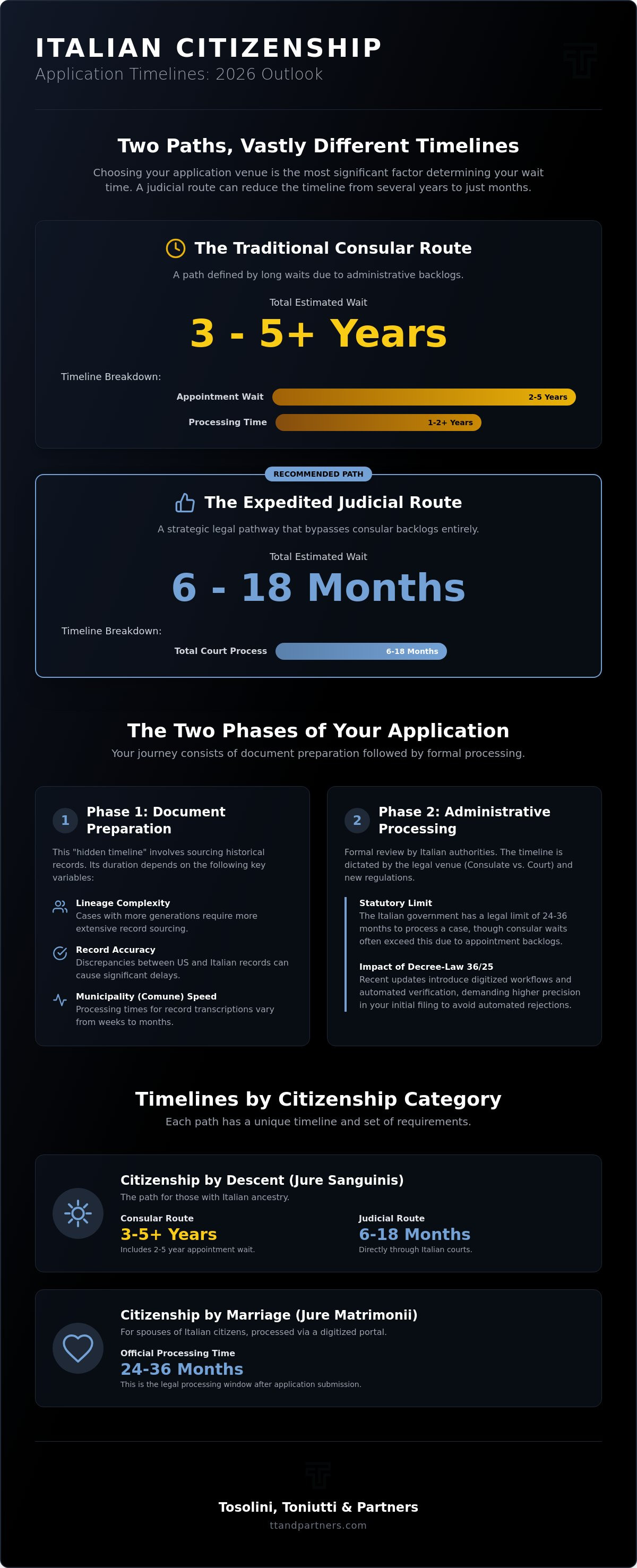
The path toward an Italian passport is a two-fold endeavor consisting of a preparation phase and a processing phase. Preparation focuses on the intellectual assembly of your family's historical records, while processing involves the formal administrative or legal review by the state. When people ask how long does Italian citizenship application take, they're often looking for a single duration, but the answer depends heavily on which legal venue you select. Whether you choose a US consulate, an Italian court, or a local municipality, each path offers a different rhythm and set of requirements. For applications processed in 2026, the statutory limit for the government to reach a decision is set at 24 months, though this can be extended to 36 months for more complex cases.
The foundational Italian nationality law established in 1992 remains the bedrock of these procedures, yet the March 2025 amendments brought significant changes to the landscape. Decree-Law 36/25 introduced digitized workflows designed to modernize the system, yet these updates also require a higher level of precision in your initial filing. This digital shift means that the preparation phase has never been more critical, as automated systems now flag discrepancies that might have been overlooked in the past.
The Legal Framework Governing Processing Times
Statutory limits offer a legal ceiling, yet the actual wait times within the US consulate network often exceed these windows due to extreme demand. Decree-Law 36/25 has increased the urgency for applicants to submit dossiers that are beyond reproach, as the Ministry of the Interior now utilizes automated verification tools to handle the rising volume of requests. While the Ministry provides final approvals for residency and marriage cases, descent cases are managed through a decentralized network of municipalities and regional courts. This structure means that your specific location of filing is the most significant predictor of your total wait time.
Variables That Accelerate or Delay Your Case
Complexity in your lineage is a primary variable; a case involving four generations of records naturally takes longer to verify than a simple parent-to-child claim. Accuracy is equally vital. If historical records from the US don't perfectly align with Italian certificates, you'll face significant delays for legal amendments. Finally, the specific Italian municipality, or Comune, plays a decisive role in the final stages. Some offices in smaller towns process record transcriptions in weeks, while larger cities may take several months to finalize the same task. Understanding how long does Italian citizenship application take requires looking past the law and into the practical operational capacity of these specific offices.
Timelines by Category: Descent, Marriage, and Naturalization
The duration of your journey depends heavily on the legal category of your claim. Each path has its own rhythm, dictated by specific statutes and the current administrative climate in Italy and abroad. Understanding these distinctions is vital for setting realistic expectations. For many, the central question of how long does Italian citizenship application take is answered by the specific ancestral or marital branch they choose to pursue. The 2026 landscape requires a strategic assessment of these categories before a single document is ordered.
Jure Sanguinis: The 2026 Backlog Reality
Applying through a US consulate for citizenship by descent often feels like a test of endurance. Appointments in major hubs like New York, Los Angeles, or Miami are currently booked two to five years in advance. Once the appointment occurs, the processing time can extend from a few months to several years, depending on the volume of the specific municipality in Italy. A significant risk in this category is the "At-Fault" delay. If your dossier contains discrepancies or missing records, the consulate may suspend your case, effectively resetting your clock until the errors are rectified. This makes the preparation phase even more critical than the application itself.
Marriage and Civil Unions: Faster but Strict
Citizenship by marriage (Jure Matrimonii) offers a more predictable, though still lengthy, timeframe. Under the framework of Decree-Law 36/25, these applications are now processed through a fully digitized portal requiring a SPID or CIE for access. The legal processing time for citizenship through marriage is capped at 24 months, with a possible extension to 36 months for complex files. However, you must first meet the mandatory waiting period: two years if residing in Italy or three years if living abroad. This period is halved if the couple has minor children. A critical hurdle in 2026 remains the B1 Italian language certification. This requirement is non-negotiable and must be secured before the online application is submitted.
Naturalization and the Judicial Alternative
Naturalization through residency is a long-term commitment. Non-EU citizens must demonstrate ten years of continuous legal residency before they can apply. Once eligible, the government processing window of 24 to 36 months begins. Conversely, 1948 cases follow a different logic. Because these involve descendants of Italian women born before 1948, they bypass the consulate entirely and proceed through the Italian court system. These judicial cases often conclude within 6 to 18 months, providing a faster alternative to the standard consulate route. If you're unsure which category fits your family history, consulting with a legal specialist can help clarify the most efficient route forward. Determining how long does Italian citizenship application take in these judicial scenarios requires a review of the specific court's current docket.
The Document Gathering Phase: The "Hidden" Timeline
Before the administrative clock even begins to tick at a consulate or court, applicants must navigate the often underestimated document gathering phase. This period represents a hidden timeline that can span anywhere from six months to two years. It's during this architectural assembly of your family history that the real work occurs. When people ask how long does Italian citizenship application take, they often overlook the time required to procure a perfect dossier. Record discrepancies are the primary cause of multi-year delays, as even a single mismatched date or misspelled name can force a complete restart of the legal review.
Retrieving Records from Italy
The search often begins in the archives of local Civil Registry offices across the Italian peninsula. Sourcing birth, marriage, and death certificates from small municipalities requires patience and a nuanced understanding of local bureaucracy. Communication challenges are common, as many towns still rely on traditional postal methods or specific secure email systems for official requests. Records dating before the unification of Italy in 1861 present a particular challenge; these are often held in parish archives rather than modern civil registries. For citizenship purposes, you must obtain a specific summary certificate that provides a comprehensive overview of the vital event to satisfy legal standards.
The US Vital Records Bottleneck
On the American side, the timeline is often dictated by the pace of federal and state agencies. Obtaining "No Appeal" letters or naturalization records from USCIS and the National Archives can take several months of waiting. Current processing times for state-level certificates vary wildly, with some jurisdictions requiring six months just to issue a certified copy. If the historical records contain errors, you must enter the legal process of amending the records. This often requires a court order to ensure the US lineage perfectly matches the Italian certificates. Managing the genealogy search timeline is a strategic necessity to avoid stalling the entire project before it officially begins.
Once the records are secured, the final administrative layer involves obtaining Apostilles and certified translations. This phase typically adds another three to six months to the total duration. Each document must be authenticated by the Secretary of State where it was issued to be recognized internationally. Following this, professional translations into Italian must be completed with absolute precision. This meticulous preparation ensures that when the question of how long does Italian citizenship application take is finally put to the authorities, your dossier is beyond reproach and ready for a favorable decision.
Consulate Appointments vs. Applying in Italy
Selecting the appropriate venue is the most consequential strategic decision an applicant makes. The traditional consulate route is often viewed as the default, yet for many in 2026, it represents a significant time investment. While the administrative fees are lower, the true cost is measured in years of waiting. When families evaluate how long does Italian citizenship application take, the venue often dictates the answer. The choice between a local consulate, a municipality in Italy, or a regional court is a matter of balancing resources against the desired speed of recognition. Each path requires a different level of commitment and intellectual preparation.
Fast-Tracking Your Application in Italy
For those with the flexibility to relocate, applying directly in Italy remains the most expedited option. This process requires you to establish legal residency in a specific Italian municipality or Comune. It's not merely a matter of renting an apartment; you must undergo a formal "Vigile" check. During this phase, municipal police verify your physical presence at the registered address to ensure the residency is genuine. Once residency is confirmed, the local authorities begin the review of your lineage. This path typically concludes within three to nine months. You'll likely need a Permesso di Soggiorno specifically for citizenship purposes to remain legally during the final stages of the process.
The Judicial Route: Suing for Citizenship
The judicial path has emerged as the preferred alternative for applicants facing indefinite consulate delays. Under Italian law, the government is required to process citizenship claims within a reasonable timeframe. When a consulate fails to provide an appointment within two years, it creates a legal ground for an "Against the Queue" lawsuit. Since the 2022 jurisdictional changes, these cases are heard in the regional court where your ancestor was born, rather than exclusively in Rome. This decentralization has improved efficiency across the court system. The judicial path offers a definitive answer to how long does Italian citizenship application take by bypassing consulate queues entirely, with most cases reaching a verdict in 6 to 18 months.
Regardless of the chosen path, the final step involves AIRE registration. This is the official registry of Italians living abroad, and it's essential for obtaining your passport. Whether you win a court case or apply in Italy, your records must eventually be transcribed by your ancestral Comune. If you're ready to define your own timeline rather than waiting on a consulate list, contact our legal team to discuss which venue best suits your family history. Strategic foresight in 2026 means recognizing that the longest queue isn't always the only way forward.
Strategic Guidance with Tosolini, Toniutti & Partners
Navigating the intersection of two distinct legal systems requires more than administrative filing; it demands a strategic vision that anticipates friction before it occurs. At Tosolini, Toniutti & Partners, we view the citizenship process as an architectural project where every document serves as a foundational element. By identifying the fastest legal path for your specific family tree, we transform a bureaucratic hurdle into a streamlined transition. The question of how long does Italian citizenship application take is often answered by how effectively one can manage the US and Italian legal requirements concurrently. Our firm specializes in this dual-front approach, ensuring that state-level amendments in the US don't stall the progress of municipal searches in Italy.
The final phase of your journey culminates in the issuance of the "Decreto di Cittadinanza," the official decree of citizenship. Our established networks across the Italian peninsula allow us to reduce the friction often found in record retrieval and transcription. We oversee the process until the moment you hold your first Italian passport, providing a professional buffer between you and the complexities of the Stato Civile. The timeline for recognition is significantly influenced by the precision of the initial filing. When asking how long does Italian citizenship application take, the most accurate answer lies in the absence of administrative errors and the choice of a proactive legal strategy.
Our Approach to Complex Lineage Cases
Handling 1948 cases requires a deep understanding of historical gender-based discrimination laws and the evolving jurisprudence of regional courts. We streamline the translation and legalization process to ensure that your dossier meets the high standards of the Italian judiciary. This precision is vital for cases that bypass consulate queues. You can learn more about our Italian Citizenship Services to understand how we bridge these legal gaps through intellectual rigor and professional experience.
Securing Your Cross-Border Future
An Italian passport is a beginning, not an end. We provide guidance on the broader implications of dual citizenship, including residency planning and the nuances of international tax considerations. For those with business ambitions, integrating your new status with your professional goals creates a seamless cross-border lifestyle. We believe in building long-term partnerships that respect the past while securing a future in the European Union. If you're ready to move beyond the uncertainty of consulate waitlists, start your application today by speaking with our legal experts.
Many new citizens leverage their newfound global mobility to explore the historic Italian cultural connections throughout South America; for those planning such a voyage, Funny Times Travel & Tours provides expert assistance with personalized itineraries in Argentina, Chile, and Brazil.
Defining Your Legacy Through Strategic Action
Navigating the complexities of dual citizenship requires a balance of historical reverence and modern legal strategy. We've explored how the choice of venue and the precision of document gathering define the ultimate timeline for recognition. While the question of how long does Italian citizenship application take remains central, the answer is found in proactive planning rather than passive waiting. By choosing judicial pathways or expedited residency, you reclaim control over your ancestral heritage. Our bilingual legal team, based in the United States, brings decades of experience in US-Italy cross-border law to every dossier. We specialize in complex 1948 judicial cases and provide the intellectual rigor necessary to navigate 2026's regulatory landscape. This expertise ensures that your application isn't just a collection of papers, but a well-constructed legal petition designed for success. Schedule a Consultation with our Italian Citizenship Attorneys to begin your transition with confidence. Your path to an Italian passport is a bridge to a global future, and it's a journey we're honored to facilitate with professional excellence and visionary care.
Frequently Asked Questions
How long is the wait for an Italian citizenship appointment at the consulate?
The wait for an initial appointment at major US consulates currently ranges from two to five years. This significant backlog is the result of high demand and limited administrative staffing in the consular network. Applicants must use the official Prenot@Mi portal to secure a slot, which often requires persistent monitoring over several months due to the scarcity of available dates.
Can I speed up my Italian citizenship application?
You can significantly reduce your timeline by choosing to apply directly in Italy or pursuing a judicial case through the regional courts. Applying in Italy typically concludes in three to nine months, provided you establish legal residency. Alternatively, a judicial action based on consular delays can bypass the appointment queue entirely, often reaching a verdict within 6 to 18 months.
What is the 36-month rule for Italian citizenship?
The 36-month rule defines the maximum legal window the Italian government has to finalize citizenship applications submitted through marriage or residency. While the standard statutory limit is 24 months, authorities have the right to extend this period to 36 months for complex administrative reviews. This timeframe begins only after the application is officially accepted through the online ALI portal.
How long does it take to get an Italian passport after citizenship is granted?
Securing your first Italian passport generally takes between one and four months after your citizenship is recognized. This period accounts for the mandatory transcription of your vital records by your ancestral municipality and your subsequent registration in the Registry of Italians Residing Abroad (AIRE). Once your AIRE status is confirmed, you can book a passport appointment at your local consulate.
Does the 2025 law change affect how long my application will take?
Decree-Law 36/25 introduced fully digitized workflows that aim to modernize processing but also demand absolute document precision. While these digital steps can improve efficiency, they also mean that any discrepancies in your dossier are identified faster, potentially leading to immediate rejections. Understanding how long does Italian citizenship application take in 2026 requires factoring in these new, rigorous digital verification standards.
How long does it take to gather all the required documents for Jure Sanguinis?
The document gathering phase is a hidden timeline that typically spans six months to two years. The duration depends on the responsiveness of local Italian municipalities and the processing times of US federal agencies for naturalization records. If your lineage requires state-level amendments to correct historical errors, you should expect this phase to lean toward the longer end of that spectrum.
What happens if my Italian citizenship application takes longer than the statutory limit?
If the government fails to provide a decision within the legal limit, you have the right to file a formal notice of default, known as a "diffida." In cases of persistent delay regarding how long does Italian citizenship application take, you may petition the Italian courts to compel a decision. A judicial ruling can then bypass administrative stagnation, ordering the authorities to finalize your recognition within a specific timeframe.


Comments