

E-2 Visa to Green Card Pathway: The 2026 Strategic Transition Guide
- Gianni Mendes Toniutti, Esq.

- 4 days ago
- 12 min read
The E-2 visa is frequently mischaracterized as a temporary bridge to nowhere, a status that offers immediate entry but denies a permanent home. For the visionary investor, however, this non-immigrant status is actually the most versatile foundation for building a lasting American legacy. You likely understand the delicate tension of this position; the constant pressure to prove your intent to depart while simultaneously scaling a business that demands your long-term presence. Navigating the E-2 visa to green card pathway requires more than just paperwork. It demands a strategic architectural shift in how you position your professional and personal future in the United States.
We recognize the anxiety that stems from uncertain processing times and the fear that a single misstep during renewal could disrupt your operations. This guide provides the clarity you need to transition from a treaty investor to a lawful permanent resident through refined legal strategies like the EB-1C or the self-sponsored EB-2 National Interest Waiver. You'll learn how to bridge the gap between non-immigrant intent and permanent residency without compromising your current visa status. We will outline a precise roadmap for 2026 that secures your business continuity and ensures your family's place in the American landscape.
Table of Contents
The E-2 Visa Non-Immigrant Intent vs. Green Card Ambitions
The E-2 non-immigrant visa is a sophisticated legal instrument designed for agility. It allows Italian investors to build and manage substantial enterprises within the United States without the immediate, heavy capital requirements of residency-based categories. However, its greatest strength is also its primary limitation. As a non-immigrant classification, it’s built on the legal foundation of "intent to depart." This means every time you renew your status or re-enter the country, you’re affirming that your stay is temporary. This requirement creates a delicate friction for those who begin to envision a permanent future for their families and business operations.
Unlike the H-1B or L-1 categories, the E-2 doesn’t officially recognize "dual intent." While you aren't required to maintain a foreign residence, you must demonstrate an unequivocal intent to leave once your status terminates. This is why the E-2 visa to green card pathway is never a straight line; it’s a strategic evolution. Attempting to jump directly from an investor visa to a green card without a transition strategy can signal to USCIS that your original non-immigrant intent was disingenuous. This perception puts your current ability to work and live in the U.S. at significant risk. Success requires a bridge that honors your current obligations while building toward a permanent stay.
The Problem with Direct Conversion
A sudden shift from "investor" to "immigrant" can trigger the 90-day rule, a regulatory presumption that an individual who applies for residency shortly after entry misrepresented their intentions. In 2026, USCIS scrutiny remains high regarding the timing of these filings. If you apply for a green card while on an E-2, you essentially announce your desire to stay forever. This makes it nearly impossible to renew your E-2 visa if the residency application encounters delays or issues. Because the E-2 lacks a direct conversion mechanism, it requires a "bridge" visa or a carefully timed immigrant petition to maintain legal continuity.
The 2026 Regulatory Landscape for Treaty Investors
The current landscape demands a more integrated approach to business architecture. As of mid-2026, USCIS policies emphasize the operational health of the E-2 enterprise during any residency transition. You can’t simply let the business drift while focusing on a green card; the underlying investment must remain active and substantial. For a deeper look at the foundational requirements, explore our E-2 Visa Guide 2026. Success in this transition relies on professional oversight to ensure your immigrant ambitions don't collide with your existing treaty obligations. If you're ready to map your specific trajectory, we invite you to contact our team for a strategic consultation.
Primary Bridge Pathways: From E-2 to Permanent Residency
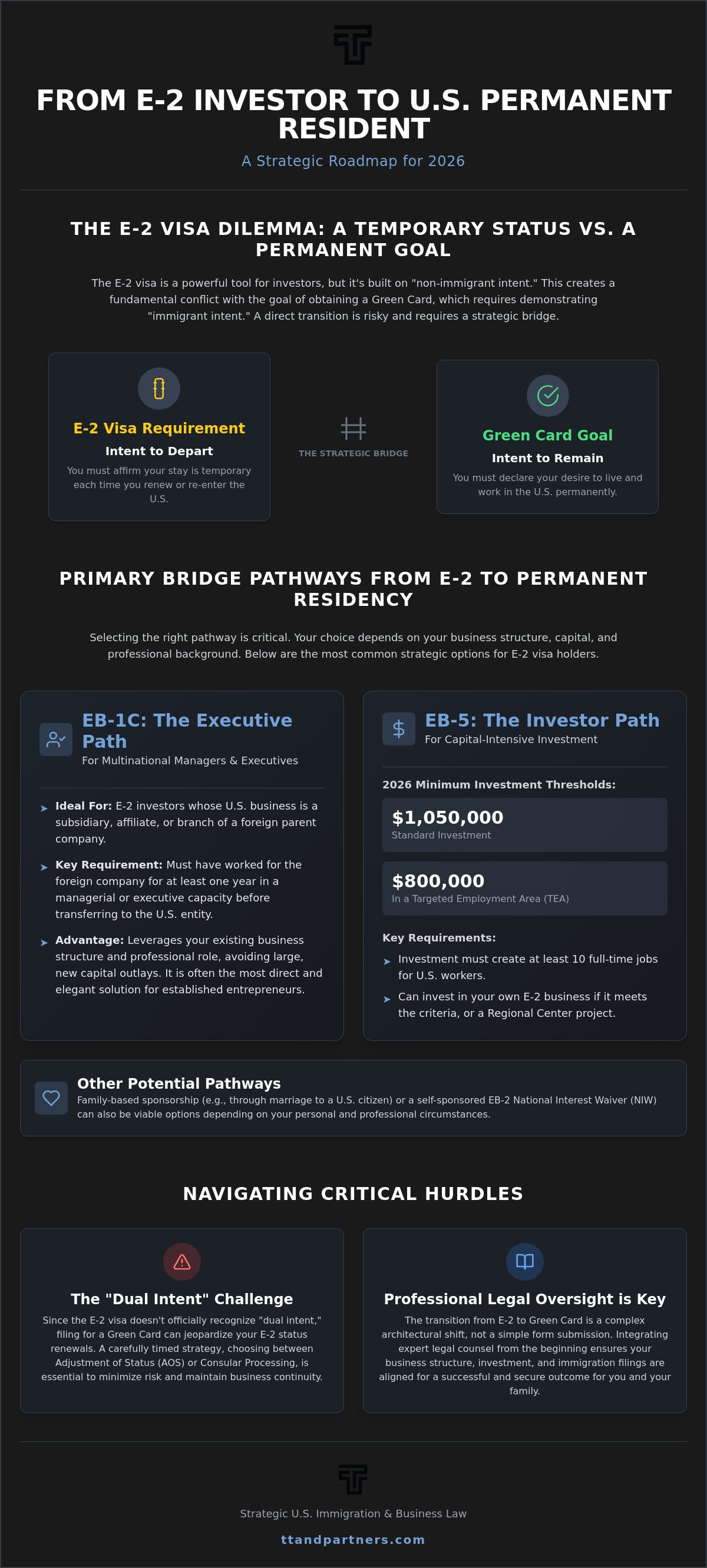
Transitioning from a treaty status to permanent residency isn't a singular event; it's a multi-layered legal process. Investors must identify which of the Primary Bridge Pathways best supports their long-term vision. For some, the EB-5 program offers a direct route through capital investment. As of July 2026, this requires a minimum of $1,050,000, though this threshold drops to $800,000 if the project is located within a Targeted Employment Area. While the I-526 filing fee stands at $11,160, this path remains attractive for those with significant liquid capital who prefer a passive or semi-passive investment structure.
For others, family-based sponsorship provides a personal resolution. A marriage-based green card application for a spouse already in the U.S. costs approximately $3,005 in government fees for the full package of forms. However, most business-minded investors prefer routes that capitalize on their professional achievements. Selecting the right E-2 visa to green card pathway depends heavily on how your initial U.S. presence was established and how your enterprise has matured since its inception.
EB-1C: The Strategic Choice for Business Owners
The EB-1C category for multinational managers is often the most elegant solution for Italian entrepreneurs. It requires a qualifying relationship between a foreign parent company and a U.S. subsidiary. Many E-2 investors realize too late that their initial standalone setup lacks this vital link. Successful transitions often necessitate a reorganization of the corporate hierarchy to meet these stringent requirements. Our LLC Incorporation Guide details how to structure these entities for maximum legal flexibility. If your business is scaling rapidly, this route avoids the high capital demands of other categories.
EB-2 NIW: Leveraging Extraordinary Ability
Entrepreneurs in the technology and renewable energy sectors are increasingly turning to the EB-2 National Interest Waiver. This self-sponsored petition bypasses the need for a U.S. employer if you can prove your work has substantial merit and national importance. It’s a powerful tool for those whose innovations align with federal priorities. Many who qualify for this route also find value in our O-1 Visa Guide, as both paths reward exceptional professional standing. To determine which bridge suits your specific corporate architecture, you may wish to consult with our strategic legal team for a personalized assessment.
Comparing EB-1C vs. EB-5: Which Investor Path Is Best?
Choosing the right E-2 visa to green card pathway often comes down to a fundamental choice between active management and passive capital. For the Italian entrepreneur, this decision dictates not only the financial outlay but also the daily operational reality of their U.S. presence. While the EB-1C category rewards the complexity of your corporate hierarchy, the EB-5 program focuses almost exclusively on the economic impact of your investment. Both routes have distinct risk profiles and timelines that must align with your long-term business architecture and family goals.
The processing landscape in 2026 highlights a significant divergence in speed. An I-140 petition for an EB-1C multinational manager currently averages around 8.1 months for standard processing, with the option for premium processing within 45 business days. In contrast, the average processing time for an EB-5 (I-526) petition has stretched to approximately 71.1 months. This timeline discrepancy makes the EB-1C an attractive option for those seeking a faster transition, provided their business structure can support the rigorous operational requirements.
The EB-1C Operational Requirement
The EB-1C is designed for executives who oversee a multi-tier organization. To qualify, your U.S. entity must have been active for at least one year and demonstrate a clear hierarchy where you manage other professional or managerial staff. A common pitfall for E-2 holders is maintaining a "mom and pop" structure where the owner remains involved in daily administrative tasks. To bridge this gap, your business must scale beyond the initial E-2 startup phase to prove you're functioning in a truly executive capacity. This route prioritizes operational longevity over raw capital injection.
EB-5: The Capital-Intensive Alternative
For investors with significant liquidity, the EB-5 remains a powerful, albeit slower, alternative. As of 2026, the minimum investment stands at $1,050,000, or $800,000 if the project is located in a Targeted Employment Area. Beyond the capital, you must prove that the investment will create at least 10 full-time jobs for U.S. workers. The burden of proof regarding the "source of funds" is exceptionally high, requiring a transparent paper trail of your global assets. While EB-1C demands continued executive involvement, the EB-5 Regional Center path allows for a more passive approach to permanent residency once the capital is deployed and jobs are created. If you're unsure which route matches your current assets, contact our legal architects to evaluate your specific case.
Navigating the Dual Intent Hurdle and Consular Processing
The E-2 visa's lack of formal dual intent creates a strategic bottleneck for investors. Unlike the L-1 or H-1B categories, the E-2 requires you to maintain an ongoing intent to depart the United States upon the conclusion of your status. This legal requirement doesn't forbid you from pursuing permanent residency, but it does demand that your actions remain synchronized with your current non-immigrant obligations. The E-2 visa to green card pathway is essentially a test of timing and transparency. If you file for residency too soon after an entry or renewal, you risk a finding of "preconceived intent," which can jeopardize both your current visa and your future green card.
In 2026, the choice between Adjustment of Status (AOS) and Consular Processing is more than a matter of convenience; it's a decision about business continuity. Filing an I-485 application while inside the U.S. allows you to remain and work, but it effectively grounds you until you receive Advance Parole. With current processing times for employment-based I-485 applications ranging from 8 to 18 months, this period of restricted travel can be a significant hurdle for multinational business owners. The filing fee for a paper-based I-485 in 2026 stands at $1,440, a cost that reflects the complexity of the government's review process.
Managing the "Intent" Risk
The 90-day rule remains a critical benchmark in 2026. USCIS often presumes that an individual who files for residency within 90 days of entry misrepresented their intentions at the border. To mitigate this risk, it's vital to document your continued ties to Italy, such as property ownership or active bank accounts, even as you move toward residency. During the pending period of your I-485, you'll rely on an Employment Authorization Document (EAD) to maintain your right to work if your E-2 status expires. Managing these overlapping timelines requires a defensive strategy that anticipates potential Requests for Evidence (RFE) regarding your original intent.
Consular Processing: The Safer Exit?
Some investors prefer Consular Processing, which involves attending an interview at a U.S. embassy abroad. This route avoids the "dual intent" conflict inherent in the Adjustment of Status process because you aren't attempting to change your status while on U.S. soil. While this can offer a cleaner legal break, it exposes you to the unpredictability of embassy wait times and the risk of being stuck abroad if an issue arises. Should procedural errors or status disputes lead to a legal impasse, the expertise found in our guide to International Litigation 2026 becomes a vital resource. To ensure your transition is legally sound and your intent is never questioned, we recommend you schedule a strategic review of your immigrant intent with our team.
Strategic Planning: Why Professional Legal Oversight is Critical
Strategic planning is the cornerstone of any cross-border evolution. The stakes of the E-2 visa to green card pathway are exceptionally high, as a single procedural error can resonate across your entire corporate structure. While the loss of a $715 I-140 filing fee or the $2,965 premium processing investment is manageable, the potential revocation of your E-2 status is catastrophic. This risk arises if USCIS determines that your immigrant petition has rendered your non-immigrant intent untenable. Professional oversight ensures that every filing is timed to protect your current operational rights while advancing your permanent residency goals. It's not just about the destination; it's about maintaining your right to work during the journey.
Tax coordination is equally critical during this transition. Obtaining a green card shifts your status to that of a U.S. tax resident, exposing your global income to federal scrutiny. We work in concert with specialized tax professionals to manage this exposure before your residency is finalized. To navigate complex IRS requirements as you transition, check out US Tax Advocate Services LLC. This holistic approach transforms a complex legal hurdle into a calculated business expansion. By addressing these fiscal and legal layers simultaneously, you maximize the long-term ROI of your U.S. presence. Permanent residency shouldn't be a burden. It should be the ultimate tool for your enterprise's growth.
Customized Roadmap for Treaty Investors
Our strategic approach is divided into three distinct phases. In Phase 1, we conduct a rigorous audit of your current E-2 business to determine if it meets the operational complexity required for an immigrant category like EB-1C or EB-2 NIW. Phase 2 involves implementing the necessary corporate bridge structure, such as establishing the vital parent-subsidiary link between Italy and the U.S. that many initial E-2 setups lack. Finally, Phase 3 manages the concurrent filing of petitions in 2026. We navigate the latest USCIS fee structures and processing backlogs to ensure a seamless transition for your family and key executives alike.
Securing Your Future with Tosolini, Toniutti & Partners
Tosolini, Toniutti & Partners operates at the intersection of Italian and U.S. law, providing a unique vantage point for treaty investors. We don't just process applications; we architect cross-border business models that are built to withstand the scrutiny of both jurisdictions. DIY transitions frequently collapse because investors lack the strategic framework to reconcile their immediate non-immigrant obligations with their long-term residency goals. By aligning your corporate architecture with your personal ambitions, we secure a future that is both legally sound and professionally rewarding. If you're ready to evolve your status, contact Tosolini, Toniutti & Partners for a strategic E-2 transition consultation to begin your journey toward permanent residency.
Architecting Your Permanent American Legacy
The transition from a treaty investor to a lawful resident is a sophisticated evolution of your original professional vision. Successfully navigating the E-2 visa to green card pathway depends on your ability to reconcile current non-immigrant obligations with long-term residency goals. Whether you prioritize the operational depth of the EB-1C or the capital-driven route of the EB-5, your success in 2026 relies on a corporate architecture that honors both Italian and U.S. legal frameworks. Timing and transparency remain your most valuable assets in this complex process.
Tosolini, Toniutti & Partners specializes in this delicate cross-border immigration architecture. Our team provides the comprehensive corporate and real estate support necessary to secure your family's future while protecting your business interests. Don't leave your status to chance when you can build it on a foundation of professional precision. We invite you to secure your permanent US residency with a strategic legal consultation. Your American journey is a structure worth building with the right partners.
Frequently Asked Questions
Can I apply for a Green Card directly from an E-2 visa?
No direct conversion exists because the E-2 is strictly a non-immigrant category. You must secure an approved immigrant petition, such as an EB-1C for multinational managers or an EB-5 for investors, to bridge the gap to permanent residency. This involves a separate legal filing that demonstrates you meet the specific criteria of an immigrant visa class rather than just the treaty investor requirements.
Does the E-2 visa have "dual intent" like the H-1B or L-1?
The E-2 visa does not officially recognize dual intent. You're required to maintain an unequivocal intent to depart the U.S. when your status terminates. Demonstrating a permanent intent to stay through a green card filing can lead to complications during E-2 renewals or re-entries if the transition isn't managed with professional oversight to reconcile these conflicting legal requirements.
How much investment is required to transition from E-2 to an EB-5 Green Card in 2026?
In 2026, the EB-5 investment thresholds are $1,050,000 for standard projects and $800,000 for those in Targeted Employment Areas (TEA). You must also prove the creation of at least 10 full-time jobs for qualifying U.S. workers. This capital must be fully committed to the enterprise, and the source of funds must be documented with absolute transparency to satisfy USCIS scrutiny.
Can my spouse get a Green Card if I transition from E-2?
Your spouse and unmarried children under 21 are eligible for green cards as your dependents. They'll transition alongside you, provided they maintain their legal status throughout the process. This provides a secure long-term path for your family members to live, work, and study in the United States without the restrictions inherent in dependent E-2 status.
What happens to my E-2 visa if my Green Card application is denied?
A denied immigrant petition can make it difficult to prove non-immigrant intent for future E-2 renewals. Because you've officially declared your desire to stay permanently, the government may view your E-2 status as inconsistent with your goals. This is why the E-2 visa to green card pathway requires a high level of strategic planning to avoid potential status revocation or entry denials.
How long does the E-2 to Green Card process take in 2026?
Timelines depend on the specific bridge you choose. An EB-1C petition can be resolved in 45 business days with premium processing, while the EB-5 currently averages 71.1 months. Once the underlying petition is approved, the final Adjustment of Status (I-485) typically takes between 8 and 18 months to finalize, depending on current USCIS backlogs and interview waiver policies.
Can I travel outside the US while my Adjustment of Status is pending?
You shouldn't travel internationally while your I-485 is pending unless you've received your Advance Parole travel document. Leaving the country without this prior authorization usually results in the USCIS considering your application abandoned. It's vital to remain in the U.S. during the initial months following your filing to ensure your residency petition remains active and valid.
Is the EB-1C or EB-5 pathway better for a small business owner?
The EB-1C is often superior for small business owners who can demonstrate a multi-tier managerial hierarchy and have a qualifying foreign parent company. It avoids the million-dollar capital requirements of the EB-5. However, if you prefer a passive role and have the necessary $800,000 or $1,050,000 available, the EB-5 might be the more suitable E-2 visa to green card pathway for your specific lifestyle and financial goals.


Comments