

E-2 vs L-1 Visa: A Strategic Comparison for Investors and Executives in 2026
- Gianni Mendes Toniutti, Esq.

- 3 days ago
- 11 min read
In 2026, the boundary between a seamless US expansion and a costly administrative setback isn't defined by the scale of your capital, but by the architectural precision of your visa strategy. You likely recognize that selecting an E-2 vs L-1 path is more than a clerical necessity; it's a foundational decision that dictates your family's daily life and your company's long-term operational rhythm. The complexity of modern immigration laws often feels like a barrier to growth, especially when a single oversight in a business plan might stall your vision for months.
We've designed this comparison to provide the clarity you need to navigate the latest 2026 regulatory environment, from the $2,965 premium processing fees for L-1 petitions to the increased scrutiny on E-2 investments under $100,000. You'll discover a clear decision matrix that balances the immediate flexibility of treaty-based investment with the structured corporate path toward a Green Card. This analysis explores the total commitment of time and capital required, ensuring you secure a framework where your business thrives and your family enjoys the freedom to work and study within the United States.
Table of Contents
Understanding the Core Architecture: E-2 Investor vs. L-1 Transferee
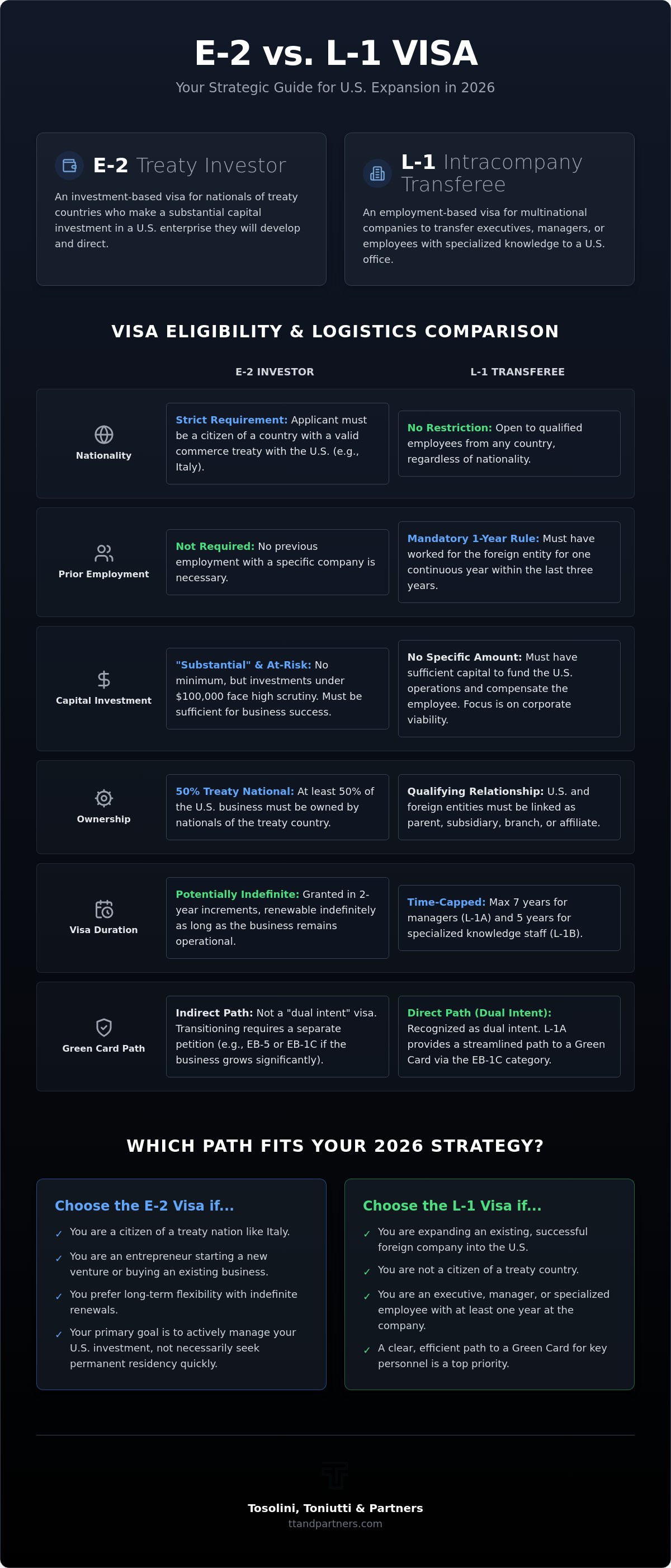
Selecting the optimal path for US market entry requires an appreciation for the distinct legal DNA of each category. The E-2 Investor Visa is a product of bilateral commerce treaties, rewarding citizens of specific nations who commit significant personal or corporate capital to a US enterprise. Conversely, the L-1 category is the primary tool for global corporate mobility. It's designed to transplant existing talent from a foreign entity into a US office, maintaining the continuity of leadership and specialized expertise across borders.
In 2026, the choice of E-2 vs L-1 is heavily influenced by the applicant's country of citizenship and the existing corporate structure. The "Treaty National" status acts as the primary filter for the E-2. If your country doesn't hold an active commerce treaty with the United States, the E-2 path is closed, regardless of your investment capacity. The L-1 remains agnostic to nationality, focusing instead on the strength of the corporate "umbilical cord" connecting the foreign and domestic entities.
The E-2 Framework: Investment and Control
A "substantial" investment in the 2026 market isn't defined by a static dollar amount. It's a proportionality test. While investments under $100,000 face heightened scrutiny, the core requirement is that the capital is sufficient to ensure the venture's success. The investment must be "at risk" and active. Passive holdings, like residential real estate, don't qualify. The marginality test further requires that the business possesses the capacity to contribute significantly to the US economy, rather than merely supporting the investor's family.
The L-1 Framework: Multinational Synergy
The L-1 path relies on a qualifying relationship between the foreign employer and the US branch, subsidiary, or affiliate. A non-negotiable prerequisite is the one-year foreign employment rule; the transferee must have worked for the foreign entity for one continuous year within the last three. Applicants must fit clearly into executive, managerial, or specialized knowledge roles. This structure ensures that the US expansion is an extension of an already successful global operation, fostering a seamless transfer of institutional intelligence.
Eligibility Comparison: Nationality, Structure, and Ownership
The eligibility landscape for an E-2 vs L-1 visa is defined by two distinct filters: the passport you hold and the formal structure of your business. While the L-1 category is accessible to any qualified executive regardless of their country of origin, the E-2 is strictly reserved for citizens of nations that maintain a specific treaty of commerce with the United States. This distinction often makes the E-2 a more personal journey for independent entrepreneurs, whereas the L-1 remains a structural maneuver for established global enterprises seeking to transplant their culture and expertise.
Ownership requirements further separate these paths. For an E-2, at least 50% of the US enterprise must be owned by individuals or companies possessing the nationality of the treaty country. In contrast, the L-1 focuses on the qualifying relationship between a foreign company and its US counterpart. This relationship must demonstrate common control, often achieved through a parent, subsidiary, or affiliate arrangement. Correctly executing LLC incorporation is the essential first step in manifesting this control within the US legal system, providing the necessary framework for both visa types.
The Treaty National Prerequisite for E-2
Italian citizens possess a historical advantage in this category, benefiting from a long-standing treaty that simplifies the cross-border investment process. However, the 2026 landscape includes stricter oversight via the AMIGOS Act. This legislation requires individuals who obtained treaty country citizenship through investment programs to be domiciled in that country for at least three continuous years before applying. If you hold dual citizenship, selecting the correct passport for your application is a strategic decision that directly impacts your long-term residency goals and processing times.
Corporate Relationship Requirements for L-1
The L-1 visa demands a robust link between the foreign entity and the new US branch. According to the USCIS L-1A Intracompany Transferee guidelines, the US office must be part of a qualifying organization that continues to operate actively in at least one other country. Proving this link involves exhaustive documentation of the foreign company’s health and the planned hierarchy of the US entity. Establishing this architecture requires professional precision to avoid common pitfalls during the initial filing. If you are uncertain about how your current corporate structure aligns with these requirements, you may wish to contact our specialists for a strategic review of your eligibility.
Strategic Logistics: Duration, Renewals, and New Office Realities
When comparing the temporal architecture of an E-2 vs L-1 visa, the most striking difference lies in the concept of finality. The E-2 category offers a sense of permanence through its indefinite renewal cycle, provided the underlying business remains active and non-marginal. In contrast, the L-1 is a finite instrument, designed for a specific corporate mission with a hard expiration date. This distinction fundamentally shapes how an executive plans their US tenure and their eventual exit or transition strategy.
The E-2 Renewal Cycle: Living in Five-Year Increments
Often described as a perpetual visa, the E-2 allows for renewals in five-year increments without a cumulative limit. This longevity depends entirely on the business’s continued vitality. By the fifth year, investors must demonstrate that the enterprise has grown beyond a mere means of support for their family, typically through job creation for US workers. If the business undergoes a strategic pivot; for instance, shifting from retail to wholesale; the investor must ensure the new model still meets the "active" investment criteria to avoid complications during the renewal interview at the consulate.
The L-1 Hard Cap: 5 or 7 Years of Corporate Utility
The L-1 path is governed by strict time limits: seven years for an L-1A Intracompany Transferee and five years for L-1B specialized knowledge staff. For those establishing a "New Office," the initial approval is restricted to a single year. This twelve-month period is a high-stakes sprint. The company must prove it has reached a level of operational maturity and staffing that justifies a manager or executive by the end of that first year. Failure to do so results in a denial of the extension, forcing a rapid cessation of US operations. Executives can recapture time spent outside the US to extend their stay, but the hard cap remains a primary driver for seeking more permanent residency options before the clock runs out.
Both categories offer a significant advantage for families: spousal work authorization. Since 2022, spouses of E and L visa holders are authorized to work "incident to status," meaning they don't need a separate employment authorization document to begin their professional journey in the US. This shared benefit provides a layer of domestic stability that is essential for long-term relocation success, allowing the family to integrate into the US economic fabric more quickly.
The Road to Permanent Residency: Green Card Transitions
The legal architecture of the L-1 visa inherently accommodates "dual intent," a critical distinction when evaluating E-2 vs L-1 pathways. This provision allows an executive to maintain their non-immigrant status while simultaneously pursuing a permanent residency application. For the E-2 holder, the path is more nuanced. While the E-2 doesn't explicitly recognize dual intent in the same way, it remains a viable platform for residency if managed with precision. The challenge lies in maintaining the intent to depart upon status expiration while an immigrant petition is pending, a delicate balance that requires a sophisticated legal strategy to ensure renewals aren't jeopardized.
The L-1A and the EB-1C Immigrant Petition
The EB-1C category represents the natural evolution of the L-1A status, often referred to as the "Golden Path" for multinational managers. Unlike many other employment-based categories, the EB-1C bypasses the rigorous PERM Labor Certification process. This exemption significantly reduces the administrative burden and timeline by removing the requirement to prove a lack of qualified US workers for the role. Strategic timing is paramount. Initiating the process after the first year of a "New Office" success allows the applicant to leverage their documented corporate achievements. Understanding the Green Card cost and timeline is essential for budgeting this transition within your 2026 business plan.
Bridging the Gap: Moving from E-2 to Permanent Status
Common misconceptions often paint the E-2 as an immigrant dead end, but this is far from the reality in 2026. Investors can transition to permanent status through several sophisticated channels, most notably the EB-2 National Interest Waiver (NIW). This path allows entrepreneurs to argue that their US business venture provides a benefit so significant to the US economy or a specific industry that the labor certification requirement should be waived. For those with extraordinary professional profiles, O-1 Visas can serve as a powerful intermediary step. This reinforces the applicant's high-caliber standing before they file an immigrant petition. If you're ready to map out your long-term US residency strategy, schedule a consultation with our immigration architects to explore your options.
The 2026 regulatory environment, including the AMIGOS Act's domicile requirements, has added layers of complexity for those using citizenship-by-investment to access treaty benefits. Navigating these hurdles requires a holistic view of your global footprint. Whether you choose the corporate-heavy L-1 path or the investor-driven E-2, the transition to a Green Card is a multi-year project that demands early planning and meticulous documentation of your business’s impact on the US market.
Decision Matrix: Which Visa Fits Your 2026 US Strategy?
The final selection between an E-2 vs L-1 visa depends on the alignment of your corporate architecture with your personal aspirations. If you're an entrepreneur from a treaty country like Italy, seeking to maintain at least 50% ownership while enjoying the flexibility of indefinite renewals, the E-2 is your most resilient tool. It rewards those who prioritize control and long-term operational autonomy without the pressure of a fixed expiration date. Conversely, the L-1 is the superior choice for those integrated into a global corporate hierarchy who view the US branch as a precursor to permanent residency. For these executives, the seven-year cap is a manageable trade-off for the streamlined EB-1C Green Card transition.
Sometimes, neither path is the perfect fit. If your business model relies on a high volume of international trade rather than a substantial capital investment, the Treaty Trader (E-1) Visa might be the more efficient alternative. This hybrid approach allows for similar benefits while focusing on the exchange of goods or services between the US and your home country. Selecting the wrong category can lead to unnecessary costs and administrative delays, making professional counsel in cross-border US-Italy legal matters indispensable for a successful 2026 expansion.
Assessing Your Long-Term Objectives
Your decision should be guided by three critical inquiries. First, evaluate if a Green Card is your ultimate objective or if you simply require a long-term platform for US operations. Second, confirm the health and scale of your foreign company; the L-1 requires a robust, active entity abroad, whereas the E-2 is more forgiving of smaller foreign footprints. Finally, consider your tolerance for administrative oversight. The L-1 involves intense USCIS scrutiny and high filing fees, such as the $2,965 premium processing cost, while the E-2 often finds a more streamlined path through consular processing.
Next Steps: Securing Your US Future
The blueprint for success in either category is a meticulously structured business plan. This document must go beyond financial projections, articulating the strategic necessity of your presence in the US market. Whether you're preparing for a high-stakes consular interview in Rome or filing a change of status within the US, the precision of your legal documentation is your greatest asset. Securing your future in the United States requires a partner who understands the nuances of cross-border US-Italy law. You can reach out to Tosolini, Toniutti & Partners for a strategic consultation to refine your 2026 relocation roadmap.
Architecting Your American Expansion
Expanding your vision into the United States in 2026 requires more than capital; it demands a sophisticated legal architecture. Whether your path leads through the treaty-based flexibility of the E-2 or the corporate-driven mobility of the L-1, your choice will define the trajectory of your business and family life. The decision regarding E-2 vs L-1 isn't merely administrative. It's a strategic commitment to your future residency goals and operational success.
At Tosolini, Toniutti & Partners, we offer decades of experience in US-Italy cross-border law, providing a specialized focus on corporate transfers and investor visas. Our team delivers comprehensive support, guiding you through every phase from initial LLC incorporation to the final acquisition of a Green Card. We believe that professional precision and a visionary approach are the keys to unlocking the potential of the US market.
If you're ready to define your path, Schedule a Strategic Visa Consultation with Our US-Italy Experts. We look forward to building your American success story together.
Frequently Asked Questions
Can I switch from an E-2 visa to an L-1 visa while in the United States?
You can transition from E-2 to L-1 status within the United States by filing a change of status petition with USCIS. This process requires you to demonstrate that you've met the one-year foreign employment prerequisite within the last three years and that a qualifying corporate relationship exists between the foreign and US entities. It's a strategic move often used by investors whose businesses have grown into multinational structures.
Does the E-2 visa allow my children to attend school in the US?
Children of E-2 visa holders are permitted to attend US schools, including both public and private institutions, until they reach the age of 21. They don't need to apply for a separate F-1 student visa, which simplifies the family's relocation and integration into the local community. Once they reach 21, they'll need to secure their own independent visa status to remain in the country.
What is the minimum investment required for an E-2 visa in 2026?
There isn't a fixed minimum dollar amount for an E-2 investment in 2026; instead, the law requires the capital to be "substantial" relative to the business type. While our research shows that applications with investments under $100,000 face heightened scrutiny, the core test remains the proportionality of the investment to the total cost of establishing or purchasing the enterprise. A well-structured business plan is essential to justify lower investment amounts.
Can a startup company qualify for an L-1 visa petition?
A startup can qualify for an L-1 visa through the "New Office" category, which is specifically designed for foreign companies expanding into the US market. The initial approval is granted for one year, during which the US entity must demonstrate sufficient growth to support a managerial or executive position. This one-year period is a critical phase where the company must prove its long-term viability to secure an extension.
Is an interview required for an L-1 visa renewal?
An interview isn't typically required if you're filing for an extension of status with USCIS while remaining inside the United States. However, if you choose to travel abroad and your visa stamp has expired, you must attend a consular interview to obtain a new stamp before re-entering the country. Consular officers will review the company’s progress and your continued eligibility during this meeting.
What happens to my E-2 status if I sell my US business?
Selling your US business terminates your E-2 status immediately because the visa is tethered to your specific investment in that enterprise. Since you no longer maintain "control" or an "active" investment in the entity for which the visa was granted, you would fall out of status. You'd need to identify an alternative visa category or depart the US shortly after the sale is finalized.
Can my spouse work for any employer on an L-2 or E-2 dependent visa?
Spouses of E-2 vs L-1 visa holders are authorized to work for any US employer "incident to status" as of 2026. This means they don't need to apply for or wait for a separate Employment Authorization Document (EAD) to begin their professional journey. Their I-94 record serves as sufficient proof of their right to work, allowing for an immediate start in the US job market.
How does the US-Italy tax treaty affect E-2 and L-1 visa holders?
The US-Italy tax treaty acts as a protective framework that prevents double taxation on income earned by individuals with interests in both countries. It provides specific "tie-breaker" rules to determine tax residency and offers relief for specific types of income, such as dividends or royalties. Navigating these provisions is vital for maintaining financial harmony while managing a cross-border business structure.


Comments