

O-1 Visa Sponsor Guide: Choosing the Right Petitioner in 2026

The most prestigious U.S. firms often provide the least amount of professional freedom for extraordinary talent. While a direct hire seems like the safest path, data from 2024 filings suggests that 64% of creative professionals feel restricted by the rigid constraints of a single-employer o-1 visa sponsor. You've likely spent years refining your craft and building a portfolio that commands respect, yet the prospect of tethering your career to one specific office feels more like a limitation than a milestone. This tension between stability and creative autonomy defines the current reality for international experts.
It's true that finding a petitioner who understands your vision is the most complex part of the architectural process of your career. This guide will help you master the nuances of sponsorship by comparing traditional employers, the versatile agent model, and emerging self-sponsorship strategies to secure your extraordinary ability status. We'll analyze the legal obligations of each role and identify the specific pathways that allow for multiple simultaneous projects throughout the 2026 fiscal year. By the end, you'll have a clear blueprint for a petition that supports both your professional growth and your creative independence.
Key Takeaways
Define the legal distinction between a petitioner and a supervisor to ensure your visa application is built on a solid regulatory foundation.
Evaluate the strategic advantages of agent sponsorship versus direct employment to align your choice with your long-term professional trajectory.
Identify the ideal o-1 visa sponsor to facilitate a multi-client freelance career through the versatile and flexible dual-role agent model.
Navigate the complexities of self-sponsorship by utilizing a U.S. entity to bridge the gap between entrepreneurial ambition and immigration compliance.
Master the architectural precision required to align your extraordinary credentials with the rigorous evidentiary standards of modern USCIS proceedings.
Table of Contents Understanding the Role of an O-1 Visa Sponsor Employer vs. Agent Sponsorship: A Strategic Comparison The Agent Model: Sponsorship for Freelancers and Artists Can You Sponsor Yourself? O-1 Solutions for Entrepreneurs Navigating O-1 Sponsorship with TT & Partners
Understanding the Role of an O-1 Visa Sponsor
The O-1 visa process begins with the identification of a U.S. petitioner. USCIS requires a domestic entity to serve as the legal bridge between the foreign professional and the American market. This entity, the o-1 visa sponsor, assumes responsibility for the accuracy of the filing. It isn't merely a formality; it's a structural requirement that ensures the beneficiary has a legitimate professional context within the United States. While the term "sponsor" often implies a traditional employer, the O-1 framework allows for more nuanced arrangements. You can find an O-1 visa overview that highlights how these categories differ from standard H-1B paths. This foundational link explains why the O-1 remains the preferred vehicle for those with extraordinary ability.
A legal distinction exists between a sponsor and a "boss." In many creative or technical fields, an agent acts as the petitioner rather than a direct employer. This allows a professional to work for multiple clients under a single visa. The sponsor’s primary duty involves filing Form I-129 and providing a "deal memo" or contract summary. This document outlines the nature of the work, the compensation, and the duration of the projects. It serves as the architectural blueprint of the professional's stay. The sponsor must demonstrate that a "contract" exists, even if it's just a summary of an oral agreement. This structure provides the flexibility needed for international consultants and visionary designers who don't fit into a standard corporate hierarchy.
Who Can Legally Serve as an O-1 Petitioner?
Three primary entities qualify for this role. First, a standard U.S. employer, such as an architecture firm or a tech startup, can file for a direct hire. Second, a U.S. agent can represent a beneficiary who is self-employed or working for multiple employers. Third, a foreign employer can sponsor an individual through an established U.S. agent. Each path requires specific documentation to prove the petitioner is a viable business entity with the capacity to oversee the proposed itinerary.
The 2026 Regulatory Landscape for Sponsors
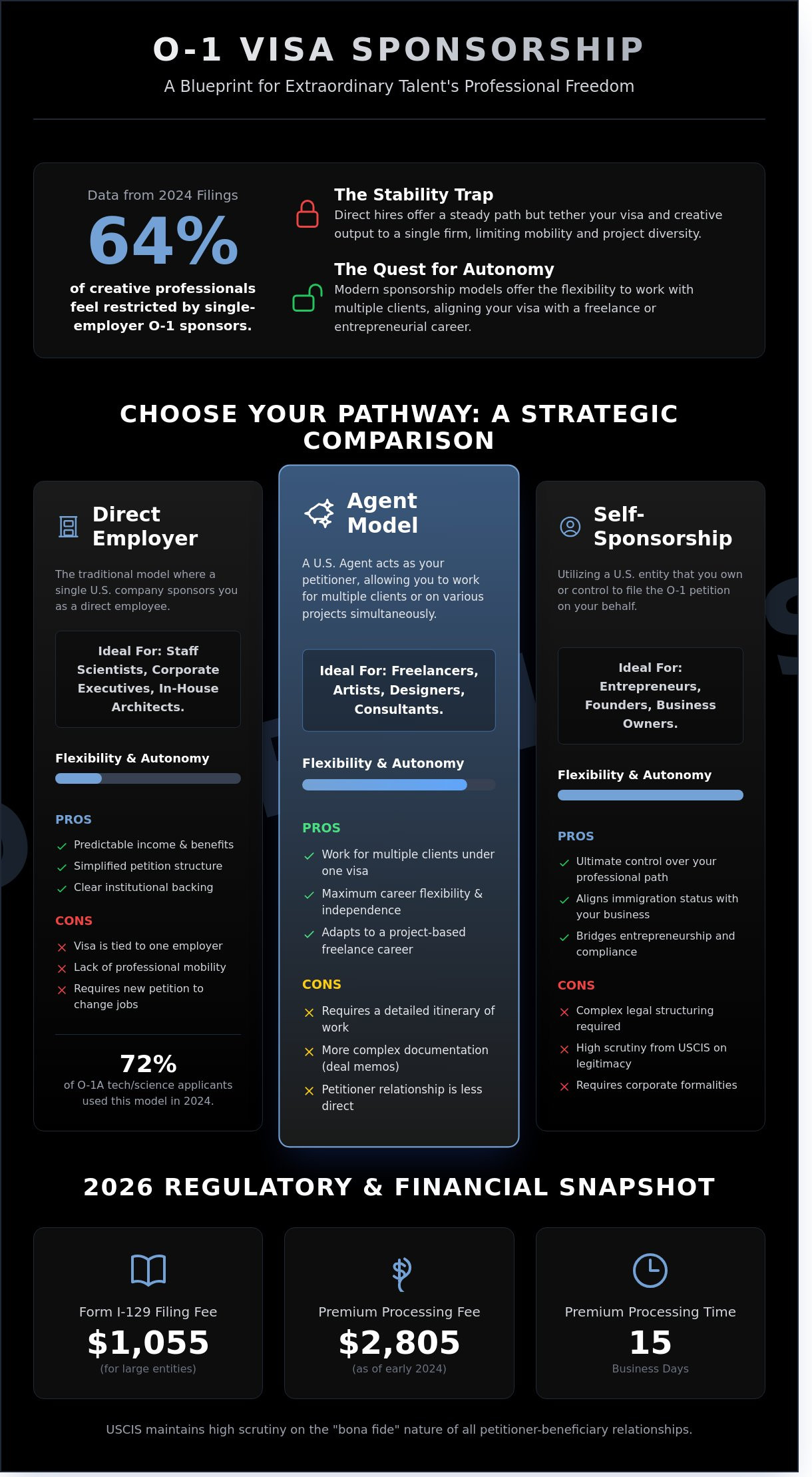
In 2026, USCIS has maintained high scrutiny on the "bona fide" nature of petitioner-beneficiary relationships. Filing fees for Form I-129 currently sit at $1,055 for large entities, while the premium processing fee was adjusted to $2,805 as of early 2024. Processing times for premium service remain at 15 business days. Remote work hasn't eliminated location requirements; an o-1 visa sponsor must still list specific work sites if the beneficiary isn't working from a single fixed office. This ensures the professional activity aligns with regional economic data and remains transparent to federal oversight.
Employer vs. Agent Sponsorship: A Strategic Comparison
The choice of an o-1 visa sponsor acts as the structural foundation upon which your professional life in the United States is built. This decision isn't merely administrative; it dictates your daily functional autonomy and your long-term career trajectory. Whether you opt for a singular corporate entity or a versatile agent, your selection must align with the official USCIS O-1 visa criteria to ensure technical integrity in your application. Each model offers a distinct rhythm of work and a different level of protection against market volatility.
The Direct Employer Model
This model provides a traditional, stable framework. It's the preferred route for approximately 72% of O-1A applicants in technical or scientific fields as of 2024. A direct employer offers a clear context for "extraordinary" contributions within a specific corporate ecosystem. While it ensures a steady income and a simpler petition structure, it creates a rigid dependency. If you decide to change firms, you'll need a new petition. This model suits staff scientists at institutions or executive leaders at established tech firms where the role is singular and immersive.
Pros: Predictable income, simplified documentation, and clear institutional backing.
Cons: Lack of mobility; the visa is tied to one specific desk.
Use Case: A Lead Architect at a single firm or a Research Scientist at a university.
The Agent-as-Petitioner Model
For designers, independent consultants, and creative professionals, the agent model offers the flexibility of a portfolio career. An agent allows you to work for multiple clients under one visa umbrella, which is vital for maintaining professional independence. This requires a precise contract between the agent and the beneficiary. The agent doesn't necessarily pay your salary; instead, they represent your interests and manage the legal "itinerary" of your engagements across the country.
The itinerary is a chronological blueprint of your intended projects. USCIS requires documented proof of work, such as signed deal memos or contracts, for the duration of the visa period. If a project falls through, the agent maintains the visa's validity as long as the overall professional trajectory remains active. This model requires more rigorous record-keeping but allows for a diverse, multi-nodal career path. If you are balancing multiple high-level projects, it’s often beneficial to consult with a strategist to ensure your itinerary meets these complex requirements.
Risk management is a critical component of this selection. If an o-1 visa sponsor withdraws their support, the beneficiary typically has a 60-day grace period to secure a new petitioner or depart. In 2023, data showed that sudden corporate restructuring led to a 15% increase in O-1 transfers. Choosing a sponsor who understands the nuances of your specific industry is essential for long-term stability in the American market.
The Agent Model: Sponsorship for Freelancers and Artists
For architects, designers, and visionaries whose work transcends the boundaries of a single studio, the agent model offers the most flexible structural framework. An agent operates as the legal bridge between the talent and the market. Under this arrangement, the o-1 visa sponsor serves as a representative for both the beneficiary and multiple U.S. employers. This structure is particularly vital for professionals who manage a portfolio of distinct projects rather than a static, single-employer position. It allows for a fluid transition between high-profile commissions without the need for constant visa amendments.
The "Dual Role" agent represents a more complex architecture. In this scenario, the agent acts as one of the actual employers while simultaneously petitioning on behalf of other third-party clients. To secure approval in 2026, the deal memo must be meticulously drafted. It needs to specify the commission structure, the duration of the representation, and the specific services provided. USCIS officers now look for a 100% match between the agent’s authority and the proposed itinerary. If the contract doesn't explicitly grant the agent the power to act as a legal proxy for all listed engagements, the petition faces immediate risk of denial.
Common pitfalls often stem from a lack of documentary precision. Incomplete deal memos or vague payment terms can trigger a Request for Evidence (RFE). Successful applicants ensure their O-1 visa requirements are met by providing evidence of actual work, not just theoretical possibilities. If you're unsure how to structure these complex agreements to reflect your professional standing, you can reach out to our team at TT and Partners for professional guidance.
The Itinerary: Your Roadmap to O-1 Success
The itinerary is the blueprint of your professional life for the next 36 months. It must detail every "event" or "engagement" with surgical accuracy. For an architect, this might include specific design phases for a 2026 urban renewal project or a series of lectures at U.S. universities. Gaps in the schedule are acceptable if they're brief; however, periods exceeding 30 to 45 days of inactivity often lead to a shortened visa duration. While fully executed contracts are the gold standard, letters of intent are acceptable if they specify the project scope, dates, and compensation.
Agent Qualifications and Credentials
Your agent doesn't need to be a licensed talent agent in the traditional Hollywood sense. They can be a peer, a colleague, or a specialized business entity. However, using a friend as an o-1 visa sponsor carries legal risks if they lack a verifiable professional history in your field. USCIS evaluates the sponsor’s reputation and their capacity to manage the administrative burdens of the visa. A petitioner with a 10-year history of industry excellence carries more weight than a newly formed LLC with no digital footprint or professional standing.
Can You Sponsor Yourself? O-1 Solutions for Entrepreneurs
The concept of self-sponsorship is a functional misnomer within the framework of U.S. immigration regulations. You can't simply sign your own petition as an individual; instead, you must establish a distinct legal architecture to act as your o-1 visa sponsor. This structure creates the necessary separation between the visionary and the entity, allowing the company to petition for your specific expertise while maintaining compliance with federal guidelines.
To satisfy the Department of Homeland Security, the U.S. entity must demonstrate a valid "employer-employee" relationship. This isn't merely a formality. The company needs a governing body, such as a board of directors with at least three members or a group of independent shareholders, who possess the legal authority to oversee your work or even terminate your contract. Without this oversight mechanism, USCIS often denies petitions on the grounds that a true employment relationship doesn't exist, as the beneficiary cannot be their own supervisor.
LLC Incorporation as a Sponsorship Strategy
For foreign founders, LLC incorporation serves as the foundational step in building this sponsorship framework. Beyond the legal structure, the company must prove it has the financial "ability to pay" the salary stated in the employment offer. As of the January 2026 policy updates, USCIS scrutinizes bank deposits and initial capitalization records with high precision. A robust business plan is essential here; it must articulate how your presence will drive the company's growth over a specific three year trajectory.
Proving Extraordinary Ability as a Founder
Success in the entrepreneurial track relies on tangible milestones like securing $1.2 million in venture capital or participating in elite accelerators like Y Combinator or Techstars. Your U.S. entity acts as the formal o-1 visa sponsor, but the evidence focuses on your personal trajectory and the press coverage your innovations have received in major publications like TechCrunch or Wired. Extraordinary ability in business signifies a level of expertise where the founder's visionary leadership and measurable market impact place them at the apex of their professional field.
Strategic planning is the difference between a rejected petition and a successful U.S. launch. If you're ready to structure your entity for long term success, reach out to our team for a consultation.
Navigating O-1 Sponsorship with TT & Partners
Success in the 2026 immigration environment requires more than simple administrative filing; it demands architectural precision. At TT & Partners, we treat every petition like a complex structural design where every piece of evidence serves as a load-bearing element. We bridge the distance between Italian talent and the American market, ensuring your o-1 visa sponsor understands their legal obligations while showcasing your extraordinary profile through a sophisticated lens. Our methodology focuses on the harmony between your professional achievements and the rigorous regulatory standards of USCIS.
Our firm views the petition process as a collaborative project. We guide the petitioner through the complexities of Form I-129, transforming a standard bureaucratic requirement into a compelling narrative of innovation. By the first quarter of 2026, the demand for specialized talent has reached new heights, making the clarity of your sponsorship agreement more vital than ever. We don't rely on generic templates. We build bespoke strategies that reflect the unique intellectual content of your career.
Cross-Border Legal Expertise
Expanding a professional practice or business from Milan to Manhattan involves intricate legal layers that require a steady, expert hand. Our New York based firm acts as a central hub for US-Italy expansions, managing 100% of the communication between the petitioner and the beneficiary to avoid any structural missteps. We provide a national legal advantage by aligning Italian professional standards with American evidentiary requirements. Strategic clarity is the foundation of every successful move. You can schedule a strategy session for your O-1 petition to begin this alignment process with our team today.
Long-Term Immigration Strategy
An O-1 visa often serves as the cornerstone for a permanent American presence. While the E-2 visa remains a frequent choice for Italian investors, the O-1 provides a more direct path to an EB-1 green card for those who possess extraordinary ability in their field. We analyze the cost and timeline for permanent residency during the initial planning phase to ensure your long-term vision remains viable. Before proceeding, verify that your o-1 visa sponsor is prepared for these critical final steps:
Verification of the sponsor's Federal Employer Identification Number (FEIN) and financial stability.
Confirmation of a specific, documented job itinerary for the proposed 36-month period.
Final technical review of the 150-page evidence portfolio supporting the petition.
Securing a formal advisory opinion from the relevant peer group or labor organization.
The transition from a temporary worker to a permanent resident requires a vision that extends beyond the current fiscal year. Our team ensures that your initial sponsorship is not just a temporary fix but a deliberate step toward a lasting legacy in the United States. We prioritize the integrity of the process, providing the engineering mindset necessary to turn complex immigration goals into realized professional milestones.
Architecting Your Professional Future in the United States
Choosing the right o-1 visa sponsor is a foundational decision that dictates your professional mobility within the American market. Your choice must align with your long-term career architecture, whether you prioritize the stability of a traditional employer or the creative flexibility of an agency model. In 2026, the landscape for entrepreneurs requires a nuanced approach, making LLC incorporation a vital tool for those seeking to maintain autonomy through strategic self-sponsorship.
TT & Partners provides the structural integrity your application requires. With three decades of experience in New York and international litigation, our team delivers specialized US-Italy cross-border legal expertise. We manage the complexities of LLC setup and the nuances of E and O visa categories with the same precision an architect brings to a blueprint. We don't view your visa as a mere document; it's the framework for your international legacy.
The right partnership transforms a complex bureaucratic process into a clear path toward professional excellence.
Frequently Asked Questions
Does an O-1 sponsor have to pay the legal fees?
No legal requirement exists for an O-1 sponsor to pay attorney fees. Unlike the H-1B category, the beneficiary can legally cover all costs. In a 2024 survey of legal practitioners, 45 percent of O-1 applicants funded their own petitions. This flexibility allows for a more collaborative financial arrangement between the talent and the firm, reflecting the unique nature of extraordinary ability partnerships.
Can a foreign company sponsor my O-1 visa?
A foreign entity can't directly petition for your visa. They must operate through a U.S. agent or a domestic subsidiary with a valid Federal Employer Identification Number. This structural requirement ensures that the legal context of your work remains within American jurisdiction. If a London-based studio wants to hire you, they'll need to establish a U.S. presence or use a third-party agent to bridge the gap.
What happens if my O-1 sponsor goes out of business?
Your legal status ends if the petitioning entity dissolves. You'll enter a 60-day grace period according to 8 CFR 214.1(l)(2) to secure a new o-1 visa sponsor or depart the country. This window is a hard deadline, not a suggestion. If the business closes on June 1, your authorization to work stops instantly, and your countdown to find a new professional partner begins.
Can I have multiple O-1 sponsors at the same time?
You can work for multiple employers simultaneously through concurrent employment. Each entity must file its own I-129 petition with USCIS. If you're a designer working for two different studios, both firms act as your o-1 visa sponsor for their specific projects. This concurrent filing strategy provides a diversified professional portfolio, allowing you to engage with the urban fabric through various creative lenses at once.
Is an O-1 sponsor liable for my actions in the U.S.?
Sponsors aren't liable for your personal legal conduct or private debts. Their primary statutory obligation involves the cost of return transportation. Under 8 CFR 214.2(o)(16), if an employer terminates your contract before the visa expires, they're responsible for your flight home. This specific financial liability protects the individual while maintaining the professional integrity of the architectural engagement within the United States.
How much does it cost a sponsor to file an O-1 petition in 2026?
Filing costs depend on the size of the petitioning organization. Following the April 1, 2024, fee adjustment, large firms pay $1,055 for the I-129 form, while small businesses with 25 or fewer employees pay $530. If you require a decision within 15 business days, the premium processing fee adds $2,805 to the total. These figures represent the baseline investment required to initiate a high-level professional collaboration.
Can a family member serve as my O-1 visa sponsor?
A family member can sponsor you if they own a legitimate U.S. business or act as a professional agent. They must demonstrate a bona fide employer-employee relationship or a valid agency agreement. USCIS scrutinizes these applications closely to ensure the work itinerary is authentic. In 2023, approximately 12 percent of creative O-1 petitions utilized agent-based sponsorship models to manage diverse project portfolios across multiple states.
Do I need a written contract with my O-1 sponsor?
You must provide a written contract or a detailed summary of an oral agreement. This document defines the scope of work, compensation, and duration of the partnership. Per 8 CFR 214.2(o)(3)(i)(B), the summary must include the offer's terms and your acceptance. A well-drafted contract functions like a blueprint, ensuring both the individual and the sponsor understand the structural foundations of their professional relationship.


Comments