

Cross-Border Inheritance Law Italy USA: A Strategic 2026 Guide
- Gianni Mendes Toniutti, Esq.

- May 1
- 13 min read
Updated: May 5
What if the legacy you built across two continents was dismantled by the 20 percent discrepancy between Italian forced heirship rules and American testamentary freedom? Managing an estate that spans the Atlantic is an exercise in structural precision. You likely feel that the weight of potential double taxation and the friction of competing legal systems threaten the equilibrium of your global assets. Understanding the nuances of cross-border inheritance law Italy USA is no longer optional for those seeking to preserve a transcontinental heritage in 2026. It's about creating a legal architecture that respects both the historical context of Italian succession and the functional requirements of US probate.
You recognize that a successful transition requires more than just a will; it demands a visionary strategy that harmonizes two distinct legal landscapes. We'll show you how to design a bulletproof estate plan that minimizes tax exposure and bypasses the 12 month average delay often found in Italian probate proceedings. This strategic guide explores the essential 2026 updates regarding jurisdictional precedence and the specific mechanisms used to shield your family from avoidable disputes, ensuring your global wealth remains intact for the next generation.
Key Takeaways
Understand the structural divergence between US Common Law and Italian Civil Law to ensure your testamentary intent remains paramount across both jurisdictions.
Learn to leverage the "Choice of Law" provisions within EU Regulation 650/2012 to establish a predictable legal framework for your Italian property holdings.
Discover how to navigate cross-border inheritance law Italy USA using strategic tools like trusts and LLCs to shield your legacy from forced heirship claims.
Utilize the 1955 US-Italy Estate Tax Treaty to achieve fiscal harmonization and protect your global portfolio from the risks of double taxation.
Implement a holistic execution strategy that synchronizes US probate processes with Italian notary protocols for a seamless and secure transfer of wealth.
Table of Contents The Conflict of Succession: Common Law vs. Italian Civil Law Choice of Law: Leveraging EU Regulation 650/2012 in 2026 Overcoming Forced Heirship: Protecting Your Global Legacy Tax Harmonization: The US-Italy Estate Tax Treaty Strategic Execution: Securing Assets Across the Atlantic
The Conflict of Succession: Common Law vs. Italian Civil Law
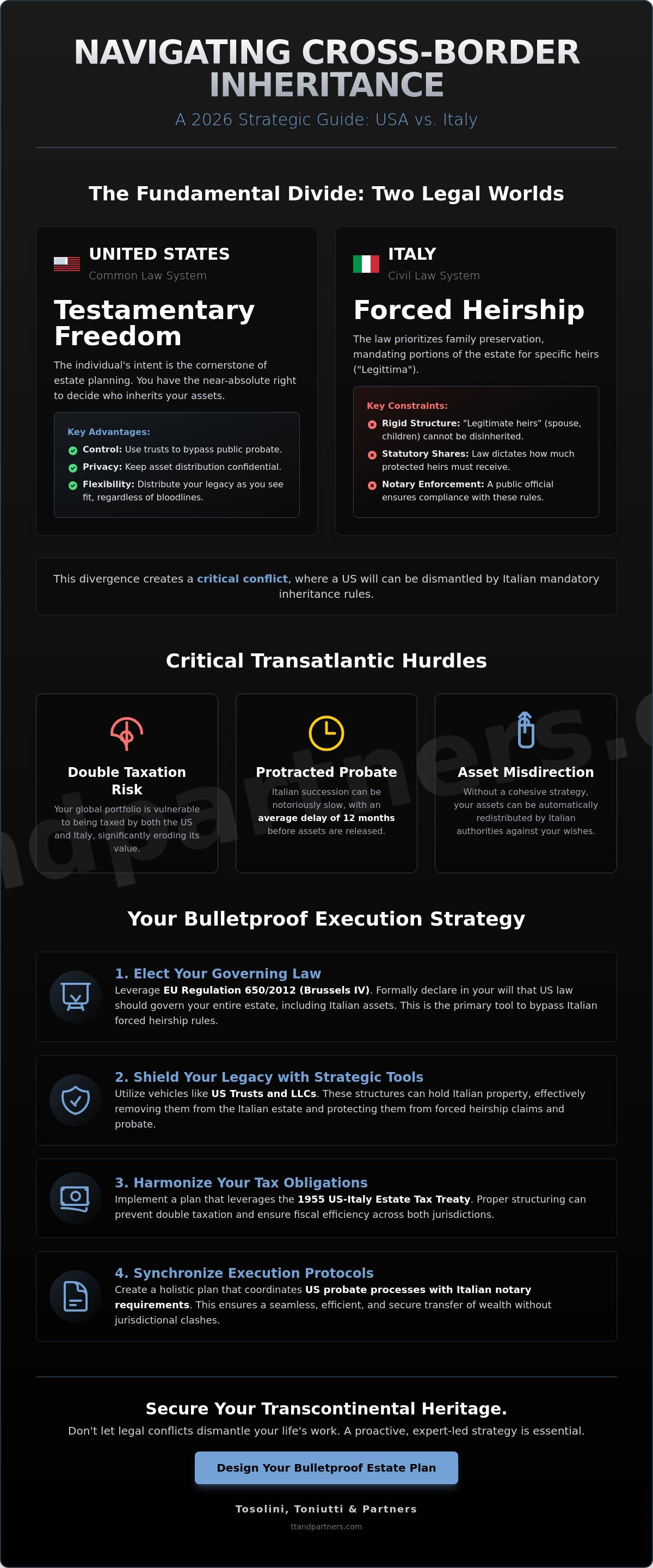
The architecture of a global estate requires the same structural integrity as a physical building; it must withstand the pressures of two distinct legal foundations. Succession law in the United States is rooted in Common Law, a system that prioritizes the individual’s intent above almost all else. In contrast, Italy follows the Civil Law tradition, where the state acts as a guardian of family lineages through rigid statutory mandates. This fundamental divergence creates a friction point for those with assets in both jurisdictions. While the American system celebrates the autonomy of the testator, the Italian system imposes a communal responsibility toward heirs.
The 2026 landscape for cross-border inheritance law Italy USA has reached a level of complexity where a simple local will is no longer a functional solution for global citizens. Whether you are coordinating assets in Europe or working with the Israel Cross Border Law Firm to manage US-Israel business and investment, specialized legal architecture is essential. The integration of digital assets, shifting residency patterns, and updated tax treaties means that a strategy designed for one country often collapses under the weight of the other’s regulations. Achieving harmony between these two systems is the only way to ensure an estate remains timeless and protected.
Testamentary Freedom in the United States
Testamentary freedom stands as the cornerstone of American estate planning, granting individuals the nearly absolute right to dictate the final destination of their assets. This flexibility allows for the use of US trusts to bypass the public probate process, providing a level of privacy and control that's often unavailable in Europe. US probate courts generally focus on the testator’s written intent, even when foreign assets are involved; however, they don't always account for the mandatory claims of overseas relatives. It's common for American planners to assume a will's validity in New York or California guarantees its enforceability in Rome, a misconception that often leads to protracted litigation. The American system is built on the premise that you own your legacy and have the right to distribute it as you see fit, regardless of family bloodlines.
The Rigid Structure of Italian Succession
The Italian Civil Code operates with a different logic, prioritizing the preservation of the family nucleus over individual preference. Central to this is the "Legittima," a legal framework of Forced Heirship that reserves specific portions of an estate for spouses, children, and in some cases, ascendants. These "legitimate heirs" cannot be disinherited through a standard will, regardless of the testator’s wishes. The Italian Notary plays a pivotal role here; they aren't merely witnesses but public officials responsible for ensuring the distribution adheres to these statutory shares. This rigid structure restricts an individual’s ability to distribute their own property, often clashing with American-style estate plans that attempt to leave assets to a single person or a charitable trust. For those managing cross-border inheritance law Italy USA, these mandates require a proactive, strategic approach to avoid the automatic redistribution of assets by Italian authorities. If you require a bespoke analysis of your international estate structure, you may reach out to our team at https://www.ttandpartners.com/contact.
Choice of Law: Leveraging EU Regulation 650/2012 in 2026
The legal framework for managing international assets requires the same structural integrity as a well-designed building. EU Regulation 650/2012, commonly known as Brussels IV, serves as the foundation for this stability. It permits non-EU citizens to designate their national law as the governing authority for their entire estate. For those navigating cross-border inheritance law Italy USA, this provision is a critical instrument for asset protection. Without a formal election, the default rule applies the law of the country where the deceased had their last habitual residence. For an American expatriate in Italy, this often triggers Italian succession laws, which include mandatory set-asides for specific relatives. However, the regulation has limits. Italian public policy, or ordre public, may override foreign law if the result is considered fundamentally incompatible with Italian legal principles, though this is rare in standard inheritance cases.
The Professional Election of Law
A successful estate plan in 2026 relies on an explicit "Choice of Law" clause. Italian courts and notaries have become increasingly strict regarding the clarity of these elections. The choice must be stated clearly within a Will or a specific codicil. Vague or implied references to foreign law are no longer sufficient to override Italian forced heirship protocols. This election allows a US citizen to apply the laws of their home state, such as New York or Florida, to their Italian property. While the US-Italy Estate Tax Treaty provides the necessary framework for avoiding double taxation, the choice of law governs the actual distribution of assets. It's a strategic move that ensures your legacy follows your intent rather than local statutory mandates. The distinction between residency and nationality is pivotal here; your nationality grants the right to choose the law, regardless of where you reside at the time of death.
The European Certificate of Succession (ECS)
Managing the complexities of cross-border inheritance law Italy USA often involves the use of the European Certificate of Succession (ECS). The ECS functions as a standardized legal document designed to fast-track the recognition of heirs across EU borders. It bridges the gap between US probate processes and the Italian land registry. When a US citizen elects their national law, the ECS confirms this choice to Italian authorities, preventing the "renvoi" trap. This trap occurs when a legal system refers a case back and forth between jurisdictions without resolution. By 2026, the integration between US letters testamentary and the ECS has improved, yet the process requires careful coordination between legal experts in both countries. This technical harmony is essential for the seamless transition of property. If you're looking to integrate these legal structures into your broader asset strategy, reaching out for a professional consultation can provide the necessary clarity for your 2026 planning.
Overcoming Forced Heirship: Protecting Your Global Legacy
The most common anxiety for US investors holding Italian assets is the loss of testamentary control. Italian law enforces a system of "legittima," where specific family members are guaranteed a fixed portion of the estate. You can't simply disinherit a child or spouse as you might in many US states. This rigid framework acts as an architectural constraint on a legacy that should be fluid and personal. To manage this, practitioners rely on EU Regulation 650/2012. This regulation allows non-EU nationals to elect the law of their citizenship to govern their entire estate. This choice of law is the foundational pillar of modern cross-border inheritance law Italy USA, effectively allowing a US citizen to bypass Italian forced heirship rules if their will is drafted with precision.
Italian courts also utilize a concept known as "Collazione." This rule treats significant lifetime gifts as advancements on an inheritance. If you gifted a New York condo to one child in 2018, that value is mathematically added back into your Italian estate calculation upon your passing. This "reconstitution" ensures no forced heir is deprived of their mandatory share. For a New York estate plan to survive an Italian probate process, every gift and transfer must be mapped with the same technical accuracy one would use for a structural blueprint. Without this foresight, an Italian villa could be tied up in claims for years.
Trusts in the Italian Legal System
Italy doesn't have a domestic trust law, yet it recognizes foreign trusts via the Hague Convention of July 1, 1992. By 2026, the "internal trust" has become a sophisticated tool for managing Italian assets under foreign law. Many clients utilize LLC incorporation to wrap Italian real estate in a US corporate shell. This strategy shifts the asset from "real property" to "membership interests," which can move the probate process away from Italian courts and toward more flexible US jurisdictions. It's a method of creating a protective envelope around a legacy, ensuring the owner's vision remains intact across borders.
Defensive Planning Against Legittima Claims
Strategic defense begins with identifying every potential claimant under the Italian Civil Code before a conflict arises. Heirs have a 10-year statute of limitations from the date of death to file an "azione di riduzione" to reclaim their forced share. This decade-long window of uncertainty requires proactive measures. When disputes become unavoidable, international litigation serves as the final mechanism to resolve heirship conflicts. We emphasize a pre-emptive approach. Documenting intent and the choice of law clearly in both US and Italian wills minimizes the grounds for future challenges. It's about building a legal structure that is as durable as it is elegant.
Tax Harmonization: The US-Italy Estate Tax Treaty
The 1955 US-Italy Estate Tax Treaty functions as a structural framework to prevent double taxation. It's the cornerstone of cross-border inheritance law Italy USA. The treaty defines the "situs" or location of assets to determine which nation holds primary taxing rights. Real estate is taxed where it's physically located. Intangible assets like corporate bonds or bank accounts generally follow the residency of the deceased. This clarity prevents the erosion of family wealth through overlapping jurisdictional claims.
To mitigate heavy tax burdens, the treaty utilizes foreign tax credits. If an estate pays tax in Italy on assets also subject to US federal estate tax, the US allows a credit for the Italian portion. This mechanism ensures that the total tax paid doesn't exceed the higher of the two countries' rates. It requires meticulous documentation and an understanding of the 1955 treaty's specific articles. Accuracy in these filings preserves the integrity of the total estate.
Inheritance Tax Rates in Italy
Italy applies a tiered tax system based on the proximity of the relationship. Spouses and direct descendants benefit from a 1 million Euro exemption per heir, with a 4% rate on the excess. Siblings have a 100,000 Euro exemption and a 6% rate. For more distant relatives or unrelated parties, the rate reaches 8% with no exemption. Italian inheritance tax is often lower than US federal rates but requires precise filing. For residents, Italy taxes global assets, while non-residents are only taxed on assets situated within Italian borders.
US Federal Estate Tax for Non-Residents
Non-resident Italians with US assets face a strict 60,000 USD exemption threshold. This low limit can expose even modest US holdings to a 40% federal tax rate. The treaty provides relief by allowing qualified Italian residents to claim a pro-rata portion of the unified credit available to US citizens. Beyond estate taxes, US beneficiaries inheriting Italian assets must comply with FBAR and FATCA reporting. These rules require disclosing foreign bank accounts if the total value exceeds 10,000 USD at any point during the year.
Heirs selling US real property must also account for the Foreign Investment in Real Property Tax Act of 1980. This law mandates a 15% withholding on the gross sales price. It's a compliance measure rather than a final tax liability, but it impacts immediate liquidity during the settlement process. Managing these overlapping regulations is an integral part of cross-border inheritance law Italy USA. Precision is required here.
Strategic planning ensures your legacy remains intact across borders. For professional guidance on international estate structures, contact our legal experts today.
Strategic Execution: Securing Assets Across the Atlantic
Managing assets across two continents isn't a task for a single document; it's a structural challenge that requires architectural precision. To master cross-border inheritance law Italy USA, you need a blueprint that accounts for both the Italian Civil Code and the specific probate laws of US states. A holistic approach ensures that the transfer of real estate in Tuscany and investment portfolios in New York doesn't lead to a decade of litigation. This coordination requires a simultaneous dialogue with Italian Notaries and US Probate Attorneys to align timelines and tax obligations.
The Dual-Will Strategy
Drafting separate wills is usually the safest path for high-net-worth individuals with global footprints. An Italian will, executed before a notary, handles local assets with the precision required by the 2012 EU Succession Regulation. Simultaneously, a US will manages domestic interests. These documents must act as mirrors. They shouldn't overlap or accidentally revoke each other through broad "revocation of all prior wills" clauses. Bilingual legal oversight eliminates the risk of linguistic ambiguity. A single mistranslated term in a 2026 estate plan could trigger unforeseen tax liabilities or forced heirship claims that contradict your original intent.
Partnering for Longevity
TT and Partners functions as the bridge between these two distinct legal cultures. We don't view estate planning as a one-time transaction; it's a long-term partnership built on vision and context. Our method applies the same rigor to legal structures that we apply to complex architectural design. We look at the urban fabric of your life, connecting the dots between Italian tax residency and US estate tax exemptions. This visionary planning creates legal durability for your cross-border portfolio. Italian probate typically takes 6 to 12 months to finalize, while US probate timelines vary by state. Synchronizing these processes ensures liquidity is available when it's needed most.
As we approach 2026, the global regulatory environment is shifting toward greater transparency and automated data exchange. It's time to review your assets to ensure they're protected against future volatility. You can contact us for a strategic evaluation of your cross-border estate to begin this essential process. Our team focuses on the harmony between functionality and law, ensuring your legacy remains intact across every border you've crossed. We believe in building structures that last for generations, whether they're made of stone or legal statutes.
Architecting a Resilient Transatlantic Succession Strategy
Navigating cross-border inheritance law Italy USA requires more than just a passing knowledge of two legal systems; it demands a precise architectural approach to asset protection. By leveraging the choice of law provisions in EU Regulation 650/2012, you can effectively bypass rigid forced heirship rules that often disrupt long-term succession plans. The 1956 US-Italy Estate Tax Treaty provides the necessary framework to prevent double taxation, but its application depends on meticulous documentation and timing. It's not just about drafting a document. It's about building a durable structure that respects both New York statutes and the Italian Civil Code.
Our team brings decades of experience in international litigation to every case. We provide dual-jurisdiction expertise in both New York and Italian law, focusing specifically on high-net-worth individuals who require sophisticated asset protection strategies. We don't just react to legal changes; we anticipate them to ensure your global footprint remains intact. Your legacy deserves a strategy that's as enduring as the assets you've spent a lifetime acquiring.
Schedule a strategic consultation with our cross-border legal experts at ttandpartners.com to begin your planning process today. We're ready to help you navigate these complexities with confidence and precision.
Frequently Asked Questions
Is a US will valid in Italy for inheriting real estate?
A US will is legally valid in Italy for real estate transfers as long as it adheres to the formal requirements of the 1961 Hague Convention. Italian authorities accept foreign testamentary documents under Law 218/1995, provided they're authenticated with an apostille and translated by a certified professional. This architectural approach to legal documentation ensures that your intent remains structural and intact across borders.
Can I disinherit a child in my Italian estate plan if I am a US citizen?
You can't typically disinherit a child under Italian law because Article 536 of the Italian Civil Code mandates a reserved share for direct descendants. This forced heirship principle allocates between 50% and 75% of the estate to protected heirs. However, US citizens can bypass these constraints by explicitly electing US law in their will under EU Regulation 650/2012. This strategic choice provides the flexibility to distribute assets according to personal vision rather than statutory mandates.
How much is the inheritance tax in Italy for US-based heirs in 2026?
Italian inheritance tax for US-based heirs in 2026 remains governed by Legislative Decree 346/1990, featuring some of the lowest rates in the European Union. Direct descendants and spouses pay 4% on amounts exceeding a 1 million Euro threshold per heir. Siblings face a 6% rate after a 100,000 Euro exemption. All other heirs are taxed at a flat 8% without an allowance. These precise figures allow for rigorous financial modeling of your cross-border inheritance law Italy USA strategy.
What happens if an Italian citizen dies in the US without a will?
If an Italian citizen dies in the US without a will, the distribution of their estate follows the rules of intestate succession defined by their last habitual residence under EU Regulation 650/2012. This often means US state law governs movable assets like bank accounts, while Italian real estate remains subject to the Italian Civil Code. Without a clear testamentary structure, the process loses its intentionality and defaults to rigid statutory frameworks.
How does the US-Italy tax treaty prevent double taxation on inheritance?
The 1954 Estate Tax Treaty prevents double taxation by allowing heirs to claim a tax credit in one country for taxes already paid in the other. This bilateral agreement ensures that the same asset isn't depleted by dual levies from the IRS and the Agenzia delle Entrate. It functions as a financial bridge, maintaining the integrity of the estate's value across the Atlantic. By applying these treaty benefits, you ensure the long-term sustainability of the family's wealth.
What is the Choice of Law clause and why is it important for dual citizens?
The Choice of Law clause is a provision under EU Regulation 650/2012 that lets dual citizens designate their national law to govern their entire estate. This is vital for US-Italy successions because it allows you to opt out of Italy's forced heirship rules. By choosing US law, you gain the freedom to design a distribution plan that reflects your specific values. It's the cornerstone of a sophisticated cross-border inheritance law Italy USA plan.
Do I need an Italian lawyer to handle probate for property in Italy?
You'll need a specialized professional to manage the Dichiarazione di Successione, which must be filed with the Italian Revenue Agency within 12 months of death. While not strictly mandated by every statute, the complexity of aligning Italian land registry records with US probate documents requires expert precision. A lawyer ensures that the legal transfer of property is seamless and avoids future title defects. This professional oversight acts as a quality control mechanism for your legacy.
How long does the cross-border inheritance process typically take between the US and Italy?
A typical cross-border inheritance process between the US and Italy spans 6 to 18 months. This timeline accounts for the 12-month deadline for the Italian tax declaration and the time needed to obtain apostilles from US Secretary of State offices. Delays often stem from the meticulous translation of documents and the synchronization of two different legal systems. Planning with this duration in mind allows for a more composed and predictable transition of assets.


Comments