

E-2 Visa for Italian Citizens: The 2026 Strategic Guide for Treaty Investors
- Gianni Mendes Toniutti, Esq.

- Apr 30
- 12 min read
What if the most critical element of your U.S. market entry isn't the business model itself, but the structural integrity of your legal application? Many investors find that securing an E2 visa for Italian citizens involves a level of complexity that mirrors a high-end architectural project. You're likely aware that the ambiguity of substantial investment and the rigorous documentation of Italian financial sources can create significant friction during the process. It's a challenge that requires both a visionary outlook and a meticulous attention to technical detail.
Our 2026 strategic guide clarifies these uncertainties by providing a clear blueprint for the Rome Consular interview and the capital requirements mandated by current treaty standards. We'll show you how to construct a compliant U.S. business structure that offers long-term stability for your family and your enterprise. By the end of this article, you'll possess the insights needed to transform a complex regulatory hurdle into a foundation for your American legacy.
Key Takeaways
Understand how the 1851 Treaty of Commerce and Navigation establishes a unique legal framework for Italian nationals to secure long-term investor status.
Learn to apply the proportionality test to determine the ideal investment threshold for an E2 visa for Italian citizens, tailored to your specific business model.
Identify the critical requirements for "at risk" capital and the precise documentation needed to trace funds from Italian banks to U.S. entities.
Navigate the 2026 E-Visa Navigator protocols at the U.S. Embassy in Rome to ensure a seamless digital submission and interview process.
Explore the strategic advantage of aligning visa planning with corporate incorporation and tax architecture for a holistic approach to U.S. expansion.
Table of Contents The US-Italy Treaty Framework: Eligibility for Italian Investors in 2026 Decoding the 'Substantial Investment' Requirement for Italian Applicants Source of Funds and the 'At Risk' Capital Doctrine The Consular Process in Rome: Navigating the E-Visa Navigator Strategic Architecture: Why Italian National Entrepreneurs Partner with TT and Partners
The US-Italy Treaty Framework: Eligibility for Italian Investors in 2026
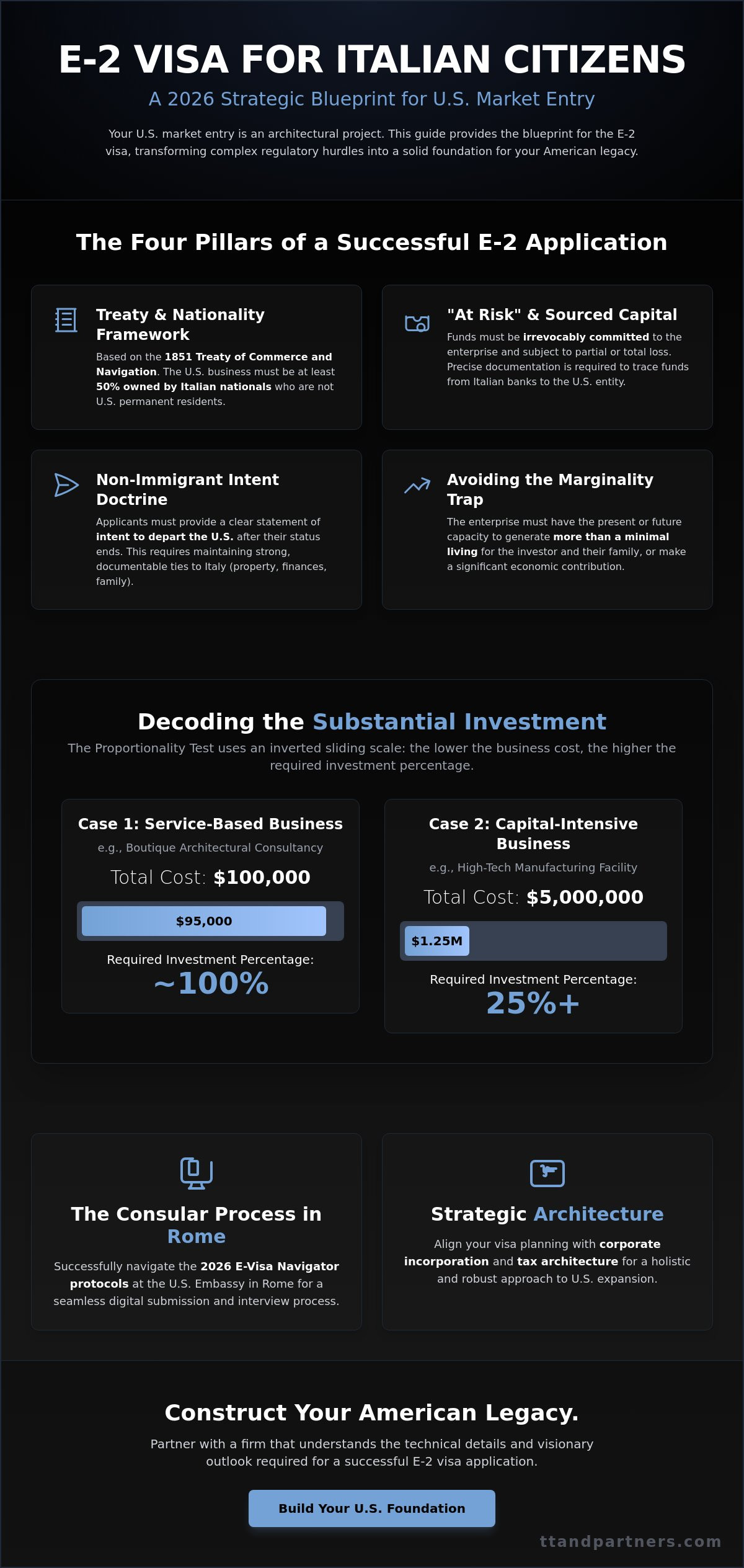
The architectural foundation of the E2 visa for Italian citizens is built upon the Treaty of Commerce and Navigation signed on February 26, 1851. This historical agreement secures a privileged position for Italian investors, allowing them to shape the US economic landscape through strategic capital placement. In 2026, the framework remains a testament to the enduring partnership between the two nations, requiring a balance of technical precision and visionary intent.
Success in 2026 requires more than just capital; it demands a structural alignment with treaty standards. The E-2 Investor Visa serves as the primary vehicle for this transatlantic expansion. Investors must navigate the complexities of Treaty National status, a designation that applies to both individual entrepreneurs and corporate entities looking to establish a robust presence in the American market.
Nationality and Ownership Requirements
Establishing the Italian character of a US enterprise is a fundamental step. The business structure must prove at least 50% ownership by Italian nationals who aren't US permanent residents. For larger Italian corporations, this allows for the sponsorship of executive or specialist employees who share the same nationality. Guidelines updated as of January 2026 clarify that dual US-Italian citizens cannot qualify for E-2 status, as their US citizenship takes precedence in the eyes of USCIS. This distinction is vital for families with multi-generational ties across both borders.
The Non-Immigrant Intent Doctrine
The E-2 visa is strictly a non-immigrant classification. Applicants must provide a clear statement of intent to depart the US once their status expires or the investment concludes. While the visa allows for indefinite renewals, it doesn't possess the dual intent found in the O-1 visa category. According to 2026 consular standards, O-1 holders can actively pursue a Green Card without jeopardizing their status, whereas E-2 investors must maintain strong ties to their Italian residency. This often involves documenting property ownership, financial accounts, or deep-rooted family connections within the Italian urban fabric.
Strategic planning ensures that the investor's presence in the US remains focused on operational growth and innovation. If you need a tailored assessment of your corporate structure, you can reach out through our contact page to discuss your specific context. Maintaining this balance between long-term US expansion and Italian national identity is the hallmark of a successful 2026 application.
Decoding the 'Substantial Investment' Requirement for Italian Applicants
The legal architecture of the E2 visa for Italian citizens doesn't mandate a rigid, numerical floor for capital entry. Instead, the regulatory environment in 2026 emphasizes a qualitative "Proportionality Test." This mechanism weighs the investment against the total purchase price of an existing business or the cost of establishing a new one from the ground up. Under the US-Italy Treaty Framework, adjudicators look for a commitment of funds that ensures the investor's dedication to the success of the enterprise. This approach treats capital not just as a fee, but as the structural foundation of the business venture.
The Proportionality Test in Practice
The logic follows an inverted sliding scale. If a business costs $100,000 to establish, an investor should contribute nearly 100% of that value. For a capital-intensive manufacturing plant costing $5,000,000, a 25% investment might suffice to meet the requirement. A $100,000 investment often succeeds for a boutique architectural consultancy because it covers the entirety of its operational needs; however, that same amount would likely fail for a high-tech manufacturing facility requiring heavy machinery. According to the 2026 Foreign Affairs Manual, substantiality is defined as an amount sufficient to ensure the treaty investor's financial commitment to the successful operation of the enterprise.
Avoiding the Marginality Trap
Financial sustainability remains a vital pillar of a successful application. An enterprise is considered marginal if it lacks the present or future capacity to generate more than a minimal living for the investor and their family. To bypass this hurdle, Italian applicants must present a five-year business plan that projects the hiring of at least two to three full-time U.S. workers by the end of year two. Precision in financial modeling is vital. You'll need to demonstrate how the Italian capital infusion stimulates the local U.S. market through tax contributions and job creation. Consider these factors for your projections:
Detailed payroll schedules for U.S. employees starting from the first 12 months.
Market analysis showing the demand for Italian-driven innovation in the specific U.S. region.
Evidence that the business can support its own growth without relying on the investor's personal savings.
Strategically, 2026 has introduced a "vetted company" list for Italian enterprises. This list streamlines the process for established brands expanding into the U.S. market, reducing the burden of proving substantiality if the parent company meets specific revenue benchmarks. If your project requires this level of structural planning, you can consult with our strategic partners to refine your business model. Ensuring your E2 visa for Italian citizens application aligns with these shifting standards is the difference between a rejected file and a successful expansion.
Source of Funds and the 'At Risk' Capital Doctrine
The E2 visa for Italian citizens requires more than a mere demonstration of wealth; it demands an irrevocable commitment of capital. Under the "at risk" doctrine, the investor must place their funds in jeopardy, meaning the capital must be subject to partial or total loss if the business fails. You can't simply hold 100,000 USD in a savings account and claim it as an investment. The US Citizenship and Immigration Services (USCIS) and Department of State officials look for evidence that the money is already active in the US market. This involves signed contracts, purchase orders, or funds transferred into a corporate account specifically for business operations.
Tracing the path of these funds is a structural necessity. For an Italian citizen, this usually begins with a transfer from a personal account at a domestic institution like Intesa Sanpaolo or UniCredit to a US based business or escrow account. Every Euro must be accounted for. If you're using proceeds from a property sale in Milan or Rome, you'll need the "rogito" (deed of sale) and bank statements showing the deposit and subsequent transfer. Transparency is the foundation of a successful application.
Loans present a specific hurdle. Only personal loans secured by your own assets, like a second home or a private portfolio, qualify. Unsecured loans or debt secured by the assets of the E-2 enterprise itself are strictly prohibited. The logic is simple: the investor, not the business, must bear the financial risk. If the business defaults, the investor's personal assets must be on the line.
Documenting Italian Financial Transactions
Italian "donazioni" (gifts) require precise documentation to satisfy US authorities. If a family member provides the capital, you must prove the donor's lawful source of those funds. This includes the donor's tax returns or employment records. Under Italian Legislative Decree 346/1990, gift taxes apply at rates of 4%, 6%, or 8% depending on the relationship. Evidence of these tax payments adds a layer of credibility. Additionally, every Italian document, from bank certificates to property contracts, must have a certified English translation that meets the standards of 8 CFR § 103.2(b)(3).
Structuring 'At Risk' Capital
To protect your capital while meeting the "at risk" requirement, you can utilize escrow agreements. These contracts ensure funds are only released to the seller or landlord once the E2 visa for Italian citizens is approved. This satisfies the legal requirement of commitment without leaving the investor vulnerable. Purchasing tangible assets like machinery or signing a commercial lease also counts as committed capital. For a strategic review of your financial structure, you can reach out through our contact page to ensure your investment meets these rigorous standards.
The Consular Process in Rome: Navigating the E-Visa Navigator
The journey toward securing an E2 visa for Italian citizens culminates at the U.S. Embassy in Rome. This is where the transition from business planning to legal reality occurs. Success depends on navigating the E-Visa Navigator, a digital submission system that demands the same structural integrity as a complex architectural blueprint. Applicants must first complete the DS-160 form and register through the official visa service portal. By January 2026, the Rome Consulate fully integrated this streamlined electronic queue, requiring all documentation to be submitted and vetted via the Navigator before an interview slot is even offered.
The Electronic Submission Architecture
Rome enforces a rigorous 70-page limit for the primary E-2 binder. This constraint isn't a suggestion; it's a hard limit. If your file exceeds 20MB or fails to follow the Tab A through Tab G formatting, the system often rejects the upload. The table of contents must be hyperlinked for ease of use. Tab E focuses on the investment itself, while Tab G addresses marginality, proving the business will do more than just support the investor's family. A common trigger for a Request for Evidence (RFE) in the 2026 digital queue is the failure to provide a clear nexus between the Italian parent company and the U.S. entity. Precision in these digital files prevents months of unnecessary delays.
Tab A: Table of Contents and Cover Letter.
Tab D: Proof of Italian Nationality and Ownership.
Tab F: Evidence that the business is currently real and operating.
Mastering the Consular Interview
The interview in Rome is a technical defense of your business vision. Adjudicators focus heavily on the "develop and direct" requirement. They want to ensure the applicant possesses the actual authority to lead the enterprise. You'll need to articulate how your professional background in Italy translates to the specific demands of the American market. It's common for officers to ask about the source of funds, looking for a clear, documented path from an Italian bank to the U.S. business account. Don't be surprised by questions regarding your five-year hiring plan.
As of early 2026, processing times for E-2 reviews in Rome average 45 to 60 days from the initial submission to the interview notification. This timeline requires strategic planning to align with business launch dates. Upon approval, an E2 visa for Italian citizens typically grants a 5-year reciprocity period. This is the maximum duration allowed under current treaty agreements, providing a stable foundation for long-term growth. This five-year window allows for significant operational expansion without the immediate pressure of renewal. If you're ready to build your U.S. presence with professional precision, contact our team for a strategic consultation.
Strategic Architecture: Why Italian National Entrepreneurs Partner with TT and Partners
Success in the American market requires a foundation as solid as the buildings we admire. For an E2 visa for Italian citizens, the application isn't a standalone document; it's a structural component of a larger business vision. TT and Partners operates with a dual-border presence that eliminates the friction typical of international expansion. We don't just process forms. We design the legal framework that supports your investment from the first wire transfer to the final certificate of occupancy. Our approach treats legal strategy as a form of architecture, where every clause and filing serves a functional purpose in your commercial landscape.
Integration of visa strategy with corporate governance.
Direct management of US real estate closings to satisfy "at risk" investment requirements.
Coordinated tax planning between US and Italian jurisdictions.
Long-term mapping from non-immigrant status to potential Green Card pathways.
Cross-Border Synergy
Our team synchronizes your US objectives with your Italian obligations. We coordinate directly with your Italian accountants to ensure global tax compliance doesn't become a liability. This involves precise LLC Incorporation for Foreign Investors, where the entity structure reflects both US liability protection and Italian fiscal requirements. By managing US real estate closings internally, we ensure your physical investment meets the strict evidentiary standards of the 1881 Treaty of Commerce and Navigation, updated for the 2026 regulatory environment. We act as the bridge between two distinct legal cultures, ensuring nothing is lost in translation.
Beyond the Visa: Building a US Legacy
An E2 visa for Italian citizens provides more than a right to work; it establishes a family's future in a new urban context. We secure derivative status for spouses, granting them open work authorization, and ensure children under 21 can access the American educational system. Our support extends into the operational phase of your enterprise. We provide strategic planning for International Litigation to protect your trade interests if disputes arise. As your business matures, we analyze your growth to identify transition points for permanent residency. We view the E-2 as the first phase of a multi-generational project. Contact us today for a strategic consultation to begin building your US legacy.
Building Your American Legacy: The 2026 Roadmap for Italian Capital
Securing an E2 visa for Italian citizens in 2026 requires a level of structural precision that mirrors a high-end architectural commission. Success depends on navigating the U.S. Consulate in Rome's specific expectations regarding substantial investment and the at-risk nature of capital. We've found that the most resilient applications are those where the business plan serves as a blueprint for long-term growth and local integration. TT and Partners provides the specialized US-Italy cross-border legal expertise needed to bridge these two distinct markets. Our team delivers comprehensive support for LLC formation and real estate acquisition, ensuring your corporate structure is as robust as your physical assets. We've established a proven track record with the U.S. Consulate in Rome by focusing on the intellectual content and technical accuracy of every filing. Your vision deserves a foundation built on professional confidence and meticulous planning.
The journey toward American expansion is a transformative process, and we're ready to help you design that future today.
Frequently Asked Questions
Is there a minimum investment amount for an E-2 visa for Italian citizens?
There's no fixed statutory minimum investment for an E2 visa for Italian citizens under current U.S. regulations. Most practitioners recommend a capital commitment of at least $100,000 to demonstrate the investment is substantial. This amount must be sufficient to ensure the successful operation of the enterprise within its specific industry context, reflecting a genuine commitment to the American market and its economic growth.
Can I buy a franchise in the US to qualify for the E-2 visa?
You can definitely purchase a franchise to qualify for the E-2 visa. Franchises provide a proven operational framework and established brand identity, which often streamlines the business plan approval process. This path allows investors to leverage existing structural systems while fulfilling the requirement for an active, non-marginal business. It's a strategic choice for those seeking a predictable entry into the U.S. economy.
Does the E-2 visa lead to a Green Card for Italians?
The E-2 visa doesn't lead directly to a Green Card because it's classified as a non-immigrant category. Investors seeking permanent residency typically transition to other paths like the EB-5 immigrant investor program or employment-based categories such as EB-2 or EB-3. You'll need a separate legal strategy to bridge the gap between temporary status and permanent residency while maintaining your business's functionality and compliance.
How long can an Italian citizen stay in the US on an E-2 visa?
Italian citizens can typically stay in the U.S. for up to 24 months on a single entry. While the E2 visa for Italian citizens is often issued for a 60-month validity period based on current reciprocity, the duration of legal status is granted at the border. You can extend your stay indefinitely as long as the business remains operational and continues to meet all regulatory requirements.
Can my spouse work in the US if I have an E-2 visa?
Your spouse is legally permitted to work anywhere in the United States under their E-2S status. They don't need to apply for a separate work permit because their authorization is incidental to their status. This flexibility allows your family to integrate into the professional fabric of your new community while you manage the primary investment. It's a significant benefit for maintaining household stability during your residency.
What happens if my E-2 visa business fails?
If your business fails, your E-2 status becomes invalid, and you must depart the United States. You're generally granted a 60-day grace period to wind down operations or apply for a different visa category. It's vital to monitor the financial health of your enterprise to avoid sudden lapses in your legal residency status. A resilient business model is essential for long-term visa security and professional success.
Do I need to have a physical office in the US before applying?
You must have a physical office or commercial space secured before you submit your application. Consular officers at the U.S. Embassy in Rome rarely approve visas for businesses operating solely from residential addresses or virtual offices. A signed commercial lease provides the necessary proof that your investment is real, active, and ready for operations. This physical presence demonstrates your commitment to the local urban and economic environment.
How long does the E-2 visa interview in Rome take?
The interview at the U.S. Embassy in Rome typically lasts between 15 and 20 minutes. You should plan to spend approximately 3 hours at the facility to account for security screenings and administrative processing. Officers focus their questions on your professional background, the source of your funds, and the business's projected growth. Preparation is key to navigating this final stage of the strategic investment process successfully.


Comments