

O-1 Visa Sponsor Requirements: The Complete 2026 Guide for Employers and Agents
- Gianni Mendes Toniutti, Esq.
- 6 hours ago
- 12 min read
The success of an O-1 petition often rests less on the brilliance of the talent and more on the structural integrity of the sponsorship itself. While the beneficiary's accolades provide the foundation, the petitioner's ability to navigate the specific O-1 visa sponsor requirements determines whether that foundation holds under USCIS scrutiny. You likely recognize that the extraordinary ability threshold is high, yet the persistent anxiety regarding potential Requests for Evidence often stems from the technical complexities of the filing process rather than the merit of the individual.
This guide provides the architectural clarity you need to master these legal obligations for the 2026 landscape. Whether you're a corporate employer or a US-based agent, you'll gain a definitive understanding of the mandatory 02/27/26 Form I-129 edition and the strategic nuances of petitioner roles. We will outline the essential evidentiary standards and timeline milestones that transform a complex regulatory burden into a streamlined, professional achievement. This overview ensures you can choose the right petitioning strategy and meet the rigorous 2026 standards with the precision that world-class talent demands.
Table of Contents
Defining the O-1 Visa Petitioner: Employer vs. Agent
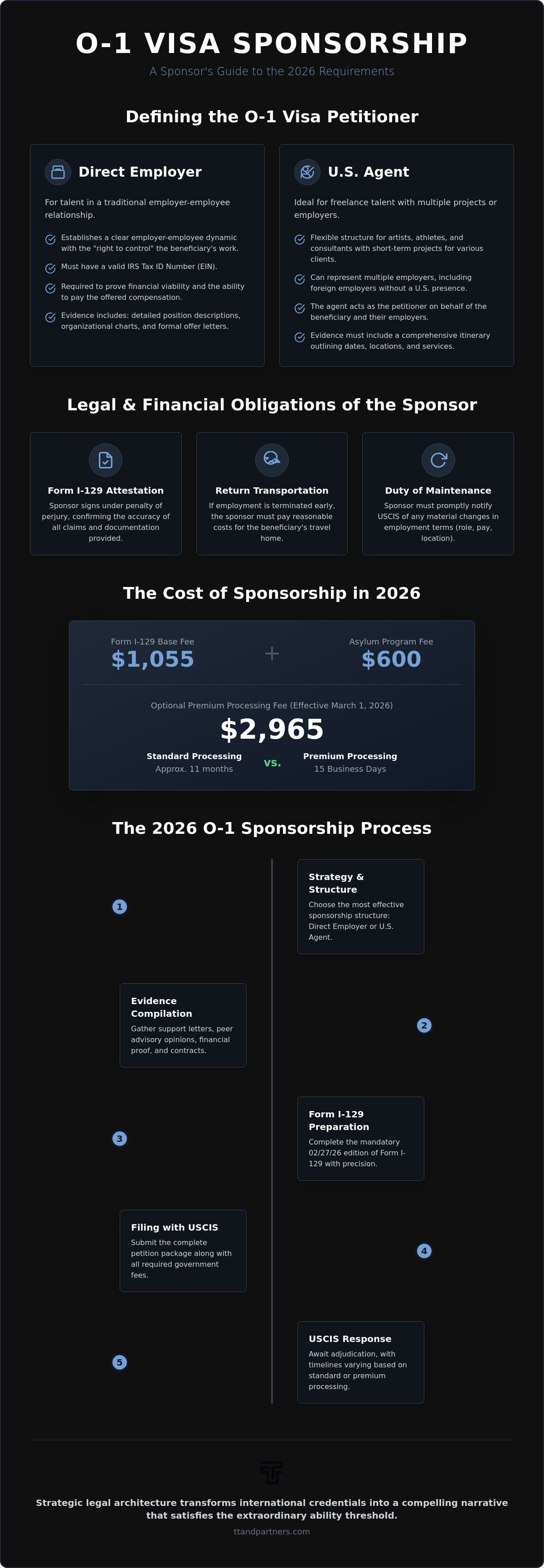
The O-1 petition process begins with a fundamental distinction: the beneficiary cannot file on their own behalf. The petitioner serves as the legal anchor for the entire application, taking responsibility for the Form I-129. While the beneficiary's talent provides the narrative foundation, the petitioner's status determines the structural integrity of the filing. A US employer must possess a valid IRS Tax ID (EIN) and extend a legitimate offer of employment. Understanding these O-1 visa sponsor requirements is essential for building a case that withstands rigorous scrutiny. For a broad O-1 visa overview, one can see the diversity of talent covered, yet the petitioner's role remains a constant regulatory pillar across all disciplines.
When to Use a US Agent as a Sponsor
Agents offer a flexible architecture for talent whose work doesn't fit the traditional 9-to-5 corporate model. This path is ideal for artists, athletes, and consultants who manage multiple short-term projects across different venues or clients. In this scenario, the agent acts as the petitioner. You must provide a comprehensive itinerary that outlines the dates and locations of the proposed services. USCIS distinguishes between an "agent performing the function of an employer" and an "agent representing multiple employers." The latter is particularly powerful because it allows a US agent to represent a foreign employer. This creates a vital bridge for international companies that lack a physical US presence but need to deploy high-level talent to the American market.
Traditional Employer Sponsorship Requirements
Traditional sponsorship relies on a clearly defined employer-employee relationship. The core of this requirement is the "right to control" the beneficiary’s work, which must be documented through precise evidence. Sponsors must provide detailed position descriptions, organizational charts, and formal offer letters that articulate this hierarchy. While the O-1 category doesn't require a prevailing wage certification like the H-1B, the petitioner must still demonstrate financial viability. You don't need to show massive profits, but you must prove the ability to pay the offered compensation. Precision in these documents is the best defense against a Request for Evidence (RFE). O-1 visa sponsor requirements demand that every claim of authority and financial capacity is backed by verifiable documentation.
Choosing between an agent and a direct employer is a strategic decision that shapes the entire immigration journey. If you're unsure which structure best serves your organizational goals or talent needs, seeking specialized guidance can prevent costly procedural delays. You can reach out for a strategic assessment through our contact page to ensure your petition's architecture is sound from the start.
Legal and Financial Obligations of the O-1 Sponsor
Sponsorship carries a weight that extends far beyond the initial filing date. When an entity signs Form I-129, it enters into a formal agreement with the US government. This attestation, signed under penalty of perjury, confirms that the claims regarding the beneficiary's extraordinary ability are accurate and documented. Beyond the paperwork, the petitioner assumes a specific financial liability known as the 'Return Transportation' rule. If you terminate the beneficiary's employment before their authorized stay expires, you're legally responsible for the reasonable costs of their travel back to their last residence outside the US. This obligation ensures that the burden of relocation doesn't fall on the individual if the professional relationship ends prematurely.
Adhering to USCIS O-1 visa requirements also involves maintaining the integrity of the employment terms. Any material change in the beneficiary's role, compensation, or work location requires prompt notification to USCIS. This duty of maintenance is continuous. Failure to report changes can jeopardize the beneficiary's status and the sponsor's future petitioning credibility. It's a partnership built on transparency and regulatory compliance.
The Cost of Sponsorship in 2026
The financial architecture of a petition includes several non-negotiable government fees. For most corporate sponsors, the base filing fee for Form I-129 is $1,055, supplemented by a $600 Asylum Program Fee. While standard processing can take approximately 11 months, many choose the efficiency of Premium Processing. As of March 1, 2026, the fee for this expedited service is $2,965. It guarantees a response within 15 business days. This investment is often necessary for projects with rigid start dates. Budgeting for these costs early prevents friction during the filing process.
Contractual Requirements for O-1 Sponsorship
A clear contractual foundation is vital. You must provide either a formal written contract or a detailed summary of an oral agreement. These documents must specify the compensation, duration of the project, and the exact nature of the work. Precision here is paramount. In the arts, a 'Deal Memo' often serves as a valid substitute for a formal contract, provided it captures the essential terms of the engagement. If you need assistance structuring these agreements to meet O-1 visa sponsor requirements, you can consult our team for a tailored review of your documentation.
The Evidentiary Burden: What the Sponsor Must Provide
The Petitioner’s Statement serves as the architectural blueprint of the entire case. It's far more than a simple cover letter; it's a sophisticated narrative that synthesizes the beneficiary’s past triumphs with their future role in the United States. This document must articulate exactly why the beneficiary's presence is vital and how their specific expertise meets the high standards set by the U.S. Citizenship and Immigration Services (USCIS). A critical yet often overlooked factor is the sponsor’s own prestige. When a petitioner is a leader in their field, their endorsement carries significant weight, effectively elevating the beneficiary’s claim to extraordinary ability through institutional association. Meeting O-1 visa sponsor requirements means proving that both the talent and the employer operate at the pinnacle of their respective industries.
Obtaining the Peer Advisory Opinion
Precision in timing is essential when securing a peer advisory opinion. This written consultation from a labor organization or management group must confirm the beneficiary’s standing within their field. If a relevant union exists, their input is mandatory. In instances where no appropriate peer group can be identified, a "No Objection" letter from a similar professional entity may suffice. You should initiate this process well before the formal filing, as delays in receiving these opinions are a common cause of missed deadlines. The opinion acts as a third-party validation that the beneficiary’s entry into the US market is both appropriate and beneficial to the local professional ecosystem.
Documenting the 'Event' or 'Service' Itinerary
USCIS grants O-1 status based on specific "events" or "services" rather than general employment. To secure the maximum three-year duration, you must provide a detailed itinerary that spans the entire period. This document should list specific projects, dates, and locations. While professional life often includes natural lulls, significant gaps in the itinerary can lead to a shortened visa approval or a Request for Evidence. You can bridge these gaps by detailing preparatory phases, research periods, or promotional tours associated with the primary work. Matching the itinerary’s depth to the requested visa duration is a technical necessity that requires careful strategic planning. If you need assistance mapping out a complex multi-year project schedule, you can reach out for a professional review on our contact page.
Every piece of evidence you provide must reinforce the central narrative of excellence. O-1 visa sponsor requirements demand a level of documentation that leaves no room for ambiguity. By treating the petition as a structured argument rather than a mere application, you position the beneficiary for a successful entry into the American market.
The 2026 O-1 Sponsorship Process & Timeline
A successful petition requires more than just evidence. It demands a precisely calibrated timeline. By treating the preparation as a phased project, sponsors can ensure every technicality of the O-1 visa sponsor requirements is satisfied without the stress of last minute rushes. In 2026, the standard processing time for 80% of petitions is approximately 11 months, making the strategic choice between regular and premium processing a critical business decision for time sensitive ventures.
Month 1: Preliminary Assessment. We analyze the beneficiary's portfolio against regulatory criteria to ensure a high probability of success before committing resources.
Month 2: Documentation Assembly. This phase focuses on drafting the sophisticated support letter and gathering the sponsor's essential legal and financial records.
Month 3: External Coordination. We secure the mandatory Peer Advisory Opinion and finalize all contract signatures or deal memos to complete the evidentiary package.
Month 4: Filing and Adjudication. We submit Form I-129. If you opt for Premium Processing at the current $2,965 fee, USCIS guarantees a response within 15 business days.
Month 5: Finalization. Depending on the beneficiary's current location, this involves either a Change of Status or Consular Processing at a US embassy.
Change of Status vs. Consular Notification
If the beneficiary is already in the US on a different visa, such as an H-1B or F-1 OPT, you may petition for a Change of Status. This allows them to transition to O-1 standing without leaving the country. However, you must be aware of the 'Travel Gap' risk. Leaving the US while a Change of Status petition is pending can result in the automatic abandonment of that request. This forces the individual to wait abroad for consular processing, which can disrupt project timelines and corporate planning. To navigate these nuances effectively, you can contact our team for a strategic filing assessment.
Managing RFEs (Request for Evidence)
An RFE is a request for clarification, not a denial. In 2026, we see increased scrutiny on the 'Sustainability of Acclaim,' where USCIS questions if the beneficiary's success is ongoing rather than historical. The sponsor plays a vital role here by providing additional project proof or corporate context that reinforces the beneficiary's future impact. Addressing an RFE requires the same professional precision as the initial filing. If you're facing complex O-1 visa sponsor requirements or need to respond to a challenging request, reach out to us for expert guidance that preserves your timeline.
Why Strategic Legal Counsel is Vital for O-1 Sponsors
The O-1 visa is fundamentally a narrative visa. While other categories rely on rigid salary tiers or specific educational degrees, the O-1 demands a compelling story of professional preeminence. Legal counsel acts as the architect of this story, ensuring that the beneficiary's achievements aren't just listed but are strategically positioned within the US legal framework. This expertise is vital for bridging the gap between international credentials and American regulatory standards. For Italian entrepreneurs and scientists, professional guidance ensures that prestigious European accolades are translated into the specific evidentiary language required to satisfy O-1 visa sponsor requirements without losing their original luster.
Strategic counsel also serves to mitigate risk for the petitioner. By providing precise advice on contract drafting and the 'Return Transportation' liability, a specialized firm protects the sponsor's interests. This isn't merely about obtaining an approval; it's about integrating the O-1 petition into a broader business expansion strategy. When the sponsorship is handled with professional precision, it becomes a tool for growth rather than a regulatory burden. You don't just want a visa; you want a secure legal foundation for your US operations.
Customized Solutions for Entrepreneurs and Startups
Modern founders often need to act as both the visionary and the employee. Tosolini, Toniutti & Partners specializes in helping entrepreneurs sponsor themselves through their own US entities. This process requires a sophisticated understanding of the synergy between LLC Incorporation and visa regulations. By establishing a clear employer-employee relationship within the corporate architecture, you can utilize the O-1 Visa for Entrepreneurs to lead your American venture. This customized approach ensures that your corporate structure fully supports the O-1 visa sponsor requirements from day one.
Long-term Immigration Strategy
The initial O-1 approval is rarely the final destination. It's the beginning of a multi-year journey that often leads toward permanent residency. Maintaining strict compliance during the three-year visa term is essential for a smooth transition to the EB-1 Green Card. We ensure that the narrative of extraordinary ability remains consistent and documented throughout the beneficiary's stay. This foresight prevents complications during renewals or future immigrant petitions. If you're ready to secure your professional future in the United States, schedule a consultation to begin your O-1 sponsorship journey with the precision it deserves.
Architecting Your Professional Future in the United States
Mastering the O-1 visa sponsor requirements involves more than checking boxes on a government form. It requires a deep understanding of how to bridge the gap between international excellence and US regulatory precision. By choosing the correct petitioner structure and meticulously documenting the extraordinary narrative of the talent involved, you transform a complex legal hurdle into a strategic milestone. Whether you're a US employer seeking world-class expertise or an agent representing multiple projects, the integrity of your petition depends on professional legal architecture.
Tosolini, Toniutti & Partners brings specialized expertise in US-Italy cross-border immigration to ensure your filing meets the highest standards of the 2026 landscape. We provide the strategic business and legal framework necessary for extraordinary ability petitions to succeed. Secure your O-1 sponsorship strategy with Tosolini, Toniutti & Partners today and begin your journey with confidence. Your vision for the American market is within reach when built on a sound legal foundation.
Frequently Asked Questions
Can a foreign company sponsor an O-1 visa directly?
A foreign employer cannot file a petition directly with USCIS. To meet the necessary O-1 visa sponsor requirements, the foreign entity must utilize a US agent to act as the petitioner. This agent serves as the legal bridge, filing the Form I-129 and assuming responsibility for regulatory communications within the United States. This structure allows international talent to work on US projects without the foreign parent company establishing a local branch.
Is the O-1 sponsor liable for the beneficiary's taxes?
The sponsor isn't directly liable for the beneficiary's personal income tax obligations. However, a US employer must adhere to standard federal and state payroll tax withholding requirements if a formal employer-employee relationship exists. If the petitioner acts as an agent for multiple employers, the tax responsibility typically remains with the individual or the specific entities providing the compensation. It's a matter of standard payroll compliance rather than a specific visa liability.
What happens to the O-1 visa if the sponsor goes out of business?
The beneficiary's legal status is tied to the specific petitioner. If the sponsor ceases operations, the O-1 status is effectively terminated because the underlying employment or agency agreement no longer exists. There's usually a grace period of up to 60 days to secure a new sponsor or change status. During this window, a new petition must be filed to maintain the individual's right to remain and work in the country.
Does the O-1 sponsor have to pay a specific prevailing wage?
The O-1 category doesn't have a mandatory prevailing wage requirement like the H-1B visa. While you don't need a Labor Condition Application, you must still demonstrate the ability to pay the wage specified in the contract or deal memo. The compensation should reflect the high standing of someone with extraordinary ability. USCIS will scrutinize the pay to ensure it's consistent with the beneficiary's claimed level of expertise and prestige.
Can an O-1 beneficiary have multiple sponsors at the same time?
Concurrent sponsorship is permitted under US immigration law. An individual can work for multiple employers if each entity files a separate O-1 petition detailing the specific role and duration. Alternatively, a single US agent can sponsor the beneficiary for multiple employers by providing a comprehensive itinerary. This agency model is often more efficient for talent participating in various short term projects across different organizations.
What are the requirements for a US Agent to act as a sponsor?
A US agent must prove they are in business as an agent and provide a detailed itinerary of the beneficiary's activities. They must submit the contracts between the agent and the beneficiary, along with agreements from the end clients. To satisfy O-1 visa sponsor requirements, the agent must also possess a valid IRS Tax ID. This role carries the same legal weight and signature authority as a traditional corporate employer.
How much does it cost an employer to sponsor an O-1 visa in 2026?
In 2026, the base filing fee for Form I-129 is $1,055 for most employers, plus a mandatory $600 Asylum Program Fee. If the project timeline requires an expedited decision, the Premium Processing fee is $2,965. These figures represent the direct government costs and don't include legal fees or the potential liability for return transportation. Budgeting for these fees early ensures the petition moves through the system without administrative delays.
Can I sponsor my own O-1 visa if I own a US company?
Self-sponsorship is possible if you've established a US entity that acts as the petitioner. The key is demonstrating a valid employer-employee relationship where the company has the right to control your work. This usually requires a board of directors or other officers who have the legal authority to manage your employment. It's a sophisticated legal structure that founders frequently use to lead their American startups while maintaining valid status.