

US Bank Account for Foreigners: A Strategic Guide for Non-Residents in 2026

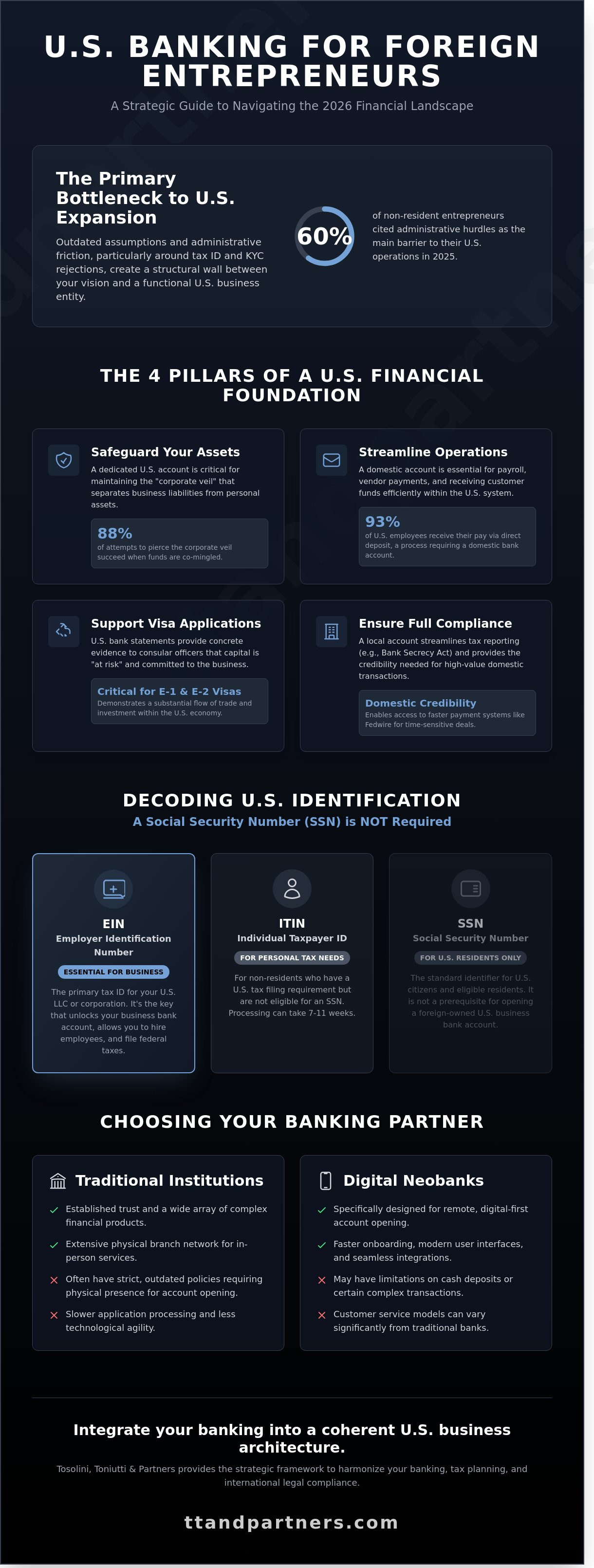
What if the most significant barrier to your global expansion isn't capital, but the outdated assumption that you must physically stand in a Manhattan branch to sign a ledger? In 2025, industry data showed that 60 percent of non-resident entrepreneurs cited administrative friction, specifically regarding tax identification and KYC rejections, as the primary bottleneck for their US operations. You recognize that securing a us bank account for foreigners is a functional necessity for an enduring international investment strategy. It's frustrating when the nuances of SSN, ITIN, and EIN requirements create a structural wall between your vision and a working business entity.
We've designed this strategic roadmap to provide the clarity and precision your project demands. You'll gain a professional framework to establish a fully compliant financial presence that integrates perfectly with your US LLC. This guide analyzes the 2026 banking landscape, details the exact documentation required for remote approval, and offers a step-by-step protocol to ensure your capital remains mobile and your structure remains sound.
Key Takeaways
Understand how a us bank account for foreigners serves as the vital financial heartbeat for cross-border operations while maintaining essential legal protections for your assets.
Discover why a Social Security Number is not a prerequisite for entry and how to leverage ITIN and EIN alternatives to bridge the identification gap effectively.
Evaluate the structural trade-offs between traditional "Big Four" institutions and agile digital neobanks to align your banking choice with your specific operational depth.
Follow a precise, step-by-step roadmap to establish your US corporate entity and secure necessary documentation for a fully remote account opening process.
Learn to integrate your financial infrastructure into a broader business architecture that harmonizes banking, tax planning, and international legal compliance.
Table of Contents Why a US Bank Account is Essential for Foreign Investors in 2026 Navigating Identification: SSN, ITIN, and EIN Requirements Comparing Banking Models: Traditional vs. Digital vs. Correspondent A Strategic Roadmap to Opening Your Account Remotely Integrating Banking into Your US Business Architecture
Why a US Bank Account is Essential for Foreign Investors in 2026
Establishing a presence in the United States requires more than a mere legal filing; it demands a functional financial foundation. A us bank account for foreigners serves as the structural core for any cross-border operation. It's the primary mechanism for maintaining the "corporate veil," a legal boundary that separates personal assets from business liabilities. In 2024, data from corporate litigation surveys indicated that 88% of attempts to pierce this veil were successful when owners co-mingled funds. A dedicated account prevents this structural failure and ensures the integrity of the investment remains intact.
The Legal Necessity for Business Continuity
Precision in tax compliance is impossible without local banking infrastructure. US-based accounts streamline the reporting required by the Bank Secrecy Act, providing the transparency that federal regulators demand. Beyond regulation, operational efficiency hinges on the ability to execute direct deposits. With over 93% of US employees receiving paychecks electronically as of 2025, a domestic account is the only way to meet the expectations of a modern workforce. In 2026, a US bank account represents the definitive digital and financial nexus that transforms a foreign entity into a recognized domestic participant within the American economic fabric.
Banking as a Prerequisite for Visa Success
The path to residency or long-term operational status often runs through the banking system. For E-2 Treaty Investor visas, the capital must be "at risk," meaning it's committed to the business. Consular officers look for US bank statements as primary evidence that funds have left the investor's personal control and entered the US economy. Similarly, E-1 Treaty Trader applicants must demonstrate a "substantial" flow of trade. Frequent, documented transactions through a US-based entity provide the empirical data needed for approval. Consular officers in 2026 prioritize these statements because they offer an unfiltered view of a business's viability and commitment to the US market.
High-value transactions also require this local anchor. Whether you're closing a commercial real estate deal or settling a cross-border legal dispute, the speed of the Fedwire system is essential. International transfers can take days and incur unpredictable fees, whereas domestic transactions provide the immediacy required for time-sensitive contracts. For those ready to formalize their US presence, reaching out to a strategic partner via our contact page can help align your financial structure with your long-term goals. Having a local account isn't just about convenience; it's about establishing the credibility needed to operate at the highest levels of the US economy.
Navigating Identification: SSN, ITIN, and EIN Requirements
The architecture of a financial setup in the United States often feels inaccessible to those outside its borders. You don't need a Social Security Number (SSN) to lay the first stone of your fiscal foundation. While the SSN is the standard identifier for domestic residents, the system provides alternative frameworks designed specifically for international actors. Opening a us bank account for foreigners requires a precise understanding of these identifiers to ensure your application meets the stringent compliance standards of 2026.
Banks prioritize the verification of your identity and your tax standing. If you lack an SSN, the system shifts its focus to the ITIN for individuals or the EIN for corporate structures. These numbers act as the functional permit for your financial presence, allowing you to move from a transient visitor to a recognized participant in the American economy.
Obtaining an ITIN for Personal Banking
The Individual Taxpayer Identification Number (ITIN) serves as the primary bridge for non-residents. You qualify for an ITIN if you've got federal tax filing requirements but aren't eligible for an SSN. As of January 2026, the IRS has streamlined the digital submission process, yet the physical verification of documents remains a cornerstone of the procedure. Expect a processing timeline of 7 to 11 weeks, though peak seasons can extend this to 14 weeks.
An ITIN is more than a tax tool; it's a credit-building asset. Most major US banks now accept the ITIN in place of an SSN for credit card applications. This allows you to establish a credit history, which is essential for securing better interest rates or financing for future investments. It also ensures you're compliant with non-resident tax returns, preventing legal friction as your US assets grow.
The EIN: The Key to Business Accounts
If you're operating through an LLC or a corporation, your company requires its own identity. Your LLC requires an Employer Identification Number (EIN) before you can even approach a bank's commercial desk. Think of the EIN as the structural blueprint for your business's legal existence. Without it, the bank cannot verify the entity's tax status under US law. You can learn more about how to get an EIN for non-residents to streamline your setup before you begin the banking application.
In 2026, the IRS has maintained a specific pathway for international applicants who don't have an SSN or ITIN. While domestic applicants get instant results online, international founders must still use the SS-4 form via fax or mail. Current IRS processing times for these specific applications are holding steady at 4 to 5 weeks. Accuracy is vital; a single typo in your registered address can reset the entire clock. If you find the regulatory landscape shifting too quickly, you can contact our specialists for a clear perspective on your specific case.
Beyond these tax numbers, banks will demand a suite of primary and secondary identification. This dual-layer verification ensures the integrity of the us bank account for foreigners against global fraud standards. You'll need to provide:
A Valid Passport: This remains the gold standard for identity verification across all 50 states.
Secondary Photo ID: A national ID card or a foreign driver's license often satisfies this requirement.
Proof of Address: A utility bill or bank statement from the last 90 days, translated into English by a certified professional.
Visa Documentation: Even if you're applying remotely, banks may request a copy of your most recent entry stamp or visa type.
Comparing Banking Models: Traditional vs. Digital vs. Correspondent
Selecting the right financial infrastructure requires a balance between accessibility and long-term structural integrity. For those seeking a us bank account for foreigners, the decision typically falls into three distinct categories: legacy institutions, digital-first platforms, or specialized correspondent services. Each model serves a specific functional purpose within a global business strategy, much like choosing the foundation for a complex architectural project. The choice depends on the scale of your operations and your physical presence within the United States.
The Traditional Banking Experience
As of January 2026, JPMorgan Chase and Citibank remain the primary choices for non-residents who can facilitate an in-person visit. These 'Big Four' institutions offer unparalleled prestige and a full suite of commercial services. However, their onboarding process is rigorous. You'll participate in a 'Know Your Customer' (KYC) interview that functions like a formal design review; bankers scrutinize the source of wealth and the intended use of the account. A physical US residential or commercial address is mandatory. Industry data from 2025 indicates that 94% of major institutions now automatically reject applications using virtual PO boxes or mail-forwarding services to comply with updated federal transparency standards.
Digital and Fintech Alternatives
Digital-first platforms like Mercury and Relay have redefined the speed of entry for international entrepreneurs. They're ideal when a us bank account for foreigners is needed to initiate LLC operations or manage digital transactions remotely. These platforms prioritize user experience and rapid integration. You should account for specific operational limitations:
Daily outgoing wire limits often start at $50,000 for new entities.
FDIC insurance is typically provided through sweep programs with partner banks like Evolve Bank & Trust.
Direct access to complex credit facilities or construction financing is rarely available.
While these neobanks offer agility, they lack the institutional weight that global partners often require for high-value contracts.
Correspondent and Expat Solutions
Correspondent banking leverages existing relationships with your home-country bank to bridge the gap into the US market. This is a strategic choice for high-net-worth individuals who maintain significant liquidity. Programs like HSBC Premier or Charles Schwab International offer a seamless transition, though they often require a minimum balance of $100,000 to waive monthly maintenance fees. This model provides a global view of your assets, ensuring your financial narrative remains cohesive across borders. If you require a bespoke approach to your US expansion and need to discuss the structural requirements of your financial presence, you can reach out to our team at https://www.ttandpartners.com/contact for a professional consultation.
A Strategic Roadmap to Opening Your Account Remotely
Establishing a us bank account for foreigners follows a rigorous logic similar to urban planning. Success isn't found in haste; it's found in the precise sequence of execution. In 2026, the process has become more digitized, yet the scrutiny regarding entity substance has intensified. A non-resident must approach this as a multi-layered construction project where each step provides the stability for the next.
Step 1: Establishing your US corporate entity. You must choose between an LLC or a C-Corp. This legal scaffolding defines your tax obligations and your standing with financial institutions.
Step 2: Securing your EIN. The Employer Identification Number is your entity's primary identifier. Without this IRS-issued document, a bank cannot legally recognize your business.
Step 3: Selecting a bank with a dedicated international desk. Digital-first banks now handle 65% of new non-resident accounts; however, tier-one institutions offer greater stability for high-volume transactions.
Step 4: Preparing a comprehensive 'Business Case'. You'll need to articulate your revenue model, target US clients, and expected monthly transaction volumes.
Step 5: Completing identity verification. Most institutions now utilize encrypted video calls or notarized digital passports to satisfy federal "Know Your Customer" requirements.
Building Your Corporate Foundation First
Banks reject filings that appear as "shells" without operational substance. Follow our guide on LLC incorporation to ensure your legal structure is bank-ready. A professional US business address is essential; 88% of major US banks now flag CMRA (Commercial Mail Receiving Agency) addresses as high-risk. A physical office lease or a dedicated suite provides the necessary context for approval, ensuring your us bank account for foreigners remains active and compliant.
Mastering the Bank Interview
Expect questions regarding your specific industry and projected monthly wire transfers. Compliance officers look for clarity in your "Source of Funds". Providing a three-year history of audited financial statements or verified investment records satisfies anti-money laundering rules. These protocols are strict. A legal introduction or a referral from a recognized firm can reduce your onboarding time by up to 15 days. Banks prioritize applicants who demonstrate a clear, long-term vision for their US operations rather than those seeking a temporary transactional tool.
If you need a strategic partner to help design your US presence and ensure your financial architecture is sound, contact our advisory team.
Integrating Banking into Your US Business Architecture
Securing a us bank account for foreigners represents a critical milestone, but it's merely one component within a sophisticated cross-border framework. Think of it as a load-bearing pillar; its strength depends entirely on the foundation of tax planning and immigration strategy beneath it. In the 2026 fiscal environment, financial institutions operate under heightened scrutiny. A bank account isn't a static tool. It's a dynamic interface between your international operations and the US regulatory ecosystem. Every transaction leaves a digital footprint that must align with your stated business purpose.
The synergy between corporate law and financial management is absolute. If your visa status changes or your LLC fails to file its 2024 Corporate Transparency Act (CTA) reports, your banking access can vanish overnight. Maintaining this architecture requires a holistic view that treats legal compliance not as a hurdle, but as a structural necessity for growth. Modern banking partners expect your corporate records to be as precise as an architectural blueprint. Discrepancies between your IRS filings and bank records are the primary triggers for modern compliance audits.
Managing Compliance and Reporting
Compliance defines the lifespan of your US presence. Foreign-owned accounts must address FBAR (Report of Foreign Bank and Financial Accounts) and FATCA requirements with precision. Errors here aren't just administrative; they're existential risks to your capital. Industry data indicates that co-mingling personal and business funds remains a primary reason for "piercing the corporate veil," which effectively strips away your limited liability protection. Keeping your LLC in good standing through timely annual reports in states like Delaware or Wyoming ensures the bank views your entity as a low-risk partner. Active status is the oxygen that keeps your financial channels open.
Your Strategic Partners in US Expansion
Success in the American market demands more than just a functional account. It requires a multi-disciplinary approach where immigration pathways, such as E-2 or L-1 visas, align perfectly with your corporate structure. Legal counsel reduces the friction of market entry by anticipating regulatory shifts before they impact your cash flow. At TT and Partners, we bridge the gap between Italian entrepreneurial vision and US technical requirements. Our team provides the strategic oversight needed to transform a simple us bank account for foreigners into a robust platform for international scaling. We view your business setup as a cohesive project where every legal and financial element serves the final vision. For tailored assistance with your US-Italy business setup, reach out to TT and Partners.
Architecting Your US Financial Presence
Opening a us bank account for foreigners in 2026 is a foundational step that requires the same precision as a structural blueprint. You'll need to master the interplay between EIN acquisition and ITIN requirements while selecting a banking model that fits your specific operational flow. Whether you're navigating the complexities of E-1 or E-2 visa structures, your financial architecture must remain compliant with both US and international regulations. Our firm specializes in US-Italy cross-border law, providing the intellectual depth needed to bridge these two distinct legal landscapes. We offer comprehensive support throughout the process, managing everything from initial LLC formation to rigorous banking compliance checks. Precision matters. It's about creating a sustainable system where your capital moves with the same fluidity as your vision. Secure your US business future with expert legal counsel. Build your enterprise on a legacy of professional excellence and strategic foresight.
Frequently Asked Questions
Can a foreigner open a US bank account online without visiting the US?
You can open a US bank account for foreigners online through specialized fintech platforms or international banking divisions without traveling to the United States. Digital institutions like Mercury or Relay utilize remote identity verification technologies to onboard non-resident founders. While the Patriot Act of 2001 established strict identity requirements, 2026 digital standards allow for secure, remote document submission. You'll need a valid passport and your company's formation documents to initiate this process.
What documents does a non-resident need to open a US business bank account?
Non-residents must provide an Employer Identification Number (EIN), Articles of Organization, and a valid international passport to open a business account. Banks also require a physical US address to satisfy "Know Your Customer" protocols, though this doesn't imply tax residency. Since 2024, most institutions also request a detailed description of your business model and expected transaction volumes. These documents form the structural foundation of your US financial presence.
Is it possible to open a US bank account without an SSN or ITIN?
It's entirely possible to open an account using an Individual Taxpayer Identification Number (ITIN) or an EIN if you don't have a Social Security Number. Many financial institutions accept a foreign passport as primary identification for non-resident individuals. This inclusive framework allows the 44 million non-citizens currently active in the US economy to access essential banking services. You'll simply need to provide alternative proof of residency and identity during the application.
How long does it take for a non-resident to open a US bank account?
The setup process typically takes between 5 business days and 3 weeks depending on the bank's internal compliance speed. Digital-first platforms often approve applications within 48 hours, while traditional legacy banks require more time for manual document verification. If your corporate structure involves multiple international layers, expect the review to take at least 15 days. Planning for these timelines ensures your business operations remain fluid and uninterrupted during the transition.
Are US bank accounts for foreigners FDIC insured?
Every US bank account for foreigners is protected by the Federal Deposit Insurance Corporation (FDIC) for up to $250,000 per depositor. This insurance applies to both residents and non-residents, ensuring your capital is shielded against bank failure. This regulatory safety net provides an essential layer of security for international investors seeking a stable financial environment. It's a non-negotiable standard for any reputable institution operating within the US domestic market.
What is the difference between a personal and a business bank account for a non-resident?
Personal accounts manage individual wealth and require a passport, while business accounts are structural tools for corporate entities requiring an EIN. Business accounts provide a legal shield, separating your personal assets from company liabilities. According to 2025 financial guidelines, maintaining this distinction is vital for protecting the "corporate veil" of your LLC. Choosing the right account type depends on whether you're managing private savings or building a scalable commercial enterprise.
Can I use a virtual office address to open a US bank account?
You generally can't use a virtual office address as your primary business location because of strict anti-money laundering laws. Banks require a physical street address where the entity is legally registered or where a registered agent resides. However, you can utilize a virtual mailbox for your mailing address to receive debit cards and bank statements. This distinction ensures compliance with federal regulations while allowing for the flexibility of a remote business model.
What are the tax implications of a foreigner having a US bank account?
Having a US account doesn't trigger automatic tax residency, but you're responsible for reporting any income effectively connected to a US trade or business. Interest income earned on personal deposits is typically tax-exempt for non-resident aliens under current IRS codes. You'll need to submit Form W-8BEN to the bank to certify your foreign status and access treaty benefits. Consulting with a cross-border tax specialist ensures your financial structure remains compliant and efficient.


Comments