

2026 Strategic Guide: Green Cards for Italian Parents

The success of your parents' relocation to the United States depends less on the forms you file and more on how you bridge the gap between two incompatible legal systems. Securing a family-sponsored green card for Italian parents is a sophisticated legal project that requires balancing federal immigration statutes with the specific administrative nuances of the Italian civil registry. You likely feel the weight of this responsibility, especially when faced with the high stakes of your parents' future healthcare and the complexities of international document verification.
We understand that the distinction between Adjustment of Status and Consular Processing feels opaque, and the pressure to meet the 2026 financial sponsorship requirements adds a layer of anxiety. This guide provides the professional clarity you need to move forward with confidence. We'll outline a precise timeline for the petition, detail the exact civil certificates required by US authorities, and address the critical five-year waiting period for Medicare eligibility. This roadmap offers the technical insight to avoid costly procedural errors, ensuring a seamless transition for your family's next chapter.
Table of Contents
Understanding Eligibility: Italian Parents as Immediate Relatives
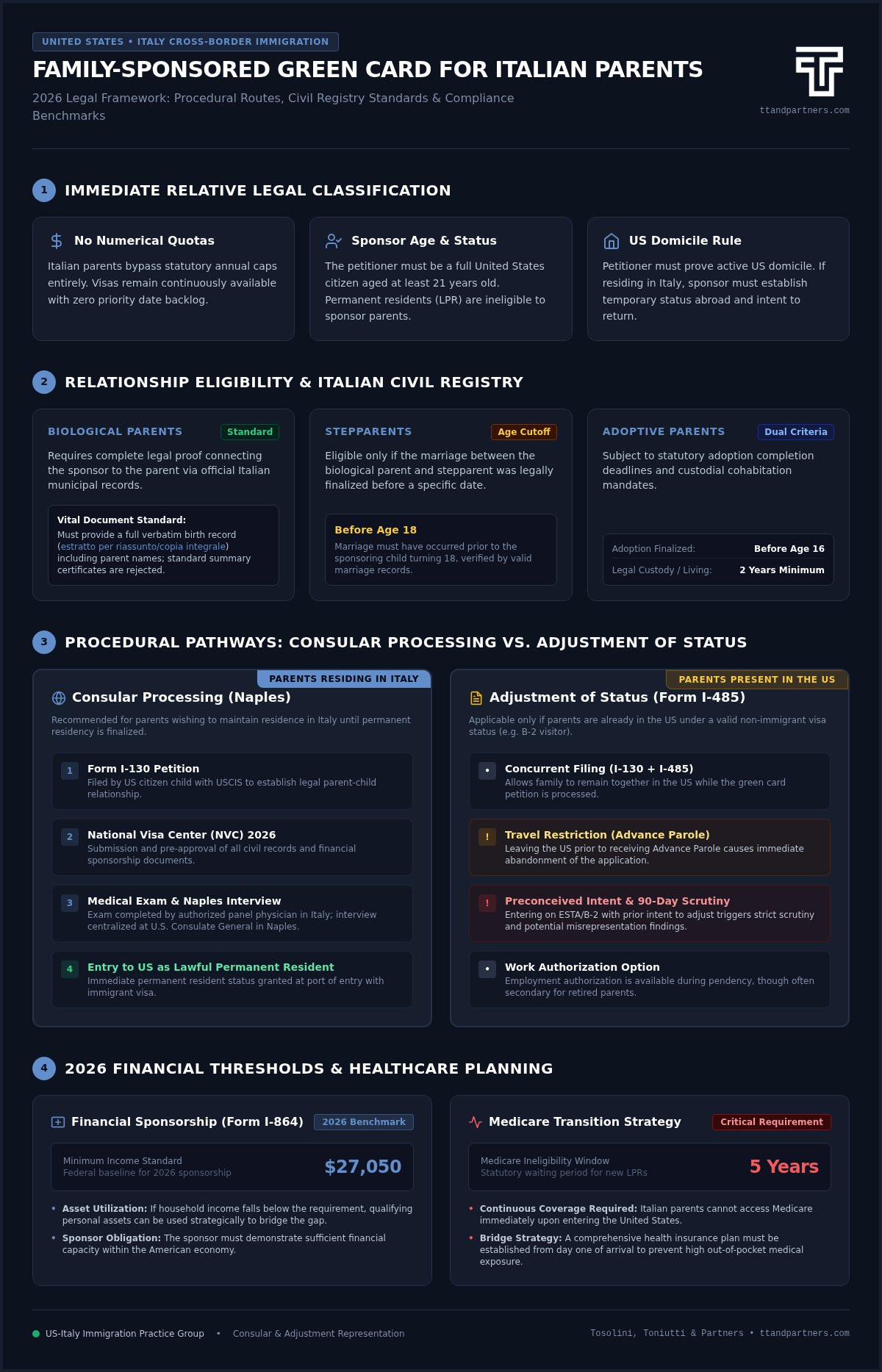
Under US immigration law in 2026, parents of adult US citizens are classified as Immediate Relatives. This status is the cornerstone of a family-sponsored green card for Italian parents because it removes the burden of annual quotas. Unlike other family categories, visas for parents are always available. There's no priority date backlog to monitor. This means once the initial petition is approved, the path to residency is clear and direct, providing a predictable timeline for families transitioning from Italy.
The US Citizen Sponsor Requirements
You must be a United States citizen and at least 21 years old to sponsor a parent. Permanent residents aren't eligible for this specific petition. You'll need to provide evidence of your status through a US passport or naturalization certificate. Additionally, you must prove you're domiciled in the US. If you're currently living in Italy, you must show that your stay abroad is temporary and that you've maintained active links to the US with a clear plan to return. Achieving lawful permanent resident status for your family requires proving you can support them within the American economy.
Defining the Parent-Child Relationship
Establishing the legal bond requires documentation that satisfies both US federal rules and the standards of the Italian civil registry. Biological relationships are straightforward, but step-relationships and adoptions have specific deadlines. A stepparent only qualifies if the marriage to the biological parent took place before the sponsoring child turned 18. This timing is critical and must be supported by valid marriage and birth records that clearly state the dates of the union.
Adoptions are similarly time-sensitive. The adoption must be finalized before the child is 16, and the child must have lived with the adoptive parent for two years. When pursuing a family-sponsored green card for Italian parents, you must obtain a full verbatim birth record from the local Italian municipal office. Standard summary certificates often omit the parental names that US officials require for verification. Precise documentation at this stage prevents the administrative delays that can derail a family's long-term vision.
The Application Path: Consular Processing vs. Adjustment of Status
Choosing the right trajectory for a family-sponsored green card for Italian parents depends entirely on their current physical location and their immediate travel needs. The decision isn't merely administrative; it's a strategic choice that affects processing speeds, filing fees, and the family's ability to remain together during the transition. While both paths lead to the same result, the procedural requirements and legal risks differ significantly between processing through a consulate in Italy or filing within the United States.
Consular Processing in Italy
For parents residing in Italy, the process begins with the I-130 petition and moves to the National Visa Center (NVC) in 2026. Once the NVC approves the financial and civil documents, the case is transferred to the U.S. Consulate General in Naples, which centralizes all immigrant visa interviews for Italian residents. This path is often preferred for those who wish to maintain their residence in Italy until the final approval. The required medical examination must be performed by an authorized panel physician in Italy before the interview. Official USCIS guidance on sponsoring parents confirms that this method results in an immigrant visa, which grants permanent residency immediately upon entry.
Adjustment of Status Within the US
If your parents are already in the US on a valid non-immigrant visa, such as a B-2 visitor visa, they may be eligible to adjust status without leaving the country. This involves the concurrent filing of Form I-130 and Form I-485. While this keeps the family united, it carries significant restrictions. Parents shouldn't travel outside the US until they receive Advance Parole, or their application may be considered abandoned. Furthermore, work authorization is available but often secondary to the needs of retired parents.
The most critical risk with this path involves "preconceived intent." US officials scrutinize parents who enter on an ESTA or visitor visa with the hidden plan to stay and file for residency. Applying too soon after arrival can trigger the 90-day rule, potentially leading to allegations of visa fraud. It's essential to analyze the timeline of their entry and their original intent to avoid a permanent bar from the US. If you're unsure which path aligns with your family's needs, consulting with a legal strategist can provide the necessary clarity to navigate these technical intent issues. This ensures the family-sponsored green card for Italian parents is obtained without compromising their future legal standing.
Required Documentation: Navigating the Italian Civil Registry
The success of a family-sponsored green card for Italian parents relies on the granular accuracy of the evidence provided. The Italian administrative system is exceptionally thorough, yet it produces various versions of the same record that can confuse those unfamiliar with the civil registry structure. Submitting a version that lacks necessary details is a primary cause for a Request for Evidence, which can stall an application for several months. Precision during the document gathering phase is the only way to maintain the integrity of your timeline and avoid administrative friction.
Essential Italian Civil Documents
When requesting birth records from the local municipality, you must specifically ask for a long-form birth record extract. While a standard summary birth certificate confirms that a birth occurred, it often omits the names of the parents, which is the foundational relationship you are required to prove. The long-form extract provides the comprehensive data needed to verify biological or legal lineage. If your parents have been married or divorced, you must also secure the full marriage certificate and the final divorce decree. It's vital to ensure the divorce judgment is final and bears the official seal of the court. Coordinating with smaller municipal offices often requires significant lead time; requesting these records months in advance prevents last-minute procedural hurdles.
For families following the consular path, the Department of State requires specific police clearances issued by the Ministry of Justice. You must provide both the general criminal record certificate and the certificate of pending charges. These documents verify the applicant's background and are essential for the final interview. In many international legal contexts, a specialized certificate of authentication, known as an apostille, is required to make the document legally valid in the United States, as noted in the USCIS guide to petitioning for parents as permanent residents.
Translation and Certification Standards
Every non-English document submitted to US authorities must be accompanied by a full English translation. In 2026, the standard for a certified translation remains a complete rendering of the original text, including all seals, stamps, and marginal notes, paired with a signed statement from the translator. This statement must attest to the translator's competence and the translation's accuracy. The sponsoring child cannot translate the documents personally to ensure impartial verification and absolute accuracy. Mistakes in translating legal terminology, such as confusing a legal separation with a final divorce, are frequent triggers for rejection. Utilizing a professional who understands the specific nuances of both Italian and US legal terminology is the most effective way to secure a family-sponsored green card for Italian parents without technical interruptions.
Financial Sponsorship and Healthcare Planning for 2026
Securing a family-sponsored green card for Italian parents involves a profound financial commitment that extends far beyond the initial filing fees. The US government requires petitioners to sign Form I-864, an Affidavit of Support, which serves as a legally binding contract ensuring that the sponsored immigrants will not rely on public assistance. In 2026, the 125% poverty guideline threshold for a household of two is $27,050, while a household of four requires $41,250. If your individual income falls short, you can utilize liquid assets, including those held in Italy, provided they can be converted to cash within one year. For parent sponsorship, the total value of these assets must be five times the income gap.
Meeting the Financial Requirements
The financial obligation of the sponsor is significant and enduring. It generally remains in effect until the parent becomes a US citizen, earns 40 quarters of work credit, or departs the country permanently. If you cannot meet the income requirements alone, a joint sponsor who is a US citizen or permanent resident and meets the threshold independently can be added to the case. This professional scrutiny ensures that the family has the resources to thrive without becoming a public charge, a test that has become increasingly focused on the totality of the family's circumstances in 2026. Precision in calculating household size and qualifying income is essential to avoid administrative delays.
Healthcare and Insurance for Aging Parents
Transitioning from Italy's public Servizio Sanitario Nazionale (SSN) to the US private insurance model requires meticulous planning. New lawful permanent residents aged 65 and older are subject to a five-year continuous residency requirement before they can buy into Medicare Part A and Part B. During this critical window, parents must secure coverage through the Affordable Care Act (ACA) Health Insurance Marketplace or private family plans. Gaining residency is a Qualifying Life Event, providing a 60-day window to enroll outside the standard open enrollment period. This ensures that your parents have access to medical care from the moment they arrive.
While the US-Italy social security totalization agreement helps coordinate pension benefits, it does not bypass the Medicare waiting period. You must account for the costs of private premiums and potential out-of-pocket expenses for pre-existing conditions. Demonstrating a clear healthcare strategy is now a vital component of the public charge assessment during the interview process. If you need assistance structuring your financial evidence or evaluating healthcare insurance options for a family-sponsored green card for Italian parents, contact our legal team for a strategic review of your sponsorship plan. This proactive approach ensures your parents' transition is both legally sound and personally sustainable.
Strategic Legal Support for US-Italy Immigration
Sponsoring a family-sponsored green card for Italian parents involves a sophisticated legal strategy that transcends standard immigration paperwork. It requires an intimate understanding of the intersection between U.S. federal statutes and the specific administrative structures of the Italian Republic. General immigration practitioners often lack the localized expertise needed to interpret complex Italian civil records or the specific evidentiary preferences of the U.S. Consulate General in Naples. This lack of specialized knowledge frequently results in administrative delays that separate families longer than necessary.
General firms might overlook the importance of coordinating with the Italian Anagrafe or fail to recognize how a specific Italian decree impacts a parent's eligibility. By contrast, a firm with a dual-jurisdictional perspective provides a seamless bridge between the two legal systems. This approach ensures that every aspect of the petition is optimized for the current 2026 regulatory environment, protecting your family's future from the start. Precision is not optional.
Avoiding Costly Delays and Denials
The most frequent errors in these petitions stem from a failure to bridge the procedural gap between the two nations. Whether it's submitting a summary birth certificate instead of the verbatim extract or failing to properly authenticate a divorce decree, these technical oversights signal a lack of preparation to USCIS officers. A comprehensive legal review ensures that every document, from financial affidavits to Italian police clearances, meets the exact evidentiary standards of 2026. Understanding the financial commitment is also a key part of this strategy. For a deeper look at the fiscal requirements, read our guide on How Much Is a Green Card? The 2026 Cost and Strategy Guide.
Next Steps: Securing Your Parents' Future
Once the paperwork is in order, the focus shifts to the personal aspect of the petition. Preparing your parents for the interview, whether it occurs at a local USCIS office or in Naples, is essential for a smooth outcome. Adjudicators often probe the "totality of circumstances" regarding healthcare and financial stability, making a well-prepared case file your parents' best asset. They want to see a clear, viable plan for their life in the United States.
Beyond the initial approval, you must consider the long-term responsibilities of maintaining permanent residency. This includes understanding travel restrictions and the eventual path to US citizenship. Tosolini, Toniutti & Partners acts as a strategic partner, managing the complexities of the Italian civil registry and US immigration law simultaneously. We streamline the entire process, allowing you to focus on welcoming your family home. To begin your roadmap, Contact Tosolini, Toniutti & Partners for a consultation and ensure your application is handled with the precision it deserves.
Securing a Legacy of Family Unity
Reestablishing your family's daily life in the United States requires more than just filing forms; it demands a meticulous bridge between two distinct legal systems. By leveraging the immediate relative status and securing precise long-form extracts from the Italian civil registry, you avoid the technical errors that often lead to administrative rejection. Managing the 2026 financial sponsorship requirements and anticipating long-term healthcare needs ensures a stable transition for your aging parents.
Obtaining a family-sponsored green card for Italian parents is a significant legal undertaking that demands professional precision and a vision for the future. Our bilingual legal team, based in the US, brings decades of experience in US-Italy cross-border law to every complex petition. We maintain a specialized focus on Italian family reunification, providing the intellectual depth needed to navigate overlapping jurisdictions with absolute confidence. Schedule a Consultation with our US-Italy Immigration Experts to begin this journey.
Your family deserves the security of a well-executed plan. We look forward to helping you bring your parents home and ensuring their new chapter in the United States is defined by harmony and legal certainty.
Frequently Asked Questions
How long does it take to get a Green Card for Italian parents in 2026?
Obtaining a family-sponsored green card for Italian parents typically takes between 12 and 18 months in 2026. Since parents are classified as Immediate Relatives, they aren't subject to annual numerical caps or quota-related waiting lists. The total processing time depends largely on the current workload at USCIS and whether you choose the Consular Processing path in Naples or the Adjustment of Status route within the United States.
Can my parents stay in the US while the Green Card application is pending?
Italian parents can only remain in the United States while their application is pending if they have filed for an Adjustment of Status while legally present in the country. This requires them to have entered on a valid visa and maintained their status until the filing. If they are processing through the consulate in Naples, they must remain abroad until their immigrant visa is officially issued by the Department of State.
What is the minimum income required to sponsor a parent from Italy?
The minimum annual income required to sponsor a parent from Italy in 2026 is $27,050 for a household of two. This figure represents 125% of the federal poverty guidelines for the 48 contiguous states. For a household of four, the required income increases to $41,250. If the primary sponsor's income is insufficient, you can use liquid assets or a joint sponsor to meet these mandatory federal financial obligations.
Do Italian parents need a medical exam for the US Green Card?
Yes, every Italian parent must undergo a mandatory immigration medical examination performed by an authorized physician. For those processing their family-sponsored green card for Italian parents in Italy, the exam must be conducted by a panel physician approved by the US Consulate in Naples. If adjusting status domestically, an approved civil surgeon must complete the evaluation. This step ensures the applicant meets all health-related admissibility standards before residency is granted.
What happens to my parents Italian pension if they move to the US?
Moving to the United States generally doesn't cause Italian parents to lose their accrued Italian pension benefits. The US-Italy Social Security Totalization Agreement helps coordinate benefits between the two nations, ensuring that residency changes don't unfairly penalize retirees. However, parents must report their global income to the IRS once they become lawful permanent residents. It's advisable to consult with a cross-border specialist to understand how residency impacts specific pension distributions and tax obligations.
Can I sponsor my parents if I am only a Green Card holder and not a citizen?
You cannot sponsor your parents for a Green Card if you are currently a lawful permanent resident. Under existing US immigration law, only United States citizens who are at least 21 years old have the legal standing to petition for their parents. If you are a Green Card holder, you must wait until you successfully naturalize as a US citizen before you can initiate the family-sponsored green card for Italian parents process.
Do Italian documents need an Apostille for USCIS applications?
USCIS typically doesn't require an Apostille for Italian civil documents like birth or marriage certificates as long as they're accompanied by a certified English translation. However, an Apostille may be necessary if you're using US documents for certain Italian administrative procedures or if the US Consulate specifically requests it during consular processing. It's always safer to verify the specific requirements for your chosen pathway to ensure all international documents are properly authenticated.
Can my parents work in the US while waiting for their Green Card?
Italian parents can only work in the United States while waiting for their Green Card if they have applied for and received an Employment Authorization Document. This is typically filed alongside an Adjustment of Status application. In 2026, the filing fee for this work permit is $260 when filed concurrently with Form I-485. Parents processing through the consulate in Italy aren't eligible for US work authorization until they enter the country as permanent residents.


Comments