

LPR Status for Italians: 2026 US Residency Guide

Does the temporary nature of a treaty visa eventually compromise the very stability you sought to build on American soil? For many, the transition to LPR status for Italian nationals feels like a delicate architectural renovation where one must preserve the heritage of Italian citizenship while building a permanent foundation in the US. You've likely felt the weight of uncertainty as your E-visa expiration date approaches, or perhaps you're concerned about how dual intent might affect your standing. It's a common anxiety for those who have built successful lives and businesses but still lack the finality of a Green Card.
Securing your future shouldn't feel like a gamble against shifting immigration policies. This guide provides a clear, expert roadmap to help you secure a Green Card in 2026, balancing the technical precision of US law with the unique needs of the Italian community. We'll examine the legal requirements for this transition, address the complexities of US-Italy tax implications, and outline strategies to ensure long-term family stability. From understanding priority dates to managing cross-border assets, you'll gain the clarity needed to transform a temporary stay into a lasting legacy.
Table of Contents
Understanding Lawful Permanent Resident (LPR) Status for Italians
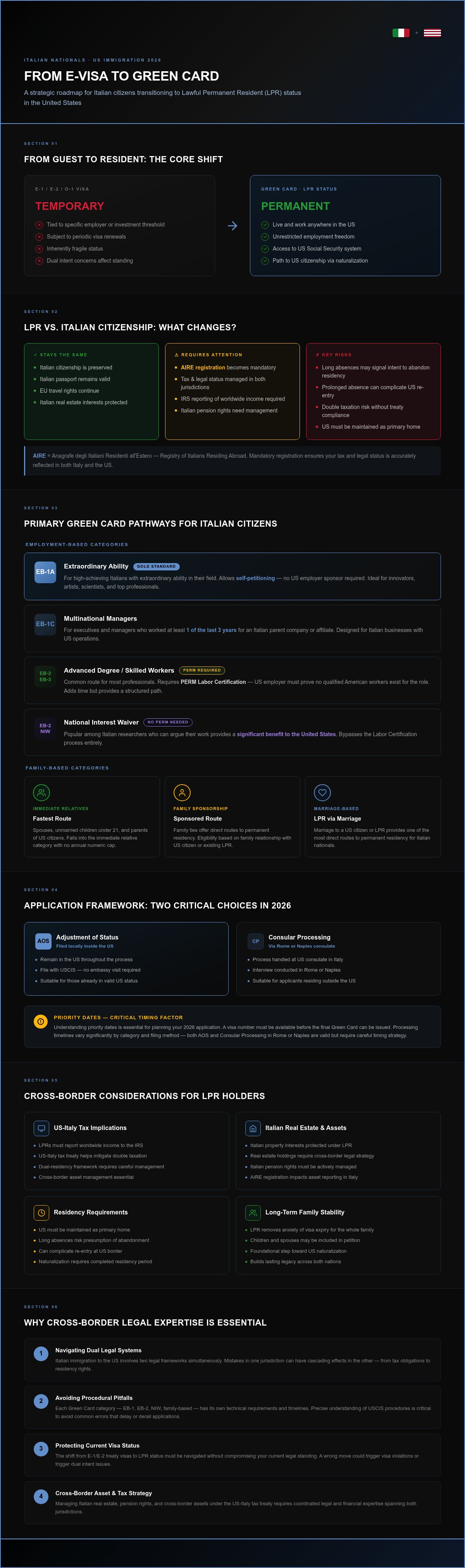
Securing LPR status for Italian nationals is a strategic transition that replaces the restrictive boundaries of non-immigrant visas with the permanence of a Green Card. While E-1 or O-1 visas provide a functional entry point, they remain inherently fragile, tied to specific professional roles or investment thresholds. In contrast, obtaining Lawful Permanent Resident status in the United States offers a structural stability that allows Italian citizens to live and work anywhere in the country without the constant oversight of an employer or the anxiety of visa renewals. It's a fundamental shift from being a guest to being a resident.
This status brings significant benefits, including unrestricted employment freedom and access to the US social security system. It also establishes the foundational eligibility for US citizenship, should you choose to pursue naturalization after the required period of residency. However, this transition requires a shift in mindset. Unlike temporary visas, LPR status is a commitment to making the United States your primary home. Maintaining this status requires careful attention to residency requirements, as long absences can signal an intent to abandon your permanent home.
The Rights and Responsibilities of an LPR
As a permanent resident, you possess the right to reside in any state and work for any organization. This autonomy is often the primary driver for Italian entrepreneurs who wish to expand beyond their initial investment ventures. With these rights come specific obligations. You're required to report worldwide income to the IRS, though the existing US-Italy tax treaty helps mitigate double taxation risks. Maintaining your status depends on your intent to remain a resident; prolonged absences from the US can lead to the presumption that you've abandoned your residency, potentially complicating your reentry at the border.
LPR Status vs. Italian Citizenship: What Changes?
One of the most frequent concerns for the Italian diaspora is the impact of a Green Card on their heritage. It's essential to understand that LPR status doesn't void your Italian citizenship or your EU travel rights. You'll continue to hold your Italian passport. However, your administrative relationship with Italy will change. Registering with the AIRE (Anagrafe degli Italiani Residenti all'Estero) becomes mandatory to ensure your tax and legal status is accurately reflected in both jurisdictions. This dual-residency framework requires careful management to protect your Italian real estate and future pension rights while you build your American future. For personalized strategies regarding your transition, you can reach out through our contact page.
Primary Pathways to a US Green Card for Italian Citizens
Selecting the right path to residency is less about following a trend and more about aligning legal strategy with your long-term professional or personal architecture. For those seeking LPR status for Italian nationals, the 2026 landscape offers several distinct avenues, each with its own set of technical requirements and timelines. Whether you're an entrepreneur, a researcher, or joining family, the transition requires a precise understanding of the official USCIS green card information to avoid common procedural pitfalls.
Employment-Based Preferences for Italian Professionals
The EB-1 category remains the gold standard for high-achieving Italians. The EB-1A subcategory caters to those with extraordinary ability in their field, allowing for self-petitioning without a specific US employer. Conversely, the EB-1C pathway is designed for multinational managers who've spent at least one of the last three years working for an Italian parent company or affiliate. For many professionals, the EB-2 or EB-3 routes are more common, though they typically involve the PERM Labor Certification process. This requires the US employer to prove there are no qualified American workers for the position; it's a step that adds time but provides a structured route to residency. Italian researchers often bypass this via the National Interest Waiver (NIW), arguing that their work provides a significant benefit to the United States.
Family Sponsorship and Marriage-Based LPR
Family ties offer some of the most direct routes to permanent residency. Spouses, unmarried children under 21, and parents of US citizens fall into the immediate relative category, which isn't subject to annual numerical caps. This often results in faster processing compared to preference categories, such as the siblings of US citizens or the family members of existing Green Card holders. While these paths are common, they still require rigorous documentation of the relationship's validity. Understanding the financial commitment is also vital; you can learn more about the cost of a Green Card to prepare for the 2026 filing cycle.
For high-net-worth individuals, the EB-5 investment program provides a direct route through capital contribution to US-based projects. This path is particularly relevant for Italians looking to secure a future for their entire family through a single strategic investment. Regardless of the chosen pathway, the complexity of cross-border documentation means that a tailored approach is always the most effective. If you're unsure which category fits your current profile, a professional review of your case can provide the necessary clarity through our contact page.
Strategic Comparison: Transitioning from Treaty Visas to LPR Status
Transitioning from a non-immigrant status to residency is a deliberate evolution of your legal standing in the United States. For those currently holding E-1 or E-2 visas, the primary challenge is the concept of dual intent. These treaty-based visas are technically non-immigrant categories, meaning they require an intention to depart the US once the visa expires. Securing LPR status for Italian nationals while on these visas requires a sophisticated strategy to ensure you don't jeopardize your current status while demonstrating your intent to remain permanently.
Timing is the architectural core of this transition. Initiating the process too late can lead to status gaps, while moving too early without considering the specific restrictions of your current visa can complicate future renewals. Establishing a priority date early in 2026 is essential for Italian citizens to maintain a seamless presence in the country. Consulting the official USCIS Green Card information is the first step in identifying how your current non-immigrant trajectory aligns with permanent residency requirements.
From E-2 Treaty Investor to Lawful Permanent Resident
The E-2 treaty investor visa is a powerful tool for Italian entrepreneurs, but it lacks a built-in bridge to residency. To obtain LPR status, investors often look toward the EB-5 program or the EB-2 National Interest Waiver. Converting an existing business into an EB-5 eligible project involves meeting higher capital and job creation thresholds. Alternatively, filing an EB-1 or EB-2 NIW petition as a secondary track allows you to maintain your investor status while your permanent case is processed. Reviewing the E-2 Visa Guide 2026: Strategic Framework can help clarify how your current investment aligns with these long-term residency goals.
The O-1 to EB-1 Pipeline for Italian Talent
For Italian artists, scientists, and business leaders, the O-1 visa is often the most logical precursor to the EB-1A Green Card. The evidentiary standards for extraordinary ability in both categories share significant DNA. If you've already secured an O-1, you've likely gathered the bulk of the documentation needed for residency. Leveraging Italian national awards, media coverage in major European publications, and high-level memberships can effectively satisfy the rigorous USCIS requirements. Our O-1 Visa: The Complete 2026 Guide details how to curate these professional achievements for maximum impact during the LPR transition.
The LPR Application Framework: Timelines and Compliance in 2026
The roadmap to LPR status for Italian nationals in 2026 demands more than just procedural adherence; it requires an understanding of the current regulatory momentum. The journey begins with establishing a priority date through the filing of an immigrant petition, such as the I-140 for professionals or the I-130 for family members. This initial step acts as your placeholder in the queue. In 2026, Italian citizens generally benefit from favorable priority dates in many categories, but backlogs in high-demand employment streams mean that early filing is a strategic necessity rather than a suggestion. The earlier you file, the more protected your timeline becomes.
Following the approval of the petition, the path involves a medical examination by a civil surgeon and a biometrics appointment for fingerprinting. These administrative milestones are followed by a formal interview, where the consistency of your documentation is tested. Once the interview is successfully navigated, the physical Green Card is issued, marking the final transition to permanent residency. It's vital to respect the 90-day rule regarding international travel during this sensitive period to avoid any appearance of status abandonment. Every detail in your travel history must align with your residency claims.
Adjustment of Status vs. Consular Processing
Choosing between these two paths depends on your current location and professional needs. Adjustment of Status (I-485) allows you to remain in the US and obtain an Employment Authorization Document (EAD) while waiting. This provides immediate continuity for your career. Alternatively, Consular Processing at a US diplomatic post in Italy might offer a faster timeline for those currently residing in their home country. However, adjusting status within the US often imposes stricter travel restrictions. Leaving the country without "Advance Parole" can lead to the automatic abandonment of your application.
Common Pitfalls and How to Avoid RFEs
A Request for Evidence (RFE) can stall your residency for months. For Italian nationals, the most frequent triggers include imprecise translations of legal documents or gaps in documenting the source of funds, particularly in EB-5 contexts. Every Italian certificate must have a certified English translation that mirrors the original structure. Maintaining your underlying non-immigrant status throughout this multi-year framework is non-negotiable. Even a brief lapse in compliance can jeopardize your entire application. To ensure your documentation meets the rigorous 2026 standards, you can schedule a strategic compliance review with our team.
Securing Your Future: Why Cross-Border Legal Expertise is Essential
Obtaining LPR status for Italian nationals is rarely a standalone event; it's a comprehensive restructuring of one's legal and financial identity across two distinct jurisdictions. While the Green Card provides the physical right to remain in the United States, it also triggers a cascade of reporting requirements that span the Atlantic. The transition demands a vision that looks beyond the immediate immigration filing toward the long-term preservation of assets and the mitigation of tax liabilities. Professional counsel acts as the bridge, ensuring that your growth in America doesn't inadvertently cause legal friction in Italy.
The US-Italy tax treaty serves as a vital instrument for permanent residents. It's designed to prevent double taxation, yet its application requires surgical precision. Once you become an LPR, the IRS requires disclosure of worldwide income and foreign financial assets. This includes everything from family-owned real estate in your home region to retirement accounts held in Italian financial institutions. Managing these disclosures while protecting your Italian heritage requires a firm that understands the nuances of both Italian civil law and US federal regulations. It's a dual-layered approach that protects your lifestyle from administrative oversight.
Beyond Immigration: Corporate and Real Estate Integration
For many Italian entrepreneurs, residency is the catalyst for deeper commercial roots. Aligning your new status with LLC incorporation allows for a more robust business architecture, providing liability protection and tax flexibility. This corporate foundation often intersects with personal property goals. You might find yourself managing real estate closings in Italy while physically based in the US. These transactions require a legal team capable of bridging the gap, ensuring that power of attorney and title transfers comply with both Italian notary requirements and US legal standards. Strategic planning today ensures that your path to US citizenship remains clear while your Italian roots stay nourished.
Schedule a Strategic Consultation
Every residency journey is unique, shaped by individual professional achievements and family dynamics. Whether you're facing a complex cross-border dispute that requires international litigation or simply need a roadmap for your transition, expert guidance is indispensable. We provide a personalized assessment of your current visa standing and LPR eligibility, focusing on the technical details that others might overlook. You can begin this process by visiting our contact page to schedule a comprehensive review of your US-Italy legal lifecycle. Our goal is to provide the clarity and precision needed to secure your permanent future.
Establishing Your Permanent American Legacy
Building a life in the United States is an architectural project that requires both a bold vision and a precise legal blueprint. Achieving LPR status for Italian nationals in 2026 involves more than just submitting forms; it's about strategically transitioning from temporary treaty visas into a permanent framework. This journey necessitates a deep understanding of dual residency implications, from US-Italy tax treaty compliance to the protection of your Italian real estate assets.
Success lies in the details of your transition strategy and the timing of your filings. By aligning your professional achievements with the right residency pathway, you don't just secure a Green Card; you build a stable legacy for your family and business. Our firm provides the specialized cross-border expertise needed to oversee these high-stakes transitions with confidence. With a proven track record in E-visa and O-visa transitions, we manage the entire legal lifecycle to ensure your residency process is handled with professional care.
Secure your US future with expert cross-border counsel-Contact Us Today. Your permanent American chapter begins with a single, well-planned step.
Frequently Asked Questions
Can an Italian citizen hold both LPR status and Italian citizenship?
Yes, you can maintain your Italian citizenship while holding a Green Card. US law doesn't require you to relinquish your original nationality to become a Lawful Permanent Resident. Italian citizens continue to hold their Italian passports and enjoy EU travel rights while residing permanently in the US. This dual status is a strategic advantage, though it requires careful management of your administrative standing to ensure your legal status is correctly recognized in both jurisdictions.
How long does it take for an Italian national to get a Green Card in 2026?
Timelines in 2026 depend on your specific path and current USCIS backlogs. For many Italian professionals, employment-based residency can take between 12 and 24 months from the initial filing. Family-based petitions for immediate relatives often move more quickly, sometimes concluding within a year. It's essential to consult the latest Visa Bulletin to understand how priority dates affect your specific category, as administrative shifts can impact these windows without much prior notice.
What happens to my E-2 visa if I apply for LPR status?
Filing for LPR status for Italian nationals doesn't immediately invalidate an E-2 visa, but it does signal a permanent intent that contrasts with the E-2's non-immigrant nature. This can make renewing your E-2 or re-entering the US on that visa more difficult. It's often safer to maintain your E-2 status until the final stage of the Green Card process is complete, using specific legal strategies to bridge the gap between these categories.
Do I need to live in the US full-time once I have LPR status?
You must maintain the United States as your primary residence to keep your Green Card. While you're free to travel abroad, staying outside the US for more than six months can lead to questioning at the border. Absences of more than one year are generally considered an abandonment of residency unless you've secured a reentry permit in advance. Maintaining a physical home and financial ties in the US is critical for status preservation.
Can I work for any employer in the US with a Green Card?
Holding a Green Card grants you full employment authorization across the United States. Unlike the restrictive nature of treaty visas, which often bind you to a specific employer or investment project, LPR status allows you to work for any company in any industry. You can also pursue freelance opportunities or start multiple business ventures without seeking new visa approvals. This professional freedom is a cornerstone of the long-term stability that permanent residency provides.
What are the tax implications for an Italian citizen becoming a US permanent resident?
Transitioning to permanent residency means the IRS will tax your worldwide income. This includes earnings from Italian businesses, rental income from properties in Italy, and interest from European bank accounts. While the US-Italy tax treaty helps prevent you from paying twice on the same income, you'll still face rigorous disclosure requirements like FBAR and FATCA. Coordinating your transition with cross-border tax experts is the only way to protect your global assets from unnecessary penalties.
Can my family members get LPR status at the same time as me?
Your spouse and unmarried children under 21 can typically join your application as derivative beneficiaries. This means they can obtain their own Green Cards based on your eligibility, provided they meet standard health and security requirements. In the 2026 landscape, ensuring that all family members are included in the initial filing is vital for maintaining household unity. This collective transition provides your entire family with the same rights to work and study in the US.
Is an interview at the US Embassy in Italy required for LPR status?
An interview is a mandatory step in the residency process. If you're applying from Italy, you'll attend an interview at a US diplomatic post in your home country. If you're already in the US and choose to adjust your status, the interview will occur at a domestic USCIS office. The purpose of this meeting is to verify the details of your petition and confirm that you meet all legal requirements for LPR status for Italian nationals.


Comments