

Forming a US LLC from Italy: The 2026 Strategic Legal Guide

For the visionary Italian entrepreneur, a US entity isn't merely a corporate filing; it's a strategic bridge built with the same precision as a timeless architectural structure. While the digital allure of Delaware or Wyoming suggests simplicity, the reality of forming a US LLC from Italy involves a complex dialogue between two distinct legal and fiscal systems. You're likely aware that the American market offers unparalleled scale, yet the friction of the US-Italy tax treaty and the intricacies of Italian CFC rules can feel like significant barriers to entry.
We understand that your goal isn't just to exist in the US, but to thrive within a framework that's both legally sound and strategically positioned for growth. This 2026 guide provides the comprehensive legal roadmap you need to incorporate, manage, and scale your business with absolute confidence. We'll explore the technical requirements for cross-border compliance, the path to securing US banking without a physical presence, and how to align your corporate structure with future E-2 or O-1 visa eligibility. By the end, you'll have the clarity to turn your international vision into a sustainable, high-performing reality.
Table of Contents
Strategic Advantages of a US LLC for Italian Founders
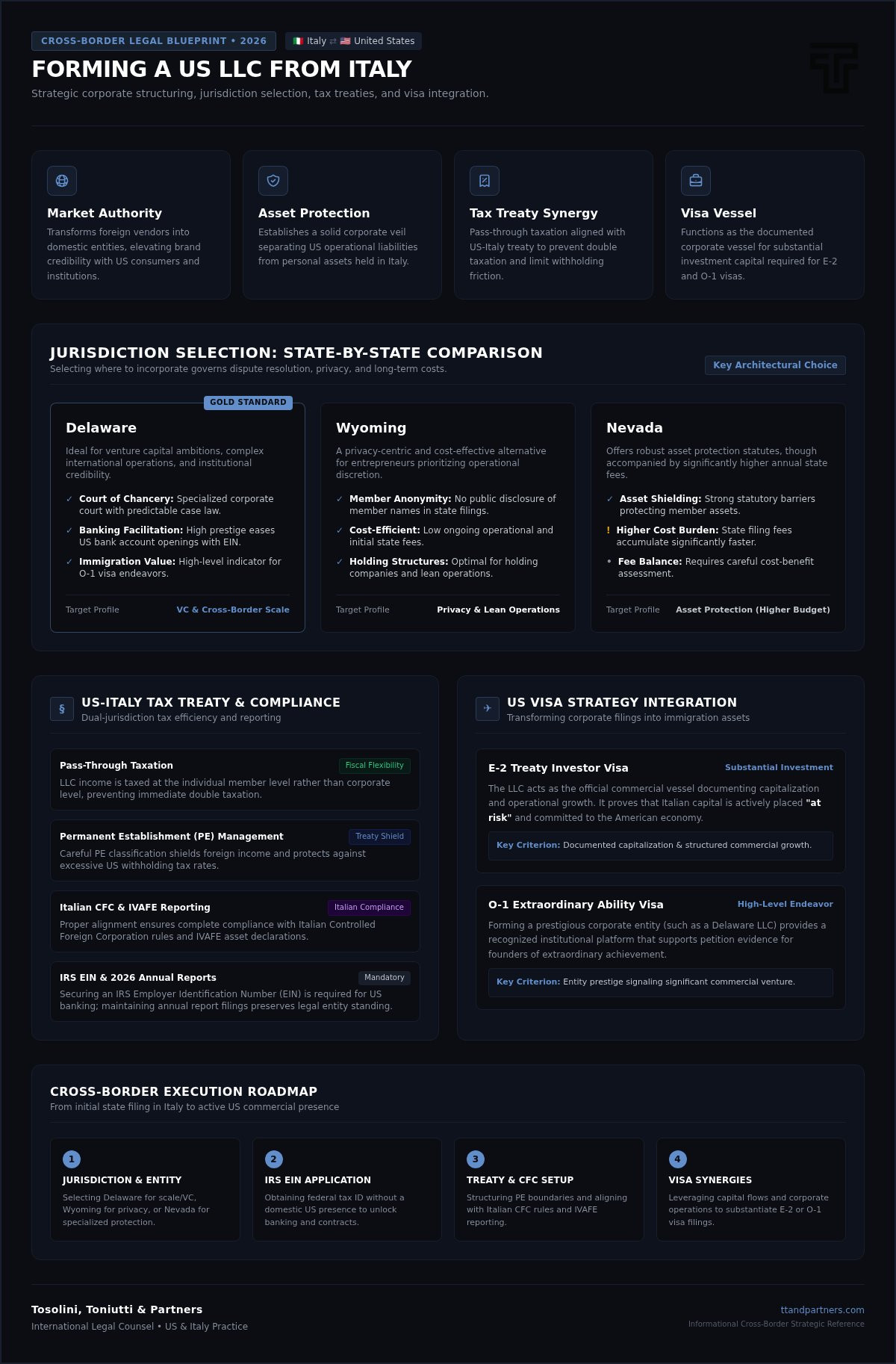
Establishing a presence in the United States represents more than a geographic expansion; it's a commitment to a global standard of excellence. For entrepreneurs forming a US LLC from Italy, the primary driver is often the immediate elevation of brand authority. American consumers and institutional partners prioritize domestic entities, viewing them as signs of long-term stability and local accountability. This structural choice transforms your business from a foreign vendor into a domestic player, easing friction in procurement and partnership negotiations. It's a strategic move that positions your vision within the heart of the world's most dynamic market.
Asset Protection and Legal Shielding
The limited liability company structure serves as a robust barrier between your US business activities and your personal holdings in Italy. This "corporate veil" ensures that liabilities arising from American operations don't compromise your domestic assets. In a cross-border context, this protection is vital. US law offers sophisticated jurisdictional advantages for international contracts, allowing you to define dispute resolution terms that favor predictability and commercial logic. It's a foundational layer of security that allows for bold expansion without personal exposure, provided the entity is maintained with professional rigor.
The US-Italy Tax Treaty Framework
Strategic tax planning is where the architectural precision of your setup becomes apparent. The US-Italy tax treaty is designed to prevent double taxation, yet its benefits depend on careful navigation of "Permanent Establishment" (PE) definitions. For Italian residents, the LLC often acts as a pass-through entity, meaning income is taxed at the individual level rather than the corporate level. This flexibility is essential when managing Italian CFC (Controlled Foreign Corporation) rules and IVAFE reporting requirements. Proper alignment with the treaty protects you from excessive US withholding and ensures that your global revenue management remains seamless and compliant with both jurisdictions.
Beyond fiscal efficiency, the LLC plays a pivotal role in long-term immigration strategy. By documenting the capitalization and operational growth of the entity, you establish the "substantial investment" required for an E-2 Treaty Investor Visa. It acts as the tangible vessel for your capital, proving that your resources are "at risk" and dedicated to the American economy. This synergy between corporate formation and visa eligibility is what distinguishes a simple filing from a comprehensive strategic expansion. If you're ready to design your US entry with this level of precision, you can reach out to our team at Tosolini, Toniutti & Partners for a tailored consultation.
Choosing Your Jurisdiction: Delaware vs. Wyoming vs. Others
Selecting a state is the architectural foundation of your American venture. While the process of forming a US LLC from Italy is digitally accessible across all fifty states, the legal and fiscal implications vary significantly. You must look beyond the initial filing fee to consider the long-term governance and the specific protections your business model requires. In the American legal landscape, the state of incorporation dictates which statutes govern your internal corporate disputes and how your assets are shielded from external claims.
Delaware: The Sophisticated Choice
Delaware remains the undisputed gold standard for Italian founders with aspirations for venture capital or complex international operations. The state's Court of Chancery is a specialized court with a deep body of corporate case law, providing a level of predictability that other jurisdictions can't match. This legal maturity is highly regarded by US financial institutions, often streamlining the process of opening business accounts once you complete the IRS Employer Identification Number (EIN) application. For those pursuing an O-1 visa, the prestige of a Delaware entity serves as a powerful indicator of a high-level professional endeavor.
Wyoming and Nevada: Privacy and Protection
Wyoming has carved a niche as a privacy-centric, cost-effective alternative for entrepreneurs who prioritize discretion. It's particularly appealing for smaller operations or holding companies where anonymity is a primary concern. Unlike Delaware, Wyoming doesn't require the public disclosure of member names in its state filings. Nevada offers similarly robust asset protection benefits but carries significantly higher state fees. These costs can accumulate quickly, potentially outweighing the benefits for startups that don't yet require Nevada's specific legal nuances. It's essential to avoid the "hype" surrounding certain states and focus on your actual operational reality.
In 2026, evaluating your operational "nexus" is critical for long-term compliance. If your business maintains physical assets, warehouses, or employees in a specific state, you may be required to register as a foreign entity there, regardless of where you initially incorporated. Choosing a jurisdiction based solely on online trends can lead to redundant administrative burdens and unexpected tax obligations. A precise analysis of your planned activities ensures your corporate structure remains a tool for growth rather than a source of friction. If you're weighing these options, a strategic consultation can help align your jurisdiction with your specific commercial and immigration goals.
How to Form a US LLC from Italy: A Step-by-Step Guide
The transition from selecting a jurisdiction to the actual execution requires a disciplined approach. Forming a US LLC from Italy is a deliberate legal construction rather than a mere administrative task. It begins with the selection of a unique business identifier. You must verify name availability within your chosen state's database to ensure no conflicts exist with established trademarks or existing entities. Once a name is secured, you must appoint a US Registered Agent. This entity acts as your physical point of contact for legal service of process, ensuring your business remains in good standing while you manage operations from Italy.
The Articles of Organization
The Articles of Organization represent the formal birth of your company. This filing includes essential data such as the company name, the registered agent's address, and the management structure. In 2026, state processing times vary. Expedited filings often receive approval within 24 to 48 hours, while standard submissions may take several weeks depending on the jurisdiction. A critical decision during this stage is the distinction between Member-Managed and Manager-Managed structures. For Italian founders who may eventually appoint US-based directors or seek external investment, a manager-managed structure provides superior long-term flexibility and a clearer separation of duties.
The Operating Agreement: Your Internal Law
If the Articles of Organization are the birth certificate, the Operating Agreement is the company's constitution. Italian founders should avoid generic online templates. These documents rarely account for the complexities of cross-border revenue or the specific USCIS E-2 Treaty Investor requirements. Your agreement must define profit distribution, management authority, and provisions for international dispute resolution. This document is your primary defense in maintaining the corporate veil. It also serves as evidence for banks and immigration officers that your enterprise is a legitimate, functioning entity. Precision in this document ensures that your at-risk investment is clearly documented and protected. For founders seeking a structure that aligns with sophisticated growth and visa goals, our team at Tosolini, Toniutti & Partners provides the necessary legal foresight.
Post-Formation Compliance and Annual Report Filing
The architectural integrity of your American enterprise depends on consistent maintenance. Once you've completed the initial steps of forming a US LLC from Italy, the focus shifts toward federal and state compliance. Securing an Employer Identification Number (EIN) is the first milestone. For Italian residents without a Social Security Number, this involves a specialized application process via Form SS-4. This number is your gateway to the American financial system, enabling you to establish a business bank account. In 2026, while digital banking platforms have simplified access, institutional transparency remains paramount. You'll need to demonstrate a clear operational purpose to satisfy rigorous Know Your Customer (KYC) protocols.
Federal Tax Reporting for Foreign-Owned LLCs
Transparency with the IRS is non-negotiable for non-resident owners. Single-member LLCs owned by Italian residents are often classified as "disregarded entities" for tax purposes, yet they face strict disclosure requirements. You must file Form 5472 alongside a pro-forma Form 1120. This filing tracks "reportable transactions" between the Italian owner and the US entity, including capital contributions and loan repayments. The penalties for non-compliance are severe. Failing to file can result in fines starting at $25,000 per violation. The IRS does not offer leniency for ignorance. Maintaining a US-compliant bookkeeping system from Italy isn't just a best practice; it's a legal necessity to ensure these figures are accurate and defensible.
Maintaining "Good Standing" with the State
Your relationship with the Secretary of State requires annual attention. Most jurisdictions mandate an Annual Report to confirm your company’s current address and management. Delaware requires this by June 1, while Wyoming ties the deadline to the anniversary of your incorporation. Neglecting these filings leads to a loss of "Good Standing," eventually resulting in administrative dissolution. Reinstating a dissolved LLC is possible but involves back taxes, interest, and significant administrative hurdles. Your Registered Agent plays a vital role here, acting as an early warning system for these critical deadlines. They ensure that legal correspondence and compliance alerts reach you in Italy without delay. This proactive approach safeguards your assets and your eligibility for future US immigration benefits.
Effective cross-border management requires a partner who understands the friction between Italian CFC rules and American disclosure mandates. To ensure your entity remains a robust vehicle for your international growth, contact our legal team for specialized compliance support.
Integrating Your LLC into a US Visa Strategy (E-2 and O-1)
The structural integrity of your American entity serves a dual purpose, acting as both a commercial gateway and a legal foundation for residency. For many entrepreneurs, forming a US LLC from Italy is the catalyst for a broader immigration strategy. A well-constructed company doesn't just hold assets; it serves as the primary evidence of your commitment to the US market. When your corporate documents are drafted with future visa requirements in mind, you create a seamless transition from a non-resident owner to an active, present leader within the American economy.
The E-2 Visa Investment Framework
The E-2 Treaty Investor Visa remains one of the most effective paths for Italian nationals to live and work in the United States. Your LLC acts as the essential vehicle for this investment. To satisfy federal requirements, you must prove that your capital is "at risk" and "substantial." This means the funds must be irrevocably committed to the entity's operations, such as inventory, equipment, or office leases. Consular officers look for a clear trail of the source of funds, often originating from an Italian parent company or personal savings. Your LLC must also demonstrate it isn't "marginal," meaning it has the capacity to contribute significantly to the US economy by employing local workers rather than merely supporting the owner's family.
For individuals with extraordinary ability in business, science, or the arts, the LLC provides a different strategic advantage. It can serve as the petitioner for an O-1 visa, allowing you to maintain your professional status while managing your own enterprise. This setup requires the LLC to have a designated agent or board that can legally oversee your employment, ensuring the entity remains compliant with US labor and immigration laws. Looking further ahead, a correctly structured LLC can facilitate the transition toward permanent residency and Green Card goals, provided the corporate hierarchy supports long-term growth and executive functions.
Legal Consultation for Cross-Border Success
Success in this complex landscape requires more than just filing forms; it demands a holistic vision. The friction between Italian CFC disclosures and American immigration mandates can derail an expansion if not managed with professional precision. Relying on a single legal partner to handle both corporate formation and immigration strategy ensures that your business structure remains in perfect harmony with your personal residency goals. This coordination is vital when discussing your venture with Italian tax advisors to ensure that your US operations don't create unintended tax liabilities at home. To design a corporate structure that supports your global ambitions, contact Tosolini, Toniutti & Partners for a strategic consultation.
Designing Your Global Legacy
Success in the American market requires a synthesis of corporate precision and cross-border foresight. You've seen how the strategic choice between Delaware's legal depth and Wyoming's efficiency sets the stage for your operations. Forming a US LLC from Italy isn't just a filing; it's the creation of a vehicle that must withstand IRS scrutiny and satisfy USCIS requirements. From rigorous Form 5472 disclosures to documenting at-risk capital for an E-2 visa, every technical detail matters.
At Tosolini, Toniutti & Partners, we bring decades of experience in international litigation and corporate law to bridge the gap between Italy and the United States. We don't just incorporate businesses; we architect integrated strategies for immigration and growth. If you're ready to secure your presence in the US with a legally sound and visionary approach, Schedule a Consultation for Your US Business Expansion today. Your American journey deserves a foundation built for the long term.
Frequently Asked Questions
Do I need to travel to the US to form an LLC from Italy?
No, physical presence isn't required during the incorporation process. You can complete the entire procedure of forming a US LLC from Italy through electronic filings and by appointing a US-based Registered Agent. This agent serves as your official point of contact for legal correspondence within the United States. Modern digital infrastructure allows you to manage the administrative lifecycle of your company entirely from your Italian office.
How much does it cost to maintain a US LLC annually in 2026?
Annual maintenance costs involve state-specific franchise taxes or report fees along with the renewal of your Registered Agent service. Delaware and Wyoming have different fee structures that must be settled to remain in good standing. You should also budget for professional tax preparation, especially regarding mandatory federal disclosures like Form 5472. These recurring costs are essential investments to preserve the limited liability protections your entity provides.
Can an Italian citizen open a US business bank account remotely?
Yes, remote banking has become significantly more accessible for non-residents. While traditional brick-and-mortar banks often require a physical visit, several US-based financial technology platforms allow Italian founders to open accounts digitally. You'll need a valid EIN, your approved Articles of Organization, and a compliant Operating Agreement. These institutions use sophisticated verification processes to satisfy federal Know Your Customer requirements without necessitating international travel.
What is the difference between a Disregarded Entity and a C-Corp for an Italian owner?
A Disregarded Entity allows profits to pass directly to the owner, potentially avoiding corporate-level taxation in the US. This is common for single-member structures. In contrast, a C-Corp is taxed as a separate legal person, which can lead to double taxation when dividends are paid. For Italian entrepreneurs, the choice depends on whether they prioritize simplicity or the ability to reinvest earnings at a specific corporate tax rate.
What are the penalties for not filing the US LLC Annual Report?
Neglecting this filing leads to immediate late fees and the loss of your company's "Good Standing" status. If the delinquency continues, the Secretary of State will administratively dissolve your entity. This dissolution terminates your legal right to conduct business under that name and compromises your asset protection. Reinstating a dissolved company requires paying all back fees and interest, which is a costly and time-consuming administrative burden.
Does forming an LLC automatically give me a US visa?
No, incorporating a business doesn't grant any immediate immigration benefits or work authorization. While the entity is a prerequisite for certain paths, such as the E-2 Treaty Investor Visa, you must still meet specific USCIS criteria. This includes proving a substantial, at-risk investment and demonstrating that the business will create a significant economic impact. The LLC is the legal vehicle for your strategy, not a substitute for the visa application itself.
How does the US-Italy tax treaty affect my LLC profits?
The treaty is designed to eliminate double taxation by defining which country has the primary right to tax specific types of income. For Italian residents, it provides a framework to claim foreign tax credits for taxes paid to the IRS. Understanding "Permanent Establishment" rules is vital, as it determines if your LLC's activities trigger a tax nexus in the US. This ensures your global revenue is managed with maximum fiscal efficiency.
Do I need an ITIN to own a US company?
You don't need an Individual Taxpayer Identification Number (ITIN) to form or own a company, as the entity uses its own EIN. However, an ITIN becomes necessary if you need to file a personal US tax return or if certain banks require it for identity verification. Obtaining an ITIN is a separate administrative process that Italian founders often undertake to ensure full compliance with federal reporting requirements for foreign-owned entities.


Comments