

US Real Estate Closing for Foreign Investors: The 2026 Legal Checklist

Most international buyers view a property deed as the ultimate finish line, but in the evolving 2026 market, the deed is merely the midpoint of a sophisticated legal architecture. Navigating a US real estate closing for foreign investors requires more than just capital. It demands a synchronized strategy that balances federal tax obligations with local procedural nuances. You've likely felt the weight of uncertainty surrounding FIRPTA withholding or the frustration of trying to open a US bank account from across an ocean. It's natural to feel confused by the differing roles of title companies and attorneys, as these distinctions often dictate the long term security of your investment.
We understand that a successful acquisition isn't just a transaction; it's the foundation of your global portfolio. This guide provides a comprehensive legal framework designed to help you master these complexities and ensure a seamless property transfer. We'll explore how proper entity selection optimizes your tax liability, the specific steps to resolve banking hurdles, and what your post-closing management obligations look like in the current regulatory environment. By the end, you'll have the clarity needed to transform a complex process into a controlled, strategic victory.
Table of Contents
The Architecture of a US Real Estate Closing for Foreign Investors
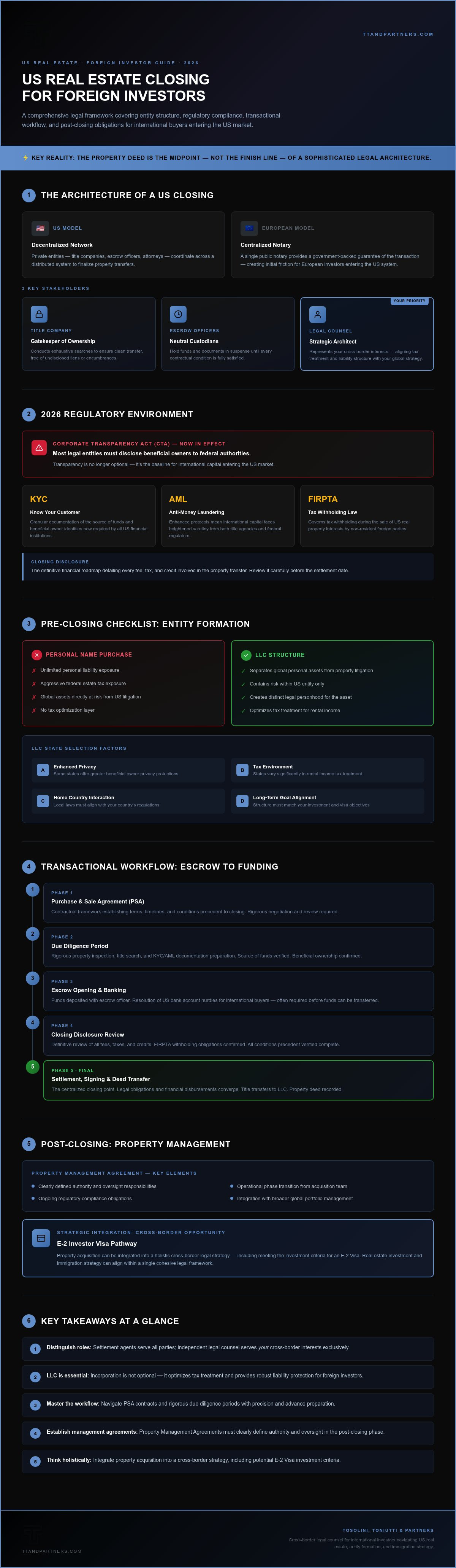
The US closing process functions as a centralized settlement, a singular point where legal obligations and financial disbursements converge to finalize a property transfer. Unlike the civil law systems common in Europe, where a centralized notary provides a public guarantee of the transaction, the American model relies on a decentralized network of private entities. This distinction often creates initial friction for international buyers. A US real estate closing for foreign investors isn't just a signing ceremony; it's the culmination of a rigorous verification cycle that requires precise coordination between multiple parties.
International capital currently faces heightened scrutiny through enhanced Know Your Customer (KYC) and Anti-Money Laundering (AML) protocols. US financial institutions and title agencies now require granular documentation regarding the source of funds and the identity of beneficial owners. This rigorous vetting ensures that the acquisition remains legally sound and protected from future federal inquiries. Preparing these documents well in advance of the closing date is essential to avoid administrative delays that could jeopardize contract deadlines.
Key Stakeholders in the US Closing Process
Navigating this architecture requires understanding three distinct roles. The Title Company serves as the gatekeeper of ownership, conducting exhaustive searches to ensure a clean transfer, free of undisclosed liens or encumbrances. Escrow Officers act as the neutral custodians of the transaction, holding funds and documents in suspense until every contractual condition is met. Finally, specialized Legal Counsel represents the foreign investor's specific cross-border interests. While a closing agent facilitates the transaction for all parties, your attorney serves as the strategic architect, ensuring that the deal aligns with your specific tax and liability requirements.
The 2026 Regulatory Environment for Foreign Buyers
The regulatory landscape has shifted significantly with the full implementation of the Corporate Transparency Act (CTA). This legislation mandates that most legal entities, including those used for property holdings, disclose their beneficial owners to federal authorities. Transparency is no longer optional; it's the baseline for international capital entering the US market. This environment also necessitates strict adherence to the Foreign Investment in Real Property Tax Act (FIRPTA), which governs tax withholding during the sale of US interests by non-resident parties. To finalize the numbers, the Closing Disclosure serves as the definitive financial roadmap, detailing every fee, tax, and credit involved in the transfer. Mastering these layers ensures your investment is not only profitable but also remains beyond legal reproach.
Pre-Closing Checklist: Entity Formation and Tax Identity
A successful US real estate closing for foreign investors begins long before the final settlement statement is drafted. The most critical decision involves the legal vessel used to hold the asset. While purchasing property in an individual name might seem simpler, it often exposes international buyers to significant risks, including unlimited personal liability and aggressive federal estate taxes. Transitioning from a personal acquisition to a structured corporate holding is the first step in building a resilient investment architecture. This preparation ensures that when the centralized settlement occurs, the legal foundation is already immovable.
Strategic LLC Incorporation for Real Estate
An Limited Liability Company (LLC) serves as a vital shield, separating your global personal assets from property-specific litigation. Through LLC incorporation, you create a distinct legal personhood that contains risk within the US entity. State selection is equally paramount. Some jurisdictions offer enhanced privacy for beneficial owners, while others provide more favorable tax environments for rental income. This choice should be made in consultation with counsel who understands how these local laws interact with your home country's regulations. If you're seeking to align your structure with your long term goals, you can reach out for a strategic consultation.
Tax Identity and Withholding Preparation
Securing your tax identity is the next mandatory milestone. Every holding entity requires an Employer Identification Number (EIN) to open US bank accounts and file annual returns. Simultaneously, foreign principals must often apply for an Individual Taxpayer Identification Number (ITIN). These identifiers aren't merely bureaucratic hurdles; they're the keys to accessing the US financial system. Without them, the funding phase of the closing can stall, leading to potential contract breaches.
Failing to plan for the IRS FIRPTA withholding requirements can lead to a sudden 15% liquidity drain at the time of a future sale. This federal mandate requires buyers to withhold a portion of the gross sales price from foreign sellers unless specific exemptions apply. Strategic planning involves analyzing tax treaties, such as the US-Italy treaty, which may offer relief or lower rates. Preparing Form 8288-B well in advance allows you to request a withholding certificate. This proactive approach ensures that your capital remains available for reinvestment rather than sitting in government accounts for months after the transaction concludes.
The Transactional Workflow: From Escrow to Funding
Once the legal entity is established, the focus shifts to the transactional mechanics of the Purchase and Sale Agreement (PSA). For an international buyer, the PSA review requires a specialized lens that accounts for cross-border contingencies. It's not enough to negotiate the price; the contract must allow sufficient time for federal tax registrations and the potential review by the Committee on Foreign Investment in the United States (CFIUS) if the property sits near sensitive infrastructure. These timelines are often longer than domestic standards, and failing to secure these windows can lead to a forfeited deposit before the US real estate closing for foreign investors even begins.
The due diligence period serves as the investor's primary window for risk mitigation. This phase encompasses professional inspections, zoning verifications, and environmental audits to ensure the asset's physical and legal integrity. Simultaneously, the title search identifies any "clouds" on the title, such as historic liens or unresolved encumbrances. For a foreign buyer, these issues are particularly dangerous because they can complicate the future exit strategy. Clearing these hurdles during escrow ensures that the eventual transfer of ownership is absolute and uncontested.
Title Insurance: The Foreign Investor's Essential Guard
Owner's Title Insurance is a non-negotiable component of a secure international investment. While the lender's policy only protects the bank, the owner's policy shields the investor's equity from unforeseen legal challenges. This coverage is vital because it protects against "hidden" risks like forged deeds, unknown heirs, or clerical errors in public records. Without this insurance, a non-resident owner might find themselves defending their property rights in a foreign court system without a safety net.
Funding Logistics and Currency Risks
Funding the transaction is often the most stressful phase for international buyers due to the rigorous "Source of Funds" (SOF) verification required by US banks. Anti-money laundering regulations mean that every dollar must be clearly traced to its origin. You'll need to coordinate with your bank weeks in advance to ensure that international wire transfers don't trigger administrative freezes. Managing wire fraud risk is also paramount; always use multi-factor verification protocols for any escrow instructions. It's best to initiate transfers early to account for time zone differences and intermediary bank delays, ensuring the capital arrives precisely when the settlement agent requires it.
US Property Management Legal Agreements: A Post-Closing Checklist
The final signature at a US real estate closing for foreign investors represents the birth of an operational asset. This transition from acquisition to management requires a new set of legal instruments designed to preserve the integrity of the investment. Without a structured post-closing framework, the liability protections established during entity formation can quickly erode. You must view the management phase as a continuation of the legal architecture that began with the initial purchase agreement. Efficient operations depend on a foundation of clear, enforceable contracts that bridge the gap between US local practices and your global investment strategy.
The Property Management Agreement (PMA) is the primary document defining the scope of authority granted to your local representative. It's essential to establish clear Tenant Lease Agreements that comply with federal and state fair housing laws, as non-compliance can lead to severe regulatory penalties. Additionally, Service Provider Contracts must be drafted to protect the holding LLC from vendor-related liability, ensuring that maintenance risks remain isolated from your core capital. Each of these documents serves as a defensive layer in your broader asset protection plan.
Key Clauses in US Property Management Agreements
Indemnification clauses are a non-negotiable component of any PMA. They determine who carries the financial weight when a tenant or visitor is injured on the property. You must also secure robust termination rights, allowing you to exit a management relationship if service levels decline. Precise reporting requirements are equally important; they ensure you receive the specific data needed for your foreign tax compliance and annual filings. These clauses transform a simple service contract into a strategic tool for oversight.
Legal Frameworks for Leasing and Operations
Standardizing your leases across different properties creates a consistent legal shield. If a tenant defaults on payments, these documents serve as the foundation for any international litigation or recovery efforts. Protecting the 'Corporate Veil' remains a constant duty during the operational phase. This means your property manager must handle funds through dedicated accounts to avoid commingling capital with your personal finances. Maintaining this separation reinforces the legal personhood of your LLC and prevents creditors from reaching your global assets. To ensure your management agreements provide maximum protection, you can contact our firm for a comprehensive document review.
Strategic Advantages of Cross-Border Legal Counsel
The true value of a US real estate closing for foreign investors lies in the strategic foresight applied before the first document is signed. Engaging counsel who understands both the American legal landscape and your home country's business culture is essential. This translation of law isn't merely linguistic. It's a conceptual bridge that ensures your US acquisitions don't conflict with your existing global structures. A specialized firm acts as a strategic architect, building a framework that supports long term growth while maintaining strict compliance with annual filings and federal tax reporting. Without this dual perspective, investors often find themselves caught between two incompatible legal systems.
A successful US real estate closing for foreign investors is the result of meticulous planning and cross-border expertise. Protecting your US investment starts before the first offer is made; it begins with the decision to build on a foundation of expert knowledge. Initiating this process with a comprehensive consultation allows you to identify risks that generalist firms often overlook. Whether you're managing a single luxury asset or a complex portfolio, the right legal partnership transforms a series of transactions into a legacy. You'll gain the confidence to move forward, knowing that every detail is legally sound.
Real Estate as a Foundation for US Residency
Property acquisition often serves as the first step toward a larger American presence. While a single passive residence rarely qualifies an individual for a visa, a structured investment in multiple properties can form the basis of a business that meets E-2 Visa requirements. By consulting with Tosolini, Toniutti & Partners, you can align your property goals with your residency aspirations. This planning also prevents the "accidental residency" trap, where improper management structures inadvertently trigger unintended US tax obligations on your worldwide income. Strategic counsel ensures that your physical presence in the US is a choice, not a tax liability.
Ensuring Continuity Across Borders
Holding US property requires a vision that extends beyond your own lifetime. Without a tailored estate plan, your assets may fall into the "Foreign Estate" tax trap, where federal taxes can significantly diminish the value passed to your heirs. Specialized counsel ensures that your US holdings are integrated into a global succession plan, resolving potential inheritance or title disputes before they arise. This continuity is the hallmark of a mature investment strategy. It's about protecting the asset's value for the next generation through precise legal engineering and ongoing maintenance.
Mastering Your Global Real Estate Legacy
Achieving a successful US real estate closing for foreign investors is a sophisticated achievement that extends far beyond the final signature. By prioritizing robust LLC incorporation and securing your tax identity before the transaction begins, you build a defensive perimeter around your global capital. Managing the complexities of escrow and funding with specialized oversight ensures that every procedural milestone strengthens your portfolio rather than creating future liabilities.
The path to a secure property acquisition requires a partner who understands the nuances of both US and international legal landscapes. Our firm brings dual-jurisdiction expertise in US and Italian law, offering a proven track record in LLC formation for non-residents and specialized cross-border litigation support. We transform regulatory hurdles into strategic advantages, allowing you to focus on the growth and preservation of your assets.
Secure your US real estate investment-Contact Tosolini, Toniutti & Partners for a Closing Consultation. Your vision for a successful US portfolio is within reach. With the right legal architecture, your investment will stand as a testament to your global ambition.
Frequently Asked Questions
Do I need to be physically present in the US for a real estate closing?
You don't need to be physically present in the United States to finalize your transaction. Most closings are now handled through remote online notarization or mail-away packages coordinated with a local US consulate or a qualified notary. Many international buyers choose to execute a specific Power of Attorney, allowing their legal counsel to sign documents on their behalf. This flexibility ensures a seamless US real estate closing for foreign investors regardless of their home jurisdiction.
Can a foreign investor get a mortgage for US property in 2026?
Foreign national loan programs remain widely available for international buyers who meet specific criteria. Lenders typically require a higher down payment, often ranging from 30% to 40%, because traditional US credit scores aren't available for non-residents. You'll need to provide comprehensive proof of income from your home country and maintain liquid reserves in a recognized financial institution. These loans allow you to leverage your capital while building a domestic credit profile over time.
What is FIRPTA and how does it affect my closing as a seller?
FIRPTA is a federal mandate that requires a 15% withholding on the gross sales price when a foreign person disposes of US real property. While this primarily affects the sale phase, it's a critical consideration during the initial US real estate closing for foreign investors. The buyer is legally responsible for withholding these funds and remitting them to the IRS. Proper planning with cross-border counsel can help you apply for a withholding certificate to reduce this amount.
Is it better to buy US real estate through a foreign company or a US LLC?
Holding property through a domestic LLC is generally superior to using a foreign corporation for most investment strategies. Foreign entities often face higher tax rates and more complex reporting requirements, such as the branch profits tax. A US LLC provides a familiar structure for title companies and lenders while offering robust liability protection and pass-through tax treatment. This domestic structure simplifies your annual compliance and makes the eventual resale process much more efficient.
What are the typical closing costs for a foreign buyer in the US?
Buyers should generally budget between 2% and 5% of the total purchase price for closing expenses. These costs cover essential services like title insurance, escrow fees, government recording charges, and legal representation. If you're utilizing financing, your costs will be on the higher end of that spectrum due to loan origination and appraisal fees. You'll receive a detailed Closing Disclosure before the settlement date that provides a precise breakdown of every financial obligation.
How long does the real estate closing process take for an international investor?
A typical transaction usually takes between 30 and 60 days from the moment the contract is signed to the final transfer of ownership. For international buyers, the timeline can be influenced by the time required for LLC incorporation or obtaining federal tax identifiers. Coordinating international wire transfers also requires extra lead time to satisfy bank verification protocols. Engaging specialized counsel early in the process helps ensure that these administrative steps don't delay your closing date.
Do I need a US bank account to buy property in the United States?
While not strictly a legal requirement for the purchase itself, having a US bank account is a practical necessity for property ownership. You'll need a domestic account to pay recurring expenses like property taxes, insurance, and utilities. Most title companies also prefer receiving the final settlement funds from a US-based institution to comply with anti-money laundering regulations. Opening an account in the name of your LLC is a vital step in your post-closing operational strategy.
What are the tax filing requirements for a foreign owner of US rental property?
Foreign owners are generally required to file an annual US income tax return, specifically Form 1040-NR, to report any rental income generated by the property. You can elect to be taxed on a net basis, which allows you to deduct operating expenses, mortgage interest, and depreciation. This often reduces your actual tax liability significantly. You must also comply with the Corporate Transparency Act by reporting beneficial ownership information for your holding entity to federal authorities.


Comments