

2026 US Work Visa Guide for Italian Citizens
- Gianni Mendes Toniutti, Esq.

- 3 days ago
- 12 min read
While many Italian professionals fixate on the unpredictability of the H-1B lottery, the most robust bridge to the United States often lies within a historic treaty that favors the visionary over the lucky. You likely understand that moving a career or a business across the Atlantic requires more than just ambition. It demands a precise architectural plan to navigate a regulatory environment where a single administrative error can stall a legacy. This guide provides that blueprint, offering a strategic framework to align your professional goals with the most efficient legal pathways available in 2026.
We'll analyze the critical nuances of the E-1 vs E-2 visa for Italians to determine which treaty advantage serves your specific capital or trade structure. Beyond the technical requirements, we'll clarify the centralized electronic processing at the U.S. Embassy in Rome and explore how to mitigate the risk of a Request for Evidence. You'll discover a clear roadmap for relocation that transforms bureaucratic uncertainty into a calculated, professional transition. By the end of this guide, you'll have the clarity needed to harmonize your international business goals with a secure immigration status.
Table of Contents
The Strategic Landscape of US Employment for Italian Citizens in 2026
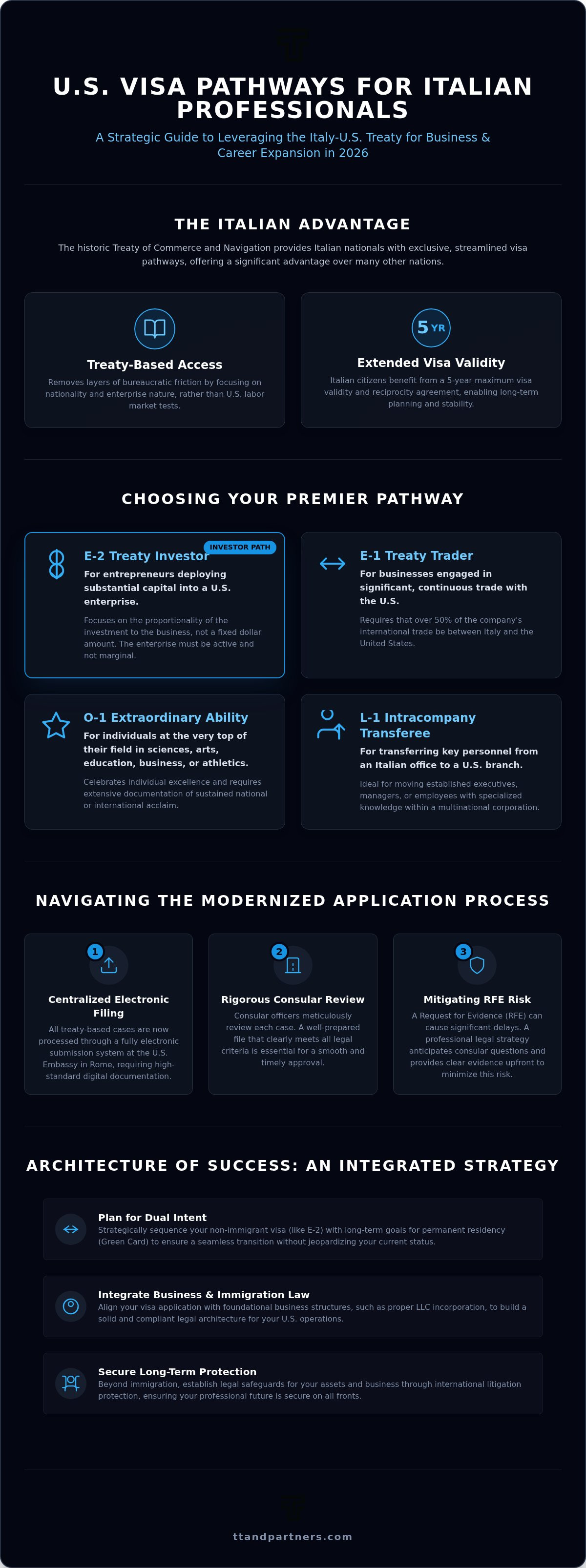
The relationship between the United States and Italy isn't just diplomatic; it's deeply economic. In 2026, the framework for professional mobility remains anchored in the historic Treaty of Commerce and Navigation. This agreement grants Italian nationals a level of accessibility that many other European counterparts lack. While citizens of some nations face restrictive quotas or short visa durations, Italians benefit from a streamlined architecture designed to foster bilateral growth. Many European nationals face either shorter visa durations or a complete lack of treaty-based options, but Italian citizens maintain a distinct advantage through their 5-year reciprocity agreement. The current landscape favors those who view immigration as a strategic corporate asset rather than a hurdle, making it a vital strategic choice when comparing the E-1 vs E-2 visa for Italians. Processing has shifted toward a fully electronic submission system for treaty cases, which demands a higher standard of digital documentation and intellectual rigor.
The Italy-US Treaty Advantage
The foundation of this mobility rests on treaty status. For entrepreneurs and trade specialists, this status removes several layers of bureaucratic friction. It allows for a more direct alignment between business vision and legal reality. Understanding the nuances of the E-2 Investor Visa Overview is essential for those looking to deploy capital. Unlike standard employment visas that require a U.S. sponsor to prove a lack of local talent, treaty visas focus on the individual’s nationality and the nature of their enterprise. This distinction is the primary reason why the E-1 vs E-2 visa for Italians is often the most agile choice for market entry. Italian citizens currently enjoy a 5-year maximum validity for these visas, a significant advantage over other nations. However, leveraging these benefits requires a professional legal architecture that ensures every filing adheres to the specific evidentiary standards of 2026.
Distinguishing Intent: Non-Immigrant vs. Immigrant Pathways
Strategic planning involves more than just the initial entry. Most treaty-based options are non-immigrant visas, meaning they're intended for a temporary stay, even if they're renewable indefinitely. It's vital to differentiate these from a Green Card, which grants permanent residency. Some visas allow for "dual intent," where you can work temporarily while pursuing a permanent status. In 2026, the transition from a short-term assignment to a long-term professional future requires careful sequencing. You don't want to jeopardize your current status by mismanaging the timeline for a residency application. A holistic approach ensures that your immediate relocation goals don't conflict with your ultimate vision for life in the United States. This foresight allows professionals to move with confidence, knowing their legal status supports both their current operations and their future growth.
Premier Pathways: E-1, E-2, and O-1 Visas for Italian Excellence
Selecting a visa is an architectural decision that defines the structural integrity of your U.S. expansion. For Italian professionals, the choice between the E-1 Visa, the E-2 Visa, and the O-1 Visa depends on the nature of your professional capital. While the E categories rely on historical treaty privileges, the O-1 celebrates individual excellence. Matching your career stage to the right visa architecture ensures long-term stability in the U.S. market. It's about aligning your current assets with the legal framework that offers the most fluid path forward.
E-2 Treaty Investors: Securing an Italian Stake in the US Market
In 2026, a "substantial investment" for Italian nationals isn't defined by a rigid dollar amount but by the proportionality test. The investment must be sufficient to ensure the successful operation of the specific enterprise you're building. You must also pass the "marginality" test; the business cannot exist solely to provide a living for the investor and their family. It must have a present or future capacity to make a significant economic contribution. Integrating LLC Incorporation into your E-2 strategy provides the necessary corporate framework for active management. When evaluating the E-1 vs E-2 visa for Italians, the E-2 stands out for those building new entities from the ground up through direct capital deployment.
O-1 and E-1: Alternatives for Traders and Extraordinary Talent
If your value lies in intellectual property or trade volume rather than liquid capital, other pathways emerge. The O-1 Visas for Entrepreneurs are tailored for those who can demonstrate "extraordinary ability" through sustained national or international acclaim. This is often the most prestigious route for innovators who don't wish to tie their status to a specific investment amount. Conversely, the E-1 Visa serves established Italian export businesses where at least 50% of the international trade is between the U.S. and Italy. The burden of proof for an O-1 is individual-centric and rigorous, while E-1 and E-2 focus on the corporate and treaty relationship. If you're unsure which framework fits your goals, discussing your strategy with a legal architect can provide the necessary precision for your transition.
Corporate Mobility: L-1 Transfers and H-1B Specialty Occupations
While the E-1 vs E-2 visa for Italians provides a path for those leveraging treaty privileges, corporate mobility often requires a different architectural approach. For established Italian firms, the L-1 and H-1B categories offer precision-engineered solutions for transferring human capital across borders. These pathways aren't based on treaty trade or investment amounts but on the structural relationship between a parent company and its U.S. branch or the specific intellectual requirements of a role. Success in these categories depends on the integrity of your corporate hierarchy and your ability to meet rigorous prevailing wage standards.
L-1 Transfers: Bridging Italian and American Operations
The L-1 visa is the primary tool for Italian companies seeking to expand their footprint in the United States. To qualify, the Italian staff member must have been employed by the foreign entity for at least one continuous year within the preceding three years. This visa is divided into two distinct tiers: L-1A for managers and executives, and L-1B for those with specialized knowledge of the company's products or processes. For those launching a new venture, the "New Office" L-1 allows for a one-year initial stay to establish operations, provided there's a qualifying parent-subsidiary relationship. You must ensure your corporate structure is transparent and legally sound to withstand the scrutiny of U.S. Citizenship and Immigration Services.
Navigating these pathways in 2026 requires strict attention to fiscal requirements and compliance. L-1 blanket visa fraud prevention and detection fees are set at $500. If your timeline demands urgency, I-907 premium processing fees reached $2,965 as of March 1, 2026. Additionally, Italian nationals should be prepared for varying reciprocity fees that are paid after visa approval at the consulate.
H-1B Dynamics: Specialty Roles for Italian Graduates
The H-1B visa remains the standard for specialty occupations that require at least a bachelor's degree or its equivalent. For Italian graduates, a degree equivalency evaluation is often a prerequisite to ensure their academic credentials align with U.S. standards. However, the H-1B landscape is exceptionally competitive. The cap for Fiscal Year 2027 was reached on July 28, 2026, highlighting the need for early preparation and strategic timing. If you don't secure a spot in the lottery, you'll need to pivot quickly to other frameworks. This might involve exploring the O-1 for extraordinary talent or returning to the treaty-based advantages of the E-1 or E-2 categories if the applicant has the requisite ownership or trade background. Aligning your professional goals with these deadlines is essential for a successful U.S. transition.
Navigating Consular Processing at US Embassies in Italy
Consular processing represents the final technical alignment of your U.S. transition. In 2026, the process for Italian citizens is highly centralized and demands absolute consistency between your initial petition and your final interview. While the preliminary legal architecture might be built through stateside filings, the visa issuance happens on Italian soil. The application fee for E-1 and E-2 visas is $315, while H, L, and O visa categories require a $205 fee. Beyond these initial costs, Italian applicants must account for reciprocity fees; these are paid only after the visa is approved at the window. This stage requires a flawless DS-160 and a comprehensive package that reflects the intellectual rigor of your business goals. It's the moment where your strategic planning meets administrative reality.
Consular Logistics: Rome and Milan Procedures
Jurisdiction is a key logistical factor for any professional relocation. In 2026, all E-visa applications for Italian citizens are submitted electronically and processed exclusively at the U.S. Embassy in Rome. Other temporary worker categories, such as the L-1 or O-1, may be processed in either Rome or Milan. The visa officer operates under the 214(b) presumption, which assumes every applicant intends to stay in the U.S. permanently. Your task is to demonstrate strong ties to Italy and a clear non-immigrant intent. Current wait times fluctuate, making expedited appointment strategies essential for time-sensitive corporate expansions. Preparing for the interview involves more than just gathering documents; you must be prepared to articulate your professional role and the business's impact with absolute clarity. Any hesitation or contradiction during this brief encounter can lead to a denial under section 214(b).
Mitigating RFEs and Ensuring Document Precision
A Request for Evidence (RFE) is a strategic hurdle that often stems from imprecise financial documentation or vague business plans. For Italian applicants, common triggers include inconsistencies in ownership structures or insufficient proof of trade volume. When weighing the E-1 vs E-2 visa for Italians, the documentation must surgically address the specific criteria of the chosen category. Financial statements must be translated with professional precision. Every word and number must align with the broader narrative of your application. You don't want to leave your professional future to chance due to a mistranslated balance sheet or an incomplete tax record. Overcoming an RFE requires legal precision to provide the exact data the officer needs to reach a favorable conclusion. To ensure your application meets these rigorous standards, you can consult with our strategic legal architects for personalized guidance.
The Architecture of Success: Integrating Immigration and Business Law
A successful relocation to the United States requires more than just securing a stamp in a passport. It demands a holistic legal architecture where immigration strategy, corporate structure, and asset protection operate in harmony. Viewing the visa process in isolation often leads to unforeseen vulnerabilities in tax liability or business governance. By integrating your immigration status with a robust corporate framework, you ensure that your professional journey is built on a foundation of legal precision. This integrated approach is particularly vital when determining the most efficient path between the E-1 vs E-2 visa for Italians, as the underlying business structure dictates the long-term viability of your status.
Strategic alignment must also account for potential disputes that arise in cross-border commerce. Protecting your interests through International Litigation frameworks ensures that your U.S. operations remain resilient against legal challenges. For relocating families, the transition often involves significant capital shifts, requiring expert guidance on real estate closings and asset protection. Moving from a non-immigrant work visa to permanent residency is a multi-year roadmap that starts with the very first filing. Every decision made during the initial setup influences the eventual transition to a Green Card.
Cross-Border Legal Synergy
Your business incorporation does more than support visa eligibility; it serves as a shield against personal liability. For Italian citizens, navigating the tax treaty implications of working in the United States is essential to avoid double taxation and optimize fiscal efficiency. Maintaining your legal standing in Italy while residing abroad preserves your rights and facilitates a seamless connection between your two professional worlds. This synergy allows you to focus on growth while the legal architecture manages the complexities of dual-jurisdiction compliance. Whether you're weighing the trade volumes of the E-1 vs E-2 visa for Italians or establishing a new subsidiary, the corporate structure must be engineered for both immigration success and operational durability.
Your Strategic Partner for US-Italy Relocation
Tosolini, Toniutti & Partners operates as a strategic architect for those bridging the gap between Italy and the United States. Our approach moves beyond standard filings, offering visionary guidance for high-net-worth individuals and corporate entities embarking on complex cross-border transitions. We create customized legal frameworks that harmonize immigration needs with corporate litigation and real estate requirements. This holistic perspective ensures that your U.S. expansion isn't just a move, but a calculated advancement of your professional legacy. To begin designing your roadmap, Contact Tosolini, Toniutti & Partners to schedule a consultation regarding your strategic U.S. expansion.
Designing Your American Professional Legacy
Navigating the complexities of U.S. relocation in 2026 requires more than just administrative compliance; it demands a strategic alignment of your business goals with the specific legal frameworks available to Italian nationals. Whether you're analyzing the E-1 vs E-2 visa for Italians to optimize trade or investment, or leveraging the O-1 for extraordinary talent, your success depends on a unified vision. A robust transition integrates immigration strategy with professional LLC incorporation and asset protection, ensuring that your expansion remains resilient across borders.
Tosolini, Toniutti & Partners serves as a strategic advisor, offering specialized expertise in the delicate legal landscape between the U.S. and Italy. From securing treaty-based visas to managing complex real estate closings, our approach focuses on the harmony of your international interests. You don't have to navigate these bureaucratic hurdles alone. Secure your professional future in the United States. Contact Tosolini, Toniutti & Partners today. Your vision for a global career is within reach, and with the right legal architecture, your transition will be as seamless as it is successful.
Frequently Asked Questions
Do Italian citizens need a visa to work in the US if they have an ESTA?
Italian citizens cannot work in the United States using an ESTA. The Visa Waiver Program is strictly for tourism or brief business consultations, such as attending conferences or negotiating contracts. Engaging in local employment or receiving a salary from a U.S. source while on an ESTA is a violation of status. To legally work, you must secure a specific non-immigrant classification like the E-1 vs E-2 visa for Italians or an H-1B.
How long does it take to get an E-2 visa for an Italian investor in 2026?
The processing time for an E-2 visa at the U.S. Embassy in Rome typically ranges from several weeks to a few months in 2026. Because all E-visa applications in Italy are now submitted through a centralized electronic system, the timeline depends heavily on the volume of cases and the complexity of your business plan. It's essential to ensure your digital documentation is complete to avoid delays caused by administrative requests for additional evidence.
Can my spouse work in the US if I have an L-1 or E-2 work visa?
Spouses of L-1 and E-2 visa holders are generally authorized to work in the United States. Under current regulations, spouses of treaty investors and intra-company transferees receive employment authorization incident to their status. This means they don't necessarily need to apply for a separate Employment Authorization Document (EAD) before starting a job. This benefit provides significant flexibility for Italian families relocating together, allowing both partners to contribute to their new professional environment.
What are the 2026 reciprocity fees for Italian citizens applying for H-1B visas?
Reciprocity fees for Italian citizens applying for H-1B or L-1 visas are separate from the initial application fee and are paid only after approval. In 2026, these fees vary based on the specific visa category and are designed to match the fees Italy charges U.S. citizens for similar services. You'll pay this amount directly at the consulate in Rome or Milan during your appointment. Always verify the exact figure on the Department of State website before your interview.
Is it possible to change from a work visa to a Green Card while in the US?
Yes, it's possible to transition from a work visa to a Green Card through a process called adjustment of status. Certain classifications, such as the H-1B and L-1, are dual intent visas, meaning they explicitly allow you to seek permanent residency while working temporarily. While E-1 and E-2 visas are non-immigrant categories, many professionals successfully navigate a multi-year roadmap toward residency by aligning their business growth with employment-based immigrant petitions.
Do I need to have a physical office in the US to get a work visa as an Italian?
Most work visa categories, including the E-2 and L-1, require proof of a physical office space in the United States. For an E-2 treaty investor, the investment must be real and active, which usually necessitates a dedicated commercial premises rather than a residential address. Similarly, a New Office L-1 petition requires evidence that sufficient physical premises have been secured to house the new operations. Virtual offices are rarely sufficient for these specific classifications.
What happens if my US work visa application is denied at the consulate in Rome?
If your visa application is denied at the U.S. Embassy in Rome, the officer will provide a written explanation, often citing section 214(b) for lack of non-immigrant intent. While a denial can be a significant hurdle, it doesn't necessarily prevent you from re-applying with a stronger, more detailed package. Success in a subsequent application requires a surgical review of the previous filing to address the officer's specific concerns through enhanced documentation and professional legal architecture.
Can I apply for an O-1 visa if I am an Italian entrepreneur without a US employer?
Italian entrepreneurs can apply for an O-1 visa, but they cannot technically sponsor themselves. You must have a U.S. petitioner, which can be a U.S. company you own or a U.S. agent acting on your behalf. This framework is ideal for innovators who demonstrate extraordinary ability through international acclaim. When comparing the O-1 to the E-1 vs E-2 visa for Italians, the O-1 focuses on your personal excellence rather than the volume of trade or investment.


Comments